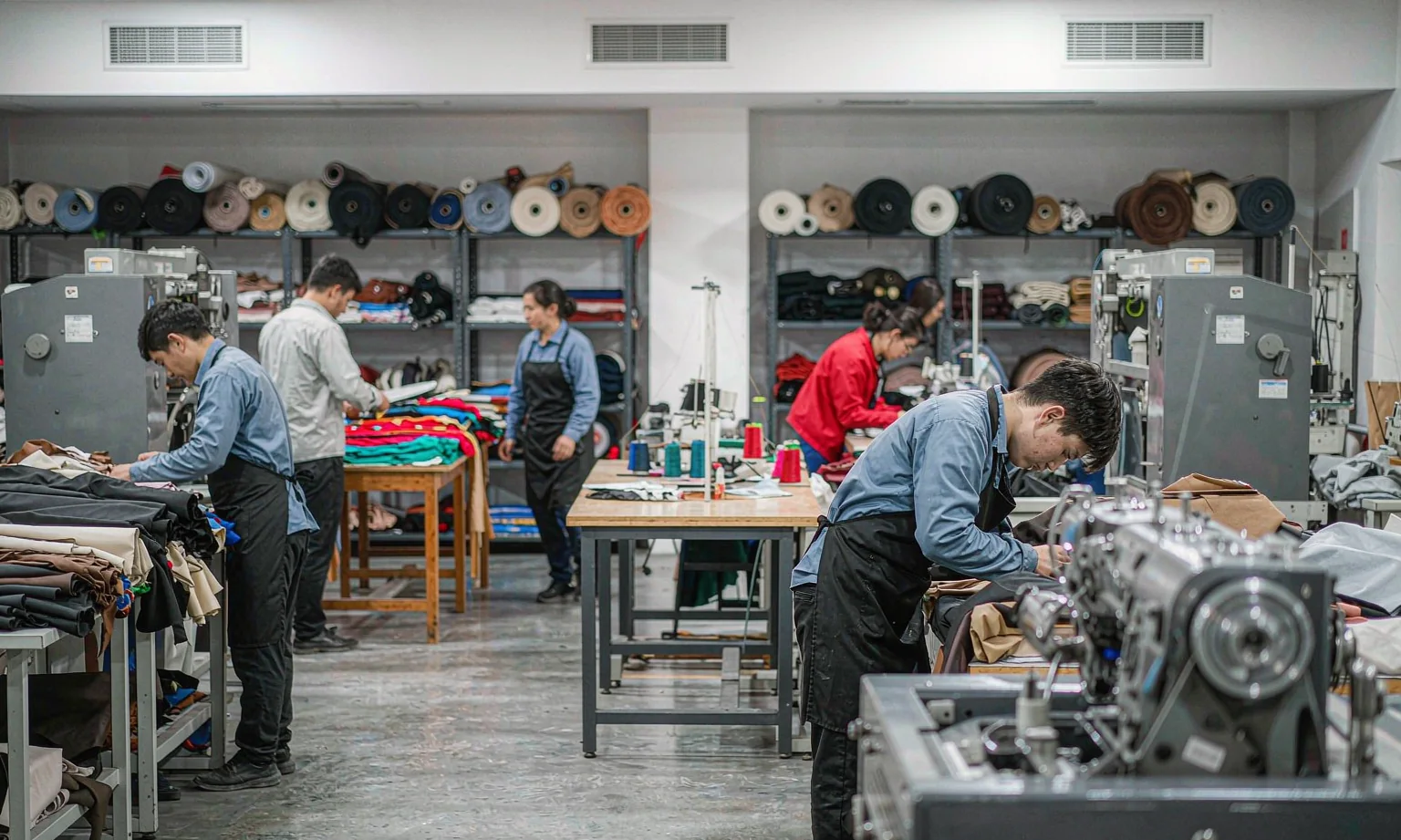
QUANZHOU JUNYUAN BAGS has run pet carrier and pet bag programmes since 2014, with its founding team working in sewn goods since 2004. Production takes place across 7 lines inside a 4,950 m² SGS-verified floor staffed by 137 people, with monthly capacity of about 200,000 units.
Who we are
QUANZHOU JUNYUAN BAGS is a sourcing and programme-management company registered in Quanzhou, Fujian. The legal entity behind this website is QUANZHOU JUNYUAN COMMERCIAL AND TRADING CO.,LTD. We coordinate pet carrier, pet travel bag and pet accessory programmes for overseas brand owners, retail chains and own-brand sellers, working with partner production lines that are audited to BSCI and ISO 9001 and verified by SGS.
We do not operate the factories ourselves. What we sell is programme management: specification development, material sourcing, sampling, production scheduling, inspection and export documentation, delivered through one commercial counterpart instead of six.
What we do for buyers
- Specification development. Turning a mood board, a competitor sample or a retailer brief into a costed tech pack with named materials and hardware.
- Sampling. First prototypes in 6-10 working days, with documented revision rounds.
- Production control. Capacity booking, inline checks and a pre-shipment inspection at AQL 2.5.
- Compliance. REACH, Proposition 65, CPSIA and Oeko-Tex documentation assembled per destination.
- Logistics. Carton optimisation, FOB Xiamen loading, or DDP to the buyer's door.
Facility and capacity
| Item | Figure | Note |
|---|---|---|
| Business started | 2014 | Founders in sewn goods since 2004 |
| Verified floor space | 4,950 m² | SGS-verified |
| Team | 137 people | 7 assembly lines, 149 machines |
| Monthly output | 200,000 units | Across pet carriers and pet travel bags |
| MOQ | 500 pcs / colourway | Mixed colourways allowed in one order |
| Samples | 6-10 working days | After tech pack confirmation |
| Bulk production | 35-50 days | After sample approval |
| Inspection | AQL 2.5 | Pre-shipment, third-party accepted |
| Terms | T/T 30/70 | FOB Xiamen; DDP available |
Quality philosophy
Failures in pet carriers are rarely dramatic; they accumulate. A strap that frays in month four, a mesh panel that pills, a slider that loses its lock. We treat those as specification problems rather than inspection problems, which is why every style receives a wear cycle before the first bulk run and why hardware is cycle-tested by batch. Inspection at AQL 2.5 catches what gets past the design stage, and we publish defect definitions with buyers before the order starts so there is no argument about what counts later.
How the partner production lines are vetted
Before a style is placed, the line that will run it is assessed against four checks: a valid third-party social compliance audit, documented machine maintenance records, a verified restricted-substance process, and a physical walk-through of the cutting and finishing areas. We then review whether the line has actually run the product type - a factory that excels at flat pouches may struggle with moulded cat shells - because capability is product-specific rather than general. Lines are re-assessed annually, and any style with recurring defects is moved rather than argued over.
Materials and restricted substances
Materials are sourced against a restricted-substance specification rather than by price alone. Every fabric dye lot carries a test report against the destination regulation set - REACH Annex XVII for the EU, California Proposition 65 for the US, CPSIA total lead and phthalates where a product may be classified for children. Buyers who need it can specify Oeko-Tex Standard 100 certified inputs, and we will build the additional documentation cost into the quote up front rather than discovering it after sampling.
What we deliberately do not do
We do not quote below the cost of the specified bill of materials and then substitute later. If a target price does not support the requested fabric and hardware, we show exactly which component has to change and let the buyer decide. We also do not take orders for animal-tested or otherwise non-compliant finishes, and we decline product requests that fall outside what the partner lines are equipped to make safely.
How we price
Quotes are built from the bill of materials plus a documented conversion cost. That means a buyer can see exactly what moves the number: fabric weight, hardware brand, print method, packaging standard, order quantity and shipping terms. If a target price is below what the specification supports, we show which line items to change instead of quietly substituting materials.
Working with us
- Send the brief: quantities, target price, destination market, reference images.
- Receive a costed tech pack and a sampling quotation.
- Approve a prototype, then a production schedule.
- Inspect, balance payment, ship.
Our main site is junyuanbags.com, which covers the wider bag range beyond pet products.
Audit Cadence, Scope and Report Validity
Audit paperwork is the part of a supplier file that buyers read last and should read first. Three families of document are normally requested of a pet carrier programme: a quality management certificate, a social compliance audit and, where the destination market requires it, a product or chemical test report. Each has a different issuer, a different scope and a different validity period, and confusing them is the most common reason a compliance portal rejects a file.
ISO 9001 certification is issued by an accredited certification body, is audited annually in surveillance visits and is re-certified on a three-year cycle, and the certificate is valid only while the surveillance record is current. Social compliance audits under BSCI are conducted by third-party audit firms and produce a report that buyers commonly accept for one year, while the underlying audit cycle runs longer for certain ratings. Semi-announced and unannounced programmes change that window, so read the report together with its own validity statement.
| Document | Issued by | Cadence | Validity to plan around |
|---|---|---|---|
| ISO 9001 certificate | Accredited certification body | Annual surveillance audit | Valid only while the latest surveillance record is current; full re-certification on a three-year cycle |
| BSCI social compliance report | Third-party audit firm | Full audit per audit cycle | Buyers commonly accept a full report for one year; semi-announced and unannounced windows differ, so read the validity statement |
| Chemical and product test reports | Accredited testing laboratory | Per lot or per material batch | REACH, Proposition 65, CPSIA, EN 71 and OEKO-TEX reports are lot-based and expire with the material, not with the site |
Scope is where most files fail. A report can cover one site and one process, and a pet carrier programme that uses sewing, welding and injection may need all three named in the scope section. Ask for the scope page first; if the scope does not name the process that makes the product, the report will not survive a retailer review. Buyers are welcome to nominate their own auditor and to walk the same floor: 4,950 m2 of SGS-verified space, 7 assembly lines, 137 people and 149 machines. Corrective action requests raised in any audit are tracked to closure, and closure normally takes 30-60 days as a planning range depending on whether the finding needs capital work or only a documented process change.
From Tech Pack to Confirmation Sample
A tech pack is the contract of the development stage, and the way it is handled inside our production team decides whether the first sample is useful or decorative. Intake is a formal step: the pack is checked for a dimensioned drawing with tolerances, a bill of materials naming each fabric and hardware item by supplier and grade, stitch density, seam construction, logo placement with artwork, and the compliance standards the destination market requires. Anything missing is queried before cutting starts rather than during the sample review, because a missing tolerance discovered at sample stage costs a full revision round of 3-5 working days.
Once the pack is complete the pattern is drafted, the marker is laid and the first sample is cut from production-intent material wherever possible. First samples leave the sample room in 6-10 working days. They are reviewed internally before they are photographed: seams are checked against the specified construction, hardware is cycle-tested on the bench, and any cabin claim is checked against the IATA Live Animals Regulations. Colour and fastness work runs in parallel against ISO 105, AATCC 8 for crocking and AATCC 61 for laundering, so that a colour approval does not later collapse in bulk.
| Gate | Output | Clock | Owner |
|---|---|---|---|
| Tech pack intake | Complete pack with dimensions, tolerances, bill of materials and standards | Query raised before cutting | Buyer and engineering |
| First sample | Sample cut from production-intent material | 6-10 working days | Sample room |
| Revision round | Marked-up sample plus written change list | 3-5 working days each | Buyer signs the change list |
| Confirmation sample | Sealed, dated and duplicated reference pair | Held for the life of the programme | Both sides |
Revision rounds are numbered rather than described. Each round produces a marked-up sample and a written change list, and the change list is what the buyer signs. When a sample is approved it becomes the confirmation sample: sealed, dated, signed by both sides and duplicated, with one reference held by the buyer and one held at the production base. That sealed pair is the physical standard against which bulk is judged, together with the AQL 2.5 pre-shipment inspection under ISO 2859-1. Version control follows ISO 9001 document control, so a superseded sample is withdrawn rather than quietly amended. The sealed reference is the only document that settles an argument about shade, hand-feel or stitch density once production is running.
Intake Screening: Four Triggers That Stop a Programme
Most enquiries are workable. The ones that are not tend to fail for the same four reasons, and all four are visible in the first email. Naming them at intake is cheaper for both sides than a month of sampling that ends in a withdrawal, so the screen is applied before a quotation is prepared rather than after a sample is cut.
The first trigger is volume below the floor. The programme minimum is 500 pieces per colourway, and that number is set by material purchase lots and line changeover time rather than by policy. A request for 100 pieces in three colourways is three set-ups at one third of a run each, and the unit price that results is not one any buyer will accept. The honest answer is to consolidate colourways to reach the floor, or to start on an existing structure where the set-up is shared with other programmes.
The second trigger is a brief with no engineering behind it. A photograph of a competitor product with a request to reproduce it, with no tech pack, no tolerances and no evidence of rights over the design, cannot be quoted and will not be sampled. Reproduction requests also carry an IP risk that the buyer inherits, because the tooling and the product would be built to a specification that neither party owns. The alternative is a development brief: describe the function, the target price band and the constraints, and the structure can be engineered to it with tooling the buyer then owns.
The third trigger is a destination market whose requirements cannot be met. A programme targeting the United States has to answer CPSIA and Proposition 65; the European Union brings REACH; toys-adjacent presentation brings EN 71. Where a buyer needs a restricted-substance position that no available material can reach, we say so at intake rather than after the first sample. The fourth trigger is a date the process cannot produce: with a first sample in 6-10 working days, revision rounds of 3-5 working days each and bulk production of 35-50 days, a request for 5,000 units in three weeks is not a scheduling problem but an arithmetic one. In each of the four cases the answer comes with an alternative, because the point of the screen is to reach a workable programme, not to close a conversation.
Ready to discuss a programme? MOQ 500 pieces per colourway, samples in 6-10 working days, bulk production in 35-50 days under AQL 2.5 inspection.
Request a quote Ask for samples