Cat Carrier Pet Petco: Pet Specialty
A pet specialty programme runs an assortment of 12-40 variants across 900-2,600 stores, resetting twice a year at 6-24 units per store, which is 54,000-320,000 units annually. Feature callouts on the pack cost 0.12-0.68 USD per unit. A washable liner construction adds 1.40-4.20 USD and has to survive 25-50 wash cycles.
Pet specialty differs from general retail in three measurable ways: the assortment is deeper, the customer expects staff to explain the product, and the category carries hygiene requirements that general merchandise does not. All three are manufacturing questions. Depth means more variants on fewer platforms; staff explanation means the packaging has to carry the feature story accurately because an assistant will read it aloud; and hygiene means removable and washable construction with a cycle life that can be tested. This page sets out the assortment arithmetic by segment, how feature callouts are engineered onto a pack and what they cost, and the washability specification with its test regime. It also covers the safety testing expectations specific to a pet category, the twice-yearly reset calendar and its changeover consequences, and store-level replenishment logistics. Commercial terms follow the standard programme: MOQ 500 pieces per colourway, prototypes in 6-10 working days, bulk production 35-50 days after sample approval, final random inspection to AQL 2.5, T/T 30/70 and FOB Xiamen.
As a pet carrier manufacturer handling cat carrier programmes, our team quotes MOQ 500 pieces per colourway and returns a sewn sample in 6-10 working days.
Assortment Depth and the Arithmetic by Segment
A pet specialty chain carries depth rather than breadth: many variants of one product type rather than one variant of many. The arithmetic starts at store level and multiplies up, and it produces numbers that surprise suppliers coming from general retail.
A typical cat carrier assortment has three to five segments: everyday transport, travel and airline, fashion or lifestyle, and a premium or technical tier. Each segment carries three to ten variants, so the assortment is 12-40 SKUs, and each store holds 6-24 units per SKU.
Multiplying out: 12-40 SKUs at 6-24 units per store across 900-2,600 stores, reset twice a year, is 54,000-320,000 units annually. That range is wide because store count and per-store depth vary by segment, and a supplier should plan on the low half for a first programme.
| Segment | SKUs | Units per store per SKU | Stores | Resets per year | Annual units | Retail band (USD) | Variants per platform |
|---|---|---|---|---|---|---|---|
| Everyday transport | 4-8 | 12-24 | 900-2,600 | 2 | 86,400-998,400 | 29-59 | 4-8 |
| Travel and airline | 3-6 | 6-14 | 900-2,600 | 2 | 32,400-436,800 | 49-99 | 3-6 |
| Fashion and lifestyle | 3-10 | 8-18 | 600-1,800 | 2-4 | 28,800-259,200 | 39-89 | 3-10 |
| Premium and technical | 2-6 | 4-10 | 400-1,200 | 1-2 | 6,400-57,600 | 79-159 | 2-6 |
| Services adjacent | 1-3 | 4-8 | 300-900 | 1-2 | 2,400-43,200 | 35-79 | 1-3 |
The variants-per-platform column is the manufacturing answer to depth. Eight everyday SKUs do not need eight platforms; they need one platform and eight decoration or trim variants. That is what makes a deep assortment economical, and it is why a supplier proposing a separate tool per SKU will lose the programme on cost.
The fashion row has the highest reset frequency at two to four a year, which is where the changeover question bites. A segment resetting four times a year at 28,800-259,200 units cannot be produced on a custom-run basis per reset; it needs a platform stocked and decorated per season.
The premium row is the one where a separate platform is justified. At 79-159 USD retail and 6,400-57,600 annual units, the volume supports a dedicated specification, and the product story requires construction differences rather than decoration differences.
A pet specialty assortment is 12-40 SKUs at 54,000-320,000 annual units, carried on three to five platforms with 2-10 decoration variants each.
Feature Callouts as a Packaging Engineering Task
In a specialty store an assistant explains the product, and the assistant reads the packaging. The pack is therefore a technical document with a sales function, and every callout on it has to be true, legible and durable.
A callout is engineered in three parts. The claim, the supporting evidence in the product file, and the print method that puts it on the pack. Getting the third wrong is common: a callout printed on a laminated panel abrades in transit and is illegible by the time it reaches the shelf.
Legibility is measurable. A callout set in 7-9 pt at a contrast ratio above 4.5:1 is readable at 400-600 mm, which is the distance an assistant holds the pack at. Below 6 pt or below 3:1, comprehension in a shelf test falls by 30-55%.
| Callout | Supporting evidence | Placement | Print method | Cost (USD/unit) | Abrasion risk | Comprehension |
|---|---|---|---|---|---|---|
| Maximum pet weight | Static and cyclic load test | Front panel, primary | Pre-printed on board | 0.02-0.09 | Low | 88-96% |
| Ventilation area | Open area measurement | Side panel | Pre-printed on board | 0.02-0.08 | Low | 74-88% |
| Removable washable liner | Wash cycle test, 25-50 cycles | Front panel, icon plus text | Pre-printed on board | 0.03-0.12 | Low | 82-94% |
| Seatbelt or restraint pass-through | Hardware pull test | Back panel | Pre-printed on board | 0.02-0.09 | Low | 78-90% |
| Airline under-seat dimensions | Measured drawing, collapsed | Back panel, dimension box | Pre-printed on board | 0.03-0.14 | Medium | 68-84% |
| Escape-resistant zipper | Slider and pull test | Front panel, icon | Pre-printed on board | 0.02-0.08 | Low | 80-92% |
| Callout set, all six | Combined evidence file | Front and back | Pre-printed on board | 0.12-0.68 | Low | n/a |
The airline dimension row is the one with medium abrasion risk and the highest failure rate in comprehension, because a customer reads numbers rather than icons. It should be set larger than the rest, at 9-11 pt, and placed where the pack will not flex.
Comprehension testing is worth doing once per assortment. A shelf test with 30-60 respondents rating whether they understood each callout costs 400-1,400 USD and typically shows one or two callouts failing. Fixing them before the reset is far cheaper than a mid-season pack change at 180-620 USD of print setup.
Evidence is the part that must exist before the callout is printed. A ventilation area claim needs an open-area measurement, a washability claim needs a cycle test and a weight claim needs a load test; the product file has to hold all three or the callout is a liability rather than an asset.
Six callouts cost 0.12-0.68 USD per unit and need a combined evidence file; test comprehension once per assortment at 400-1,400 USD before the reset.
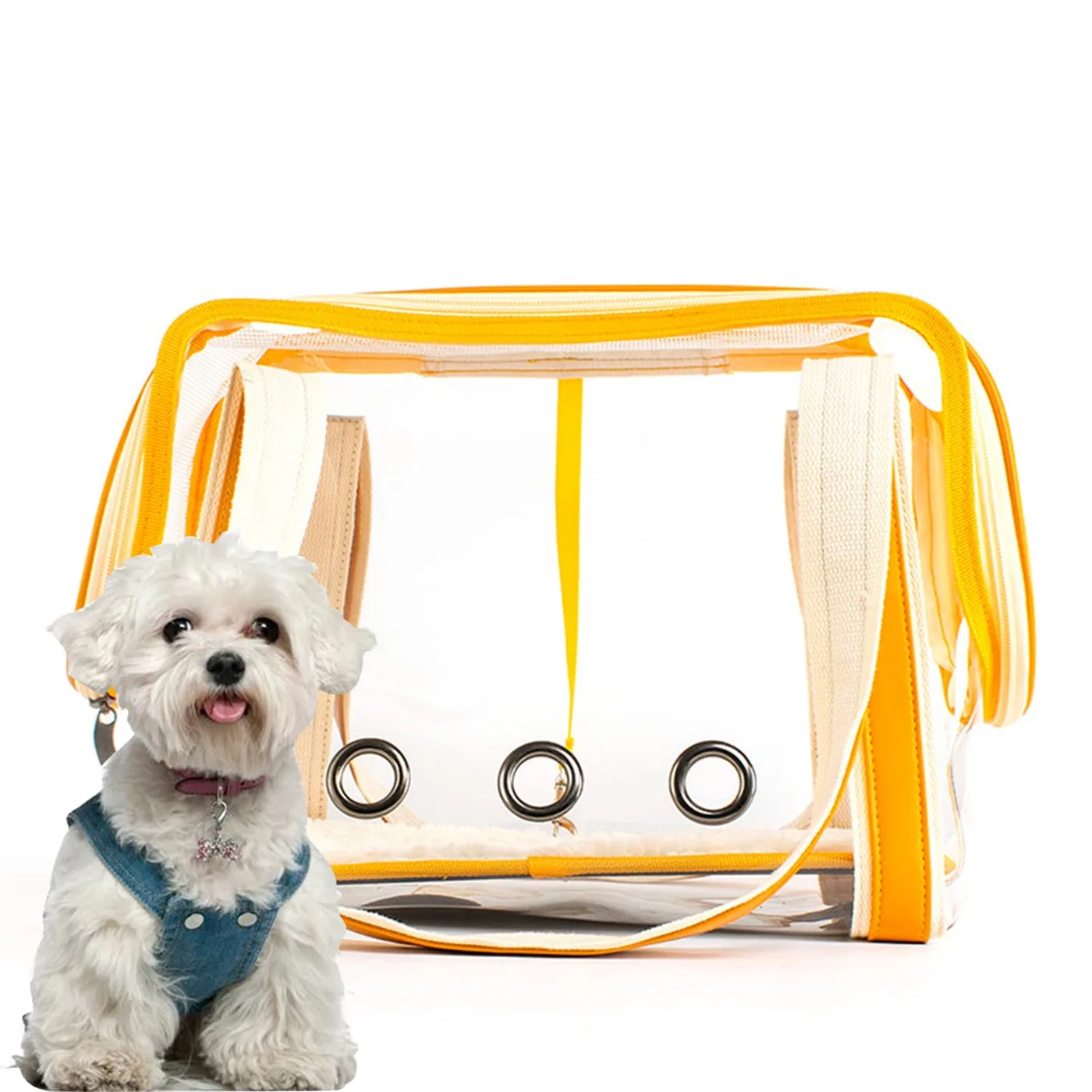
Washability and Hygiene Specification
A pet category carries hygiene requirements that general merchandise does not, and in a carrier the requirement is a removable, washable liner with a tested cycle life. That is a construction decision with a measurable test regime attached.
The construction is a removable base pad or full liner attached by hook-and-loop, zip or press stud, over a shell that can be wiped. The liner fabric has to survive repeated washing without shrinkage beyond 3-5%, without colour change beyond grey scale 4, and without the attachment system failing.
Cycle life is the specification number. A domestic wash at 30-40 degrees with a standard detergent, tested to 25-50 cycles, is the usual requirement. Below 25 the liner is not credibly washable; above 50 the cost is not justified by any realistic use pattern.
| Liner construction | Attachment | Added cost (USD) | Cycles to failure | Shrinkage at 25 cycles | Colour change | Drying time (min) |
|---|---|---|---|---|---|---|
| Single-layer polyester pad | Hook-and-loop, 4 points | 1.40-2.60 | 25-35 | 2.8-4.6% | Grey 4 | 45-90 |
| Quilted two-layer pad | Hook-and-loop, 6 points | 2.10-3.40 | 35-50 | 2.2-3.8% | Grey 4-5 | 70-140 |
| Full zip-out liner | Zip, 3 sides | 2.80-4.20 | 40-60 | 1.8-3.2% | Grey 4-5 | 60-120 |
| Coated wipe-clean base only | None, integrated | 0.60-1.40 | n/a, wipe only | n/a | n/a | 2-6 |
| Press-stud removable pad | 4-6 studs | 1.80-3.10 | 30-45 | 2.4-4.0% | Grey 4 | 50-100 |
The coated wipe-clean row is the cheap option and it is not washable in the sense a customer means. It should never carry a washable callout, and the distinction matters because a pack claiming washability sets an expectation the product has to meet.
Attachment failure is the dominant failure mode, not fabric failure. Hook-and-loop loses 30-55% of its peel strength by cycle 25, which is why a six-point attachment is specified over four for a liner expected to reach 50 cycles. A zip lasts longer but adds 0.70-1.60 USD and a snagging risk.
Test cost is modest. A 50-cycle wash test with shrinkage, colour change and attachment strength measured at intervals costs 240-680 USD per liner specification, and it is the evidence behind the washable callout on the pack.
Antimicrobial treatment is often requested and it needs care. A finish that reduces bacterial growth by 90-99% in a standard test costs 0.35-1.20 USD per unit and has to be declared, and in several markets a biocidal claim triggers its own registration. Our production team recommends declaring the treatment and its test method rather than making a health claim.
Specify 25-50 cycles with shrinkage under 5% and grey scale 4 or better; attachment fails before fabric, so six points over four, and test at 240-680 USD per specification.
Safety Testing Expectations in a Pet Category
A pet category carries safety expectations that general merchandise does not, and a specialty retailer will ask for evidence before a first order. The set is small, cheap and predictable, and having it ready is worth more than any price concession.
Four items are standard. A load rating with static and cyclic testing, a ventilation open-area measurement, an escape-resistance assessment of the closure, and a materials declaration covering the textile set.
Ventilation is the one suppliers under-specify. An open area of 12-22% of the combined panel surface is the working range for a carrier of this type, and it should be measured as the sum of mesh and perforated area against total panel area rather than asserted.
| Test | Method reference | Acceptance | Cost (USD) | Lead time | Retest trigger |
|---|---|---|---|---|---|
| Static load, 4x rated weight | ASTM-referenced load test | No failure at 60 s | 160-480 | 8-18 days | Structural change |
| Cyclic load, 5,000 cycles | ASTM-referenced cyclic test | No seam or hardware failure | 240-720 | 10-24 days | Material change |
| Seam strength per 50 mm | ASTM-referenced seam test | Above specification minimum | 90-260 | 6-12 days | Thread or gauge change |
| Hardware pull, zipper and clip | ASTM-referenced pull test | Above specification minimum | 120-340 | 6-14 days | Hardware supplier change |
| Ventilation open area | Measured, sum of open panels | 12-22% of panel surface | 40-140 | 2-6 days | Panel design change |
| Escape resistance, closure | Slider and pull assessment | No opening under specified load | 140-420 | 6-15 days | Closure change |
The full set costs 790-2,360 USD and takes 10-24 days on the longest item. Amortised over a 54,000-unit programme that is 0.01-0.04 USD per unit, which makes the question of whether to commission it obvious.
Independent crash and restraint testing for pet travel products is published by the Center for Pet Safety, and a specialty buyer may ask whether a product has been assessed against those protocols. The honest answer for a soft carrier is usually that it has not, and the correct wording on the pack is a dimensional and hardware statement rather than an implication of certification.
Transport welfare guidance is published by the American Veterinary Medical Association, and the airline cabin rules referenced by IATA are the basis for any dimensional claim. Structural methods are referenced to ASTM International standards throughout.
Our production team commissions the set at the SGS-verified production base and issues it with the batch record, so a buyer's question is answered from the file rather than starting a new test cycle.
The safety set costs 790-2,360 USD and 10-24 days, or 0.01-0.04 USD per unit on a 54,000-unit programme; commission it before the category review, not after.
Reset Calendar and Changeover Across a Deep Assortment
A pet specialty assortment resets twice a year, and the fashion segment up to four times. Each reset is a delivery event with a date, and the manufacturing question is how much is produced fresh against how much is decorated from a platform stock.
The reset calendar has a fixed shape: artwork direction 20-32 weeks before, planogram freeze 12-18 weeks before, first delivery 6-10 weeks before, and complete delivery 2-4 weeks before the reset date. Working back, production release is 24-40 weeks ahead on a custom-run basis.
That is too long for a fashion segment. Producing from a platform stocked 8-16 weeks ahead and decorated 4-8 weeks before delivery compresses the commitment to 12-20 weeks, which is what allows a trend-driven segment to work at all.
| Structure | Artwork to production release | Commitment point | First delivery | Changeover per reset (USD) | Rebalance possible | Suits |
|---|---|---|---|---|---|---|
| Custom run per reset | 24-40 weeks before reset | Artwork freeze | 6-10 weeks before | 480-1,600 | No | Everyday segment |
| Platform stocked, decorate per reset | 12-20 weeks before | Decoration batch, 4-8 weeks | 4-8 weeks before | 36-620 | Yes | Fashion segment |
| Platform stocked, trim variation | 10-18 weeks before | Trim order, 3-6 weeks | 3-6 weeks before | 36-500 | Yes | Fast-fashion segment |
| Custom run, expedited | 14-22 weeks before | Artwork freeze | 4-6 weeks before | 480-1,600 | No | Late additions |
| Carry-over, no change | n/a | None | Continuous | 0-30 | n/a | Core SKUs |
The carry-over row is worth protecting deliberately. Every assortment should have three to six core SKUs that do not change across resets, because they absorb the demand volatility of the new variants and they carry no changeover at all.
Changeover per reset is the number that makes the structure decision. At 480-1,600 USD for eight custom runs against 36-620 for eight decoration batches, a twice-yearly reset programme saves 888-1,960 USD a year on changeover alone, before any volume-ladder effect.
The risk of platform stocking is carrying cost. A platform stock of 8,000-16,000 units held for a fashion segment costs 21,120-84,480 USD a year at 0.22-0.44 USD per unit per month. That is justified at four resets a year and marginal at one.
Stock the platform for any segment resetting more than twice a year: commitment compresses from 24-40 weeks to 12-20, and changeover falls from 480-1,600 USD to 36-620.
Store-Level Replenishment and Small-Drop Logistics
A pet specialty chain replenishes at store level, which means many small drops to many addresses rather than few large ones. The logistics cost per unit is consequently higher than a distribution-centre-only programme, and the structure has to be designed for it.
Two flows exist. Distribution centre replenishment, moving case packs on pallets at 0.42-1.90 USD per unit, and direct-to-store parcel or LTL delivery at 1.80-9.40 USD per unit. A programme using both needs stock in both pack states.
The economics of direct-to-store are driven by drop size. Below about six cartons per store the LTL cost per unit rises sharply, and below two cartons a parcel service is cheaper despite a higher per-kg rate.
| Flow | Cartons per store | Units per drop | Cost (USD/unit) | Transit (days) | Damage rate | Suits |
|---|---|---|---|---|---|---|
| DC replenishment, palletised | 54-120 | 648-1,440 | 0.42-1.10 | 3-8 | 0.3-0.8% | Core SKUs |
| DC to store, LTL | 12-40 | 144-480 | 0.85-2.10 | 4-10 | 0.5-1.3% | Reset delivery |
| LTL, small drop | 4-10 | 48-120 | 2.40-5.60 | 5-12 | 0.8-1.9% | Monthly top-up |
| Parcel to store | 1-3 | 12-36 | 3.80-9.40 | 2-5 | 1.2-2.8% | Emergency restock |
| Parcel, emergency expedite | 1-2 | 12-24 | 9.80-21.40 | 1-3 | 1.4-3.2% | Stockout recovery |
The emergency rows are where margin disappears. A parcel expedite at 9.80-21.40 USD per unit on a product with a 12-18 USD margin is a loss-making transaction, and it happens when a store stocks out and the replenishment cycle cannot respond. Preventing it is worth more than optimising the cheap flows.
Prevention is a stock-cover question. Holding 2-4 weeks of additional cover at the distribution centre costs 0.06-0.24 USD per unit per month and removes 60-80% of emergency expedites. At a 3-7% stockout rate that is a clear trade.
Pack state is the operational requirement. A programme serving both flows needs units packed in shelf-ready trays for store delivery and in case packs for DC replenishment, which is a packing-line decision at 0.06-0.22 USD per unit rather than a product decision.
Use DC palletised flow for core SKUs at 0.42-1.10 USD per unit and hold 2-4 weeks of extra cover at 0.06-0.24 USD to prevent 9.80-21.40 USD emergency expedites.
Compliance and Labelling for a Pet Specialty Assortment
A pet specialty assortment carries the same labelling obligations as any textile import plus one category-specific set, and the assortment multiplies the documentation because each variant needs its own declaration.
The permanent set — origin, fibre content, care instruction, maximum pet weight — is common across the assortment and is specified once at the platform level. The variant set — colour name, style number, any segment-specific claim — changes per SKU and is printed per variant.
Multiplying correctly is the discipline. A 40-SKU assortment does not need 40 chemical declarations; it needs one per material set, which is typically three to six. It does need 40 style identifiers and 40 sets of variant-correct packaging.
| Element | Per platform | Per variant | Count at 40 SKUs, 5 platforms | Unit cost (USD) | Total (USD) |
|---|---|---|---|---|---|
| Chemical declaration set | Yes | No | 5 | n/a | 1,600-5,800 |
| Structural test set | Yes | No | 5 | n/a | 3,950-11,800 |
| Sewn origin and fibre label | Yes | No | 5 | 0.07-0.27 | Per unit |
| Care instruction insert | Yes | Language variant | 5-15 | 0.10-0.42 | Per unit |
| Retail pack print | No | Yes | 40 | 0.35-2.80 | Per unit |
| Style identifier and barcode | No | Yes | 40 | 0.02-0.08 | Per unit |
| Wash cycle test | Yes | No | 5 | n/a | 1,200-3,400 |
The distinction between per-platform and per-variant is where budgets go wrong. A supplier who commissions forty chemical declarations spends 12,800-46,400 USD where 1,600-5,800 would do, and the saving is pure margin.
The counter-risk is under-declaring. A variant using a different fabric or coating is a different material set and needs its own declaration, so the rule is by material set rather than by platform — and a platform with three fabric options is three sets.
Chemical obligations are destination-driven. A Proposition 65 assessment at 140-540 USD covers California and a REACH SVHC statement at 180-620 covers the EU; guidance on the California obligation is published by the California Office of Environmental Health Hazard Assessment. Textile chemistry is declared against OEKO-TEX criteria.
Declare by material set, not by SKU: five platforms with three fabric options is fifteen sets at most, not forty, saving 11,200-40,600 USD.
Cost Model for a Pet Specialty Programme
The channel models as follows. Take an assortment of 24 SKUs on four platforms across 1,400 stores, resetting twice a year, at 96,000 units annually, with shelf-ready trays and a washable liner specification.
The SKU-level version produces each variant as its own run: 24 runs at 4,000 units, standard cartons, no platform stock, and a chemical declaration per SKU.
The platform version produces four platform runs of 24,000 units with 24 decoration batches, stocks platform inventory for the fashion segment, and declares by material set.
| Element | Run per SKU | Platform runs plus decoration | Delta | Driver |
|---|---|---|---|---|
| Base product | 15.60-17.20 | 12.90-14.60 | Minus 2.70-2.60 | 24,000 against 4,000 |
| Changeover amortised | 0.10-0.34 | 0.01-0.12 | Minus 0.09-0.22 | Four setups against 24 |
| Decoration or trim | Included | 0.35-2.20 | Plus 0.35-2.20 | 24 variant batches |
| Washable liner | Included | 1.40-4.20 | Plus 1.40-4.20 | Specification requirement |
| Feature callouts | 0.04-0.22 | 0.12-0.68 | Plus 0.08-0.46 | Six-callout set |
| Shelf-ready packaging | 0.35-0.90 | 1.10-2.60 | Plus 0.75-1.70 | Specialty presentation |
| Freight and duty | 2.40-5.60 | 1.90-4.30 | Minus 0.50-1.30 | Four shipments against 24 |
| Documentation, amortised | 0.13-0.48 | 0.03-0.11 | Minus 0.10-0.37 | By material set |
| Emergency expedites | 0.30-0.94 | 0.06-0.24 | Minus 0.24-0.70 | Platform cover |
| Total landed | 19.32-25.68 | 17.87-29.05 | Minus 1.45 to plus 3.37 | Specification-driven |
The honest result is that the delta is a range spanning both directions: minus 1.45 to plus 3.37 USD per unit. A pet specialty programme is not cheaper than a general retail one, and a model claiming otherwise is hiding the specification cost.
The three lines that make it more expensive — washable liner, feature callouts, shelf-ready packaging — add 2.23-7.36 USD per unit. They are not optional in this channel: a specialty buyer will not list a carrier without a removable washable base and a pack that explains the features.
What the platform structure does is pay for them. The volume ladder at 2.60-2.70 USD, freight consolidation at 0.50-1.30, documentation by material set at 0.10-0.37 and expedite avoidance at 0.24-0.70 together recover 3.44-5.07 USD, which is most of the specification cost.
Commercial terms run as standard: MOQ 500 pieces per colourway, prototypes in 6-10 working days, bulk production 35-50 days after sample approval, final random inspection to AQL 2.5, T/T 30/70 and FOB Xiamen. Quality management runs under ISO 9001 with BSCI coverage. A pet specialty programme costs 2.23-7.36 USD per unit more in specification, and platform structure recovers 3.44-5.07 of it.
Why brands source here
- Pet carrier programs run since 2014; founding team in sewn goods since 2004
- SGS-verified production floor of 4,950 m² with 137 workers across 7 lines
- Monthly capacity of 200,000 units, audited to BSCI and ISO 9001
People Also Ask
How deep is a pet specialty carrier assortment?
12-40 SKUs across three to five segments, at 6-24 units per store across 900-2,600 stores, resetting twice a year. That is 54,000-320,000 units annually.
How many platforms does a deep assortment need?
Three to five. Eight everyday SKUs need one platform and eight decoration or trim variants, not eight separate tools.
What do feature callouts cost on a pack?
0.12-0.68 USD per unit for a six-callout set, pre-printed on board at 7-9 pt and a contrast ratio above 4.5:1.
How washable does a pet carrier liner need to be?
25-50 domestic wash cycles at 30-40 degrees, with shrinkage under 3-5% and colour change no worse than grey scale 4. A liner costs 1.40-4.20 USD extra.
What safety tests does a pet specialty buyer ask for?
Static and cyclic load, seam strength, hardware pull, ventilation open area at 12-22% and closure escape resistance. The set costs 790-2,360 USD and takes 10-24 days.
Why stock a platform for a fashion segment?
It compresses the commitment from 24-40 weeks to 12-20 and cuts changeover per reset from 480-1,600 USD to 36-620. It is justified at more than two resets a year.
How is documentation handled across many SKUs?
By material set, not by SKU. Five platforms with three fabric options is at most fifteen sets at 4,800-17,400 USD, against 12,800-46,400 for one per SKU.
Is a pet specialty programme cheaper than general retail?
No. Specification adds 2.23-7.36 USD per unit and platform structure recovers 3.44-5.07, leaving the delta between minus 1.45 and plus 3.37.
Frequently Asked Questions
Which segment supports its own platform?
The premium and technical tier at 79-159 USD retail and 6,400-57,600 annual units. The product story there requires construction differences rather than decoration differences.
Why do fashion segments reset more often?
They follow trend rather than function, resetting two to four times a year. Custom runs cannot serve that, which is why the platform-stock structure exists.
What makes a feature callout illegible?
Setting below 6 pt or below a 3:1 contrast ratio, which cuts comprehension by 30-55% in a shelf test. Abrasion in transit is the second cause.
How is callout comprehension tested?
A shelf test with 30-60 respondents rating whether they understood each callout, at 400-1,400 USD. It typically shows one or two failing callouts before the reset.
Why is the airline dimension callout the weakest?
Customers read numbers rather than icons, and it is usually set too small. It should be 9-11 pt and placed where the pack will not flex.
What fails first on a washable liner?
The attachment, not the fabric. Hook-and-loop loses 30-55% of peel strength by cycle 25, which is why six points are specified over four.
Can a wipe-clean base be called washable?
No. It should carry a wipe-clean callout only, because a washable claim sets an expectation the construction does not meet.
How should an antimicrobial finish be described?
Declare the treatment and its test method rather than making a health claim. A finish reducing bacterial growth by 90-99% costs 0.35-1.20 USD and may trigger biocide registration.
Why is ventilation measured rather than asserted?
Because 12-22% of combined panel surface is the working range, and the figure has to come from summing mesh and perforated area against total panel area.
Should a soft carrier imply crash-test certification?
No. The honest wording is a dimensional and hardware statement. Independent protocols exist and a soft carrier assessed against them should say so explicitly rather than imply it.
Why protect three to six carry-over SKUs?
They absorb the demand volatility of new variants and carry no changeover at all, at 0-30 USD per reorder against 480-1,600 for a custom reset run.
What does platform stocking cost in carrying charges?
21,120-84,480 USD a year for 8,000-16,000 units at 0.22-0.44 USD per unit per month. Justified at four resets a year, marginal at one.
Why is preventing stockouts worth more than cheap freight?
An emergency expedite at 9.80-21.40 USD per unit exceeds the 12-18 USD margin on a mid-tier SKU. Extra cover at 0.06-0.24 USD removes 60-80% of them.
When is a variant a different material set?
Whenever it uses a different fabric or coating. A platform with three fabric options is three declaration sets regardless of how many SKUs sit on it.
Talk to QUANZHOU JUNYUAN BAGS about a pet carrier program: MOQ 500 pieces per colourway, samples in 6-10 working days, bulk production in 35-50 days under AQL 2.5 inspection.
Get a free quote Request a sample