Cat Carrier Pet Reddit: Niche Marketing
A niche community buys specifications, so the programme needs a published measured spec sheet with test methods and sample counts, a load path rated for 9-12 kg on the XXL frame, and verification data for every claimed property. Niche volumes of 200-400 units carry an MOQ uplift coefficient of 1.18-1.72 against 500.
Niche communities are the hardest audience in this category and the most valuable, because they verify. A claim that survives a general marketplace listing will be taken apart in a specialist thread: someone will measure the interior, count the mesh openings, look up the airline dimension rule, and post the result. That changes what has to be manufactured, because the claim has to be true and provable rather than merely defensible. This page sets out the specification work behind niche programmes: load paths for very large animals, the verification data behind ventilation, washability and dimension claims, and the disclosure depth a specialist audience expects. It also covers the economics, because niche demand is usually below standard MOQ and a low-volume niche SKU carries a measurable cost uplift that has to be priced honestly. Terms follow the standard programme: MOQ 500 pieces per colourway, prototypes in 6-10 working days, bulk production 35-50 days after sample approval, final random inspection to AQL 2.5, T/T 30/70 and FOB Xiamen, with the low-volume uplift itemised rather than hidden.
Wholesale pet carrier buyers usually consolidate to fill one container; for cat carrier assortments our production team mixes sizes and colourways inside a single 500-piece minimum.
Niche Communities Ask for Specifications, Not Features
A general buyer asks whether a carrier is comfortable. A specialist community asks what the interior height is under load, what the mesh open area percentage is, what the zipper is rated to, and whether the claim is backed by a test. The difference matters because it moves the specification from adjectives to numbers.
The practical consequence is that a niche programme needs a published measured specification sheet before it needs marketing copy. The sheet states dimensions measured under defined load, material composition by component, hardware ratings, test methods with sample counts, and tolerances. Anything not on the sheet will be measured by someone else and posted.
The second consequence is that unverifiable claims are actively harmful in this channel. A claim of airline approved with no dimension evidence, or crash tested with no method and no results, will be challenged and the challenge will be more visible than the original claim. Publishing less but publishing measured is the correct posture.
| Audience | Wants | Will verify | Claims that backfire | Disclosure depth |
|---|---|---|---|---|
| General marketplace | Benefit statements | Almost nothing | Few | One page |
| Specialist community | Measured numbers | Dimensions, materials, ratings | Unsourced superlatives | Three to five pages |
| Professional buyer | Compliance evidence | Certificates, reports | Expired or generic documents | Full documentation pack |
| Technical hobbyist | Method and sample size | Test protocol | Pass or fail without data | Raw results |
| Safety-focused group | Independent standard reference | The standard itself | Self-invented standards | Standard plus results |
The measurement protocol behind the sheet has to be stated, because a number without a protocol is not verifiable. Interior height means height measured with a 4 kg distributed load on the floor panel; open area means the percentage of panel area that is aperture, measured optically; and load rating means the load at which no permanent deformation occurs after 24 hours.
Tolerance disclosure is the part most manufacturers avoid and the part that earns the most credibility in this channel. Publishing plus or minus 3 mm on internal dimensions and plus or minus 4% on weight signals that the numbers are measured rather than aspirational, and it pre-empts the thread where someone measures a unit at the bottom of the range and declares the specification false.
The last point is about what happens when the community finds a real problem. A programme that responds with a measured correction and a specification revision earns durable credibility in a way that a defensive response never does, and the cost of the correction is usually 250-900 USD against the value of a community that trusts the next claim.
Publish measured numbers with the protocol and the tolerance; in a niche community a verified smaller claim outperforms an unverifiable larger one.
Extreme-Size Requirements: Load Paths at 9-12 kg
The most common niche requirement in this category is size: a carrier for a very large cat, or for two animals, at 9-12 kg total. Standard products are engineered around 4-7 kg and the load path does not scale by simply making the bag bigger.
Scaling is not linear because the failure modes change. At 4-7 kg the critical load is carried by the shell fabric and the seam; at 9-12 kg it is carried by the base board, the handle attachment and the shoulder strap anchor. A carrier that is simply enlarged by 25% has the same handle attachment on a 70% greater load, and that is where it fails.
The engineering answer is a defined load path: a base board that spans the full floor and transfers to the side panels, side panels that transfer to a reinforced top frame, and handle and strap anchors that attach to that frame rather than to the fabric. Specifying the path costs 2.40-5.80 USD and is what separates an XXL product from an oversized standard one.
| Size class | Design load (kg) | Base board | Handle anchor | Strap anchor | Frame | Added cost (USD) |
|---|---|---|---|---|---|---|
| Small, to 4 kg | 4 | 2 mm EVA | Shell plus backing | Shell plus backing | None | 0 |
| Medium, 4-7 kg | 7 | 3 mm EVA | Reinforced panel | Reinforced panel | None | 0.85-1.90 |
| Large, 7-9 kg | 9 | 4 mm, full span | Webbing to frame | Webbing to frame | Top rail | 2.40-4.10 |
| Extra large, 9-12 kg | 12 | 5 mm, full span plus rails | Webbing loop to frame | Load-spreader plate | Perimeter frame | 3.60-5.80 |
| Two-animal, 10-14 kg | 14 | 5 mm plus divider | Double webbing loop | Load-spreader plate | Perimeter plus centre | 4.80-7.60 |
Testing at the extremes is where the specification is proved, and the test is different from a standard one. A drop test, a sustained load test and a dynamic test are the three that matter. The sustained test holds 1.5 times design load for 24 hours with acceptance of no permanent deformation above 2 mm; the dynamic test cycles from 0 to design load 5,000 times with acceptance of no anchor failure and no seam opening above 2 mm.
Handle geometry changes at high load too. A handle sized for a 6 kg carry is too narrow for 12 kg and concentrates load on the hand; the specification for the extra-large class is a handle width of 25-40 mm with a padded core, against 15-25 mm for standard. That is 0.35-0.90 USD and it is the difference between a product that can be carried and one that is technically rated but practically unusable.
Strap anchors deserve their own note because they are the most common failure. A strap sewn to a side panel pulls the panel; a strap anchored to a load-spreader plate bonded into the frame distributes it. The plate is 20-60 g and 0.55-1.30 USD, and across the extra-large and two-animal classes it is the highest-value single component in the load path.
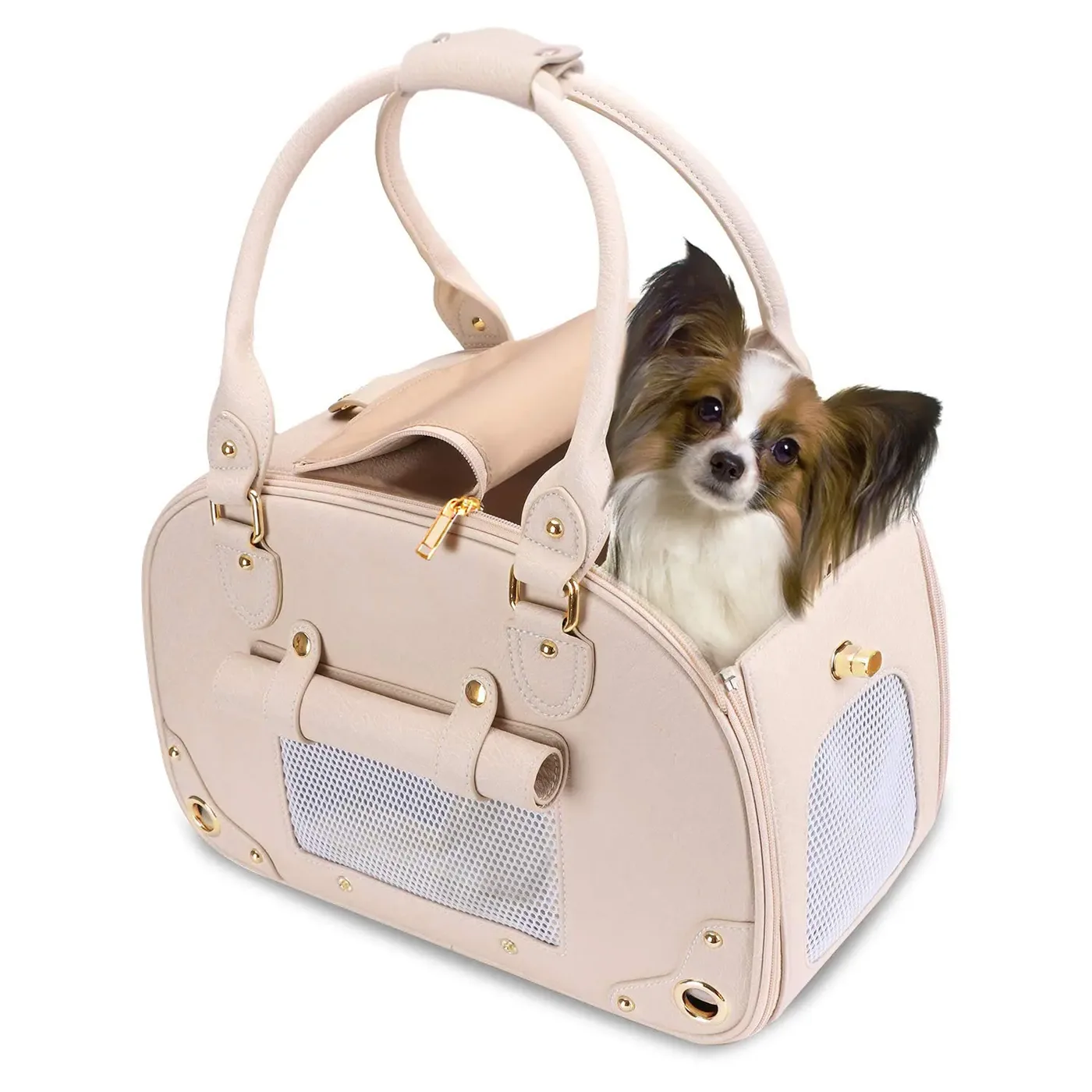
An XXL product is a load path, not a scaled-up pattern: full-span base board, perimeter frame, frame-anchored handles and a load-spreader plate at the strap.
Ventilation, Washability and Airline Dimension Claims
Three claims recur constantly in specialist discussion and all three are routinely made without evidence: ventilation, machine washability and airline compatibility. Each has a measurable definition and each has a manufacturing consequence.
Ventilation is a number, not an adjective. The measurable quantity is open area as a percentage of the total panel area, and the specification for a well-ventilated carrier is 30-45% distributed across at least two non-adjacent panels. Distribution matters as much as total, because a single large panel on one side produces no cross-flow.
Aperture size interacts with open area and with the snag risk noted elsewhere. A 2.0-2.8 mm aperture at 40% open area gives good airflow and adequate claw resistance; a 4-6 mm aperture at the same open area gives better airflow and materially worse snag resistance. The specification has to state both numbers or it is incomplete.
| Claim | Measurable definition | Test method | Acceptance | Verification cost (USD) | Common failure |
|---|---|---|---|---|---|
| Well ventilated | 30-45% open area, 2+ panels | Optical area measurement | Measured percentage published | 60-180 | Single-side ventilation |
| Machine washable | 20 cycles at 30 degrees, no damage | Domestic cycle test | No delamination, under 3% shrink | 180-460 | Liner only, not whole unit |
| Airline compatible | Fits under-seat envelope of named carriers | Dimensional check under load | Measured under compression | 40-120 | Uncompressed dimensions quoted |
| Escape resistant | Zipper and closure retain at rated force | Pull test at 150-300 N | No opening at rating | 120-320 | No rating stated |
| Water resistant | Coating holds against defined water head | Hydrostatic or spray test | Stated head or spray rating | 90-240 | Wipe-clean called waterproof |
Machine washability is the claim most often qualified to the point of being false. A carrier described as machine washable where only the liner pad can be washed is not machine washable, and a specialist audience will find that in the care label within a day. The honest specification is either a full unit rated to 20 domestic cycles at 30 degrees, or a clear statement that only the removable liner is machine washable.
Achieving full-unit washability is a real engineering requirement: all components have to survive immersion and agitation, which rules out most bonded foam, most printed labels and some hardware finishes. It typically adds 1.80-4.60 USD and it changes the construction method from bonded to sewn-and-bound in several places.
Airline dimension claims need the compressed figure. An under-seat envelope is a fixed space and a soft carrier compresses to fit it, but the dimension that matters is the one under compression, not the uncompressed external height. Publishing the compressed figure, measured under a defined load, is what makes the claim defensible. Air transport rules are published by the International Air Transport Association and animal welfare guidance during transport is commonly cross-checked against material from the American Veterinary Medical Association.
Three claims, three measurements: open area as a percentage, wash cycles at a stated temperature, and compressed dimensions against a named envelope.
Technical Disclosure Depth: What to Publish and Why
Disclosure depth is a decision with a cost, and the right depth depends on what the audience will do with the information. Publishing everything is not automatically correct; publishing what is measurable and relevant is.
The disclosure set has five layers. Layer one is dimensional and weight data with tolerances. Layer two is material composition by component, in plain material names rather than trade names. Layer three is hardware ratings and specification. Layer four is test results with method and sample count. Layer five is process and compliance evidence.
Each layer has a cost and a risk. Layer one costs almost nothing and carries no risk. Layer two costs 90-260 USD to compile and carries a small risk of revealing a sourcing decision a competitor could copy — usually an acceptable trade. Layer four costs 890-2,160 USD a year to maintain and carries the risk of publishing a result that is marginal, which is why the results published should be the ones the programme is confident in.
| Layer | Contents | Compile cost (USD) | Annual maintenance (USD) | Competitive risk | Publish |
|---|---|---|---|---|---|
| 1 Dimensions and weight | Measured values plus tolerances | 0-80 | 0-40 | None | Always |
| 2 Material composition | Fibre, denier, coating type and weight | 90-260 | 60-180 | Low | Always |
| 3 Hardware ratings | Zipper class, buckle rating, webbing tensile | 40-140 | 30-90 | Low | Always |
| 4 Test results | Method, sample size, measured values | 260-640 | 890-2,160 | Moderate | Where confident |
| 5 Process evidence | Audit and system certification | 0-120 | 400-1,400 | None | Always |
The risk in layer four is real and worth managing. Publishing a marginal result invites scrutiny of exactly the number that is weakest, and in a specialist community that scrutiny will be thorough. The discipline is to publish results that sit comfortably inside the limit and to omit the ones that do not, rather than to publish everything and hope.
Method references are what make the results checkable and they should be named explicitly. Textile and hardware test practice follows published methods at ASTM International, the quality system is certified to ISO 9001, and textile declarations are issued against OEKO-TEX criteria.
Format matters as much as content. A specification sheet as a downloadable document with a revision number and a date is treated as evidence; the same content in a product description is treated as copy. The document is 0.04-0.12 USD per unit to print and free to host, and it is the difference between being believed and being doubted.
Publish layers one, two, three and five always, and layer four selectively where results sit comfortably inside the limit.
Low-Volume Niche SKUs and the MOQ Uplift Coefficient
Niche demand is small by definition, and a niche SKU frequently cannot reach 500 units in a single colourway. The honest way to handle that is a published uplift coefficient rather than a negotiated exception, because the underlying costs are real and the audience respects a stated formula.
The uplift has three components and they behave differently. Fabric surplus: a mill minimum of 300-600 m applies regardless of order size, so below about 500 units the surplus is paid for and discarded, adding 0.40-2.60 USD per unit. Trim minimums: hardware and webbing are bought in lots of 500-5,000 pieces, adding 0.20-1.40 below the lot size. Setup amortisation: a fixed 60-360 USD changeover spread over fewer units, adding 0.05-1.20.
| Units | Fabric surplus (USD) | Trim minimums (USD) | Setup (USD) | Total uplift (USD) | Coefficient | Unit cost (USD) |
|---|---|---|---|---|---|---|
| 500 | 0 | 0 | 0.13 | 0.13 | 1.00 | 15.53 |
| 400 | 0.60 | 0.15 | 0.17 | 0.92 | 1.06 | 16.46 |
| 350 | 0.95 | 0.28 | 0.19 | 1.42 | 1.09 | 16.96 |
| 300 | 1.40 | 0.45 | 0.22 | 2.07 | 1.13 | 17.60 |
| 250 | 1.90 | 0.75 | 0.26 | 2.91 | 1.19 | 18.44 |
| 200 | 2.60 | 1.15 | 0.33 | 4.08 | 1.26 | 19.61 |
| 150 | 3.40 | 1.40 | 0.44 | 5.24 | 1.34 | 20.77 |
| 100 | 5.20 | 2.60 | 0.66 | 8.46 | 1.55 | 23.99 |
The coefficient is not linear and that is worth showing to a niche audience, because it explains why a small-batch specialist product costs more without any appeal to exclusivity. Below about 150 units the coefficient rises steeply and the order is better handled as a made-to-order or a platform variant than as a standalone SKU.
There are three legitimate ways to reduce the coefficient and all three are structural rather than negotiated. Sharing the colourway with another programme removes the fabric surplus entirely. Using stocked hardware in a standard finish removes the trim minimum. Building on a released platform pattern removes part of the setup cost.
The niche audience is unusually receptive to this kind of transparency, which is the point. A published formula that says a 200-unit order costs 26% more per unit, with the three reasons itemised, is accepted; a flat refusal below 500 units is not, and a silently inflated price is discovered and resented.
Publish the uplift as a coefficient with its three components; a niche audience will accept a formula and reject both a refusal and a hidden premium.
Modular Platforms: Shared Base, Niche-Specific Module
The economic answer to small niche volumes is a modular platform: one shared base product carrying several niche-specific modules. It converts a series of 200-unit niche SKUs into one 800-unit platform order with four variant kits, which changes the cost structure completely.
The split between shared and niche-specific has to be decided at the design stage, and the rule is that anything touching fabric minimums or tooling should be shared. Shell fabric, lining, base structure, main hardware and the pattern are shared. Colour, exterior module, interior configuration, labels and packaging are niche-specific.
A module is a sub-assembly that is added at a defined point in the build, so the line is not re-tooled for each variant. Examples in this category are an XXL frame insert, a washable liner set, a divider panel for two animals, an airline-dimension compression strap set, and a ventilation upgrade panel.
| Component | Shared or module | Units across programme | Unit cost shared (USD) | Unit cost standalone (USD) | Saving |
|---|---|---|---|---|---|
| Shell fabric and colour | Shared | 800 | 3.90 | 5.10 | 1.20 |
| Base structure and frame | Shared | 800 | 1.70 | 2.40 | 0.70 |
| Main hardware set | Shared | 800 | 2.80 | 3.90 | 1.10 |
| Pattern and tooling | Shared | 800 | 0.78 | 3.12 | 2.34 |
| XXL frame module | Module | 180 | 3.60 | 3.60 | 0 |
| Washable liner module | Module | 220 | 1.80 | 1.80 | 0 |
| Divider module | Module | 150 | 2.20 | 2.20 | 0 |
| Label and packaging variant | Module | Per variant | 0.45 | 1.30 | 0.85 |
| Total base plus one module | Mixed | n/a | 13.03-15.23 | 19.62 | 4.39-6.59 |
The saving of 4.39-6.59 USD per unit is what makes a 180-unit niche variant viable. Without the platform, the same variant carries the standalone column and prices at 19.62 USD against 13.03-15.23, which is a 29-51% penalty and usually uncompetitive.
Module inventory is the operational cost of the approach and it should be planned rather than improvised. Each module needs its own minimum, typically 150-300 units, and its own storage. Holding three modules at 200 each is 6,000-14,000 USD of working capital, against the alternative of four standalone SKUs each breaking a fabric minimum.
The design constraint is that a module must attach without changing the base build. A module that requires the shell to be sewn differently is not a module, it is a variant, and it will carry variant costs. The test at design stage is simple: can the module be fitted to a finished base unit at the packing bench? If not, it is not modular.
A modular platform saves 4.39-6.59 USD per unit on a niche variant, and the test of a true module is whether it fits a finished base at the packing bench.

Sampling for Verification: Measured Reports and Test Units
A niche programme samples for evidence rather than for approval. The sample unit is measured, photographed and tested, and the report that comes back is the artefact the community will eventually read. That changes both what is sampled and how many.
The sampling set is four units: one for dimensional measurement and photography, one for destructive testing, one retained as the reference standard, and one held for a follow-up verification. On a programme where the claims will be checked, three units is the minimum and five is comfortable.
Measurement is the core output. Each principal dimension is measured on three units and reported as a mean with a range, under the defined load condition. Weight is measured on five units. Open area is measured optically on three panels. Every number in the published specification sheet should trace to a measurement on a specific sample unit.
| Unit | Purpose | Measurements taken | Destructive | Cost (USD) | Output |
|---|---|---|---|---|---|
| 1 Dimensional | Specification sheet figures | All principal dimensions, weight, open area | No | 45-120 | Measured spec sheet |
| 2 Test | Load, cycle, wash | Sustained load, dynamic cycle, wash cycles | Yes | 45-120 | Test report pack |
| 3 Photography | Published imagery | Colour, gloss, construction detail | No | 45-120 | Image set |
| 4 Retained reference | Dispute resolution | Baseline only | No | Unit cost | Held 24 months |
| 5 Follow-up | Community re-verification | Re-measure on request | No | 45-120 | Response data |
Independent testing is the question that always arises in this channel and it should be answered plainly. Third-party laboratory testing costs 260-1,400 USD per test group depending on scope and it is worth it for the claims that matter most: load rating, restricted substances and any safety claim. For dimensional and material claims, in-house measurement against a published method with the results disclosed is usually sufficient and costs 60-180 USD.
Re-verification on request is a service worth offering. A community member who measures a unit and gets a number outside the published tolerance will post it; a programme that offers to re-measure and, if needed, replace is responding with evidence rather than with argument. Budget 2-4% of units as a verification allowance.
Sampling rounds follow the standard pattern of three rounds at 6-10 working days each, with the difference that round two carries the full measurement plan rather than a visual approval. Where the variant is a module on a released platform, rounds one and two collapse into one and the calendar shortens by 6-10 days.
Sample for evidence: five units, a measurement plan behind every published number, and third-party testing reserved for load, safety and substance claims.
Cost Model and Price Tolerance for Niche Programmes
A niche programme costs more per unit and can charge more per unit, and the question is whether the second exceeds the first. In this category it usually does, but not by as much as the audience's enthusiasm suggests.
The cost side, taking a 350-unit niche variant on a shared platform: product cost at a 1.09 coefficient is 16.96 USD, the module adds 1.80-3.60 USD, verification sampling and testing amortised across the run adds 0.55-1.80 USD, disclosure documentation adds 0.18-0.60 USD, and freight on a small shipment adds 1.10-3.40 USD. Total landed, before duty, is 20.59-26.36 USD.
The price side: a specialist audience pays a premium for a specification that meets an unmet need, and observed premiums in this category run 20-45% over a comparable general product. Against a general product retailing at 59 USD, a niche variant retails at 71-86 USD.
| Element | 200 units standalone | 350 units on platform | 500 units on platform | 800 units, two variants |
|---|---|---|---|---|
| Base product | 19.61 | 16.96 | 15.53 | 14.02 |
| Niche module | 3.60 | 3.60 | 3.60 | 2.70, amortised |
| Verification and testing | 2.80 | 1.60 | 1.12 | 0.70 |
| Disclosure documentation | 1.20 | 0.60 | 0.42 | 0.26 |
| Freight | 3.40 | 2.20 | 1.60 | 1.10 |
| Duty at 4-9% | 1.22-2.74 | 1.00-2.25 | 0.88-1.98 | 0.76-1.71 |
| Total landed | 31.83-33.35 | 25.96-27.21 | 23.15-24.25 | 19.54-20.49 |
| Retail at 55% gross margin | 70.73-74.11 | 57.69-60.47 | 51.44-53.89 | 43.42-45.53 |
| Achievable niche retail | 79-95 | 75-89 | 71-85 | 65-79 |
| Margin at achievable price | 58-65% | 65-68% | 68-71% | 70-74% |
The reading is that a niche programme is viable at every volume in the table, and that the margin improves with volume faster than the achievable price falls. The 200-unit standalone column is the weakest at a 58-65% margin, and it is the case that most benefits from moving onto a shared platform, which lifts it to the 350-unit column and adds 7 percentage points of margin.
Verification cost is the line that behaves worst at low volume and it is worth noting: at 200 units it is 2.80 USD per unit against 0.70 at 800. That is a fixed cost of roughly 560 USD spread differently, and it is the reason a niche programme should publish fewer, better-supported claims rather than a long list of thinly tested ones.
The commercial frame is standard with the uplift itemised: MOQ 500 pieces per colourway or a published coefficient down to 100 units, prototypes in 6-10 working days, bulk production 35-50 days after sample approval, final random inspection to AQL 2.5, T/T 30/70 and FOB Xiamen. Our production team builds niche and modular programmes through the SGS-verified production base under ISO 9001 and BSCI coverage. A niche variant lands at 20.59-33.35 USD and retails at 71-95 USD; the volume that most improves the economics is the move onto a shared platform.
Production capability
- SGS-verified production space of 4,950 m², 149 machines, 7 assembly lines
- Pet carrier and pet bag output since 2014 from a 137-person team
- 200,000 units shipped monthly under BSCI and ISO 9001 systems
People Also Ask
Why do niche communities require measured specifications?
Because they verify. Members measure interiors, count apertures and check dimension rules, then post the results. A claim without a protocol and a tolerance gets taken apart publicly.
What open area percentage counts as well ventilated?
30-45% of total panel area, distributed across at least two non-adjacent panels. A single large panel on one side gives no cross-flow regardless of total area.
What does an extra-large cat carrier need beyond a bigger pattern?
A defined load path: full-span base board, perimeter frame, frame-anchored handles and a load-spreader plate at the strap, at 3.60-5.80 USD. Scaling a standard pattern leaves the handle anchor on a 70% greater load.
What makes a machine washable claim honest?
Either a full unit rated to 20 domestic cycles at 30 degrees, or a clear statement that only the removable liner is washable. Calling a liner-washable unit machine washable is found within a day.
Which airline dimension should be published?
The compressed figure, measured under a defined load. A soft carrier compresses into an under-seat envelope, so the uncompressed external height is not the number that determines fit.
What is the MOQ uplift coefficient at 200 units?
1.26, adding 4.08 USD per unit: 2.60 fabric surplus, 1.15 trim minimums and 0.33 setup. At 100 units the coefficient is 1.55 and adds 8.46 USD.
How does a modular platform reduce niche variant cost?
By sharing fabric, structure, hardware, pattern and tooling across variants while variation lives in modules. It saves 4.39-6.59 USD per unit against a standalone niche SKU.
What margin does a niche programme achieve?
58-74% depending on volume, against achievable niche retail of 65-95 USD. The biggest single improvement is moving a 200-unit variant onto a shared platform, worth about 7 points.
Frequently Asked Questions
Why should tolerances be published rather than just nominal values?
Someone will measure a unit at the bottom of the range and declare the specification false. Publishing plus or minus 3 mm and plus or minus 4% signals measured data and pre-empts that thread.
What defines measured interior height?
Height with a 4 kg distributed load on the floor panel. The pad compresses 8-20 mm under load, so the unloaded figure overstates the space available.
What is the test for a 9-12 kg load rating?
Sustained load at 1.5 times design for 24 hours with under 2 mm permanent deformation, plus a dynamic test cycling to design load 5,000 times with no anchor failure and no seam opening above 2 mm.
How wide should a handle be on an extra-large carrier?
25-40 mm with a padded core, against 15-25 mm for standard. At 0.35-0.90 USD it is the difference between a product that can be carried and one that is rated but unusable.
What is a load-spreader plate?
A plate of 20-60 g bonded into the frame to which the shoulder strap anchors, at 0.55-1.30 USD. A strap sewn to a side panel pulls the panel instead of distributing the load.
Why does aperture size matter alongside open area?
A 4-6 mm aperture at 40% open area flows better than a 2.0-2.8 mm aperture at the same figure but snags far more easily. Both numbers belong in the specification.
What does full-unit washability change in construction?
It rules out most bonded foam, most printed labels and some hardware finishes, and moves several joints from bonded to sewn-and-bound. It adds 1.80-4.60 USD.
Which disclosure layers carry competitive risk?
Layer four, test results, at moderate risk. Publish results that sit comfortably inside the limit and omit marginal ones rather than publishing everything.
Why publish a specification sheet as a document rather than in a description?
A downloadable sheet with a revision number and date is treated as evidence; the same content in a product description is treated as copy. It costs 0.04-0.12 USD per unit to print.
What are the three components of the MOQ uplift?
Fabric surplus from a 300-600 m mill minimum, trim minimums bought in lots of 500-5,000 pieces, and setup amortisation of a fixed 60-360 USD changeover.
How can the uplift coefficient be reduced?
Share the colourway with another programme to remove fabric surplus, use stocked standard-finish hardware to remove trim minimums, and build on a released platform pattern to cut setup.
What is the test of a true module?
Whether it can be fitted to a finished base unit at the packing bench. A module requiring the shell to be sewn differently is a variant and carries variant costs.
How much working capital does module inventory require?
6,000-14,000 USD for three modules at 200 each, against the alternative of four standalone SKUs each breaking a fabric minimum.
When is third-party laboratory testing worth it?
For load ratings, restricted substances and safety claims, at 260-1,400 USD per test group. For dimensional and material claims, disclosed in-house measurement against a published method is usually sufficient.
Talk to QUANZHOU JUNYUAN BAGS about a pet carrier program: MOQ 500 pieces per colourway, samples in 6-10 working days, bulk production in 35-50 days under AQL 2.5 inspection.
Get a free quote Request a sample