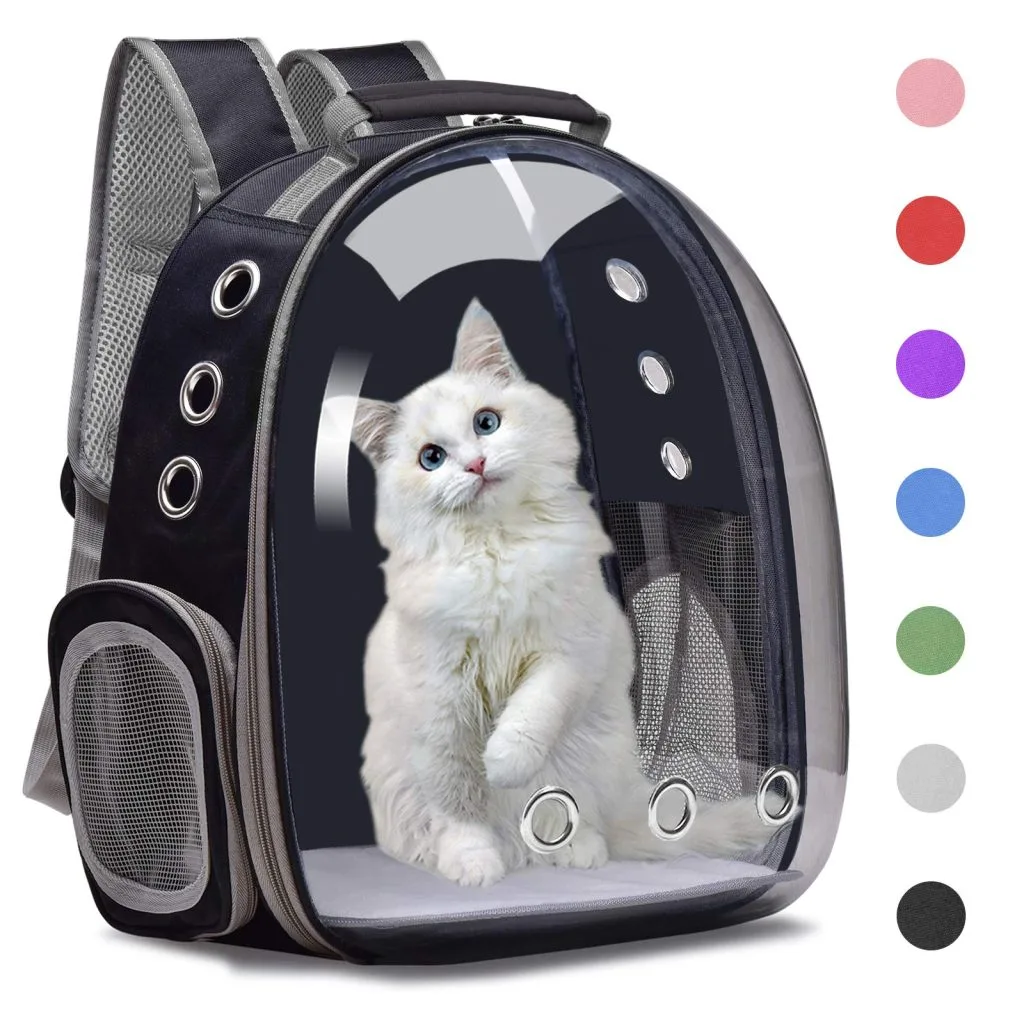
Cat Carrier Pet Target: Chain Store
A chain store programme ships 3-12 units per shelf-ready tray into a 900-1,200 mm planogram bay, and the product has to fit a shelf depth of 380-480 mm at 2-5 facings. Floor-ready packaging costs 0.85-3.40 USD per unit and removes 6-14 minutes of store labour per tray. Modular sets run 4-12 variants on one base platform.
A chain retailer buys against a planogram, and the planogram is a drawing with millimetres on it. Before any commercial question is settled, the product has to fit a shelf of fixed width, depth and height, arrive in a pack a store assistant can convert to a display without a knife, and carry the modular variety a category review has specified. This page treats those as the manufacturing constraints they are. It covers how shelf dimensions propagate back into product dimensions, what floor-ready packaging actually costs against the store labour it removes, and how a modular set of four to twelve variants is produced without twelve changeovers. It also covers the packaging sustainability expectations that now sit in most chain specifications, the carton and label set for store-ready delivery, and the compliance file and sampling sequence a category review demands. Commercial terms follow the standard programme: MOQ 500 pieces per colourway, prototypes in 6-10 working days, bulk production 35-50 days after sample approval, final random inspection to AQL 2.5, T/T 30/70 and FOB Xiamen.
A dog carrier manufacturer is expected to hold the cat carrier pattern card for at least twelve months, so a reorder matches the approved sample rather than drifting.
Planogram Geometry Propagated Into Product Dimensions
A planogram is a fixed allocation of shelf space, and every dimension on it is a constraint the product has to satisfy. Working backwards from the shelf to the product is the first engineering task in a chain programme, and it is usually done too late.
A standard gondola bay is 900-1,200 mm wide with a shelf depth of 380-480 mm and a usable height between shelves of 350-500 mm. A category is allocated 2-6 facings of 150-300 mm each, and the product at its widest must fit one facing with 10-20 mm of clearance.
The propagation is direct. A 300 mm facing means the unit's shelf-facing width cannot exceed 280-290 mm. A 400 mm shelf depth means the packed depth cannot exceed 380-390 mm. A 400 mm usable height means the unit on its shelf stand cannot exceed 380-390 mm tall.
| Bay width | Facings | Facing width | Shelf depth | Usable height | Max unit width (mm) | Max packed depth (mm) | Units per bay |
|---|---|---|---|---|---|---|---|
| 900 mm | 3 | 300 mm | 380 mm | 350 mm | 280 | 360 | 6-12 |
| 1,000 mm | 4 | 250 mm | 420 mm | 400 mm | 230 | 400 | 8-16 |
| 1,200 mm | 4 | 300 mm | 480 mm | 450 mm | 280 | 460 | 8-20 |
| 1,200 mm | 6 | 200 mm | 400 mm | 400 mm | 180 | 380 | 12-24 |
| Endcap, 900 mm | 2 | 450 mm | 500 mm | 500 mm | 430 | 480 | 4-10 |
The endcap row is worth noting because it permits a larger product and is often where a new line is tested. A unit at 430 mm wide fits an endcap facing but not a standard one, which is a reason to design two sizes rather than compromise on one.
Units per bay is the commercial consequence. A bay holding eight units at four facings sells down faster than one holding four, and the category manager allocates facings by rate of sale. A product that ships flat and stands on a shelf takes less depth and earns more facings per metre.
Shelf-ready depth is the subtle one. A unit shipped in a retail box at 480 mm depth will not fit a 420 mm shelf, so the box has to be designed to the shallowest shelf in the estate rather than to the product. That usually means shipping the unit folded with a display stand, reducing packed depth by 90-160 mm.
Design to the shallowest shelf in the estate: a 380-480 mm shelf depth forces a packed depth of 360-460 mm, which usually means shipping folded on a display stand.
Floor-Ready Packaging: Trays, PDQ Units and Store Labour
Floor-ready packaging is a carton that becomes a shelf display without tools. It is the single largest packaging line in a chain programme and it is justified by store labour rather than by freight.
A store assistant receiving a standard master carton performs six to nine operations: cut the tape, open, lift units out, unbag, place on shelf, arrange, and dispose of the carton. That is 6-14 minutes per carton. A shelf-ready tray performs three: tear the perforated front, slide onto the shelf, and collapse the lid. That is 1-3 minutes.
At a store labour rate of 14-26 USD per hour, the difference is 1.15-5.63 USD per carton, or 0.10-0.47 USD per unit at twelve units per tray. Floor-ready packaging costs 0.85-3.40 USD per unit, so the labour argument alone does not pay for it at that tray size.
| Format | Units per tray | Pack cost (USD/unit) | Store operations | Store minutes | Labour saved (USD/tray) | Net (USD/unit) | Suits |
|---|---|---|---|---|---|---|---|
| Perforated shelf tray | 6-12 | 0.85-2.10 | 3 | 1-3 | 1.15-4.50 | Minus 0.75 to plus 0.38 | Standard shelf |
| Full PDQ display unit | 8-24 | 1.40-3.40 | 2 | 1-2 | 1.90-5.63 | Minus 1.50 to plus 0.26 | Feature and endcap |
| Tray with printed riser | 6-12 | 1.10-2.60 | 3 | 2-4 | 1.15-4.50 | Minus 1.45 to plus 0.25 | Branded modular |
| Standard master carton | 12-24 | 0.35-0.90 | 6-9 | 6-14 | 0.00 | Baseline | Backroom stock |
| Carton with retail-ready lid | 12-18 | 0.62-1.60 | 4 | 3-6 | 0.85-3.20 | Minus 0.75 to plus 0.22 | Mixed estate |
The net column is honest: floor-ready packaging mostly costs more than the labour it saves, once or twice offsetting it at the favourable end. It is specified anyway, and the reason is sell-through rather than labour.
Sell-through is the real argument. A product that reaches the shelf in a branded tray with a printed riser sells 8-24% faster in the first four weeks than the same product shelved loose from a master carton, because it presents as a range rather than as units. On a 24-unit tray at 18 USD retail and a 34% margin, 8-24% of first-month sell-through is 12-35 USD of margin against 33.60-81.60 USD of tray cost for the display.
Disposal is the cost nobody counts. A store has to flatten and bin the packaging, and a full PDQ unit generates 0.4-1.2 kg of waste per display. Where a chain has a waste target, a tray using 100% recyclable board with no laminate is preferred and a plastic window is penalised.
Structural performance still applies. A shelf-ready tray has to hold its load on a shelf for 8-20 weeks without bowing, which at 6-12 units of 0.9-1.6 kg is 5.4-19.2 kg. A deflection limit of 6-10 mm over the tray span is the usual acceptance criterion.
Floor-ready packaging costs 0.85-3.40 USD per unit against 1.15-5.63 USD of store labour saved per tray; it is specified for the 8-24% first-month sell-through lift, not for the labour.
Modular Sets: Four to Twelve Variants Without Twelve Changeovers
A modular set is a group of variants presented as one range: different sizes, colours or patterns occupying adjacent facings. The category manager wants variety; production wants one setup. The reconciliation is the core manufacturing problem in this channel.
The reconciliation is a shared platform. One base construction, one material set and one sewing sequence, with the variant expressed in a way that does not require a production change — a colourway at 18-60 USD of changeover if thread and fabric change, or a decorative panel at 0-140 USD if it does not.
The practical structure is to batch by platform and vary by panel or trim. A set of eight variants produced as eight runs carries 480-1,600 USD of changeover at 70-78% utilisation. The same set produced as two platform runs of 4,000 with eight decoration batches carries 36-620 USD at 85-91%.
| Structure | Production runs | Decoration batches | Changeover (USD) | Per unit (USD) | Utilisation | Variant minimum | Lead to first ship |
|---|---|---|---|---|---|---|---|
| Run per variant | 8 | 0 | 480-1,600 | 0.30-1.00 | 70-78% | 500 each | 61-88 days |
| Platform run, panel variation | 2 | 8 | 36-620 | 0.02-0.39 | 85-91% | 500 per platform | 41-58 days |
| Platform run, trim variation | 2 | 8 | 36-500 | 0.02-0.31 | 85-91% | 500 per platform | 40-56 days |
| Single run, colourway variation | 4 | 0 | 72-240 | 0.04-0.15 | 82-88% | 500 per colourway | 44-62 days |
| Platform run plus store-level mix | 2 | 8 | 36-620 | 0.02-0.39 | 85-91% | 500 per platform | 48-66 days |
The colourway-variation row is the honest competitor and it is worth understanding. If the modular variety is genuinely colour, four colourway runs at 4,000 units each are only 0.04-0.15 USD per unit of changeover and they give a better result than a decorative panel. Panel variation wins when the variety is pattern or print rather than base colour.
Variant minimum is the constraint that shapes the set. At 500 pieces per colourway and eight variants, a set is 4,000 units minimum on a run-per-variant basis. On a platform basis it is 500 per platform, so a 4,000-unit platform order can carry eight variants of 500 — which is the same number, but with the flexibility to rebalance the mix after the first month's sell-through.
Rebalancing is the operational prize. On a platform structure, if variant three outsells variant seven by four to one, the next decoration batch simply allocates more units to variant three. On a run-per-variant structure, the programme is stuck with 500 of variant seven and none of variant three.
A platform with panel or trim variation carries eight variants at 36-620 USD of changeover against 480-1,600, and allows the mix to be rebalanced after the first month.
Packaging Sustainability Requirements in a Chain Specification
Most chain specifications now carry packaging requirements that are not about performance at all: recycled content, fibre sourcing, plastic reduction and end-of-life recyclability. These are pass-or-fail items in the packaging submission and they are decided at design stage.
Four requirements are common. A minimum post-consumer recycled content in fibre-based packaging, a fibre sourcing claim, a restriction on problematic materials such as PVC or expanded polystyrene, and a declaration that the pack is recyclable in the destination's collection system.
Each has a cost and each has a documentation burden. Recycled-content board costs 6-22% more than virgin and has 8-18% lower compression strength, which often means moving up a grade to compensate — so the real premium is 12-34%.
| Requirement | Option | Cost premium | Performance effect | Documentation | Cost (USD) | Accepted |
|---|---|---|---|---|---|---|
| Recycled content | 60-100% post-consumer board | 12-34% | Compression down 8-18% | Mill certificate | 40-180 | Widely |
| Fibre sourcing | Certified chain of custody | 3-11% | None | Certificate per batch | 120-420 | Widely |
| Plastic reduction | Paper void fill, no poly bag | Plus 0.04-0.22 per unit | Abrasion risk up | Material declaration | 30-140 | Increasingly |
| No PVC or EPS | PET or paper alternatives | 8-26% | Clarity or cushioning down | Material declaration | 30-140 | Widely |
| Recyclable in system | Mono-material pack | 0-14% | None if designed | Design declaration | 60-220 | Often |
| Compostable film | Industrial compostable | 40-120% | Shelf life down 30-50% | Certification | 180-620 | Rarely |
The plastic-reduction row is the one with a hidden performance cost. Removing a poly bag raises abrasion on the retail print by a measurable margin, and a vibration test that passed at 60 minutes with a bag can fail at 40 without one. The fix is an internal paper wrap at 0.04-0.22 USD rather than nothing.
The compostable row is included to show where the requirement has gone too far. At a 40-120% premium and 30-50% shorter shelf life it is rarely accepted, and a specification asking for it is usually a draft that will be revised.
Documentation is the recurring burden. A mill certificate and a chain-of-custody certificate are needed per board batch, at 160-600 USD combined, and a programme placing four runs a year carries 640-2,400 USD a year of packaging certification. That belongs in the budget rather than appearing as a surprise at submission.
Recycled-content board carries a real premium of 12-34% once the compression loss is compensated, and packaging certification costs 640-2,400 USD a year at four runs.
Carton and Label Specification for Store-Ready Delivery
A chain programme delivers to distribution centres and, in some cases, directly to stores. The two flows need different carton marking, and getting it wrong produces a receiving hold rather than a polite enquiry.
Distribution centre delivery needs a scannable case label on two adjacent faces with the case-level identifier, quantity, purchase order number, destination code and carton sequence. Store-direct delivery additionally needs a store number and a department code, because the carton is put straight onto a shelf rather than into a reserve location.
Carton sequence matters more than people expect. A carton marked 3 of 24 that arrives without cartons 1 and 2 is a partial delivery, and a distribution centre will hold the whole shipment rather than process seventeen of twenty-four.
| Element | DC delivery | Store-direct | Cross-dock | Cost (USD) | Failure consequence |
|---|---|---|---|---|---|
| Case identifier | Required, 2 faces | Required, 2 faces | Required, 2 faces | 0.04-0.15 per carton | Receiving hold, 40-160 USD |
| Purchase order number | Required | Required | Required | Included | Unreceivable |
| Destination code | DC code | Store number | Both | Included | Misroute, 80-340 USD |
| Department or aisle code | Not needed | Required | Required | Included | Store hold, 30-120 USD |
| Carton sequence | Required | Required | Required | Included | Partial hold, 560-1,680 USD |
| Advance shipment notice | 24-72 h before | 24-72 h before | 48-96 h before | 0.02-0.09 per carton | Refusal, full freight |
| Country of origin | Required | Required | Required | 0.03-0.12 per unit | Customs hold |
The cross-dock column is the demanding one and it is increasingly common. A cross-docked carton is never put into storage; it arrives on one dock and leaves on another within 4-18 hours, so its label has to be correct the first time because there is no opportunity to re-handle it.
Label durability is the quiet failure. A direct thermal label on a carton travelling 26-38 days by sea in a humid container fades and becomes unscannable, which is why thermal transfer or pre-printed labels are specified for long transit at a premium of 0.02-0.09 USD per carton.
Verification is a two-stage check: a scan-grade assessment of the label design at 80-240 USD, and a 100% scan verification at pack-out at 0.02-0.06 USD per carton. The second is what catches a printer that has drifted mid-run, which the first cannot.
Cross-dock delivery needs both DC and store codes on one label, thermal transfer rather than direct thermal for long transit, and a 100% scan check at pack-out at 0.02-0.06 USD per carton.
Compliance File and the Sampling Sequence for a Line Review
A chain programme is approved at a category review, and the review is driven by samples and documents rather than by a quotation. The sequence is fixed and it runs backwards from a range reset date, which is typically eight to twenty weeks before the product is on shelf.
The sampling sequence has four stages. A concept sample for the review itself, a planogram sample at final dimensions for the shelf drawing, a pre-production unit for specification sign-off, and a shipment sample from the first bulk run.
The planogram sample is the one that is missed. The category manager needs a physical unit at final packed dimensions to confirm it fits the drawing, and if the dimensions change afterwards the whole planogram has to be redrawn. Getting it right costs 45-120 USD; getting it wrong costs the slot.
| Stage | Purpose | Duration | Cost (USD) | Deliverable | Dependency |
|---|---|---|---|---|---|
| Concept sample | Review presentation | 6-10 working days | 45-120 | Physical unit | Artwork direction |
| Planogram sample, final dims | Shelf drawing confirmation | 4-9 days | 60-160 | Measured drawing plus unit | Frozen pack design |
| Pre-production unit | Specification sign-off | 3-6 days | 90-220 | Golden sample plus test pack | Approved materials |
| Packaging test report | Packaging submission | 8-18 days | 380-1,240 | Test report | Final carton spec |
| Chemical declarations | Compliance file | 6-20 days | 320-1,160 | REACH and Proposition 65 | Final material set |
| Shipment sample from bulk | Release to ship | 1-3 days | 20-70 | Retained unit | First bulk run |
The dependencies are what slip programmes. The packaging test cannot start until the carton specification is frozen and the chemical declaration cannot start until the material set is final, so a programme that is still changing materials at week six cannot meet a week-twelve deadline regardless of how fast production is.
Total sampling and documentation cost is 915-2,970 USD, which at 16,000 annual units is 0.06-0.19 USD per unit. That is small, and it is the reason the temptation to skip stages is strong. Skipping the planogram sample is the one that costs a slot.
Chemical compliance is destination-driven as always. Guidance on the California obligation is published by the California Office of Environmental Health Hazard Assessment, and textile chemistry is declared against OEKO-TEX criteria. Structural testing is referenced to ASTM International methods, and our production team issues the full sequence from the SGS-verified production base.
The sequence costs 915-2,970 USD and eight to twenty weeks; the packaging test depends on a frozen carton and the declaration on a frozen material set, so late changes are what miss the reset.

Cost Model for a Chain Store Programme
The channel models as follows. Take a modular set of eight variants at 16,000 units a year, delivered in shelf-ready trays of eight to four distribution centres, produced on two platform runs, with a recycled-content packaging specification.
The run-per-variant version of that programme is what most suppliers quote first, and it is the more expensive structure. Eight runs at 2,000 units, standard master cartons, no rebalancing.
The platform version runs two platform runs of 8,000 units with eight decoration batches, shelf-ready trays, and recycled-content board with certification.
| Element | Run per variant, master cartons | Platform runs, shelf-ready trays | Delta | Driver |
|---|---|---|---|---|
| Base product | 15.60-17.20 | 14.20-15.80 | Minus 1.40 | 8,000 against 2,000 per run |
| Changeover amortised | 0.30-1.00 | 0.02-0.39 | Minus 0.28-0.61 | Two setups against eight |
| Decoration or panel | Included | 0.35-2.20 | Plus 0.35-2.20 | Eight variant batches |
| Packaging | 0.35-0.90 | 1.10-2.60 | Plus 0.75-1.70 | Shelf-ready tray |
| Recycled content premium | 0.00 | 0.13-0.31 | Plus 0.13-0.31 | 12-34% board premium |
| Certification, amortised | 0.00 | 0.04-0.15 | Plus 0.04-0.15 | 640-2,400 USD a year |
| Freight and duty | 2.40-5.60 | 2.10-4.90 | Minus 0.30-0.70 | Two shipments against eight |
| Sell-down benefit | Baseline | Minus 0.62-1.89 | Minus 0.62-1.89 | 8-24% first-month lift |
| Chargebacks and holds | 0.94-3.40 | 0.06-0.28 | Minus 0.88-3.12 | Carton sequence, scans |
| Total landed | 19.59-28.10 | 16.38-20.94 | Minus 3.21-7.16 | 14-25% saving |
The saving is 3.21-7.16 USD per unit, or 14-25%, and it is distributed across five lines rather than concentrated in one. The volume ladder and chargeback lines are the largest; decoration, packaging and certification are the costs paid to get them.
The sell-down benefit is expressed as a negative cost because it is real and measurable: a branded shelf-ready tray lifts first-month sell-through by 8-24%, which on a range at 18 USD retail and 34% margin is worth 0.62-1.89 USD per unit across the programme.
The honest limitation is the packaging premium. Platform structure plus shelf-ready trays plus recycled content costs 1.23-2.31 USD per unit more in packaging and decoration than a master carton would, and that is only worth paying where the sell-down lift and the chargeback avoidance are both real. For a backroom-only line with no display presence, master cartons are correct.
Commercial terms run as standard: MOQ 500 pieces per colourway, prototypes in 6-10 working days, bulk production 35-50 days after sample approval, final random inspection to AQL 2.5, T/T 30/70 and FOB Xiamen. Quality management runs under ISO 9001 with BSCI coverage. A platform structure with shelf-ready trays saves 3.21-7.16 USD per unit, and the packaging premium of 1.23-2.31 is only justified where display presence is real.
Order and quality terms
- MOQ 500 pieces per colourway; samples in 6-10 working days
- Bulk production 35-50 days after approval; AQL 2.5 inspection standard
- T/T 30/70 terms, FOB Xiamen, full document set per shipment
People Also Ask
What shelf dimensions must a chain store product fit?
A bay of 900-1,200 mm with a shelf depth of 380-480 mm and 350-500 mm of usable height. At a 300 mm facing the unit width cannot exceed 280 mm.
Why ship a carrier folded rather than assembled?
A shelf depth of 380-480 mm forces a packed depth of 360-460 mm. Shipping folded on a display stand reduces packed depth by 90-160 mm.
What is floor-ready packaging worth?
0.85-3.40 USD per unit against 1.15-5.63 USD of store labour saved per tray, plus an 8-24% lift in first-month sell-through from presenting as a range.
How many units go in a shelf-ready tray?
3-12 for a standard tray and 8-24 for a full PDQ display unit. The tray has to hold 5.4-19.2 kg with deflection under 6-10 mm.
How are eight modular variants produced efficiently?
On two platform runs with eight decoration batches: 36-620 USD of changeover against 480-1,600 for a run per variant, and the mix can be rebalanced after the first month.
What does recycled-content packaging really cost?
A premium of 12-34% once the 8-18% compression loss is compensated by moving up a board grade, plus 640-2,400 USD a year in mill and chain-of-custody certification.
What carton marking does store-direct delivery need?
A case identifier, purchase order number, store number, department code, carton sequence and origin, plus an advance shipment notice 24-72 hours before arrival.
How much does a chain programme save on a platform structure?
3.21-7.16 USD per unit on 16,000 annual units across eight variants, a 14-25% saving spread across the volume ladder, chargebacks and sell-down.
Frequently Asked Questions
Why is the endcap row different in the planogram table?
An endcap facing of 450 mm permits a unit up to 430 mm wide, which a standard 300 mm facing does not. It is often where a new line is tested, and it is a reason to design two sizes rather than compromise on one.
How does packed depth affect facings?
A product that ships flat and stands on a shelf takes less depth and earns more facings per metre. Facings are allocated by rate of sale, so the effect compounds.
Why is disposal cost rarely counted?
Because it falls on the store rather than the supplier. A full PDQ unit generates 0.4-1.2 kg of waste per display, which matters where a chain has a waste target.
What deflection limit applies to a shelf tray?
6-10 mm over the tray span under 5.4-19.2 kg of load, held for 8-20 weeks on shelf.
When is colourway variation better than panel variation?
When the modular variety is genuinely colour. Four colourway runs at 4,000 units carry only 0.04-0.15 USD per unit of changeover and give a better result than a decorative panel.
Why does rebalancing matter to a category manager?
On a platform structure the next decoration batch can allocate more units to the variant that is selling. On a run-per-variant structure the programme is stuck with the original mix.
What is the hidden cost of removing a poly bag?
Abrasion on the retail print rises, and a vibration test that passed at 60 minutes with a bag can fail at 40 without one. An internal paper wrap at 0.04-0.22 USD is the fix.
Is compostable packaging ever specified?
Rarely. At a 40-120% premium and 30-50% shorter shelf life it is usually a draft requirement that will be revised before submission.
Why is cross-dock delivery the demanding flow?
A cross-docked carton is never stored; it arrives on one dock and leaves on another within 4-18 hours, so its label has to be correct first time with no re-handling opportunity.
Why specify thermal transfer labels for sea freight?
Direct thermal labels fade in a humid container over 26-38 days and become unscannable. Thermal transfer or pre-printed labels cost 0.02-0.09 USD more per carton and survive.
Which sampling stage is most often skipped and most costly?
The planogram sample at final packed dimensions. If dimensions change afterwards the whole shelf drawing has to be redone, and the cost is the slot rather than the 60-160 USD.
What makes a category review deadline slip?
Dependencies. The packaging test needs a frozen carton and the chemical declaration a frozen material set, so a programme still changing materials at week six cannot meet week twelve.
How much does the full sampling and documentation sequence cost?
915-2,970 USD, or 0.06-0.19 USD per unit at 16,000 annual units. It is small, which is why stages get skipped.
When are master cartons the correct choice?
For a backroom-only line with no display presence. Without the sell-down lift and the chargeback avoidance, the 1.23-2.31 USD packaging premium is not recovered.
Talk to QUANZHOU JUNYUAN BAGS about a pet carrier program: MOQ 500 pieces per colourway, samples in 6-10 working days, bulk production in 35-50 days under AQL 2.5 inspection.
Get a free quote Request a sample