Dog Carrier Backpack for Dachshunds: Long Body Design
A Dachshund-specific carrier is defined by spine support over a long span: the class spans 4-15 kg across miniature and standard grades, requiring unbroken rigid floor support along 600-750 mm of body length, deflection under 2 mm at mid-span, an intermediate support rib or a 6-8 mm board, and a floor-level entry geometry that removes any jump or step from loading.
This page sets out the engineering behind a carrier for a chondrodystrophic breed. The structural problem is unusual: the mass is moderate but the span is long, and deflection scales with the cube of span, so the floor is the most heavily specified component in the dog range despite carrying less weight than a Labrador product. The clinical problem is intervertebral disc disease, which affects a large proportion of the breed and which makes any sag, twist or unsupported section of the spine a design defect rather than a comfort issue. The behavioural problem is that the animal cannot be asked to jump or step up, because jumping is a primary trigger for disc extrusion. Those three set the floor, the entry and the handling geometry respectively, and they make this product longer, stiffer and lower than anything else at this mass. Commercial terms follow the standard program: MOQ 500 pieces per colourway, prototypes in 6-10 working days, bulk production 35-50 days after sample approval, final random inspection to AQL 2.5, T/T 30/70 payment and FOB Xiamen loading.
The difference between one dog carrier factory and another is rarely the stitch count - it is whether the dog carrier backpack pattern survives a 1.5x static load without permanent set.
Two Grades: Miniature and Standard Mass Classes
The Dachshund range is the widest proportional spread in the small-dog group, and it does not sit on a continuum. Miniature animals weigh 4-5 kg with a height at the withers of 130-180 mm and a chest girth of 300-400 mm; standard animals weigh 7-15 kg with a withers height of 200-280 mm and a chest girth of 350-500 mm. Those are two distinct products rather than two sizes of one product, and a single graded pattern cannot cover both without one of them being wrong.
The reason is the relationship between span and cross-section. Body length runs 400-480 mm in the miniature and 550-700 mm in the standard, a difference of roughly 45%, while chest girth differs by only about 25%. A pattern graded proportionally gives the miniature a compartment that is too long relative to its girth, or the standard one that is too short for its spine, and either error is a clinical one for this breed.
Two discrete grades is the correct answer, and the tooling cost is small because the panels scale from the same markers. Grade A covers the miniature at 220-280 mm internal width and 460-540 mm internal length; Grade B covers the standard at 280-340 mm internal width and 620-760 mm internal length. Both carry the same internal height, because height is set by the low, short-legged posture rather than by mass.
Internal height is the figure that surprises buyers. It runs 220-300 mm for both grades, which is lower than any other dog product in the range at comparable mass. The reason is that the animal's dorsal height is small and that a taller compartment invites standing and jumping. A low compartment is a clinical control here, and it is the one dimension that should not be increased for comfort.
Weight rating follows the top of each grade with a margin: 6 kg for Grade A and 16 kg for Grade B. The margin on the standard grade matters because the upper end of the standard population is genuinely heavy and because an overweight animal of the same length loads the same long span.
| Parameter | Grade A, miniature | Grade B, standard | Engineering consequence |
|---|---|---|---|
| Body mass | 4-5 kg | 7-15 kg | Rating 6 kg and 16 kg |
| Body length | 400-480 mm | 550-700 mm | Span drives deflection cubically |
| Internal length | 460-540 mm | 620-760 mm | Discrete patterns, not graded |
| Internal width | 220-280 mm | 280-340 mm | Girth, not length, sets width |
| Internal height | 220-260 mm | 240-300 mm | Low by design, discourages standing |
| Flat board required | 4.0-5.0 mm | 6.0-8.0 mm | Deflection under 2 mm at mid-span |
| Rib depth if tray used | 10-14 mm | 16-25 mm | Equivalent stiffness at lower weight |
| Intermediate support | Optional | Required above 650 mm | Halves effective span |
The two-grade decision has to be made at quotation because it doubles the pattern and marker work and it changes the floor tooling. Grading this breed proportionally is the single most expensive mistake available in the programme.
IVDD and the Full-Length Rigid Spine Requirement
Intervertebral disc disease in chondrodystrophic breeds is the clinical constraint that defines this product. The breed's cartilage-development abnormality produces discs that degenerate early and calcify, and a substantial proportion of animals will present with disc extrusion during their lifetime. The mechanical triggers are well established: flexion and extension of the spine under load, torsion, and impact from jumping or landing.
The engineering translation is simple in principle and demanding in practice: the spine must be supported along its entire length, in a neutral horizontal line, with no sag, no twist and no unsupported section, for the whole duration of the journey. That is a different requirement from supporting body weight, and it is why the floor specification for a 10 kg Dachshund is more severe than for a 30 kg dog of ordinary proportion.
Support continuity is the first element. The floor must be rigid and unbroken from the front of the compartment to the rear, with no soft section, no recessed section and no transition. Any discontinuities — a step where a mat ends, a dip where a seam crosses, a softer panel at one end — create a local unsupported length, and the disc above that length is the one that extrudes.
Torsional stiffness is the second element and it is the one most often missed. Deflection is checked on every programme; twist is checked on almost none. A floor that is stiff in bending can still be compliant in torsion, and a long narrow floor is particularly prone to it: load applied off-centre rotates the section, the animal's spine rotates with it, and the rotation is applied at the thoracolumbar junction where the breed's disc disease concentrates. The specification is a torsional check — a 5 Nm moment applied at one corner with the opposite corner fixed, accepting rotation under 1.5 degrees — in addition to the bending check.
Support of the whole body rather than of the trunk is the third element. A compartment only slightly shorter than the animal forces the head or the pelvis over an unsupported edge, and the cervical and lumbosacral junctions are both disc disease sites. Interior length must exceed body length by 60-100 mm, measured to the base of the tail rather than to the nose, which is a different measurement convention from the rest of the range and needs stating in the tech pack.
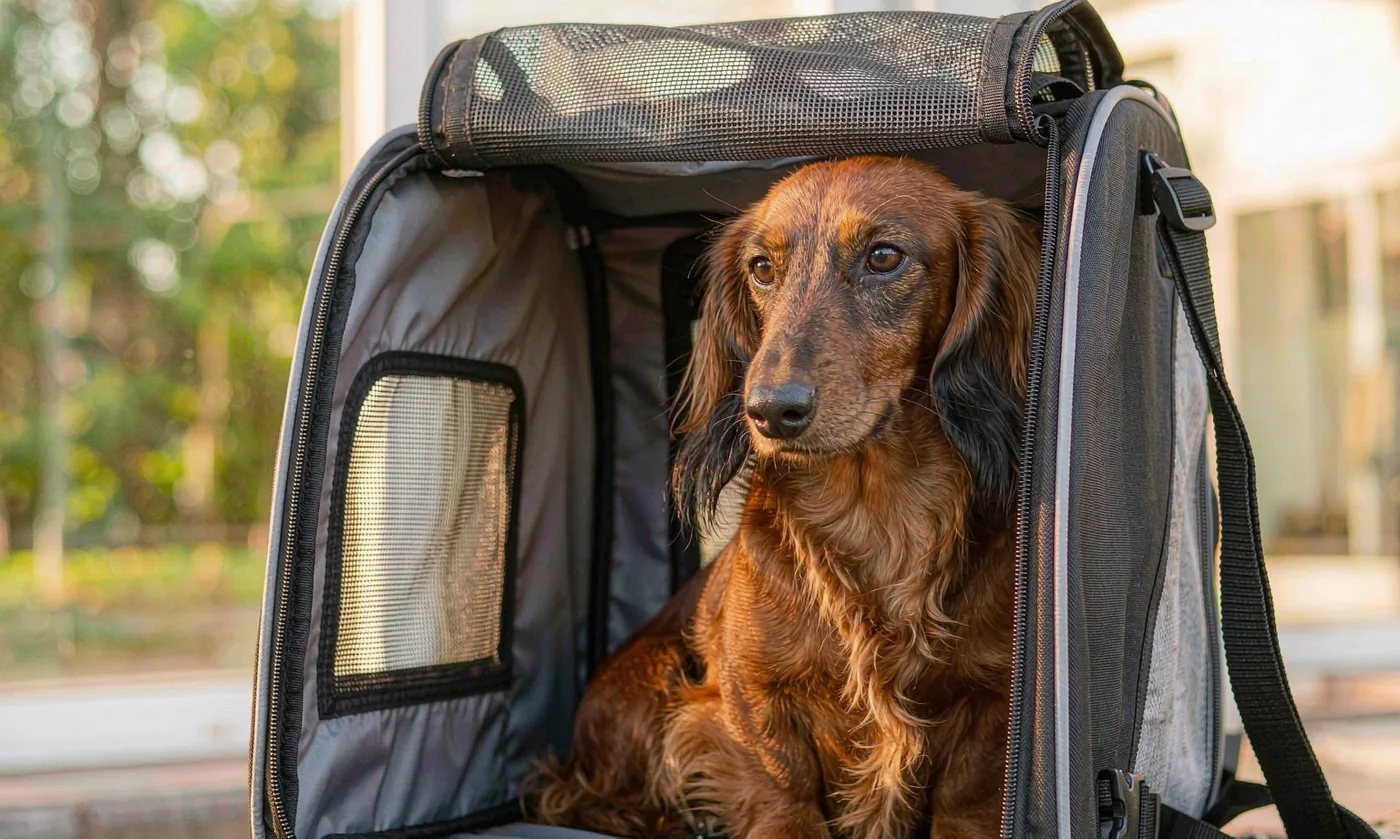
Floor Engineering Over a Long Span: Deflection and Intermediate Support
Deflection under a centrally applied load scales with the cube of span, so a floor of 700 mm span is roughly 2.7 times more compliant than one of 500 mm at identical section and material. This is the arithmetic that makes the Dachshund floor the most demanding in the dog range, and it cannot be solved by choosing a stiffer material alone.
The specification is deflection under 2 mm at mid-span under the rated load, which is tighter than the 3-4 mm used elsewhere because the tolerance is a spinal one. Two routes reach it. A flat board of 6.0-8.0 mm for Grade B, which is thick, heavy and costs 1.60-3.40 USD; or a moulded tray with ribs of 16-25 mm depth on a 35-50 mm pitch, which reaches the same stiffness at roughly half the weight and 2.40-5.20 USD of unit cost against 5,000-11,000 USD of tooling.
The third route is the one most programmes should take and few do: an intermediate support. A transverse rib or bulkhead at mid-span halves the effective span, which reduces deflection eightfold for the same section. On a long compartment this can be delivered as a moulded rib under the tray, as a wire hoop captured in the base seam at mid-length, or as a folding stiffener panel that deploys when the carrier is opened. It costs 0.40-1.20 USD and it converts a difficult floor problem into a trivial one.
Where the intermediate support is used, the load path has to be completed. A mid-span rib that bears on nothing is decorative: it has to transfer into the base seam or into a perimeter frame, which means a rib of at least the tray's rib depth and a bonded or welded connection at both ends. The check is a load applied directly over the rib, accepting the same 2 mm limit.
Material and temperature behaviour close the section. Polypropylene and HDPE stiffen and embrittle at low temperature, and a long span in a cold vehicle is a realistic case, so the board is specified with a -10 °C deflection check in addition to the ambient one. A board that meets 2 mm at 23 °C and fails at -10 °C is a real failure mode on a product sold into northern markets.
Entry Geometry: Eliminating the Jump
Jumping is a primary trigger for disc extrusion in this breed, and the jump that matters is not the dramatic one — it is the routine 200-300 mm hop up into a carrier that happens every time the product is used, and again every time the animal gets out. A product that requires a jump in normal operation is a product that causes the injury it should be preventing, and this is the most commonly overlooked requirement in the range.
The specification is a floor-level entry: the animal steps onto the compartment floor from the standing surface with a rise of no more than 40 mm, which is below the threshold at which a short-legged dog launches rather than steps. Two constructions achieve it. A full-depth side opening with a drop-down front panel that forms a lip at floor level, or a fold-flat design in which the compartment floor sits at the same height as the shell base and the animal walks in.
The drop-down panel is the more practical of the two and it does double duty as a loading ramp. The panel is specified as a rigid element — a moulded or framed piece rather than a fabric flap — with a textured walking surface at a coefficient of friction above 0.6, hinged along its lower edge and retained in the closed position by the same two-point closure used elsewhere in the product.
Entry width is the second geometry item. The animal enters lengthwise rather than sideways, and a narrow opening forces a turn inside the compartment, which is a torsional load on the spine. The opening should be at least the internal width of the compartment — 220-340 mm depending on grade — and it should be aligned with the long axis so the animal walks straight in.
Exit is the third item and it is where most designs fail even when entry is solved. An animal that has to back out or turn to leave generates the same torsional load, so the compartment needs an exit at the opposite end as well, or a top opening large enough to lift the animal straight out without rotation. Lifting is specified as two-handed and horizontal: two lift handles positioned so the animal's spine stays level, rather than one central handle that folds the compartment around it.
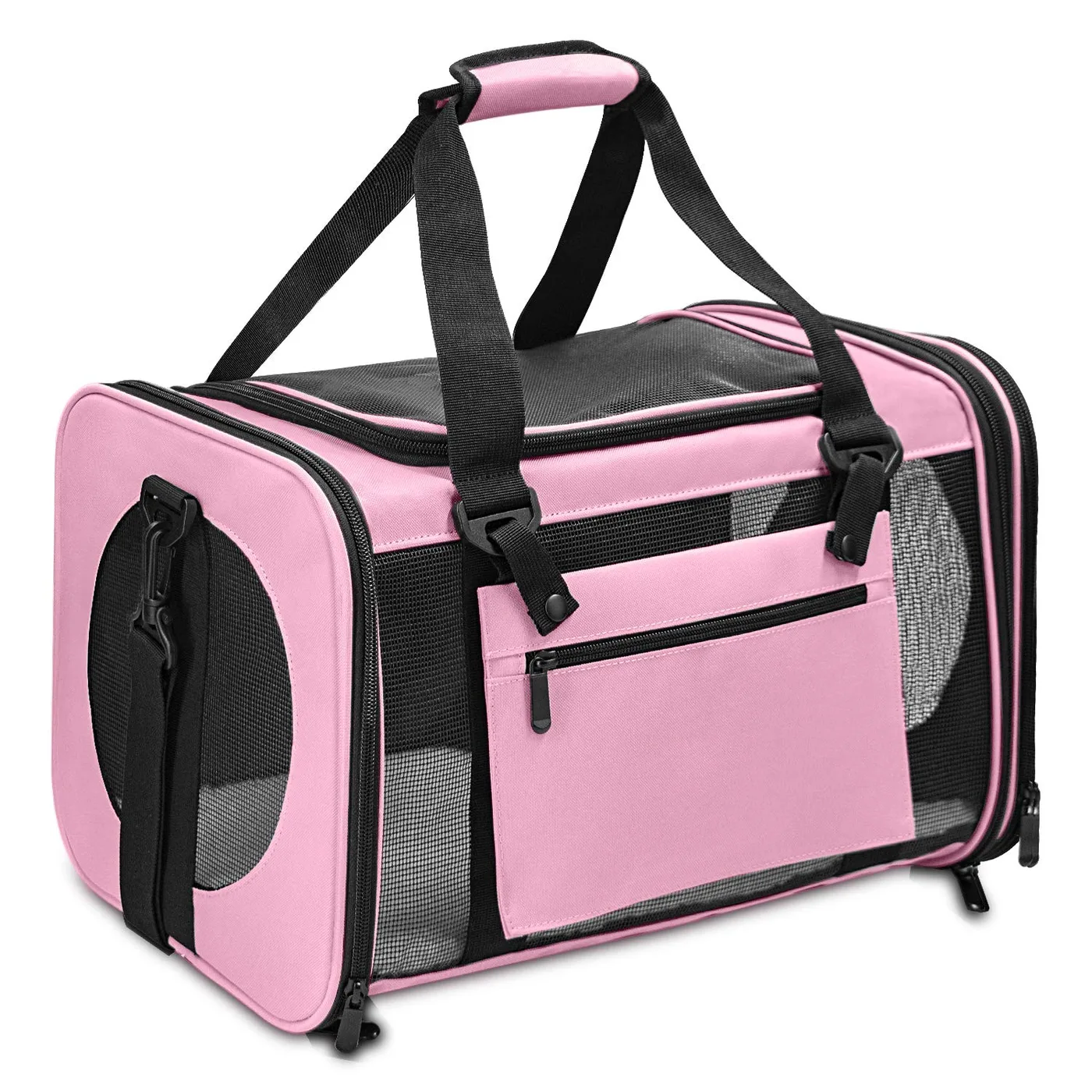
Compartment Proportion, Centre of Gravity and Suspension
A long, low compartment is an awkward load to carry and it behaves differently from a compact one. The mass is distributed over 600-750 mm of length at a height of 220-300 mm, which gives a low centre of gravity and a long moment arm in the fore-and-aft direction. On the wearer that translates into a load that is stable in roll and lively in pitch, and the suspension has to be designed for the pitch axis rather than for the roll axis.
Back panel geometry is the primary control. The panel contact area should span at least 65% of the compartment length rather than the 50-60% used on a compact product, so that fore-and-aft movement of the animal is absorbed across a longer contact patch rather than concentrated at two anchor points. The specification is a continuous contact from 150 mm above the floor line to 50 mm below it.
Load-lifter angle is the second control and it is more effective here than on any other product in the range, because the load is long and the pitch amplitude is correspondingly large. Load lifters at 25-35 degrees from horizontal, attached at 65-75% of the compartment height, pull the top of the load toward the wearer and cut the pitch amplitude substantially. At this mass the strap hardware is 25 mm webbing with a 45-60 kg/m³ foam core.
Pitch damping is the third control and it works against the animal rather than the product: any movement of the animal inside the compartment is amplified by the long moment arm. The snug-fit rule applies more strictly here than elsewhere, with lateral clearance limited to 20-40 mm at the shoulder and a shallow perimeter upstand of 10-15 mm at the floor to keep the animal centred.
Stowage and handling are worth a closing note because they are where long compartments damage themselves. A 700 mm compartment does not fit a standard shelf, a car footwell or an under-seat space, and the product is frequently folded or compressed by the customer to make it fit. The shell has to survive that, which is an argument for the framed construction used for the brachycephalic products rather than for a soft collapsible one.
Restraint, Posture and the No-Sitting Rule
Sustained sitting — the beggar posture, with the hind end on the floor and the forequarters raised — loads the thoracolumbar junction in flexion and is a recognised aggravating factor in this breed. A compartment tall enough for the animal to sit up is therefore a compartment that permits the one posture the product should discourage, which is a further argument for the low internal height already specified.
Height enforcement is the primary control and it is geometric rather than behavioural. At 220-300 mm of internal height, an animal of 200-280 mm at the withers cannot fully sit up; it can raise its forequarters slightly, which is fine, but it cannot hold the posture. A product with a taller or expandable section loses this control, and an expandable rear panel — a popular feature elsewhere in the range — should be omitted from this one.
Restraint is the second control and it is specified to prevent the animal repositioning itself into a bad posture rather than to prevent escape. A short internal tether of 120-200 mm attached to a roof-centreline anchor, rated at 120 N, used with a chest-loading harness, limits how far the animal can move fore and aft without preventing a change from lying to standing. It must not be a collar interface, because the cervical spine is a disc disease site and because neck loading in this breed is a hazard in its own right.
Floor friction supports the same goal. A slippery floor lets the animal slide into a corner and wedge itself, which produces both a lateral bend in the spine and a panic response. A coefficient of friction above 0.6 on a captive mat of 5-8 mm closed-cell foam is the specification, and the mat must be flat and full-length rather than shaped, because a contoured mat creates the local unsupported length the spine requirement prohibits.
Burrowing behaviour is the last item and it is worth accommodating rather than resisting. The breed seeks enclosed spaces and will dig at a lining to make one, which damages the interior and produces the loose-wadding hazard present across the range. The specification is a bonded or quilted lining that cannot be reduced to pieces, and optionally a fixed burrow pocket at one end of the compartment with no loose fill.
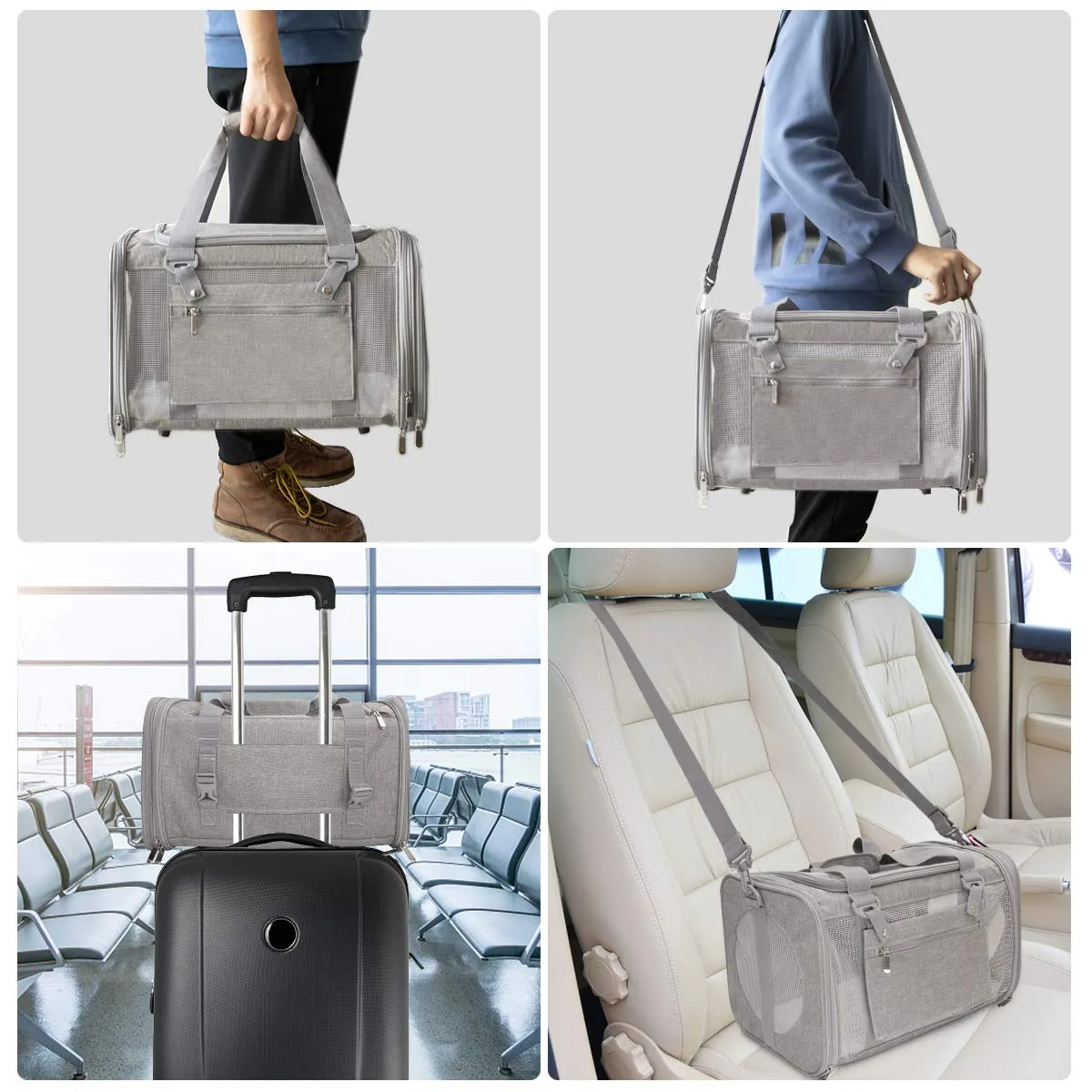
Coat Variants and Interior Surface Selection
The breed comes in three coat types and they are different enough to change interior surface selection. Smooth coats are short and dense with high shedding; longhaired coats carry a soft undercoat with feathering on the ears, chest and tail that mats against a textured surface; wirehaired coats are harsh and wiry with a dense undercoat that holds debris. A single interior specification does not serve all three well.
The common requirement is snag resistance. Feathering on a longhaired animal catches in loop pile, in open knit and in any free binding edge, and a caught feather pulls the animal rather than the lining. The specification across all variants is a tight-weave or closed interior surface with no loop, no free binding edge above 2 mm, and bindings sewn flat.
For the smooth-coat market the priority is cleanability: hair accumulates in corners and on any textured surface, so corners are radiused at R25 or greater and the floor mat is removable and shake-cleanable. For the longhaired market the priority is a low-friction face fabric so feathering slides rather than grips, which argues for a calendered or lightly coated woven rather than a brushed knit.
Moisture and cold are worth a line. The breed is low to the ground and the smooth variety has minimal insulation, so a cold floor is a real comfort and welfare issue. The mat is specified as closed-cell rather than open-cell for that reason, and it is the one place where a modest thermal resistance is wanted in a product that is otherwise about rigidity.
Cleaning validation runs across all variants: fifty wipe cycles with a diluted biocide followed by a wash, accepting no coating degradation, no seam opening, no dimensional change above 3% on the removable mat and no residual odour after 24 hours. Textile components are screened against OEKO-TEX criteria as they are across the range.
Test Protocol, Cost and Programme Notes
Release testing for the class adds four checks to the standard dog protocol: a full-length deflection test, a torsional stiffness test, an entry-rise measurement and a floor continuity survey. The structural protocol runs at 4x the grade rating, so 24 kg for Grade A and 64 kg for Grade B, and the latter is the dominant structural test in the small-dog range.
The deflection test applies the rated load at mid-span with the floor supported at its edges, accepting under 2 mm, and it is repeated at -10 °C, at 50 °C and with the load applied directly over any intermediate support. The torsional test applies a 5 Nm moment at one corner with the opposite corner fixed, accepting rotation under 1.5 degrees — a check that exists for no other product in the range.
Entry rise is measured as the vertical distance from the standing surface to the compartment floor at the entry point, accepting a maximum of 40 mm, and it is verified with the product in its normal loaded position rather than on a bench. Floor continuity is a physical survey with a straightedge across the full internal length, accepting no step, dip or soft section above 1 mm, with the mat in place.
Cost is dominated by the floor and the frame. The moulded tray with intermediate support runs 2.40-5.20 USD against 5,000-11,000 USD of tooling, or 1.60-3.40 USD for a flat board, the perimeter frame and drop-down entry panel 1.80-4.00 USD, reinforced base seam and hardware 1.00-2.40 USD, and the captive mat and lining package 0.80-1.80 USD. Total increment over a generic small-dog carrier is 5.60-13.80 USD, landing the unit at 18-32 USD FOB.
Programme notes close the page. MOQ is 500 pieces per colourway per grade, prototypes run 6-10 working days and bulk production 35-50 days after approval, with final random inspection to AQL 2.5 and the deflection, torsion and entry-rise checks written into the defect list at critical severity. Because both grades share a shell pattern and differ mainly in floor tooling, the second grade is the cheapest margin available in the programme. Method references follow conditioning practice published by ASTM International, and welfare framing is cross-checked against guidance from the American Veterinary Medical Association. The floor is the product; everything else is a bag around it.
Production capability
- SGS-verified production space of 4,950 m², 149 machines, 7 assembly lines
- Pet carrier and pet bag output since 2014 from a 137-person team
- 200,000 units shipped monthly under BSCI and ISO 9001 systems
People Also Ask
Why do Dachshunds need a fully rigid carrier floor?
Intervertebral disc disease affects a large proportion of the breed, and sag, twist or any unsupported section of the spine is a design defect rather than a comfort issue. The floor must be rigid and unbroken along the full body length with deflection under 2 mm.
How much does the floor deflect and how is it controlled?
Under 2 mm at mid-span under rated load. Deflection scales with the cube of span, so a 700 mm floor needs a 6.0-8.0 mm board, a 16-25 mm ribbed tray, or an intermediate support rib that halves the effective span and cuts deflection eightfold.
Why must a Dachshund not jump into a carrier?
Jumping is a primary trigger for disc extrusion, and the routine 200-300 mm hop happens on every use. The specification is a floor-level entry with a rise of no more than 40 mm.
Why is torsional stiffness specified separately?
A long narrow floor can be stiff in bending and compliant in twist, and off-centre load rotates the spine at the thoracolumbar junction where the breed's disc disease concentrates. A 5 Nm moment must produce rotation under 1.5 degrees.
Why is internal height kept low?
At 220-300 mm the animal cannot fully sit up, and sustained sitting loads the thoracolumbar junction in flexion. It also discourages standing and jumping, so an expandable rear panel should be omitted.
Should the two sizes be graded from one pattern?
No. Body length differs by about 45% between miniature and standard while chest girth differs by only 25%, so a proportional grade makes one of them wrong. Use two discrete patterns: 460-540 mm and 620-760 mm internal length.
How is the interior length measured for this breed?
To the base of the tail rather than to the nose, exceeding body length by 60-100 mm. A compartment that is slightly short forces the head or pelvis over an unsupported edge, and both junctions are disc disease sites.
Frequently Asked Questions
What are the two grade ratings?
6 kg for the miniature grade and 16 kg for the standard, each carrying a margin over the top of its population because an overweight animal of the same length loads the same long span.
Why is internal height similar across both grades?
Height is set by the low, short-legged posture rather than by mass, and by the clinical need to prevent standing and sitting up. Both grades run 220-300 mm, which is lower than any other dog product at comparable mass.
What is an intermediate support and how does it work?
A transverse rib or bulkhead at mid-span that halves the effective span and reduces deflection eightfold for the same section. It can be a moulded rib, a wire hoop captured in the base seam, or a folding stiffener panel, at 0.40-1.20 USD.
What is required for the intermediate support to work?
The load path has to be completed. The rib must transfer into the base seam or a perimeter frame with a bonded or welded connection at both ends, and it is verified by applying load directly over it against the same 2 mm limit.
Why is the floor tested at -10 °C?
Polypropylene and HDPE stiffen and embrittle in cold conditions, and a long span in a cold vehicle is a realistic case. A board meeting 2 mm at 23 °C and failing at -10 °C is a real failure mode in northern markets.
How is the drop-down entry panel specified?
As a rigid moulded or framed element rather than a fabric flap, with a textured walking surface above 0.6 coefficient of friction, hinged along its lower edge and retained by the two-point closure.
Why must the opening align with the long axis?
A narrow or offset opening forces the animal to turn inside the compartment, which is a torsional load on the spine. The opening is at least the internal width, 220-340 mm by grade, and aligned lengthwise so the animal walks straight in.
How should the animal be lifted out?
Two-handed and horizontal using two lift handles positioned so the spine stays level. One central handle folds the compartment around the animal, and backing out or turning generates a torsional load.
What suspension geometry suits a long compartment?
Back panel contact spanning at least 65% of compartment length, load lifters at 25-35 degrees from horizontal attached at 65-75% of height, and lateral clearance held to 20-40 mm with a 10-15 mm perimeter upstand.
What tether length is specified?
120-200 mm on a roof-centreline anchor rated at 120 N, used with a chest-loading harness. It limits fore-and-aft repositioning into a bad posture without preventing a change from lying to standing.
How does coat type change the interior specification?
All variants need a tight-weave or closed surface with no loop and no free binding edge above 2 mm. Smooth coats prioritise cleanability with radiused corners; longhaired coats need a low-friction calendered face so feathering slides rather than grips.
Why is the mat closed-cell rather than open-cell?
The breed is low to the ground and the smooth variety has minimal insulation, so a cold floor is a real welfare issue. The mat is also specified flat and full-length, because a contoured mat creates a local unsupported length.
What does a Dachshund build cost?
18-32 USD FOB, an increment of 5.60-13.80 USD: tray 2.40-5.20 USD or board 1.60-3.40 USD, frame and entry panel 1.80-4.00 USD, reinforced seam and hardware 1.00-2.40 USD, mat and lining 0.80-1.80 USD.
How is floor continuity verified?
A straightedge survey across the full internal length with the mat in place, accepting no step, dip or soft section above 1 mm. Discontinuities create the local unsupported length above which a disc extrudes.
Talk to QUANZHOU JUNYUAN BAGS about a pet carrier program: MOQ 500 pieces per colourway, samples in 6-10 working days, bulk production in 35-50 days under AQL 2.5 inspection.
Get a free quote Request a sampleKeep reading
- Dog Carrier Backpack for Corgis: Short Legs Design
- Dog Carrier Backpack Bottom: Reinforcement Options
- Dog Carrier Backpack for Senior Dogs: Comfort Design
- Dog Carrier Backpack for Small Dogs: Compact Design
- Dog Carrier Backpack Straps: Webbing Width and Strength
- Dog Carrier Backpack Size Guide: Sizing Chart and Specifications