Pet Carrier Heated Vest: Warmth
A heated garment is dimensioned at 10-30 W total draw from a 5,000-10,000 mAh cell, delivering a 2-8 hour runtime through a carbon fibre element at 0.08-0.25 W per square centimetre. Contact surface is limited to 38-45 degrees and the removable module is tested to IPX4 and 30 wash cycles.
An electrically heated animal garment sits at the intersection of a textile programme and a battery-powered device programme, and most of the cost and risk is on the device side. The element has to deliver even heat at a low voltage without a hot spot, the cell has to be certified for transport and for use, the control circuit has to hold a surface temperature limit without a sensor the animal can chew through, and the whole assembly has to survive washing with the module removed. This page treats each in turn: element architecture and the resistance and power-density numbers behind it, cell format and the certification set a lithium cell needs before it moves, thermal control and the limits that are written into the specification, ingress protection and wash durability, insulation balance, the electrical safety test regime, and the transport and market documentation that decides whether the shipment is allowed on an aircraft. Commercial terms follow the standard structure: MOQ 500 pieces per colourway, prototypes in 6-10 working days, bulk production 35-50 days after sample approval, final random inspection to AQL 2.5, T/T 30/70 and FOB Xiamen.
Any dog carrier factory quoting pet carrier accessory work should be able to show a current BSCI audit and an ISO 9001 certificate before a deposit is released.
Heating Element Architecture: Carbon Fibre Against Alloy Wire
The element is where an heated garment succeeds or fails, and the choice is between two conductor technologies with very different electrical and mechanical behaviour. Both are mature and both are used; they suit different design priorities.
Carbon fibre strand is the common choice for wearable heating. Supplied as a towing of 1,000-12,000 filaments with a resistance of 8-40 ohms per metre, it is flexible, does not work-harden, and distributes heat over its whole surface rather than at discrete points. Its disadvantage is a negative temperature coefficient in some constructions and a sensitivity to termination: a crimped joint that is adequate on copper will creep on carbon within 200-600 thermal cycles.
Metal alloy wire, typically a copper-nickel or nickel-chrome formulation, has a stable resistance of 3-15 ohms per metre and a predictable positive temperature coefficient. It is cheaper and easier to terminate reliably, but it work-hardens at bend radii below 3-6 millimetres and fails at the flex point, which is why alloy elements are usually laid in straight runs rather than curves.
| Element | Resistance (ohm/m) | Power density (W/cm2) | Flex life (cycles) | Termination | Hot spot risk | Cost index |
|---|---|---|---|---|---|---|
| Carbon fibre 3K tow | 12-30 | 0.08-0.18 | 3,000-12,000 | Crimp plus conductive adhesive | Low | 100 |
| Carbon fibre 12K tow | 8-16 | 0.12-0.25 | 2,000-8,000 | Crimp plus adhesive | Low | 115-150 |
| Copper-nickel alloy wire | 3-10 | 0.10-0.30 | 800-3,000 | Crimp or weld | Moderate | 60-95 |
| Nickel-chrome wire, silicone insulated | 5-15 | 0.15-0.40 | 600-2,400 | Crimp | Moderate | 70-110 |
| Etched foil panel | 1-6 | 0.05-0.15 | 400-1,500 | Solder tab | Low, planar | 130-200 |
| Conductive coated fabric | 200-2,000 per square | 0.02-0.10 | 1,000-4,000 | Sewn busbar | Very low | 90-140 |
Power density is the number that decides warmth, and it is lower than intuition suggests. A companion animal has its own metabolic heat and a coat, so the garment is supplementing rather than replacing. A total draw of 10-30 watts over 600-1,800 square centimetres of element area gives 0.08-0.25 watts per square centimetre, which raises the local surface temperature by 8-22 degrees above ambient still air.
Layout determines whether that heat is felt evenly. A serpentine run with a pitch of 25-50 millimetres and a minimum bend radius of 8-15 millimetres gives a temperature spread of 2-5 degrees across the panel. Tightening the pitch to 12-20 millimetres improves evenness to 1-3 degrees but doubles the element length and therefore the resistance, which the supply voltage has to accommodate.
Voltage and resistance have to be matched at the design stage, because a 5-volt supply into a 12-ohm element produces 2.1 watts and a 12-volt supply into the same element produces 12. A garment designed around a 5-volt USB-class power bank needs elements of 1.5-4 ohms, which means short runs or parallel circuits; a 7.4-volt two-cell pack allows 6-14 ohms and a simpler layout.
Carbon fibre at 8-30 ohms per metre laid in a 25-50 millimetre serpentine, at 0.08-0.25 watts per square centimetre, with crimped and adhesively bonded terminations.
Cell Format, Capacity and the Certification a Lithium Cell Needs
The power source is the component that carries the regulatory burden. A lithium cell or battery is a regulated article in transport and a regulated component in most markets, and the documentation required is not optional.
Format choice is between a cylindrical cell, a prismatic polymer pouch and a packaged power bank. Cylindrical 18650 and 21700 cells offer 2,000-3,350 mAh each at 3.6-3.7 volts nominal, are mechanically robust and widely certified. Polymer pouches pack into flatter shapes and suit a garment pocket, but they need a rigid protection plate because a punctured pouch swells.
Capacity drives runtime directly. A 5,000 mAh cell at 3.7 volts stores 18.5 watt-hours; at a 12-watt draw that is 1.5 hours of theoretical runtime and 1.2-1.4 hours delivered after conversion losses of 8-18%. A 10,000 mAh pack doubles it to 2.4-2.8 hours. Most programmes offer two heat levels so the customer can trade runtime against warmth, which is the honest way to present a limited energy budget.
| Cell | Capacity (mAh) | Energy (Wh) | Runtime at 10 W (h) | Runtime at 22 W (h) | Mass (g) | Form | Cost index |
|---|---|---|---|---|---|---|---|
| 18650 cylindrical, single | 2,600-3,350 | 9.6-12.4 | 0.8-1.1 | 0.4-0.5 | 45-50 | Rigid tube | 100 |
| 21700 cylindrical, single | 4,000-5,000 | 14.8-18.5 | 1.2-1.6 | 0.6-0.8 | 65-72 | Rigid tube | 115-140 |
| Polymer pouch, single | 3,000-6,000 | 11.1-22.2 | 0.9-1.9 | 0.5-0.9 | 60-120 | Flat plate | 120-165 |
| 2S polymer pack | 2,500-4,000 | 18.5-29.6 | 1.5-2.5 | 0.7-1.2 | 110-175 | Flat plate | 150-210 |
| USB power bank, retail | 5,000-10,000 | 18.5-37.0 | 1.4-3.1 | 0.7-1.4 | 110-220 | Rigid box | 90-150 |
| USB power bank, 20,000 | 20,000 | 74.0 | 2.8-6.1 | 1.3-2.8 | 340-460 | Too heavy to wear | 170-250 |
Certification is the gate. A lithium cell used in a consumer product is expected to carry certification to the IEC safety standard for portable sealed secondary cells, published by the International Electrotechnical Commission, and a transport test report against the UN manual of tests and criteria for lithium batteries. Without both, an air shipment can be refused and a retailer will not list the product.
The protection circuit is the second gate and it is frequently omitted in low-cost builds. A battery management module providing over-charge cutoff at 4.20-4.25 volts per cell, over-discharge cutoff at 2.75-3.00, over-current protection at 3-8 amps and a thermal cutoff at 60-75 degrees costs 0.55-1.90 USD and is the difference between a managed pack and an unmanaged one.
Sourcing the cell is the decision that most affects both cost and risk. Cells from a recognised manufacturer cost 30-80% more than unbranded equivalents and arrive with a certificate, a traceable lot and a specification sheet, which is what makes the rest of the documentation possible. Our production team requires a cell lot certificate on every receipt and rejects an undocumented lot rather than testing into it.
A certified cylindrical or polymer cell with a full battery management module, IEC safety certification and a UN transport test report; an unbranded cell without documentation is not a usable component.

Thermal Control: Sensors, Limits and Control Logic
Thermal control is the safety function of the product and it is specified as a set of limits rather than as a feeling. Three layers of protection are the industry norm, and a product with only one is not a defensible design.
The first layer is the operating thermostat, which holds the element within a band. A negative temperature coefficient thermistor at 100 kilohms nominal, positioned at the geometric centre of the element and bonded to it, gives a reading within 1-2 degrees of element temperature and a response time of 8-30 seconds. Control band is typically 3-6 degrees around the set point.
The second layer is an independent cutoff that operates if the first fails. A bimetallic or thermal-fuse device set 8-15 degrees above the maximum operating temperature, wired in series with the element rather than through the controller, opens the circuit permanently or latches off. Because it is in series and independent, it works even if the microcontroller has failed closed.
The third layer is the controller's own fault detection: a current limit, a sensor-open and sensor-short detection, and a watchdog. A product whose only protection is software is not a defensible design regardless of how good the code is.
| Layer | Device | Set point | Response | Independent of controller | Cost (USD) | Failure detected |
|---|---|---|---|---|---|---|
| Operating control | NTC thermistor 100K | Set point plus or minus 3-6 degrees | 8-30 s | No | 0.12-0.40 | Normal drift |
| Independent cutoff | Bimetallic disc or thermal fuse | 8-15 degrees above maximum | 2-15 s | Yes | 0.18-0.65 | Controller failure |
| Current limit | Fuse or electronic | 3-8 A | Under 1 s | Fuse yes | 0.06-0.55 | Short circuit |
| Cell protection | Battery management module | 4.20-4.25 V, 2.75-3.00 V, 60-75 degrees | Under 1 s | Yes | 0.55-1.90 | Cell abuse |
| Sensor fault detection | Controller logic | Open or short detected | Under 2 s | No | 0 | Broken sensor |
| Surface limit, passive | Element layout and spacing | 38-45 degrees contact | n/a | Yes | 0 | Design error |
The surface temperature limit is the number that matters most and it should be a design constraint rather than only a control setting. A contact surface held at 38-45 degrees is warm without risking a burn at sustained contact; above about 48-50 degrees the risk rises substantially on thin-coated skin. The passive limit comes from power density and element-to-surface spacing: at 0.08-0.25 watts per square centimetre with a 4-10 millimetre spacing to the outer face, the surface cannot exceed the limit even with the controller failed closed.
Sensor placement is where designs go wrong. A thermistor measuring air in the cavity rather than element temperature reads 6-14 degrees low, which lets the element run 6-14 degrees hotter than the controller believes. Bonding the sensor to the element with a thermally conductive adhesive and verifying the reading against an infrared image is a 40-120 USD check that catches the error.
Heat levels are a customer feature and they should be presented as measured surface temperatures rather than as "low, medium, high". Three levels at 32-36, 36-40 and 40-44 degrees of surface temperature, with the runtime for each stated, is honest and it is also what a reviewer compares between products.
Three protection layers, a passively limited surface at 38-45 degrees, and heat levels stated as measured surface temperature with runtime for each.
Washability, Ingress Protection and Mechanical Durability
A garment worn by an animal will be washed, and the electrical assembly has to be designed for that from the start rather than protected from it. The standard architecture is a removable module: cell, controller and connector come out, and the garment with its element and wiring goes into the machine.
The connector is the critical component. A keyed DC or magnetic connector rated to IPX4 when mated and IPX2 unmated, with a retention force of 15-45 newtons and a 3,000-10,000 cycle mating life, is the practical specification. Below 15 newtons the connector pulls out during wear; above 45 it is hard for an owner to remove and they will pull the cable.
The element and its wiring have to survive the wash mechanically as much as electrically. A stranded conductor with a silicone or thermoplastic elastomer insulation of 0.4-0.8 millimetre wall, laid with 8-20 millimetres of slack at every termination and tacked to the lining at 60-120 millimetre intervals, survives 30-50 machine cycles. A tight lay with no slack fails at the termination in 5-15 cycles.
| Test | Condition | Sample | Acceptance | Cost (USD) | Typical failure |
|---|---|---|---|---|---|
| Machine wash cycles | 30 C, mild detergent, 30-50 cycles | 4 per design | Resistance within 8%, insulation over 10 M ohm | 160-420 | Termination break |
| Connector mating | 3,000-10,000 cycles | 3 per hardware lot | Contact resistance under 50 m ohm | 60-160 | Contact wear |
| Connector retention | 15-45 N pull | 5 per lot | Does not separate | 25-60 | Pulls out in wear |
| Ingress, mated | IPX4 splash, 10 min | 3 per design | No ingress, function intact | 70-180 | Seal gap |
| Flex on lead wire | 5,000-20,000 cycles at 6 mm radius | 5 per cable lot | No open circuit | 50-130 | Conductor fatigue |
| Element resistance drift | 500 thermal cycles | 3 per design | Within 10% of initial | 120-300 | Carbon termination creep |
| Tumble dry, low | 20 cycles at 50 C | 2 per design | No deformation | 90-220 | Insulation softening |
Insulation resistance after washing is the acceptance number that matters. A freshly built garment measures over 100 megohms between the element and the lining; after 30 wash cycles the acceptance floor is 10 megohms, and a garment below that is one wash away from a leakage fault. Measuring it per batch costs 15-40 USD and it is the single best predictor of field reliability.
A common design error is to make the module pouch washable too. A cell should never go through a washing machine, and the module pocket needs a drainage path and a closure that cannot be worked open by the animal. A pocket with a hook-and-loop closure at 40-80 newtons of peel strength and a mesh base satisfies both.
Care marking has to match what was tested. If the garment was tested to 30 cycles at 30 degrees, the label says 30 degrees and no tumble dry; claiming more than was tested is how a product earns a field failure it cannot explain. Our production team writes the care label from the test record rather than from a template.
Removable module, a keyed connector at 15-45 newtons and IPX4 mated, slack at every termination, and an insulation resistance floor of 10 megohms after 30 wash cycles.
Fabric Layering and the Insulation Balance
A heated garment has two jobs and they conflict: it must keep the heat it generates near the animal, and it must not over-insulate to the point that the surface limit is exceeded or the animal cannot shed its own heat when it moves.
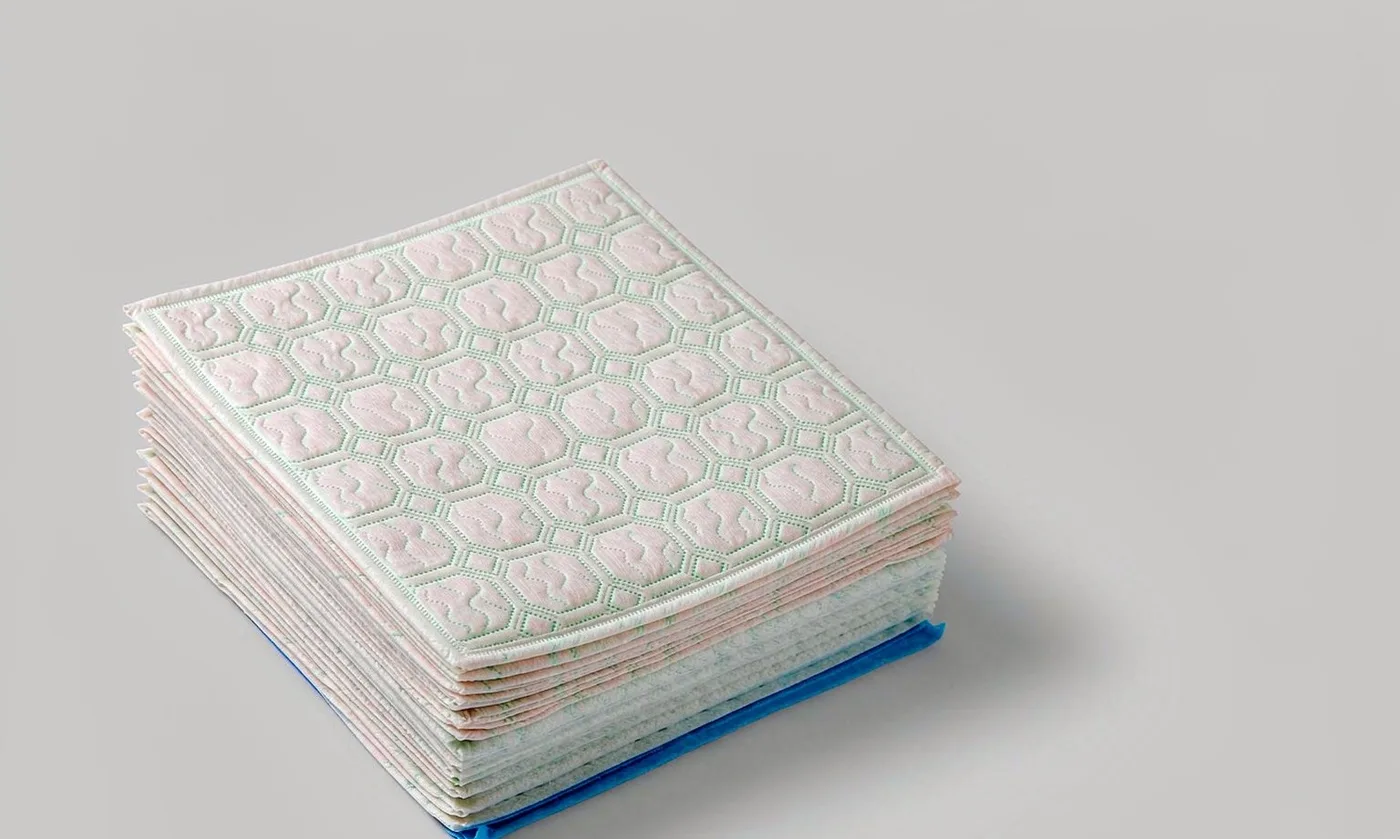
The working construction is four layers. A wicking liner against the coat moves moisture away from the skin; the element layer sits above it; a light insulation layer of 60-160 grams per square metre holds the heat; and an outer shell of 200-400 grams per square metre protects against wind and abrasion.
Wind resistance of the outer is the dominant variable, because convective loss scales with air speed. A tightly woven polyester with a coating giving an air permeability under 5-20 cubic centimetres per square centimetre per second loses 30-55% less heat at 5 metres per second than an uncoated woven at 60-120. It is the cheapest warmth in the product.
| Stack | Liner (g/m2) | Insulation (g/m2) | Shell air permeability | Surface rise at 15 W (degrees) | Heat retained | Assembly mass (g) |
|---|---|---|---|---|---|---|
| Light shell, no insulation | 120-180 | 0 | 40-80 | 6-11 | 35-50% | 220-360 |
| Light shell, 80 g insulation | 120-180 | 60-100 | 40-80 | 9-15 | 50-65% | 280-440 |
| Windproof shell, 80 g insulation | 120-180 | 60-100 | 3-12 | 14-22 | 68-82% | 300-470 |
| Windproof shell, 140 g insulation | 140-200 | 120-160 | 3-12 | 18-28 | 75-88% | 360-560 |
| Windproof plus fleece back | 180-260 | 120-160 | 3-12 | 20-30 | 80-90% | 420-640 |
| Softshell bonded, 120 g | 160-240 | 100-140 | 2-8 | 17-26 | 74-86% | 340-520 |
Over-insulation is the risk on the other side and it is real. A heavily insulated garment with the heater at full output reaches 20-30 degrees of surface rise, which on a 5-degree day is acceptable and on a 15-degree day pushes past the limit. The correct answer is either a lower maximum power in a heavily insulated build, or a control that measures surface temperature rather than element temperature.
Moisture management matters more in a heated garment than in an unheated one, because a wet liner conducts heat away 15-25 times faster than a dry one. A hydrophilic liner that moves moisture to the insulation layer rather than holding it at the coat is worth 2-5 degrees of effective warmth and it is frequently omitted.
Mass is the last consideration and it is a comfort limit rather than a thermal one. A total assembly of 300-560 grams including the module is comfortable on a medium or large animal; above about 8-10% of body mass the animal notices and alters its gait. On an extra-small size that caps the total at 200-320 grams, which restricts the cell to 2,600-3,350 mAh and the runtime to under 1.5 hours.
A windproof shell with 60-160 grams per square metre of insulation and a wicking liner, with maximum power set low enough that the surface limit holds on a 15-degree day.
Electrical Safety Test Regime and Production Control
An electrically heated garment needs a production test regime that a purely textile product does not. The regime has three parts: incoming inspection on the electrical components, in-process verification during assembly, and a finished-goods test on every unit.
Incoming inspection covers cell voltage and internal resistance against the lot certificate, element resistance within 8% of nominal, and connector contact resistance under 50 milliohms. Sampling at 3-8 units per lot costs 40-120 USD and catches the component variation that would otherwise show up as field failures.
In-process verification is the insulation and continuity check before the element is enclosed. Every element sub-assembly is tested for resistance and for insulation to the lining, because a fault found at this stage costs 0.20-0.80 USD to fix and the same fault found in finished goods costs a whole garment.
| Stage | Test | Limit | Coverage | Cost per unit (USD) | Action on fail |
|---|---|---|---|---|---|
| Incoming, cell | Voltage and internal resistance | Within certificate range | 3-8 per lot | 0.04-0.12 | Reject lot |
| Incoming, element | Resistance | Within 8% nominal | 5-10 per lot | 0.03-0.09 | Reject lot |
| In-process | Continuity and insulation | Over 100 M ohm | 100% | 0.08-0.22 | Rework |
| Finished | Function at each heat level | Draw within 10% of label | 100% | 0.10-0.28 | Rework |
| Finished | Dielectric strength | 500-1,500 V for 60 s | Per AQL sample | 0.06-0.18 | Reject batch |
| Finished | Leakage current | Under 0.25 mA | Per AQL sample | 0.05-0.15 | Reject batch |
| Finished | Surface temperature at maximum | 38-45 degrees | 3-6 per lot | 0.12-0.35 | Hold batch |
| Pre-shipment | Final random inspection | AQL 2.5 | Per standard | 0.15-0.45 | Rework or reject |
Dielectric strength testing is the one that surprises people, because it is a destructive-ish test applied to a finished product. A 500-1,500 volt application for 60 seconds between the live circuit and any accessible surface is the standard check for a low-voltage product of this class, and it is applied to the AQL sample rather than to every unit because repeated application degrades insulation.
Surface temperature verification at maximum output is a per-lot test and it is the one that catches a design drift. Three to six units per lot are run at maximum in a 20-degree chamber until stable, and the surface is measured at four points with a contact probe. Acceptance is 38-45 degrees with a spread under 6 degrees across the panel.
Traceability is what turns a test regime into a controlled process. Every finished unit carries a serial or batch code linking it to its cell lot, element lot and test record, at a cost of 0.02-0.08 USD for a printed label. Without it, a field issue cannot be bounded to a production window and the whole shipment becomes suspect.
Test the element before it is enclosed, test every finished unit for function, and apply dielectric strength and surface temperature checks at AQL sampling with full lot traceability.
Transport, Labelling and Market Documentation
A garment containing a lithium cell is a regulated article in transport and a regulated product on the shelf, and the two sets of requirements are different. Both have to be satisfied before a shipment leaves.
Transport is the harder gate. Lithium cells and batteries are classified dangerous goods for air transport and require a test report against the UN manual of tests and criteria, correct classification labelling, a state-of-charge limit of 30% or less for air freight where applicable, and packaging that meets the instruction for the classification. Missing documentation is grounds for refusal, and a refused air shipment costs 2-10 days plus re-handling.
Product documentation covers the market. In the European Union a product of this type falls within the scope of the low-voltage and general product safety framework, and requires a declaration, a technical file, a traceability label and instructions in the language of the market. A radio-equipped variant with a remote control or an app additionally needs radio and electromagnetic compatibility coverage and a marking.
In the United States the Consumer Product Safety Commission administers the general consumer product safety framework, and a product with a lithium cell is additionally subject to the transport and labelling rules enforced for batteries. Electrical safety certification to a recognised standard is not federally mandatory for every product class, but most retailers require it and it is the practical gate to shelf space.
| Item | Applies to | Issued by | Lead time | Cost (USD) | Renewal |
|---|---|---|---|---|---|
| Cell safety certification | All markets | Cell manufacturer | On receipt | Included | Per lot |
| UN transport test report | Air and sea | Cell or pack supplier | On receipt | Included | Per design |
| Pack-level test summary | Air and sea | Third-party lab | 10-30 days | 350-1,400 | Per pack design |
| Electrical safety report | EU, US retail | Third-party lab | 20-45 days | 900-3,200 | Per design |
| Technical file and declaration | EU, UK | Brand plus manufacturer | 5-15 days | 200-900 | Per revision |
| Instructions, market language | EU, UK, US | Brand | 3-10 days | 0.08-0.30 | Per revision |
| Textile declaration | Retailer-driven | Third-party lab | 10-25 days | 180-620 | Annual |
| Warning statements | All markets | Brand plus counsel | 3-12 days | n/a | Per revision |
Textile components are declared against OEKO-TEX criteria where a retailer asks, and the shell, lining and insulation are all in scope. Electrical components are covered by a restricted substance screening against the European regime documented through ECHA, which covers the cable insulation and connector housings as well as the textiles.
Warning statements are the highest-risk lines and they should be reviewed by the brand's counsel rather than written by the manufacturer. The defensible ones are procedural: remove the module before washing, do not puncture or incinerate the cell, do not use while unsupervised for longer than a stated period, and discontinue use if the element is damaged. Our production team supplies a template derived from the test record and the cell manufacturer's instructions, and does not invent claim or safety language.
Labelling on the product itself needs electrical ratings, a batch code, the textile composition and the care symbols. Electrical ratings belong on the module rather than on the garment, because the module is the part that is replaced and the part a customs officer examines.
Carry cell certification and a UN transport report before booking freight, a technical file and declaration before placing on the EU market, and keep warning statements reviewed by counsel.
Programme Economics and B2B Customisation Routes
A heated garment costs several times an unheated one, and the cost is concentrated in three components rather than spread across the bill of materials. Understanding that concentration is what makes a cost conversation productive.
At 1,000 units, the cell and its management module account for 24-38% of the cost, the element and cabling for 12-22%, the controller for 8-16%, and the textile assembly for 22-36%. The textile assembly is the smallest and most negotiable part, which is the opposite of the intuition most buyers bring to a garment programme.
Volume behaviour is unusual because the electrical components have their own price ladders driven by the cell market rather than by garment volume. Moving from 500 to 5,000 units takes 18-28% out of the textile assembly and only 8-16% out of the cell, so a large order saves proportionally less than a buyer expects.
| Element | 500 units | 1,000 units | 3,000 units | 5,000 units | Share at 1,000 | Volume sensitivity |
|---|---|---|---|---|---|---|
| Cell and management module | 5.80-12.40 | 5.40-11.20 | 5.00-10.10 | 4.80-9.60 | 24-38% | Low, 8-16% |
| Element and cabling | 2.40-5.20 | 2.20-4.60 | 1.95-4.00 | 1.85-3.75 | 12-22% | Moderate |
| Controller and connector | 1.70-3.80 | 1.55-3.35 | 1.40-2.95 | 1.32-2.78 | 8-16% | Moderate |
| Textile assembly | 5.20-9.80 | 4.60-8.40 | 3.90-6.90 | 3.65-6.35 | 22-36% | High, 18-28% |
| Testing and documentation | 1.40-3.10 | 0.85-1.90 | 0.42-0.95 | 0.32-0.72 | 5-9% | Fixed cost amortised |
| Packaging | 0.85-2.10 | 0.70-1.70 | 0.58-1.35 | 0.54-1.24 | 4-8% | Moderate |
| Total FOB Xiamen | 17.35-36.40 | 15.30-31.15 | 13.25-26.25 | 12.48-24.44 | 100% | Minus 12-33% |
Testing and documentation is the line with the steepest volume curve, because it is largely fixed. A 900-3,200 USD electrical safety report and a 350-1,400 USD pack test summary divide by the order quantity, so at 500 units they add 1.40-3.10 USD per unit and at 5,000 they add 0.32-0.72. That is the strongest argument in the whole model for committing to a larger first order.
Customisation routes are narrower than for a textile-only product, because the electrical architecture is certified as a system. A colour, a fabric, a size range and a brand mark are all open without re-certification. A change to the cell, the element power or the controller set points re-opens the electrical safety file and costs 900-3,200 USD and 20-45 days.
The practical recommendation is to freeze the electrical platform across the range and express variety through textile and finish. Three to five colourways, two shell fabrics and a full size range can all run on one certification, which is the only structure that makes a multi-variant heated programme affordable.
Programme terms: MOQ 500 pieces per colourway, prototypes in 6-10 working days for a textile variant and 20-40 days for a new electrical platform, bulk production 35-50 days after sample approval, final random inspection to AQL 2.5 including the electrical checks above, T/T 30/70 and FOB Xiamen. Production runs through the SGS-verified production base under ISO 9001 and BSCI coverage, with 4,950 square metres, 137 staff and seven lines. Freeze the electrical platform and vary the textile; a cell or controller change costs 900-3,200 USD and 20-45 days of re-certification.
Why brands source here
- Pet carrier programs run since 2014; founding team in sewn goods since 2004
- SGS-verified production floor of 4,950 m² with 137 workers across 7 lines
- Monthly capacity of 200,000 units, audited to BSCI and ISO 9001
People Also Ask
How much power does a pet heated vest draw?
10-30 W total at 5-12 V, delivered at 0.08-0.25 W per square centimetre. A 5,000 mAh cell stores 18.5 Wh, giving 1.2-1.6 hours at 10 W and 0.6-0.8 hours at 22 W.
What heating element is used in heated pet clothing?
Carbon fibre tow at 8-30 ohms per metre is the common choice, laid in a 25-50 mm serpentine. Metal alloy wire is cheaper but work-hardens below a 3-6 mm bend radius.
What surface temperature is safe for a heated garment?
38-45 degrees at the contact surface. The limit should be passive as well as controlled: at 0.08-0.25 W per square centimetre with 4-10 mm spacing the surface cannot exceed it even with the controller failed closed.
How many protection layers should a heated vest have?
Three: an NTC thermistor for operating control, an independent series thermal cutoff 8-15 degrees above maximum, and cell-level protection in the battery management module.
Can a heated pet vest be machine washed?
The garment can, with the module removed. A tested build survives 30-50 cycles at 30 degrees with insulation resistance above 10 megohms. The cell never goes in a machine.
What certification does a lithium cell need?
Safety certification to the IEC standard for portable sealed secondary cells, plus a UN transport test report. Without both, air freight can be refused and retailers will not list the product.
How much does a heated vest cost to manufacture?
15.30-31.15 USD FOB at 1,000 units, of which the cell and its module take 24-38% and the textile assembly 22-36%. At 5,000 units the total falls 12-33%.
Frequently Asked Questions
Why does element resistance have to match the supply voltage?
Power is voltage squared over resistance. A 12 ohm element draws 2.1 W on a 5 V supply and 12 W on 12 V, so a 5 V design needs elements of 1.5-4 ohms or a parallel circuit.
Why do carbon fibre terminations need conductive adhesive?
A crimp adequate on copper creeps on carbon within 200-600 thermal cycles because the filament bundle relaxes. A crimp plus conductive adhesive holds the joint for 2,000-12,000 flex cycles.
What does a battery management module protect against?
Over-charge above 4.20-4.25 V per cell, over-discharge below 2.75-3.00 V, over-current at 3-8 A and cell temperature above 60-75 degrees. It costs 0.55-1.90 USD.
Why use a retail USB power bank in some designs?
It arrives already certified with transport documentation, at 90-150 on the cost index against a custom pack. The trade is a rigid box shape and 110-220 g, which limits the smallest sizes.
Why is sensor placement a common design fault?
A thermistor measuring cavity air rather than element temperature reads 6-14 degrees low, so the element runs hotter than the controller believes. Bond it to the element and verify against an infrared image.
Why are heat levels better stated as temperatures?
Three levels at 32-36, 36-40 and 40-44 degrees with runtime for each is measurable and comparable. Low, medium and high tell the customer nothing they can verify.
What connector retention force is correct?
15-45 N. Below 15 the connector pulls out during wear; above 45 an owner cannot remove it and will pull the cable instead.
Why does the lead wire need slack at each termination?
A tight lay with no slack fails at the termination in 5-15 wash cycles. With 8-20 mm of slack and tacking at 60-120 mm intervals the build survives 30-50 cycles.
Why not make the module pocket washable too?
A cell must never be machine washed. The pocket needs a drainage path, a mesh base and a hook-and-loop closure at 40-80 N of peel strength.
Why is a windproof outer the cheapest warmth available?
Convective loss scales with air speed, and a coating giving permeability under 5-20 loses 30-55% less heat at 5 m per second than an uncoated woven at 60-120.
What is the over-insulation risk?
A heavily insulated build at full output reaches 20-30 degrees of surface rise, which is fine at 5 degrees ambient and past the limit at 15. Either cap maximum power or control on surface temperature.
Why is dielectric strength tested on a sample rather than every unit?
Repeated application of 500-1,500 V degrades insulation. It is applied to the AQL sample, while continuity and function are checked on 100% of units.
What does lot traceability cost and buy?
0.02-0.08 USD for a printed code linking each unit to its cell lot, element lot and test record. Without it a field issue cannot be bounded to a production window.
Which customisations avoid re-certification?
Colour, fabric, size range and brand mark, all of which leave the electrical architecture untouched. A new cell, element power or controller set point costs 900-3,200 USD and 20-45 days.
Talk to QUANZHOU JUNYUAN BAGS about a pet carrier program: MOQ 500 pieces per colourway, samples in 6-10 working days, bulk production in 35-50 days under AQL 2.5 inspection.
Get a free quote Request a sample