Pet Carrier Service Dog Vest: Working Dog
A working-dog vest is engineered on four numbers: patch text at 22-45 millimetres cap height, a contrast ratio of 4.5:1 or better between lettering and ground, retroreflective tape at 25-50 millimetres width, and a load-rated handle tested at four to eight times body weight. Wash life is 50-120 cycles.
A service dog vest is an identification product that happens to be worn every working day for eight to ten years, and the engineering follows from that sentence rather than from the occasion. The panel has to carry text that reads at a distance in poor light, the marking has to survive a wash cycle every one to four weeks for a decade, and the structure has to accept a handle, a leash point and a carrier tether without any of them becoming the weak link. This page works through it in manufacturing order: how large identification text has to be for the viewing distance, which patch construction lasts longest under laundering, where retroreflective material goes and what grade it needs to be, and how the vest integrates with a carrier's load points and tether. It then covers fit and adjustment range, the durability test regime, the labelling rules that apply to a working-dog product, and the programme structure for a multi-SKU government or institutional order. Commercial terms are standard: MOQ 500 pieces per colourway, prototypes in 6-10 working days, bulk production 35-50 days after sample approval, final random inspection to AQL 2.5, T/T 30/70 and FOB Xiamen.
Private label pet bags sit at the centre of most pet carrier accessory briefs we handle: the buyer owns the brand, the barcode and the artwork, while our production team holds the pattern.
Identification Legibility: Text Size, Contrast and Viewing Distance
The function of a working-dog vest is to be read. Every other specification is secondary to whether a person at a distance can read the panel in the conditions the vest is actually worn in — a doorway, a shop aisle, a street at dusk.
Cap height is set by viewing distance and the relationship is close to linear. A legibility rule of 4-8 millimetres of cap height per metre of reading distance gives a clear read, so text intended to read at 5 metres needs 20-40 millimetres and text intended to read at 8 metres needs 32-64. The working range on a vest panel is 22-45 millimetres.
Contrast is the variable that decides legibility more than size does. Black text on a red vest measures a contrast ratio of 4.5-6.5:1 and reads; the same text on a navy vest measures 1.6-2.6:1 and disappears. The specification is 4.5:1 minimum between lettering and ground, verified by measurement rather than by eye.
Word count is the third constraint and it is the one that ruins most designs. A panel of 180-320 millimetres carries 12-24 characters at a 30 millimetre cap height, which is two to four words. "SERVICE DOG" at eleven characters fits; a five-word sentence does not and it should not be attempted.
| Reading distance (m) | Cap height (mm) | Stroke width (mm) | Characters on 220 mm panel | Min contrast ratio | Works at dusk | Typical application |
|---|---|---|---|---|---|---|
| 2 | 10-16 | 1.8-3.0 | 40-60 | 3.5:1 | No | Secondary panel |
| 3 | 14-22 | 2.4-4.0 | 28-44 | 4.0:1 | Marginal | Side patch |
| 5 | 22-34 | 3.6-6.0 | 18-30 | 4.5:1 | Yes | Main panel |
| 8 | 32-45 | 5.2-8.5 | 12-22 | 4.5:1 | Yes | Large breed main panel |
| 12 | 45-64 | 7.4-12.0 | 8-16 | 5.0:1 | Yes | Street or event use |
| 20 | 70-110 | 11.5-20.0 | 5-10 | 6.0:1 | No | Vehicle or banner marking |
Letter spacing and case matter at this scale. All-capital text reads further than mixed case at the same cap height, and a letter spacing of 0.12-0.20 of cap height prevents adjacent letters from merging when the patch is wet or when the viewer is moving.
Placement is the second half of legibility. A panel on the dorsal line is read from above and from behind, which is the wrong geometry for a person approaching from the front. The working configuration is a panel on each flank plus an optional dorsal strip, with the flank panels positioned at 35-55% of body length from the shoulder.
The vest is also read by people who are not looking for it, which is the argument for a second, lower-contrast colourway. A high-contrast vest is appropriate where identification is the priority; a lower-contrast one is appropriate where the handler does not want the dog to be a focal point, and both are legitimate product requirements.
Specify 22-45 millimetres cap height, a 4.5:1 minimum contrast ratio measured not eyeballed, all-capital text, and flank panels at 35-55% of body length plus an optional dorsal strip.
Patch Construction: Embroidery, Woven, PVC and Heat Transfer
Four constructions put identification onto a vest panel and they differ in wash life, cost, weight and the minimum quantity at which they are economic. The choice is a life-cycle decision: a working vest is laundered 50-120 times a year for a decade.
Embroidery is the premium answer and the most durable. A polyester or rayon thread at 40-60 weight, at 1,200-4,500 stitches for a two-word panel, survives 100-200 wash cycles and it does not delaminate because there is no adhesive layer. The cost is 0.85-3.40 USD per panel and a digitising charge of 15-65 USD.
A woven label or a woven patch is the flat alternative, giving finer detail than embroidery at 0.35-1.45 USD with a wash life of 60-120 cycles limited by the edge binding rather than the weave. It is the right answer for small text below 12 millimetres.
PVC or silicone rubber patches are the durable modern option, holding 80-200 wash cycles, resisting abrasion better than any textile, and carrying a 3D relief that reads at an angle. They weigh 6-22 grams, which is the constraint on a small breed.
| Construction | Wash life (cycles) | Weight (g) | Minimum text size (mm) | Abrasion resistance | Setup (USD) | Unit cost (USD) | Suits |
|---|---|---|---|---|---|---|---|
| Embroidery, direct | 100-200 | 8-26 | 10-14 | High | 15-65 | 0.85-3.40 | Default, premium |
| Embroidered patch, sewn on | 100-200 | 10-30 | 10-14 | High | 15-65 plus sewing | 1.10-3.90 | Removable panel |
| Woven patch, merrowed edge | 60-120 | 4-12 | 4-6 | Moderate | 25-95 | 0.35-1.45 | Small text, detail |
| PVC or silicone rubber | 80-200 | 6-22 | 6-10 | Very high | 120-450 tooling | 0.60-2.60 | High abrasion, 3D |
| Heat transfer, polyurethane | 30-70 | 2-6 | 5-8 | Moderate | 0-40 | 0.20-0.85 | Volume, low weight |
| Screen print, plastisol | 40-80 | 3-9 | 8-12 | Moderate | 25-85 per colour | 0.18-0.75 | High volume, flat |
| Sublimation on panel | 50-90 | 0 | 4-6 | Moderate | 0-60 | 0.30-1.05 | Full-colour artwork |
Attachment method is a separate decision from patch construction and it is where programmes fail. A heat-pressed patch at 150-170 degrees Celsius for 12-20 seconds at 2.5-4.0 bar bonds correctly; the same patch pressed at 130 for 8 seconds lifts at the corner after 10-25 washes and the whole panel comes off in a laundering.
Sewing a patch on rather than pressing it is the fix for programmes where press parameters cannot be guaranteed. A perimeter stitch at 6-10 stitches per inch adds 0.15-0.55 USD and removes the adhesion variable entirely, and it is the specification for any programme that will be laundered commercially.
Backing and stabiliser matter on the reverse face. A cut-away stabiliser at 30-60 grams prevents the embroidery from puckering a light shell fabric, and a cover-up backing prevents the thread ends from abrading the animal's coat. Both are specified by weight, not by description.
Embroider or sew for a ten-year item, press only where the press parameters are documented and audited, and specify the stabiliser by weight in grams.
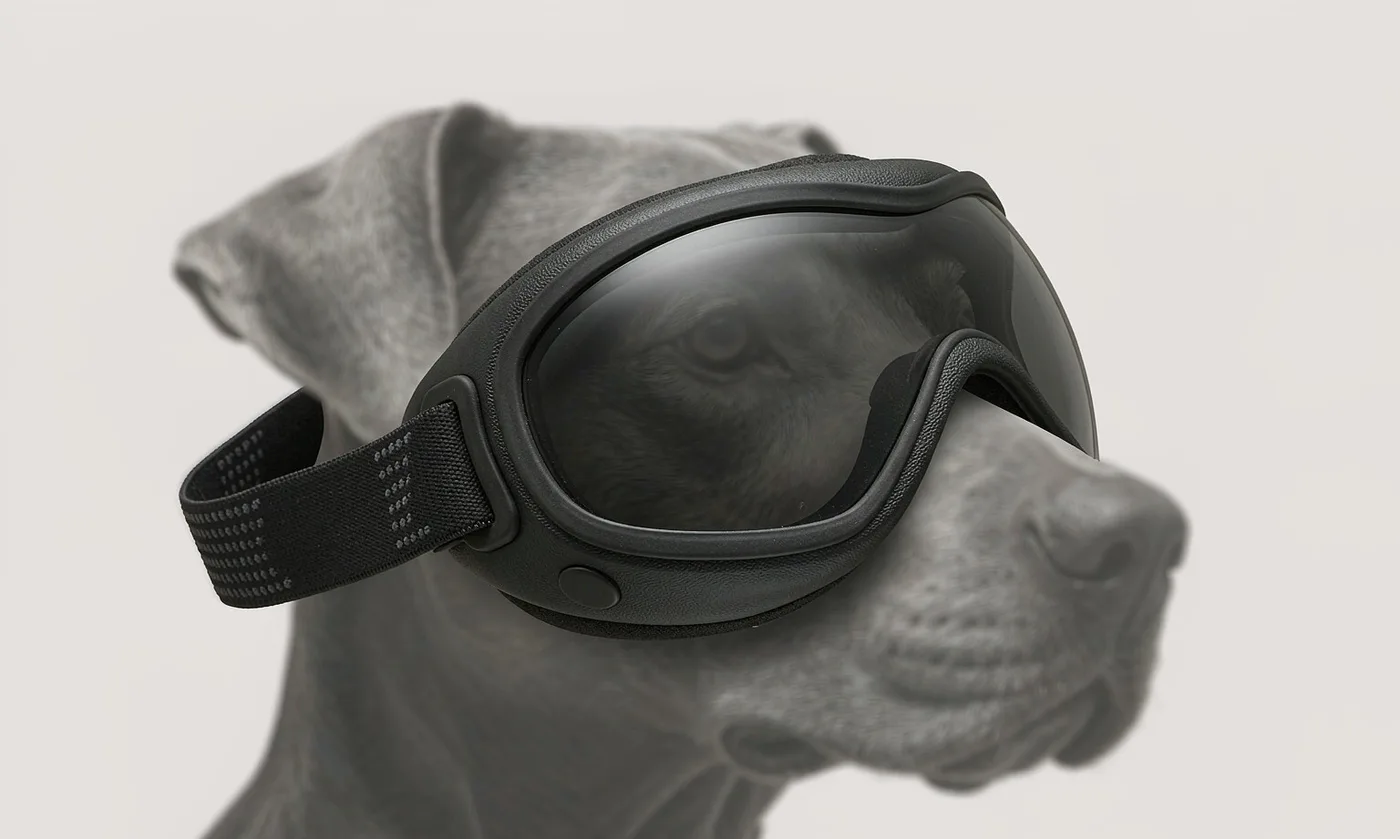
Retroreflective and High-Visibility Elements
A working dog is out in traffic, in car parks and at dusk, and the visibility package is the part of the vest that protects the animal rather than identifies it. Two technologies do the work and they are not substitutes for each other.
Retroreflective tape returns light to its source, which means it lights up for a driver but does nothing in ambient light. The performance measure is the coefficient of retroreflection, and a tape at 300-500 candela per lux per square metre is the practical specification for a vest; a decorative trim at 20-80 is not a safety element.
Fluorescent material works in daylight and does nothing at night. A fluorescent yellow-green or orange ground raises daytime conspicuity by 2-4 times over a navy or black ground, and it is the correct choice for a dusk-walking programme.
| Element | Width (mm) | Retroreflection (cd/lx/m2) | Wash life (cycles) | Daytime benefit | Cost per vest (USD) | Suits |
|---|---|---|---|---|---|---|
| Glass-bead tape, standard | 25-50 | 300-500 | 25-60 | None | 0.35-1.20 | Urban, general |
| Microprismatic tape | 25-50 | 500-900 | 50-100 | None | 0.75-2.60 | Roadside, traffic |
| Sewn-on reflective piping | 8-15 | 150-330 | 40-90 | None | 0.25-0.90 | Edge definition |
| Fluorescent ground fabric | Full vest | None | 30-70 | 2-4x conspicuity | 0.60-2.20 | Daytime, dusk |
| Fluorescent plus reflective, combined | Full plus 50 mm | 300-700 | 30-80 | 2-4x conspicuity | 0.95-3.40 | Full 24-hour coverage |
| Reflective print, transfer | 20-40 | 80-250 | 15-40 | None | 0.18-0.65 | Decorative only |
| LED strip, active | 10-20 | N/A | Remove to wash | Moderate | 2.40-8.50 | Night, supervised |
Placement is a geometry problem. A continuous band around the chest and a second band over the dorsal line gives 360-degree coverage, which is the specification for traffic use; two flank patches give about 180 degrees and leave the front and rear dark when the animal turns.
Width matters as much as performance class. A 12 millimetre reflective piping returns a signal that a driver sees at 40-90 metres; a 50 millimetre band returns one seen at 120-220 metres. Where visibility is a requirement rather than a feature, specify the width in millimetres and not just the material.
Wash degradation is the property that is never tested and always complained about. A glass-bead tape loses 30-60% of its retroreflection by 25-50 wash cycles because the beads are exposed; an encapsulated microprismatic tape loses 10-25% by 50-100 because the prisms are protected. The specification should name the cycle count at which a minimum performance must still be met.
Specify 25-50 millimetre tape at 300-500 cd/lx/m2 minimum, continuous bands for 360-degree coverage, and a performance floor that must still be met after the rated wash cycle count.
Carrier System Integration: Load Points, Handle and Tether
A working vest is worn inside a carrier, on a vehicle seat and on a lead, and each of those contexts puts a different load on a different point of the garment. The vest is the interface and it has to be engineered as one.
The dorsal handle is the primary load point and the one that is under-specified most often. A handle lifting a 40 kilogram animal takes 392 newtons static and 780-1,570 newtons in a step or a slip, so the specification is a proof load of four to eight times body weight rather than a material description.
Load distribution is what makes the difference between a handle that holds and one that tears out. A handle stitched to the shell fabric alone pulls through at 300-700 newtons; the same handle stitched through a load spreader webbing of 25-50 millimetres, backed with a 200-400 gram reinforcement panel, reaches 1,200-3,200 newtons.
The leash attachment is the second load point and it sees a different load profile — sustained tension with shock peaks rather than a lift. A D-ring on 25 millimetre webbing anchored with a box-and-cross stitch of 400-900 stitches reaches 800-2,000 newtons; the same ring on a single bar tack fails at 200-500.
| Load point | Construction | Static proof load (N) | Shock load (N) | Failure mode at limit | Test method | Cost (USD) |
|---|---|---|---|---|---|---|
| Dorsal handle, shell only | Direct stitch | 300-700 | 500-1,100 | Tears through shell | Tensile, 100 mm/min | 0.10-0.35 |
| Dorsal handle, spreader | 25-50 mm webbing plus reinforcement | 1,200-3,200 | 1,800-4,600 | Webbing elongation | Tensile, 100 mm/min | 0.45-1.40 |
| Leash D-ring, bar tack | Single tack | 200-500 | 300-800 | Stitch pull-out | Tensile plus cycle | 0.08-0.25 |
| Leash D-ring, box and cross | 400-900 stitches | 800-2,000 | 1,200-2,900 | Webbing or ring | Tensile plus cycle | 0.20-0.65 |
| Front chest point | 25 mm webbing, reinforced | 600-1,500 | 900-2,200 | Webbing | Tensile | 0.18-0.55 |
| Carrier tether clip point | 20-25 mm webbing loop | 400-1,000 | 600-1,500 | Loop elongation | Tensile plus 5,000 cycles | 0.12-0.40 |
| MOLLE or pouch attachment | 25 mm webbing ladder | 300-800 per channel | 450-1,200 | Channel tear | Tensile per channel | 0.25-0.90 |
Carrier integration is the part that a vest supplier and a carrier supplier rarely coordinate, and it is the part that fails in the field. A vest with a dorsal handle sitting inside a carrier means the handle has to clear the carrier's top opening or fold flat; a handle that stands 40-70 millimetres proud of the back panel jams a top-loading zip.
The interior tether is the second interface. A tether clip attached to a vest's D-ring instead of to a collar is the safer configuration in a carrier, and the vest has to present a D-ring in the right place — typically 80-160 millimetres behind the shoulder — for the tether to hold without pulling the vest forward.
Stack height is the third. A vest plus a harness plus the carrier's padding adds 12-30 millimetres to the animal's girth, so a carrier sized without the vest is one to two sizes too small. Fit-test with the vest worn.
Proof-load the handle to four to eight times body weight through a load spreader, box-and-cross the leash point, place the tether D-ring 80-160 millimetres behind the shoulder, and fit-test the carrier with the vest worn.

Fit, Adjustment Range and Pressure Distribution
A working vest is worn for eight to twelve hours a day, which makes fit a durability and welfare question rather than an aesthetic one. The garment has to hold its position under movement without creating a pressure point.
Adjustment range is the first specification and it sets how many sizes the programme needs. A vest with 90-140 millimetres of girth adjustment per size covers three to four of the conventional size steps, which cuts a nine-size programme to three and consolidates the MOQ.
Panel coverage determines pressure distribution. A chest panel of 180-320 millimetres wide distributes load over the sternum rather than the throat, and the girth strap should sit 40-90 millimetres behind the elbow to avoid chafing at the axilla, which is the most common wear injury from a poorly fitted vest.
Closure type follows from the duty. A side-release buckle at 25 millimetres with a 600-1,400 newton rating is standard; a hook-and-loop closure is faster but loses 30-60% of its shear strength over 6-18 months of laundering with lint contamination.
| Size | Girth (mm) | Adjustment range (mm) | Chest panel width (mm) | Back length (mm) | Vest weight (g) | Share of orders |
|---|---|---|---|---|---|---|
| XS | 380-500 | 90-120 | 150-190 | 200-260 | 120-220 | 6-12% |
| S | 480-620 | 100-140 | 180-230 | 250-330 | 180-320 | 16-26% |
| M | 600-780 | 110-150 | 210-270 | 300-400 | 260-460 | 30-42% |
| L | 760-980 | 120-170 | 250-310 | 370-480 | 380-660 | 18-30% |
| XL | 960-1,240 | 130-190 | 290-350 | 450-570 | 520-900 | 6-14% |
| XXL | 1,200-1,520 | 140-210 | 320-390 | 530-670 | 700-1,200 | 2-7% |
Vest weight relative to body weight is the constraint that governs material choice. A vest above 3% of body weight is felt on a small breed and above 5% it changes gait, so a 6 kilogram animal should carry 120-180 grams and a 40 kilogram animal 400-1,200 grams.
Movement tolerance is tested rather than assumed. A fit trial with a 20-40 minute walk plus a sit, a lie and a stair climb reveals the two failures that a static fitting misses: the panel riding forward into the axilla and the girth strap migrating over the shoulder.
Sizing data should come from the buyer's own market rather than from a generic chart. A girth distribution taken from 200-800 measurements in the target market produces a size split that is 12-28% more accurate than a chart inherited from another programme, and it directly reduces the return rate.
Specify 90-140 millimetres of adjustment per size to consolidate the programme to three or four sizes, place the girth strap 40-90 millimetres behind the elbow, and hold vest weight below 3% of body weight.
Durability: Wash Cycles, Abrasion and Colourfastness of the Marking
The distinguishing feature of a working-dog vest is the wash count. A pet garment is washed 10-40 times in its life; a working vest is washed 50-120 times a year for eight to ten years, which is 400-1,200 cycles and a completely different specification.
Dimensional stability is the first property to fail. A shell fabric that shrinks 3-7% moves the panel placement by 10-25 millimetres and the vest stops fitting; the specification is a shrinkage of 2% or less after five washes, measured on the finished garment rather than the fabric.
Seam strength is the second. A bonded or welded seam holds 60-90% of the shell strength and a sewn seam holds 80-110%, but a sewn seam at 6-10 stitches per inch with a 30-50 gram interlining holds after 400 cycles where a welded seam on a coated fabric begins to delaminate at 150-400.
Colourfastness of the marking is the third and it is the one the customer notices. An embroidered panel holds 100-200 cycles; a heat transfer holds 30-70; and the shell fabric itself holds a rating of 4-5 on wash at ISO 105-C06 with 3-4 on light as the minimum.
| Property | Test method | Cycles or duration | Pet garment spec | Working vest spec | Typical result | Failure consequence |
|---|---|---|---|---|---|---|
| Dimensional change | ISO 5077 / AATCC 135 | 5 washes | 3-5% | 2% max | 1.0-2.4% | Panel drift, poor fit |
| Wash fastness | ISO 105-C06 | 5 washes | 3-4 | 4 min | 4-5 | Fading, staining |
| Rubbing fastness, dry | ISO 105-X12 | 10 cycles | 3-4 | 4 min | 4-5 | Transfer onto coats |
| Light fastness | ISO 105-B02 | 200-1,000 h | 3-4 | 4 min | 4-6 | Outdoor fading |
| Abrasion, Martindale | ISO 12947-2 | 10,000-40,000 rubs | 10,000 | 25,000 min | 25,000-60,000 | Pile, hole at strap |
| Seam strength | ISO 13935-2 | 5 specimens | 150 N | 300 N min | 320-780 N | Seam opening |
| Buckle and hardware cycle | In-house | 5,000 cycles | 1,000 | 5,000 | Pass at 5,000 | Closure failure in use |
| Retroreflection after wash | ASTM E809 variant | 25-50 washes | N/A | Floor value at 50 | 40-70% retained | Night visibility lost |
Abrasion at the strap line is the specific local failure. The girth strap rubs the shell at one point with every step, and at 3,000-8,000 steps a day that is a wear site that fails long before the rest of the garment. A 200-400 gram reinforcement patch at the strap line is the fix at 0.10-0.40 USD.
Hardware cycle testing is the item most programmes skip and should not. A side-release buckle cycled 5,000 times with a load of 100-300 newtons reveals a catch that wears 0.2-0.8 millimetres and releases early; the same buckle untested fails in the field at 12-30 months.
Test reports should be requested on the finished garment and on the marking separately, at the rated cycle count rather than at a single initial measurement. A wash fastness of 4-5 at cycle one says nothing about cycle 400.
Specify 2% maximum dimensional change, 25,000 Martindale rubs minimum, 300 newton seam strength, and cycle hardware 5,000 times before approving it.
Labelling and Claims: What the Product May and May Not State
A working-dog vest sits close to a regulated area and the labelling discipline is the part of the programme that protects the buyer. The rule is simple: the vest is an identification garment, and neither the product, its packaging nor its documentation should state or imply any legal status, qualification or access right.
Nothing on the garment confers a status. A vest is a piece of equipment; whatever rights attach to a working dog in a given jurisdiction attach through the process that jurisdiction defines, and no garment, patch, card or certificate sold with a product changes that. A supplier should not produce documentation that implies otherwise, and a buyer should not ask for it.
The wording on the panel is therefore a buyer decision, made with the buyer's own legal review, and the supplier's role is to manufacture the specified text accurately and to refuse wording that makes a claim about legal effect. Text that describes a function is manufacturable; text that asserts a right is not.
The documentation that is legitimate is product documentation: material composition, care instructions, size and fit data, test reports and traceability. Those are the documents that a procurement review actually asks for, and they are the ones a supplier should be able to produce in an hour.
| Element | Manufacturable | Requires buyer legal review | Not manufacturable | Reason |
|---|---|---|---|---|
| Function-descriptive text on panel | Yes | Recommended | No | Describes the garment |
| Handler or organisation name | Yes | No | No | Identification only |
| Text asserting a legal right of access | No | Yes | Yes | Asserts a legal effect |
| Certificate or registration card implying qualification | No | Yes | Yes | Implies a conferred status |
| Registration number printed per unit | Yes | Yes | No | Traceability, not status |
| Care and composition label | Yes | No | No | Standard product labelling |
| Test report reference on the hangtag | Yes | No | No | Verifiable product claim |
| Health, medical or therapeutic claim | No | Yes | Yes | Regulated claim |
Material composition and care labelling is a genuine obligation rather than an optional nicety. A fibre composition label, a care instruction set and a country-of-origin marking are required in most markets, and they should be specified in the artwork pack rather than added late.
Traceability is the documentation that a public-sector or institutional buyer will ask for. A per-unit serial number or a batch code that links a vest to its material lots, its test reports and its production date costs 0.02-0.15 USD and turns a procurement question into a database lookup.
Where a programme supplies an institutional buyer, the tender documentation usually specifies test standards by name. Confirming the standard and the acceptance value in writing before sampling is the cheapest risk reduction in the whole programme, because a re-test after production costs 8-25 times a pre-test.
Manufacture the text the buyer specifies, decline any wording asserting a legal or medical effect, and ship material, care, origin and traceability documentation as standard.
Programme Structure: Colourways, Documentation and Reorder
A working-dog vest programme is usually bought by an organisation rather than by an individual, which changes the economics: the order is larger, the specification is written down, and the reorder is predictable if the platform is held.
Colourway strategy is the first decision and it is driven by the identification requirement. A high-contrast colourway — fluorescent or red with a white or black panel — serves an identification priority; a low-contrast one serves a discretion priority. Most programmes carry both at 60-80% and 20-40% of volume.
Second-season economics are where the platform earns its keep. Pattern and grading, at 0.30-0.95 USD per unit, is 100% saved on a reuse; testing and documentation is 47-89% saved because the platform is already qualified; and sampling drops from 6-10 working days for a new design to 3-6 for a confirmation sample.
Reorder behaviour in this category is unusually stable because the wear-out rate is known. A vest laundered weekly has a service life of 2-5 years, so a fleet of 200 dogs replaces 40-100 vests a year, and holding the platform means a reorder lands in 8-18 days from held stock or 35-50 from a fresh run.
| Cost element | First season (USD/unit) | Second season (USD/unit) | Saving | Driver |
|---|---|---|---|---|
| Pattern and grading | 0.30-0.95 | 0.00 | 100% | Platform reused |
| Sampling and prototyping | 0.22-0.70 | 0.06-0.22 | 68-91% | Confirmation sample only |
| Testing and documentation | 0.35-1.30 | 0.05-0.35 | 47-89% | Platform already qualified |
| Patch digitising or tooling | 0.12-0.55 | 0.00-0.08 | 85-100% | Artwork held |
| Material and making | 4.80-14.50 | 4.50-13.60 | 4-9% | Volume and cutting yield |
| Freight and duty | 0.60-2.40 | 0.55-2.20 | 4-12% | Volume and consolidation |
| Total landed | 6.40-20.40 | 5.20-16.50 | 15-24% | Combined |
Spare-part provisioning is the item that institutional buyers ask for and individual buyers do not. A vest programme should carry replacement buckles, girth straps and panels at 3-8% of annual volume, which turns a damaged vest from a replacement into a repair and cuts the replacement budget by 40-70%.
Documentation pack structure should follow the tender rather than the supplier's habit. A material declaration, a test report set, a care and composition sheet, a traceability record and a declaration that the product makes no legal or medical claim is the pack that most procurement reviews close on.
Programme terms are standard: MOQ 500 pieces per colourway, prototypes in 6-10 working days for a new design and 3-6 days for a confirmation sample on an approved platform, bulk production 35-50 days after sample approval, final random inspection to AQL 2.5 including load-point proof testing, T/T 30/70 and FOB Xiamen. Production runs through the SGS-verified production base under ISO 9001 and BSCI coverage, with 4,950 square metres, 137 staff and seven lines, and material declarations are held against OEKO-TEX limits. Hold the platform, hold 3-8% in spare parts, and the second season lands 15-24% below the first.
Why brands source here
- Pet carrier programs run since 2014; founding team in sewn goods since 2004
- SGS-verified production floor of 4,950 m² with 137 workers across 7 lines
- Monthly capacity of 200,000 units, audited to BSCI and ISO 9001
People Also Ask
How large should service dog vest lettering be?
A cap height of 22-45 millimetres, using a rule of 4-8 millimetres per metre of reading distance. Text meant to read at 5 metres needs 22-34 millimetres.
What contrast ratio is needed for vest identification?
4.5:1 minimum between lettering and ground, measured rather than judged by eye. Black on red measures 4.5-6.5:1; black on navy measures 1.6-2.6:1 and fails.
Which patch construction lasts the longest?
Direct embroidery at 100-200 wash cycles, because there is no adhesive layer to delaminate. A sewn-on embroidered patch is equal; a heat transfer holds 30-70.
How much load should a vest handle take?
A proof load of four to eight times body weight. A 40 kilogram animal means 1,570 newtons of shock load, which needs a 25-50 millimetre load spreader.
What reflective performance should a working vest have?
Retroreflective tape at 300-500 cd/lx/m2 in a 25-50 millimetre band. Decorative trim at 20-80 is not a safety element.
Does a vest confer any legal status on the dog?
No. A vest is equipment. Any rights attach through the process the relevant jurisdiction defines, and no garment, patch or card sold with a product changes that.
How many sizes does a working vest programme need?
Three to four, if each carries 90-140 millimetres of girth adjustment. That consolidates nine conventional size steps and concentrates the MOQ.
Frequently Asked Questions
Why is all-capital text specified for vest panels?
All-capital text reads further than mixed case at the same cap height, and a letter spacing of 0.12-0.20 of cap height stops adjacent letters merging when the panel is wet.
Where should the identification panel be placed?
On each flank at 35-55% of body length from the shoulder, plus an optional dorsal strip. A dorsal-only panel is read from above and behind, which is the wrong geometry for someone approaching from the front.
Why do heat-pressed patches come off in the wash?
Usually under-pressing. The bond needs 150-170 degrees Celsius for 12-20 seconds at 2.5-4.0 bar; a patch pressed at 130 for 8 seconds lifts at the corner after 10-25 washes.
Is sewing a patch better than pressing it?
For a commercially laundered programme yes. A perimeter stitch at 6-10 stitches per inch adds 0.15-0.55 USD and removes the adhesion variable entirely.
How much reflective performance is lost in washing?
Glass-bead tape loses 30-60% by 25-50 cycles; encapsulated microprismatic tape loses 10-25% by 50-100. Specify a floor value at the rated cycle count.
What is the difference between fluorescent and retroreflective?
Fluorescent works in daylight and raises conspicuity 2-4 times; retroreflective returns light to its source and works at night. They are not substitutes.
How should the leash attachment be stitched?
Box-and-cross with 400-900 stitches, reaching 800-2,000 newtons. A single bar tack fails at 200-500 newtons by stitch pull-out.
Where should the carrier tether D-ring sit?
80-160 millimetres behind the shoulder, so the tether holds without pulling the vest forward. A tether on the vest is safer than one on a collar inside a carrier.
Why fit-test the carrier with the vest on?
A vest plus harness plus carrier padding adds 12-30 millimetres of girth. A carrier sized to the animal alone is one to two sizes too small once the vest is worn.
How much should a working vest weigh?
Below 3% of body weight; above 5% it changes gait. A 6 kilogram animal carries 120-180 grams and a 40 kilogram animal 400-1,200 grams.
What abrasion resistance should the shell have?
25,000 Martindale rubs minimum against 10,000 for a pet garment, plus a 200-400 gram reinforcement patch at the strap line where wear concentrates.
Why cycle-test buckles for 5,000 operations?
A catch wears 0.2-0.8 millimetres over 5,000 loaded cycles and then releases early. Untested hardware fails in the field at 12-30 months.
Can a supplier print a registration number on each vest?
Yes, as traceability. What is not manufacturable is a certificate or card implying that the product confers a qualification or legal status.
What does the second season save on a vest programme?
15-24% landed. Pattern and grading is 100% saved, sampling 68-91%, testing and documentation 47-89%, and patch tooling 85-100%.
Talk to QUANZHOU JUNYUAN BAGS about a pet carrier program: MOQ 500 pieces per colourway, samples in 6-10 working days, bulk production in 35-50 days under AQL 2.5 inspection.
Get a free quote Request a sample