Dog Carrier Backpack Testing: Quality Assurance
A carrier test plan runs in three tiers: material, component and finished product. Core checks are fabric grammage within 5 percent, Martindale abrasion above 20,000 cycles, tear strength above 25 N, colour fastness to rubbing at grade 4, hardware passing 48 hours of salt spray, zippers surviving 500 cycles, and a finished-product static load at 3 times rated capacity. Bulk runs 35-50 days under AQL 2.5.
Executive Summary
Testing is what converts a specification from an opinion into a number. A pet carrier that is described as durable and heavy duty has no defined performance until the abrasion cycles, the tear strength in newtons and the static load in kilograms are written down and measured. Three tiers make up the plan: material testing on the incoming fabric and mesh, component testing on zippers and hardware, and finished product testing on the assembled carrier. Each tier has different sampling rules and different acceptance criteria.
Commercial terms are unaffected by the test scope: MOQ 500 pieces per colourway, samples in 6-10 working days, bulk production 35-50 days, final inspection at AQL 2.5, FOB Xiamen under T/T 30/70. Test cost and duration sit on top. A standard mechanical and chemical panel on one colourway runs 7-12 working days at an accredited laboratory and costs 400-1,200 USD depending on the number of materials submitted. That lead time runs in parallel with sampling when the panel is commissioned at the same moment, and becomes a delay only when it is ordered after approval.
Audit records from a dog carrier factory remain the fastest way to separate a real dog carrier backpack production base from a trading office with a photo catalogue.
Building a Test Plan: Material, Component and Finished Product Tiers
A test plan fails in one of two ways: it tests the wrong things, or it tests everything and costs more than the program can carry. The three-tier structure avoids both, because each tier answers a different question and each has a different cost.
The material tier answers whether the fabric and mesh will survive the product's life. It is tested on incoming roll stock before any cutting happens, which is the whole point: a fabric failure found before cutting costs a roll, while the same failure found at final inspection costs an entire production run. Material tests are cheap, fast and high-value, and they are the tier that should never be skipped.
The component tier answers whether zippers, buckles, D-rings and sliders will survive use. These are bought-in parts with their own manufacturing variation, and they are the most common source of field failure on a soft carrier because they are the parts that move. Testing is by batch and by supplier, and once a component has qualified from a supplier it can be re-tested annually rather than per order.
The finished product tier answers whether the assembly works as a system. A fabric can pass every material test and a zipper can pass every component test, and the assembled carrier can still fail because the seam joining them is under-specified. Finished product testing is the only tier that captures construction quality, and it is also the most expensive per sample, which is why it is run once at approval and then on a periodic basis.
The plan should also state who pays and what happens on failure. A written agreement that material failures are the production side's cost and that a buyer-requested change in specification is the buyer's cost prevents the most common dispute in the testing process, which is not about the result but about the invoice.
The plan should also state when it stops changing. A test plan that is revised during production produces results that cannot be compared, and comparison over time is the entire value of a testing programme. The recommended discipline is to freeze the plan at sample approval, record the version number in the tech pack, and permit revisions only at season boundaries. A frozen plan also makes the annual re-test meaningful, because the same method on the same parameter in the same laboratory produces a number that can be placed next to last year's.
Fabric Testing: Grammage, Tear, Abrasion and Colour Fastness
Fabric is the largest material cost in a carrier and the largest source of performance variation. Six parameters define whether a shell fabric is fit for purpose, and all six are measurable in a day.
| Parameter | Method basis | Typical criterion | Why it matters |
|---|---|---|---|
| Grammage | Weigh and cut | Within plus or minus 5 percent of nominal | Drives weight and cost |
| Tear strength | Elmendorf or tongue tear | 25 N minimum, warp and weft | Resists propagation from a puncture |
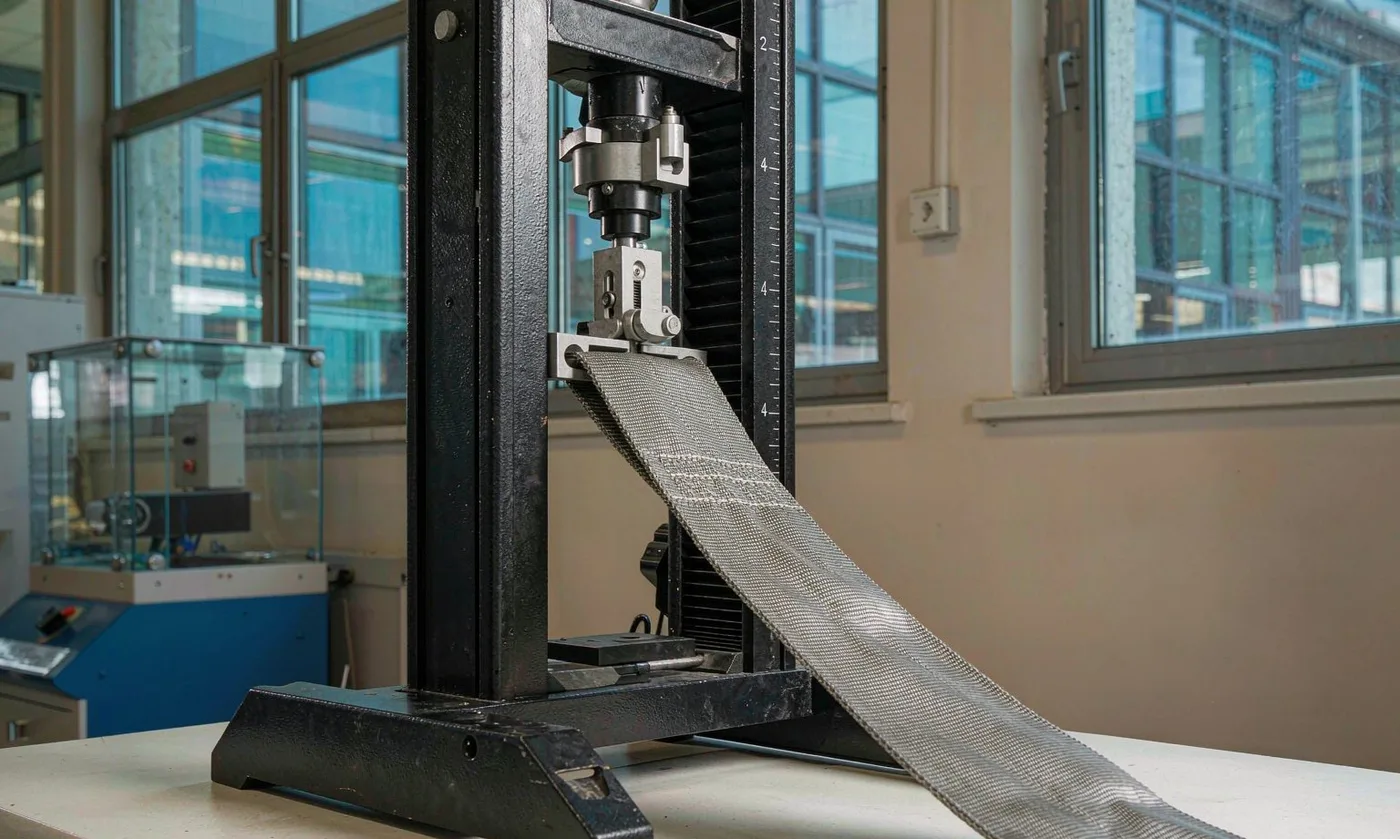
| Tensile strength | Grab or strip test | 400 N minimum | Resists load on the panel |
| Abrasion resistance | Martindale | 20,000 cycles to breakdown | Determines service life |
| Colour fastness to rubbing | Crockmeter, dry and wet | Grade 4 dry, grade 3-4 wet | Prevents colour transfer |
| Water resistance | Hydrostatic head | 1,500-5,000 mm depending on claim | Supports a water resistant claim |
Grammage is the cheapest test and the most informative about whether the mill supplied what was ordered. A 600D polyester shell specified at 240 gsm arriving at 218 gsm is a 9 percent shortfall, it is outside the normal 5 percent tolerance, and it will show up as reduced abrasion life rather than as an obviously thin fabric. Weighing a cut square takes minutes and should be done on every incoming lot.
Tear strength is the parameter that predicts whether a small puncture becomes a large hole. A coated 600D fabric typically tears at 30-50 N; an uncoated lightweight lining may tear at 12-18 N, which is fine for a lining and unacceptable for a shell. The specification should set different criteria for different components rather than one number for everything.
Abrasion is the parameter most often omitted and most often regretted. A shell that breaks down at 8,000 Martindale cycles will look worn within a season on the base panel where the carrier is set down repeatedly; one that reaches 20,000-30,000 cycles will not. The test takes several hours on a multi-head machine and is the single best predictor of how the product will look after a year.
Colour fastness to rubbing protects against a specific and damaging failure: dye transferring onto a light-coloured interior, onto upholstery or onto clothing. Wet rubbing is the harder test and grade 3-4 is a reasonable criterion for a mid-priced product. Test methods for these parameters are published by ASTM International and by the corresponding ISO technical committees, and a report should name the specific method used.

Hardware Testing: Salt Spray, Zipper Cycling and Pull Strength
Hardware fails in service more often than fabric does, because hardware moves and because plating and casting quality vary between lots. Three tests cover almost all realistic failures.
Salt spray testing addresses corrosion. A neutral salt spray exposure of 48 hours at 35 degrees Celsius with a 5 percent sodium chloride solution is the common screening level for zinc-alloy and steel components; 96 hours is used where a higher-grade finish is claimed. The acceptance criterion is no base metal corrosion beyond a defined area, no blistering of the plating and no loss of function. This test is what separates a component that will mark a light-coloured fabric after a humid voyage from one that will not.
Zipper cycling addresses the most-used moving part. A fixture opens and closes the slider through the full length of the chain, typically 500 cycles for a consumer product and 1,000 or more for a heavy-duty claim, with the failure criterion being chain separation, slider deformation or a measurable increase in pull force. Zippers should be tested both dry and after a light abrasion cycle on the teeth, because grit ingress is the realistic field failure and a dry test alone will not reveal it.
Pull strength addresses attachment. A static pull test on a D-ring, a buckle or a strap end applies load until failure, and the criterion is normally expressed as a multiple of the intended working load rather than as an absolute number: three times the rated animal weight is a common engineering basis. The failure mode matters as much as the load: a component that deforms gradually before failing is safer than one that releases suddenly.
One further check belongs in this tier and is frequently overlooked: a dimensional check on the webbing and a fit check between webbing and hardware. A 25 mm webbing specified with a 25 mm ladder lock will slip if the hardware is manufactured at the top of its tolerance and the webbing at the bottom. A ten-second fit check on five samples per lot prevents a defect that no laboratory test would catch.
Finished Product Testing: Static Load, Seam Strength and Stability
The finished product tier is where construction quality becomes visible, and three tests carry most of the information.
Static load testing simulates the animal. A distributed load of three times the rated capacity is placed on the interior floor for a defined period - commonly 24 hours - and the carrier is then inspected for seam distortion, base board deformation, strap elongation and hardware slippage. Three times rated capacity is a reasonable engineering basis for a textile product with a defined service life; a carrier rated to 8 kg should be tested at 24 kg. The measurement that matters is permanent deformation after the load is removed, not behaviour under load, because everything deforms under load.
Seam strength testing measures the assembly rather than the fabric. A strip of the actual seam construction is pulled in tension, and the criterion is that the fabric fails before the seam does, or that the seam holds a defined minimum load. A seam that fails at 180 N in a fabric rated at 400 N is an under-specified seam, and the fix is usually stitch density, thread selection or seam type rather than a stronger fabric. Bar-tacked attachment points should be tested separately as a pull-out test.
Stability testing addresses tipping. A carrier set on a level surface with a specified load placed at the interior floor's most unfavourable position should not tip, and the base board's footprint relative to the centre of gravity is the engineering variable. This is a pass-fail test with a defined geometry, and it is the one test that reliably separates a well-designed base from a poorly designed one.
Two additional checks are worth including for a carrier intended for air travel: a ventilation measurement, expressed as open mesh area as a percentage of upper shell surface, and an escape resistance check in which a specified inward force is applied to the closure at its weakest point. Neither is a regulatory requirement in most markets and both are the questions a retailer's technical team asks.
Chemical Testing Panels by Destination Market
Chemical testing is driven by destination, not by product type, and the panels differ enough that a single report rarely covers both major markets.
For the United States, the panel centres on total lead content in accessible substrates and on specified phthalates in plasticised materials. Coated textiles, printed areas and plastic components are the usual suspects. Where a product is marketed for use by children or is sold in a children's channel, the certificate obligation applies and the testing must be performed by an accredited third-party laboratory. The regulatory framework sits with the US Consumer Product Safety Commission, and the practical output is a test report plus a certificate held by the importer.
For the European Union, the panel centres on REACH restrictions: azo dyes that cleave to listed aromatic amines, certain phthalates, nickel release from metal components in prolonged skin contact, and substances of very high concern above 0.1 percent by weight. The enforcement and candidate list framework is maintained by ECHA. Many brands satisfy the textile portion through a per-material certification scheme such as OEKO-TEX, which gives a certificate per material rather than per product and is widely accepted by European retailers.
California adds a Proposition 65 assessment administered through OEHHA, which is a warning obligation rather than a pass-fail test. And several retailers, independent of regulation, now request perfluorinated compound screening on any durable water repellent finish, because that class of chemistry is being restricted at state level in the United States and at EU level.
The efficient approach is a restricted substance list attached to the tech pack, with a conformance declaration required per component at sampling. Testing then becomes a verification exercise on a documented supply chain rather than a discovery exercise on a finished product, and the cost falls because fewer materials need full screening.
Sampling Frequency and Statistical Acceptance
How often to test is a risk decision with a calculable answer, and most programs either over-test or under-test by a wide margin.
Material testing should run per incoming lot. Grammage and visual shade are checked on every roll; tear, abrasion and colour fastness on one sample per dye lot. A dye lot is normally 1,000-3,000 metres, so a 3,000-unit order generates one to three sets. This is the tier where frequency is highest because cost is lowest and consequence is highest.
Component testing should run per supplier per year, plus a per-lot visual and dimensional check. A zipper from a qualified supplier that has passed a 500-cycle test should not be re-tested every order; it should be re-tested annually, and immediately on any change of supplier or specification. The per-lot check catches the realistic failure, which is a wrong part being delivered rather than a bad part being made.
Finished product testing should run once at approval and then on a defined frequency: annually for a stable program, and additionally whenever a component, a material or a construction parameter changes. A first-season program should also test one unit pulled at random from the first bulk shipment, which is the only way to confirm that bulk matches the approved sample.
Final inspection follows a different logic entirely. AQL 2.5 at general inspection level II is an acceptance sampling plan for defects, not a performance test. At 3,000 pieces the plan draws 125 units and accepts up to 7 major defects. It answers whether the shipment is consistent, while the tests answer whether the design is sound. Both are needed and neither substitutes for the other.

Interpreting a Test Report: What a Pass Actually Means
A test report is a measurement record, not a quality guarantee, and reading one correctly requires checking five things before accepting the result.
First, the sample description. A report on 600D polyester does not cover a 900D shell, and a report on a black fabric does not automatically cover the same fabric in a pale shade, because dye chemistry affects fastness. The report must describe the specific material, shade and finish that is being supplied.
Second, the method and the date. A method reference without a year is ambiguous, and methods get revised. A report older than roughly two years should be treated as indicative rather than current, because both the material supply chain and the method may have changed.
Third, the criterion. A report that states a result without an acceptance criterion is a measurement, not a pass. The brand's own criterion should be stated in the tech pack, and the report should be read against it rather than against the laboratory's default.
Fourth, the laboratory. Accreditation matters where the report supports a certificate or a regulatory filing, and an in-house report is appropriate for internal process control but not for a compliance submission.
Fifth, the margin. A result at 26 N against a 25 N criterion is a pass with no margin, and the next lot may not pass. Reading margins rather than pass-fail marks is what turns a test report into a management tool: a parameter sitting close to its limit is the one to watch on the next order.
A sixth check applies specifically to reports supplied by a component vendor rather than commissioned by the brand. Vendor reports are often issued against the vendor's own product code, which may cover a family of parts rather than the specific part being supplied. Confirming that the report's product code, finish code and colour match the purchase specification takes a minute and is the difference between real evidence and a plausible-looking document.
Corrective Action When a Test Fails
Failures are information, and the response should be structured so that the same failure does not recur. Four steps, in order.
Step one is confirmation. A single failed specimen may be a sampling artefact rather than a lot problem, and the correct first action is a repeat test on a larger sample from the same lot rather than a rejection. Repeat testing costs a day and prevents the most expensive error in the process, which is scrapping a sound lot.
Step two is root cause on the confirmed failure. Fabric failures trace to grammage, coating weight or weave density; hardware failures trace to plating thickness, casting porosity or base material; assembly failures trace to stitch density, thread type or seam construction. Each cause has a different fix, and fixing the wrong one produces a second failure a week later.
Step three is containment. The affected lot is quarantined, and the question of whether goods already shipped are affected is answered from the tracking code rather than from memory. This is where a dated lot code earns its keep.
Step four is the corrective action record: the cause, the fix, the verification test and the date. That record is what a retailer's technical team asks for after an incident, and a brand that can produce it within a day is treated very differently from one that cannot. The record also closes the loop with the specification: a parameter that fails twice should have its criterion or its material specification revised, not simply be re-tested until it passes.
The economics of testing are worth stating plainly at the end of this section, because they decide how much of the plan a brand will actually use. A full mechanical and chemical panel on one colourway costs 400-1,200 USD and takes 7-12 working days. A single field failure that reaches retail - a strap root that separates, a zipper that splits, a dye that transfers onto upholstery - costs the brand the return, the replacement, the review and frequently the listing. The ratio is not close, and the programmes that under-test are usually the ones that have not yet had the failure.
Order and quality terms
- MOQ 500 pieces per colourway; samples in 6-10 working days
- Bulk production 35-50 days after approval; AQL 2.5 inspection standard
- T/T 30/70 terms, FOB Xiamen, full document set per shipment
People Also Ask
How is a pet carrier tested for quality?
In three tiers: material tests on fabric and mesh, component tests on zippers and hardware, and finished product tests covering static load, seam strength and stability, plus a chemical panel for the destination market.
What does AQL 2.5 mean in inspection?
An acceptance sampling plan where, at general inspection level II, a 3,000-piece lot draws 125 units and accepts up to 7 major defects. Critical defects are zero tolerance at any sample size.
How strong should a pet carrier seam be?
The criterion is normally that the seam holds a defined minimum load, or that the fabric fails before the seam does. A seam failing at 180 N in a 400 N fabric is under-specified.
Why do zippers fail on pet carriers?
Usually through grit ingress and slider wear rather than through chain breakage. Testing should include cycling after a light abrasion of the teeth, because a dry cycle test alone will not reveal the realistic failure.
What chemical tests apply to pet carriers in the EU?
REACH restrictions: azo dyes that cleave to listed amines, certain phthalates, nickel release from metal in prolonged skin contact, and SVHC above 0.1 percent by weight.
When should finished product testing be repeated?
Annually for a stable program, and additionally whenever a component, material or construction parameter changes. A first-season program should also pull one random unit from the first bulk shipment.
Frequently Asked Questions
What is the minimum test panel for a pet carrier program?
Fabric grammage, tear strength, abrasion and colour fastness to rubbing; hardware salt spray and zipper cycling; finished product static load and seam strength. Add the chemical panel for the destination market.
How long does a full test panel take?
7-12 working days at an accredited laboratory for a standard mechanical and chemical panel on one colourway, at 400-1,200 USD depending on how many materials are submitted. Commission it with sampling so it runs in parallel.
What static load should a carrier be tested at?
Three times the rated animal weight is a common engineering basis, held for 24 hours, with the acceptance criterion being permanent deformation after the load is removed rather than behaviour under load.
How many Martindale cycles should a carrier shell reach?
20,000 cycles to breakdown is a reasonable criterion for a mid-priced shell. Below roughly 8,000 cycles the base panel will show visible wear within a season.
Is AQL 2.5 inspection a substitute for testing?
No. AQL 2.5 is an acceptance sampling plan that answers whether a shipment is consistent; testing answers whether the design and the materials are sound. Both are needed.
How often should hardware be re-tested?
Annually per supplier, plus a per-lot visual and dimensional check. Re-test immediately on any change of supplier or specification. The per-lot check catches the realistic failure, which is a wrong part being delivered.
What salt spray duration is appropriate?
48 hours neutral salt spray at 35 degrees Celsius with 5 percent sodium chloride is the common screening level; 96 hours where a higher-grade finish is claimed. Acceptance is no base metal corrosion beyond a defined area and no loss of function.
Does a test report on one colour cover the same fabric in another shade?
Not automatically. Dye chemistry affects colour fastness, and the report must describe the specific material, shade and finish being supplied. Pale shades frequently perform differently from black.
What should happen when a single specimen fails?
Repeat the test on a larger sample from the same lot before rejecting. A single failed specimen is often a sampling artefact, and repeat testing costs a day against the cost of scrapping a sound lot.
Who pays for testing?
Material and component failures are normally the production side's cost; a buyer-requested change of specification is the buyer's. Agreeing this in writing before sampling prevents the dispute that follows the invoice.
Is OEKO-TEX certification a substitute for REACH testing?
It covers a substantial part of the textile chemical panel on a per-material basis and is widely accepted by European retailers, but it does not replace a restricted substance list or a nickel release check on metal components.
What is the difference between a grab test and a strip test?
Both measure tensile strength. The grab test clamps only the central portion of the specimen width and is closer to real loading; the strip test clamps the full width and gives a more repeatable result for specification purposes.
Talk to QUANZHOU JUNYUAN BAGS about a pet carrier program: MOQ 500 pieces per colourway, samples in 6-10 working days, bulk production in 35-50 days under AQL 2.5 inspection.
Get a free quote Request a sample