Cat Carrier with Bed Pad: Cozy Interior
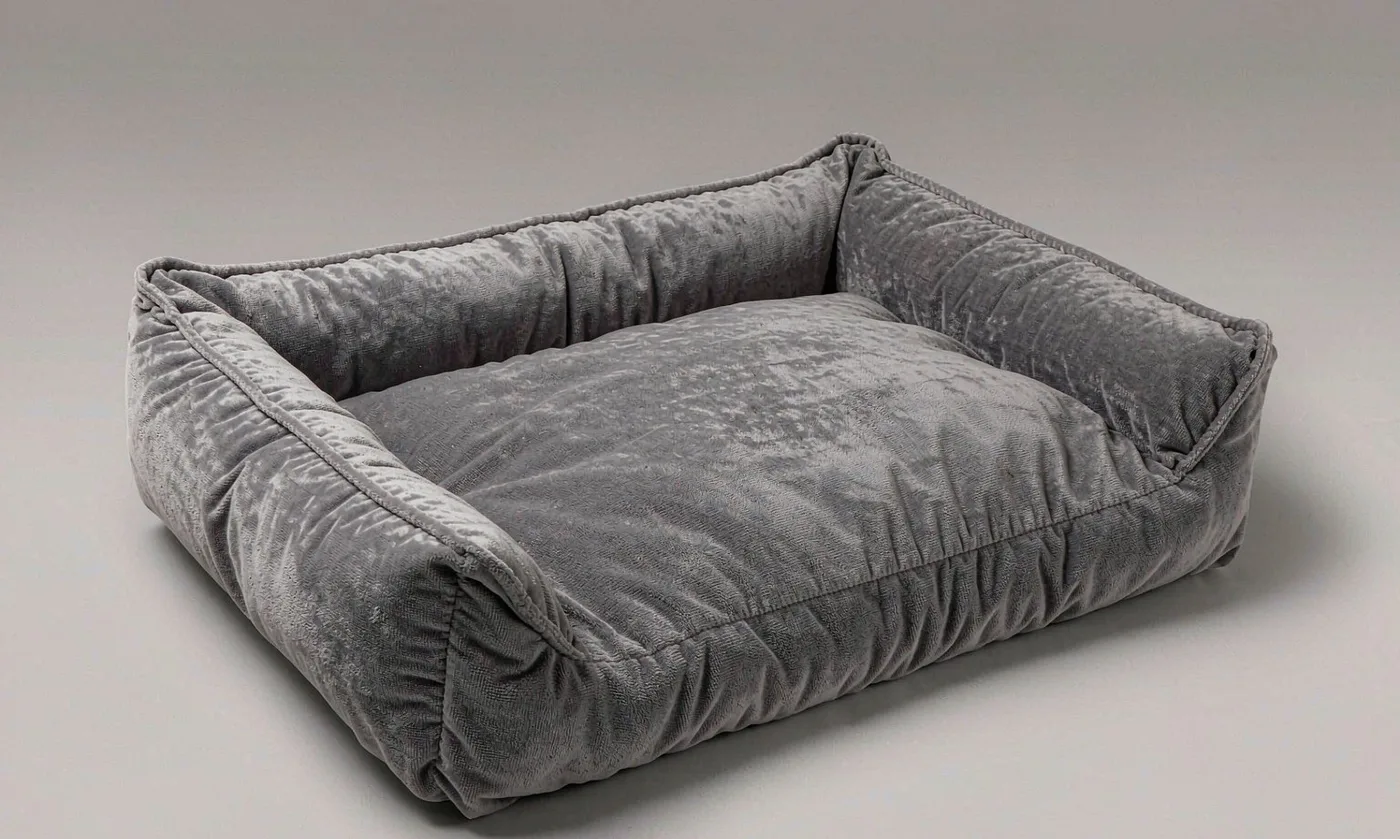
A cat carrier bed pad should be a three-layer build of 25-45 mm: a support layer with an indentation force deflection of 70-120 N, a thermal layer giving 0.5-0.9 clo at a loft retention above 85% after 50 washes, and a cover at 20,000 Martindale cycles with rewet under 3 g and wash shrinkage under 3%.
A bed pad looks like the least technical component in a carrier and is the one with the most parameters, because it has to do four jobs at once: support the animal, insulate it, manage moisture, and survive repeated laundering without changing shape. Those four requirements pull against each other in specific ways — the loft that provides insulation collapses under laundering, the density that provides support reduces absorbency, and a tight cover that resists abrasion slows strike-through — so the pad is a layering problem rather than a material selection problem. This page decomposes the four functions, gives each a measured parameter, and then treats the two things that actually determine whether the pad is still good after six months: dimensional stability through laundering and attachment that keeps it where it was put. Commercial terms follow the standard programme: MOQ 500 pieces per colourway, prototypes in 6-10 working days, bulk production 35-50 days after sample approval, final random inspection to AQL 2.5, T/T 30/70 and FOB Xiamen.
The difference between one dog carrier factory and another is rarely the stitch count - it is whether the cat carrier pattern survives a 1.5x static load without permanent set.
Decomposing the Pad: Four Functions and Four Parameters
The first step in specifying a pad is to separate what it is being asked to do, because a single material cannot do all four jobs and a pad that is sold as comfort alone usually fails the two that were never specified.
Support is the first function and it is the one that governs pressure distribution. The parameter is indentation force deflection, measured as the force to compress a standard indenter to 40% of the layer's thickness, with a working range of 70-120 N for a general-purpose pad. This is lower than the 90-140 N specified for a geriatric pad, because a general pad does not have to protect against sustained pressure at the bony prominences; it is higher than a purely decorative pad, which typically sits at 30-60 N and bottoms out.
Thermal insulation is the second function and the parameter is thermal resistance in clo. A pad that provides 0.5-0.9 clo removes the conductive loss to a cold floor that is otherwise the dominant heat loss path for a resting animal; a bare carrier floor provides about 0.05 clo, so the pad is doing effectively all of the insulating work.
Moisture management is the third function and the one most often ignored. A resting animal loses water through respiration and through contact, and any incontinence event puts 15-35 ml into the pad. The parameters are strike-through time under twenty seconds, capacity of 60-120 ml, and rewet under 3 g under a 15 N load.
Tactile acceptance is the fourth and it is a behavioural parameter rather than a physical one. Cats prefer a surface with a low initial modulus and some surface texture; a slick or a very stiff surface is refused. The measurable proxies are a compression modulus under 12 kPa at 10% compression and a surface friction coefficient between 0.35 and 0.60.
| Function | Parameter | Target | Failure below target |
|---|---|---|---|
| Support | Indentation force deflection at 40% | 70-120 N | Bottoms out, pressure rises |
| Thermal | Thermal resistance | 0.5-0.9 clo | Conductive loss to floor |
| Moisture | Rewet under 15 N | Under 3 g | Animal lies in liquid |
| Tactile | Compression modulus at 10% | Under 12 kPa | Refusal |
| Durability | Loft retention after 50 washes | Above 85% | Thermal and support loss |
| Fit | Dimensional change after 50 washes | Under 3% | Pad no longer fits the shell |
The conflict between the first and third functions is the one that shapes the design: a dense foam supports well and absorbs almost nothing, so absorbency has to come from a separate layer rather than from the support layer. That is why the working construction is three layers rather than one. Specify the four functions separately and build three layers; one material cannot support, insulate, absorb and stay soft at once.
Support Layer: Density, Indentation Force Deflection and Set
The support layer carries the animal and it is specified by three numbers rather than by a material name, because the same material at two densities behaves as two different products.
Indentation force deflection is the governing number at 70-120 N for a general pad. In practice that corresponds to a polyurethane foam of 28-40 kg/m³ at 20-30 mm, or a high-resilience foam of 35-45 kg/m³ at 18-25 mm, or a needled polyester wadding of 300-500 g/m² at 20-30 mm. The three differ in durability and cost rather than in initial feel, which is why the specification should name the force and the set rather than the foam grade.
Compression set is the second number and it is what separates a pad that lasts from one that does not. Measured as thickness recovery after twenty-two hours at 50% compression, the requirement is at least 90% at 23 °C and at least 85% at 40 °C. Standard polyurethane at 25 kg/m³ typically gives 78-86% at the elevated temperature, which is why the density floor is set where it is.
Support factor is the third number and it should exceed 2.0 for a general pad, against 2.2 for a geriatric one. It is the ratio of the 65% to the 25% indentation values and it describes whether the layer keeps supporting as it compresses, which matters when an animal shifts its weight onto one part of the pad.
Thickness interacts with the total build and with the shell's interior height. A 20-30 mm support layer inside a 25-45 mm total build leaves 5-15 mm for the thermal and cover layers, which is tight; the practical alternative is to rebate the pad into the floor panel by 10-20 mm so the pad's top surface sits near the floor line rather than above it, avoiding an internal step the animal has to climb.
| Material | Density (kg/m³) | Thickness (mm) | Set at 40 °C | Cost |
|---|---|---|---|---|
| Polyurethane, standard | 28-40 | 20-30 | 78-86% | 0.60-1.40 USD |
| Polyurethane, high resilience | 35-45 | 18-25 | 88-93% | 1.00-2.20 USD |
| Needled polyester wadding | 300-500 g/m² | 20-30 | 80-88% | 0.50-1.20 USD |
| Latex | 55-75 | 18-25 | 92-96% | 2.20-4.60 USD |
| Closed-cell EVA | 45-60 | 12-20 | 90-95% | 0.80-1.80 USD |
Latex and high-resilience foam lead on set and support factor and cost more; EVA is thin and durable but firm at the surface, which affects tactile acceptance. The usual production answer is high-resilience polyurethane, because it sits at the right point on all three numbers at a manageable cost.
Material test practice for indentation, set and support factor follows published standards work at ASTM International. Specify force, set and support factor rather than a foam grade, and set the density floor by the 40 °C set result.
Thermal Layer: Resistance, Loft Retention and Breathability
Insulation is the function that makes a pad feel like a bed rather than a mat, and it is also the function that degrades fastest through laundering. Two parameters govern it and a third constrains it.
Thermal resistance is the first, at 0.5-0.9 clo for the pad assembly. In SI terms that is 0.078-0.140 m²K/W, and it is achieved with a lofted layer of 12-25 mm at 150-320 g/m² in a needled or airlaid construction, or with a 6-12 mm closed-cell layer at 30-50 kg/m³. Lofted non-woven gives more resistance per gram and less per millimetre; closed-cell gives less resistance per gram and better recovery.
Loft retention is the second parameter and the one that determines whether the specification still holds after six months. Measured as thickness after fifty domestic wash cycles at 40 °C followed by tumble drying, the requirement is retention above 85%. Needled wadding without a binder loses 25-40% of its loft in fifty washes; a through-air bonded or resin-bonded wadding loses 8-15%; and closed-cell foam loses under 5%.
The mechanism of loss is fibre migration and entanglement under wet agitation, and the countermeasures are structural rather than chemical: a through-air bonded construction, a scrim or a light binder, and quilting at a 60-120 mm pitch to hold the layer in place. Quilting is the cheapest and most effective at 0.20-0.60 USD, and it also fixes the layer's position relative to the cover, which prevents the bunching that owners report as the pad going lumpy.
Breathability is the third parameter and it constrains the first. An insulating layer that does not transmit water vapour makes the animal lie in its own humidity; the requirement is a moisture vapour transmission rate above 1,500 g/m² per 24 hours through the pad assembly, which excludes a continuous film or a closed-cell layer without perforation. Where a closed-cell layer is used for its recovery, it should be perforated at 1-3 mm on a 15-25 mm pitch.
Placement within the build matters. The thermal layer should sit above the support layer and below the cover, because below the support layer it is compressed by the animal and loses most of its loft and therefore most of its resistance. A layer compressed from 20 mm to 8 mm loses roughly 60% of its thermal resistance.
Verification is a guarded hot plate measurement on the assembly, plus a loft measurement after fifty washes, plus a vapour transmission cup test. Insulation is a loft problem and loft is a laundering problem: bond or quilt the layer, and place it above the support layer where it will not be compressed.
Moisture Management: Strike-Through, Capacity and Rewet
A pad that insulates well and handles moisture badly is worse than a thin mat, because it holds liquid against the animal for hours. Three parameters define the function and they are frequently confused with each other.
Strike-through time is the first: the time for a standard liquid challenge to pass through the cover into the absorbent layer, with a requirement under twenty seconds. It is governed by the cover's surface energy and by any finish on it; a hydrophobic finish added for cleanability slows strike-through to 40-120 seconds, which is why a cleanable surface and an absorbing pad need to be separate layers.
Capacity is the second: 60-120 ml for an adult pad, covering one to three incontinence events at 15-35 ml each. It is provided by the absorbent layer, which is typically an airlaid or needled core of 200-400 g/m², or a superabsorbent-loaded non-woven at 120-220 g/m² where thickness is constrained. Superabsorbent polymer gives two to three times the capacity per gram at 0.40-1.20 USD and is worth it where the pad must stay thin.
Rewet is the third and the one that determines what the animal actually feels: the mass of liquid returning to the surface under a 15 N load after absorption, with a requirement under 3 g. A single-layer felt pad meets capacity and fails rewet badly, returning 8-20 g; a two-layer build with a hydrophobic top sheet over an absorbent core returns 1-3 g. The top sheet is doing the work, not the core.
| Construction | Strike-through (s) | Capacity (ml) | Rewet (g) | Thickness (mm) |
|---|---|---|---|---|
| Single felt layer, 400 g/m² | 8-15 | 80-140 | 8-20 | 8-14 |
| Top sheet plus airlaid core | 6-12 | 70-120 | 1.5-3.0 | 6-12 |
| Top sheet plus superabsorbent | 8-18 | 120-220 | 1.0-2.5 | 4-8 |
| Quilted wadding only | 15-40 | 30-70 | 6-14 | 12-25 |
| Closed-cell layer only | None | 0 | Not applicable | 6-12 |
Odour follows from rewet rather than from capacity. A surface that stays dry does not support bacterial growth; one that returns liquid does, and the resulting ammonia is the complaint that ends the pad's service life. This is the reason the rewet specification exists separately.
Verification uses a standard challenge of saline at 35 °C, a defined load and a timed collection, with ten samples per lot and the rewet measured by placing a dry filter paper under the load and weighing the transfer. Capacity is easy and rewet is what matters; a hydrophobic top sheet over an absorbent core is the construction that delivers both.
Cover Fabric: Abrasion, Pilling and Handle
The cover is the layer the animal contacts and the layer that fails visibly. Three parameters govern it, and the third is the one that determines whether the animal accepts the pad.
Abrasion resistance is the first, at a minimum of 20,000 Martindale cycles to breakdown for a general pad and 30,000 for one intended for daily use. A cat's kneading and scratching deliver a concentrated abrasive load: measured contact pressures during kneading reach 10-25 kPa with a lateral component, which is a more severe condition than the standard abrading head represents, and it is why the minimum is set high.
Pilling is the second, with a requirement of grade 4 or better after 7,000 cycles. Pilling is not a structural failure but it is the most visible one and it is the reason a pad looks old within a season. Short-staple polyester and polyester-cotton blends pill worst; filament polyester and tightly constructed knits perform better.
Handle and tactile acceptance is the third and it is where specification gets difficult, because the animal's preference is not directly measurable. Two proxies are used: a surface friction coefficient between 0.35 and 0.60, and an absence of a slick finish. A raised or brushed surface at a loop height of 0.5-2.0 mm is accepted more readily than a flat woven one, and it is worth the 0.20-0.70 USD.
Fabric construction choice follows: a warp-knitted polyester velour at 180-280 g/m² gives the best combination of abrasion, pilling and handle; a woven polyester at 200-300 g/m² is cheaper and more abrasion-resistant but less accepted; a brushed knit is most accepted and pills fastest. The usual answer is a knit velour at 220-260 g/m².
Colour fastness is the last parameter and it matters commercially: a pad is laundered repeatedly and a cover that bleeds or fades generates returns. The requirements are a fastness to washing of grade 4 or better and a fastness to rubbing of grade 4 dry and 3-4 wet.
Chemical screening closes the item, since the cover is in prolonged contact with the animal: all cover fabrics are declared against OEKO-TEX criteria. Specify abrasion, pilling and handle together; a knit velour at 220-260 g/m² is the usual answer and a flat woven surface is refused more often than it wears out.
Attachment, Fit and Dimensional Stability
A pad that moves is a pad that fails, regardless of how well its layers perform. Two mechanisms cause movement and both are addressed at the design stage rather than in the material.
Slip is the first. The interface between the pad's underside and the carrier floor should have a coefficient of friction of at least 0.45 measured by a horizontal pull method. A printed silicone dot pattern at 3-6 mm dots on a 12-18 mm pitch achieves this at 0.15-0.40 USD; an elastomer mesh or a textured backing achieves it at 0.30-0.90 USD; and a smooth backing fabric does not achieve it at all.
Bunching is the second and it is a construction issue rather than an interface one. Under an animal moving and kneading, the cover and the layers shear relative to each other and the assembly gathers at one end. The countermeasure is quilting at a 60-120 mm pitch through all layers, which fixes them relative to each other at 0.20-0.60 USD, plus a bound or welded perimeter that holds the edge geometry.
Dimensional stability is the third item and it is the one that ends a pad's life. The requirement is a dimensional change of no more than 3% in either direction after fifty domestic washes at 40 °C with tumble drying, and no more than 5% after the same at 60 °C. A knit cover without pre-shrinking changes 5-9% and the pad no longer fits its shell.
Fit tolerance follows from that. The pad should be cut 1-3% smaller than the interior plan dimension rather than to nominal, so that after any residual shrinkage it still lies flat rather than riding up the walls. A pad cut to nominal and shrinking 2% buckles against the walls, which is the most common fit complaint.
Mechanical fixing is the fourth and it is worth it on larger pads. Four hook-and-loop points, or four elastic corner loops over the floor panel's corners, hold the pad against both slip and bunching at 0.30-1.00 USD, at the cost of a more complex removal for laundering. The compromise used in production is two fixing points at one end plus a high-friction underside, which allows removal by lifting one end.
Removability for laundering is the commercial requirement that pulls against all of the above. A pad that is fixed at four corners and quilted is a pad that will be washed less often; the instruction should state a washing interval, and the construction should survive the interval it is likely to get rather than the one that is recommended. Fix the layers to each other, undersize the cut by 1-3%, and give the underside a friction pattern; movement is a design failure, not a material one.
Washability: Shrinkage, Drying Time and Cycle Life
Laundering is the dominant service-life load on a pad, and it is where the thermal and dimensional specifications are won or lost. Four parameters define it.
Wash temperature is the first. Domestic laundering at 40 °C is the realistic case and 60 °C is the case for a soiled pad; the pad should be specified to survive both, with the dimensional limit of 3% at 40 °C and 5% at 60 °C. Hotter washing accelerates both shrinkage and loft loss, and a pad specified only at 40 °C will be washed at 60 °C within a month.
Drying is the second and it is the one that governs whether the pad is available for the next journey. A pad with an open, lofted construction and a hydrophobic cover dries in 2-4 hours at ambient; one with a dense absorbent core and a quilted cover takes 8-16 hours. Where a product is sold for consecutive-day use, the specification should include a drying time under 6 hours, which usually requires the absorbent layer to be removable rather than quilted in.
Cycle life is the third and it should be stated as a number: 50 domestic cycles for a consumer claim and 150 for a professional one, with acceptance at the end of a loft retention above 85%, a dimensional change under 3% at 40 °C, rewet still under 3 g, and no delamination or quilting failure.
Chemical compatibility is the fourth. Detergent at pH 9-11 and, frequently, an oxygen-based bleach are used on a soiled pad; the cover's dyes and any printed pattern have to survive both. The requirement is a colour change no worse than grey scale 4 after 50 cycles with bleach, and no degradation of any printed silicone pattern, which is the component most likely to fail.
Validation is a full wash-and-measure protocol rather than a visual check: dimensional measurement on a marked grid before and after, thickness measurement at five marked points, a rewet test, and a visual assessment against a grey scale. Ten samples per construction, measured at 10, 25 and 50 cycles.
Instruction labelling closes the item. A pad that is washed hotter than it was specified for will fail the dimensional limit, and the label is the only mechanism available to influence that. Specify at 60 °C even if 40 °C is recommended, state the cycle life as a number, and size the drying time to consecutive-day use if that is the claim.
Cost, Layering Strategy and Programme Planning
A three-layer pad costs 2.60-7.40 USD depending on the material choices, and the layering strategy is where the money is best allocated. Two rules govern it: spend on the layers that degrade, and do not spend on the layer the animal cannot feel.
The breakdown for a mid-range pad: the support layer of high-resilience polyurethane at 1.00-2.20 USD, the thermal layer of through-air bonded wadding at 0.60-1.60 USD, the absorbent core with a top sheet at 0.70-1.90 USD, the knit velour cover at 0.90-2.20 USD, quilting and binding at 0.30-0.90 USD, and the friction pattern and fixing at 0.30-1.00 USD.
The layers that degrade are the thermal layer and the cover, and they are where the money should go. Spending an extra 0.40 USD on a bonded rather than an unbonded wadding buys 20-30 percentage points of loft retention over fifty washes; spending the same on a denser support layer buys an improvement the animal cannot feel.
Tooling for pads is minimal: a die or an automated cutting pattern at 150-450 USD, and a quilting programme if the quilting is done in-house. A welded perimeter needs a high-frequency electrode at 700-1,800 USD on two to three weeks, which is worth it only where a sealed edge is required for liquid containment.
Sizing strategy follows the shell family. A pad should be graded with the shell rather than offered in one size, because a pad that is 30 mm short in a large shell slides and bunches; the incremental cost of a second pad size is a cutting pattern at 150-450 USD and no tooling.
Spare-pad strategy is the commercial point worth planning. A pad is the first component to wear out and the easiest to sell twice; offering a spare pad at 30-50% of the carrier's accessory margin has a high attachment rate and solves the drying-time problem for consecutive-day users at the same time.
Our production team builds pad and interior programmes through the SGS-verified production base under ISO 9001 and BSCI coverage, with prototypes in 6-10 working days, bulk production 35-50 days after sample approval, final random inspection to AQL 2.5, T/T 30/70 and FOB Xiamen. Spend on the bonded thermal layer and the cover, grade the pad with the shell, and sell a spare — it is the component that wears out first and the easiest one to sell twice.
Production capability
- SGS-verified production space of 4,950 m², 149 machines, 7 assembly lines
- Pet carrier and pet bag output since 2014 from a 137-person team
- 200,000 units shipped monthly under BSCI and ISO 9001 systems
People Also Ask
How thick should a cat carrier bed pad be?
25-45 mm total across three layers: 18-30 mm of support, 12-25 mm of lofted thermal and a cover. Rebating the pad 10-20 mm into the floor panel avoids an internal step.
What indentation force deflection should a pad have?
70-120 N for a general pad, against 90-140 N for a geriatric one. Below 60 N the pad bottoms out and pressure at the contact points rises.
How much insulation does a pad provide?
0.5-0.9 clo, or 0.078-0.140 m²K/W, against about 0.05 clo for a bare carrier floor. The pad does effectively all the insulating work.
Why does a pad go flat after washing?
Fibre migration and entanglement under wet agitation. Unbonded wadding loses 25-40% of its loft in fifty washes; through-air bonded loses 8-15%, and quilting at a 60-120 mm pitch is the cheapest fix.
What is rewet and why does it matter?
The mass of liquid returning to the surface under a 15 N load. Under 3 g is required; a single felt layer returns 8-20 g and the animal lies in it, which is what produces odour.
What cover fabric should a pad use?
A warp-knitted polyester velour at 220-260 g/m², with 20,000 Martindale cycles and pilling grade 4 or better at 7,000 cycles. A flat woven surface is refused more often than it wears out.
How much can a pad shrink in washing?
No more than 3% in either direction after fifty cycles at 40 °C and 5% at 60 °C. Cut the pad 1-3% smaller than the interior so residual shrinkage still lies flat.
Frequently Asked Questions
What support factor should a general pad have?
Above 2.0, against 2.2 for a geriatric pad. It describes whether the layer keeps supporting as the animal shifts its weight onto one part of it.
What compression set is acceptable?
At least 90% thickness recovery after twenty-two hours at 50% compression at 23 °C and at least 85% at 40 °C, which is why the density floor is set at 28 kg/m³.
Why should the thermal layer sit above the support layer?
Because compression destroys loft and therefore resistance. A layer compressed from 20 mm to 8 mm loses roughly 60% of its thermal resistance.
What vapour transmission should the pad assembly have?
Above 1,500 g/m² per 24 hours, which excludes a continuous film. Where closed-cell foam is used for recovery, perforate it at 1-3 mm on a 15-25 mm pitch.
Why does a hydrophobic cleanable finish cause a problem?
It slows strike-through from under twenty seconds to 40-120 seconds. A cleanable surface and an absorbing pad have to be separate layers rather than one treated surface.
When is superabsorbent polymer worth using?
Where the pad must stay thin. It gives two to three times the capacity per gram at 0.40-1.20 USD, delivering 120-220 ml in a 4-8 mm layer.
What contact pressure does kneading apply?
10-25 kPa with a lateral component, which is more severe than the standard abrading head represents and is why the abrasion minimum is set at 20,000 cycles.
Why is a raised surface better accepted?
A loop height of 0.5-2.0 mm and a friction coefficient of 0.35-0.60 match the animal's preference better than a slick flat woven surface, at 0.20-0.70 USD.
What friction coefficient keeps a pad from sliding?
At least 0.45 against the carrier floor. A printed silicone dot pattern of 3-6 mm on a 12-18 mm pitch achieves it at 0.15-0.40 USD; a smooth backing does not.
Why quilt the pad rather than leave the layers loose?
Loose layers shear under the animal and gather at one end. Quilting at a 60-120 mm pitch through all layers fixes them at 0.20-0.60 USD.
How long should a pad take to dry?
2-4 hours for an open construction with a hydrophobic cover and 8-16 hours with a dense quilted core. Under 6 hours for consecutive-day use, which usually needs a removable absorbent layer.
What cycle life should be stated for a pad?
50 domestic cycles for a consumer claim and 150 for a professional one, with loft above 85%, dimensional change under 3% and rewet under 3 g at the end.
Which pad component is most likely to fail with bleach?
The printed silicone friction pattern. The requirement is a colour change no worse than grey scale 4 after 50 cycles with an oxygen bleach.
Why sell a spare pad?
It is the first component to wear out and the easiest to sell twice, and it solves the drying-time problem for consecutive-day users at the same time.
Talk to QUANZHOU JUNYUAN BAGS about a pet carrier program: MOQ 500 pieces per colourway, samples in 6-10 working days, bulk production in 35-50 days under AQL 2.5 inspection.
Get a free quote Request a sample