Cat Carrier with Washable Cover: Hygiene Guide
A genuinely washable cat carrier cover is one that can be removed without tools and machine washed at 60 °C for 25 cycles with under 3 % dimensional change, seam strength retention above 80 %, and colour fastness grade 4. That requires a zip-off architecture, a bonded polyester thread rather than cotton-wrapped, and a cover fabric pre-shrunk before cutting.
Washability is not a fabric property, it is a system property. A cover made from the most wash-durable fabric available will still fail if the zip is sewn so that it abrades the shell, if the thread is cotton-wrapped and rots at 60 °C, or if the pattern was cut from fabric that had not been pre-shrunk and moves 5 % on the first cycle. Our production team therefore treats a washable cover as a five-part specification: removal architecture, face fabric, interlining, thread and seam construction, and closure hardware, with a wash protocol written into the tech pack and tested before tooling is released. The commercial case is strongest in the veterinary, boarding and multi-cat household channels, where a carrier is cleaned weekly rather than seasonally. Commercial terms follow the standard programme: MOQ 500 pieces per colourway, prototypes in 6-10 working days, bulk production 35-50 days after sample approval, final random inspection to AQL 2.5, T/T 30/70 and FOB Xiamen.
Choose a pet bag supplier that keeps the cat carrier pattern card on file for at least twelve months, so a repeat order matches the approved sample instead of drifting.
Defining Washable: The Protocol Behind the Word
The word washable is used loosely enough in this category to be almost meaningless, so the first job is to replace it with a protocol. A washable cover claim should state four things: how the cover comes off, at what temperature it is washed, how many cycles it is guaranteed for, and what measurement defines failure. Without all four, two suppliers quoting the same word can deliver products whose service lives differ by a factor of three.
Removal should be tool-free and should take under 30 seconds, because a cover that requires effort will not be removed in practice and the washability feature becomes decorative. Temperature is the variable that actually determines hygiene: 30 °C removes soil, 40 °C removes most soil and some organisms, and 60 °C held for a full cycle is the threshold at which the common vegetative organisms associated with animal soiling are reliably reduced without a chemical disinfectant. For a carrier used in a veterinary or boarding setting, 60 °C is the correct specification.
Cycle count defines service life. A domestic carrier washed monthly reaches 25 cycles in about two years; a boarding carrier washed weekly reaches 25 cycles in six months. Our production team quotes 25 cycles at 60 °C as the standard warranty point and tests to 50 cycles to establish the margin, because a product that dies exactly at the warranty boundary produces returns rather than repeat orders.
Failure is measured on four axes, each with a threshold: dimensional change above 3 % means the cover will not re-fit; seam strength retention below 80 % means the seams are the next thing to go; colour fastness below grade 4 for change means the cover looks old; and any coating delamination, cracking or blocking means the fluid barrier is gone. A cover that passes all four at 25 cycles earns the claim.
Removal Architecture: Zippers, Envelope Closures and Panel Count
The mechanical design of how the cover separates from the frame determines whether the feature works after six months of use. Three architectures dominate, and the choice is driven by whether the carrier is soft-sided or has a rigid or semi-rigid panel set.
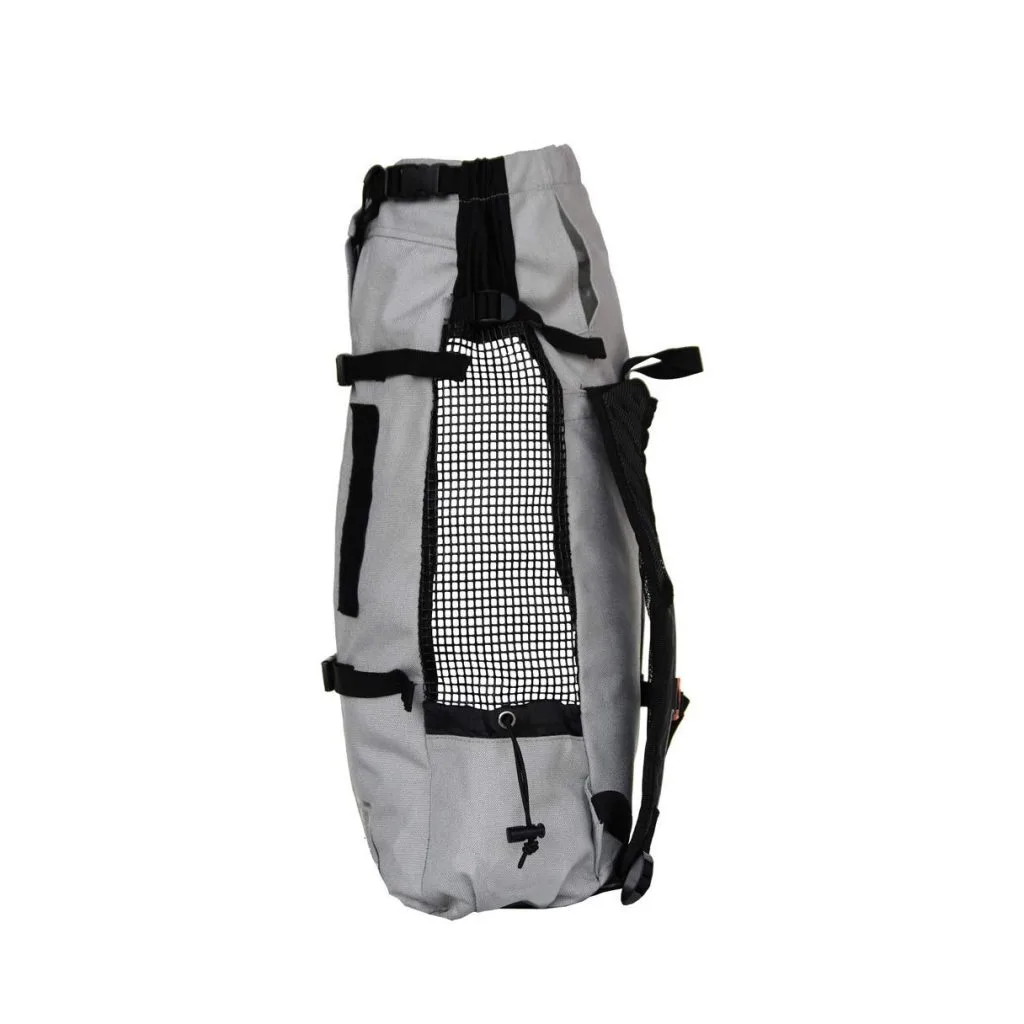
A zip-off cover uses one or two zips running along the base perimeter of the shell, allowing the fabric skin to be peeled away from an internal frame or from the carrier body. For a collapsible soft carrier this usually means a #5 coil zip on the bottom rear edge plus a second short zip at one end. The zip must be covered on the inside so it does not contact the cat, and it needs a garage at the pull end so the slider parks off the fabric. The main failure mode is the zip running around a corner: a coil zip negotiated around a 90-degree corner in a sewn cover tends to bind and to break teeth within 300-600 cycles, which is why the pattern should place the corner at a point where the zip runs straight and turn the fabric instead.
An envelope closure uses a wide overlapping flap with hook-and-loop or snap closure at one end, with no zip at all. It is the cheapest architecture at 0.20-0.45 USD, it is silent, and it has no hardware to break. It fails on fit: an envelope cover on a carrier with any internal structure tends to sag and wrinkle, and after washing the flap no longer lies flat. It works best on soft, unstructured carriers where the cover is essentially a bag.
A panel system divides the cover into three to five separate pieces, each removable independently: floor panel, two side panels, front and top. This is the architecture used in premium and veterinary programmes, because a single soiled panel can be washed without stripping the whole carrier, which matters enormously in an operational setting. It costs 0.85-1.60 USD more than a single zip-off cover in cutting and seaming, and it needs panel-to-panel attachment that survives washing, normally 20 mm snap tape on a reinforced band.
Whichever architecture is chosen, the cover needs to be keyed so it cannot be refitted incorrectly. Our production team uses asymmetric snap spacing or a single differently-coloured snap position, because a cover refitted rotated by 90 degrees is the most common post-wash complaint and it costs nothing to prevent.
Face Fabric and Interlining Selection for Repeated Hot Washing
The fabric decision is where washability is won or lost, and the constraint is not strength but dimensional and coating stability at temperature. Two candidate families are used, and both need specific treatment before they will survive 25 cycles at 60 °C.
Solution-dyed polyester in a 600 D or 900 D oxford weave is the default for a washable cover. Polyester dimensionally stabilises better than nylon above 40 °C, it absorbs less water so it dries in 2-4 hours, and solution dyeing gives light fastness of grade 6-7 and wash fastness of grade 4-5 without a dye-after treatment that can migrate. The specification detail that matters is heat setting: the fabric should be heat-set at 180-190 °C before cutting, which reduces residual shrinkage to under 1.5 %.
Nylon in a 420 D or 840 D construction is softer and more abrasion-resistant, and it is the right choice where the cover is the visible surface of a premium product. Its problem is that it has a glass transition well below wash temperature and it yellows and stiffens with repeated hot washing and drying, particularly if chlorine is present in the water. If nylon is specified, the wash protocol must drop to 40 °C and the claim must say so.
Coatings are the weakest link in a washable system. A standard PU coating of 20-30 g/m² applied to the reverse side survives 15-25 cycles at 60 °C before it crazes and starts to flake; the same coating on a fabric that has not been properly pre-cured fails at 8-12 cycles. Two options extend this: a two-component polyurethane with a crosslinker, which reaches 40-60 cycles, and a thermoplastic polyurethane film laminated rather than coated, which reaches 60-100 cycles and is what our production team specifies where the cover carries a fluid barrier requirement.
| Component | Economy spec | Standard spec | Premium spec |
|---|---|---|---|
| Face fabric | 600 D polyester, piece dyed | 600 D polyester, solution dyed, heat set | 900 D solution-dyed polyester, DWR finish |
| Coating | PU 20 g/m², single component | PU 25 g/m², crosslinked | TPU film 0.15 mm laminated |
| Thread | Cotton-wrapped polyester 40s | Bonded polyester 40s | Bonded polyester 30s, UV resistant |
| Wash temperature | 40 °C | 60 °C | 60 °C plus low-temp dryer |
| Cycles to coating failure | 8-15 | 25-40 | 60-100 |
| Cost delta per carrier | baseline | +0.55-0.90 USD | +1.40-2.20 USD |
Interlining is the component most often forgotten. A washable cover that loses its shape after washing looks worse than one that never had shape, and the fix is a non-woven interlining of 40-60 g/m² fused at 130-150 °C with a peel strength above 4 N/50 mm after 25 washes. A fused interlining that drops below 3 N/50 mm delaminates into blisters that no amount of pressing will remove.
Thread and Seam Engineering: The Components That Fail First
When a washable cover fails, it fails at the seam rather than in the fabric panel, and the reason is almost always thread. A seam is a system of needle holes, thread tension and stitch density, and each element behaves differently at 60 °C in the presence of detergent.
Thread type is the first decision. Cotton-wrapped polyester thread is cheap and sews beautifully, and it loses 25-40 % of its tensile strength after 25 cycles at 60 °C because the cotton component degrades and because cotton and polyester shrink by different amounts, which saws at the seam. Bonded polyester thread, in which a polyester core is chemically bonded to a polyester wrap, loses under 10 % over the same protocol and is the correct specification for any washable cover. It costs 0.03-0.08 USD more per carrier.
Stitch type is the second. A lockstitch at 8-10 stitches per inch is standard and adequate for panel joining. A safety stitch or a five-thread overlock is used where the seam will be loaded, because it distributes strain over more thread and it encases the raw edge so it does not fray into the wash. Where a seam is both structural and visible, a bound seam with a 20 mm tape is the premium option and it survives repeated washing better than any other construction, at 0.18-0.32 USD per carrier.
Needle damage is the third and the least understood. Every needle hole is a perforation through a woven fabric, and a seam sewn with too fine a needle or too high a thread tension cuts the yarns rather than passing between them, producing a seam that fails at 60-70 % of the fabric strength. The correction is a needle size matched to the yarn count, 90/14 for 600 D polyester, a ball-point tip to avoid cutting, and a thread tension set so the knot sits between the plies rather than on the surface.
Two tests catch all of this before production. Seam strength to ISO 13935-2 on a 200 mm strip, with a minimum of 250 N on a 600 D cover and retention above 80 % after 25 washes; and seam slippage to ISO 13936-2 at a 6 mm opening with a load of 120 N. Both are run on the first sample and repeated on a bulk pull at AQL 2.5.
Wash Testing Protocol and Acceptance Criteria
The protocol has to be written down before sampling, because it defines what pass means. The reference is the domestic laundering procedure published by the International Organization for Standardization at iso.org, which specifies the machine type, the water hardness, the reference detergent and the drying method. Using it means a test result is reproducible at a third-party laboratory rather than dependent on whoever ran the machine.
A working protocol for a 60 °C washable cover runs as follows. Wash at 60 °C on a normal cycle with a reference detergent without optical brightener or bleach, at a liquor ratio of 1:20 and a load ballast of 2 kg, for 25 cycles with measurement at 5, 15 and 25. Spin at 600 rpm. Dry flat at ambient, or tumble at 60 °C if the care label permits tumble drying. Inspect after every fifth cycle.
Acceptance criteria are set as thresholds, not as observations. Dimensional change measured against benchmarks at three points per panel, maximum 3 % in either direction and maximum 1.5 % differential between panels, because differential shrinkage is what causes a cover to twist rather than simply to shrink. Seam strength retention minimum 80 % of the as-delivered value. Colour change grade 4 minimum against the grey scale, and staining of adjacent fabric grade 3-4 minimum. Coating integrity assessed by hydrostatic head, minimum 400 mm after 25 cycles for a fluid-resistant cover. Closure function: zip or snap operated 20 times after each cycle with no binding.
Two failure modes appear only in a multi-cycle test and never in a single wash. The first is progressive seam puckering, where a seam that looks flat after one wash develops a visible ridge by cycle 15 as the thread and fabric stabilise at different rates; the fix is a pre-wash of the fabric before cutting. The second is closure corrosion, where a metal snap or zip slider with a zinc-alloy body develops white corrosion deposits by cycle 10; the fix is a brass or stainless body with a nickel-free plating, or a plastic slider on a coil chain.
Hygiene Performance: Soil Removal, Odour and Microbial Reduction
Hygiene is the reason a customer buys a washable cover, and it can be quantified in three separate measurements that together describe whether the product actually delivers it.
Soil removal is the first and the most visible. A cover contaminated with a standard soil load of sebum, saliva and hair should show no visible residue after a single wash at the stated temperature. The practical test our production team uses is a reflectance measurement before and after: a grey-scale or spectrophotometer reading that recovers to within 5 % of the uncontaminated value after one cycle at 60 °C, and after two cycles at 40 °C. Covers with a raised or textured weave trap more soil and need the higher temperature, which is a reason not to combine a heavy texture with a 40 °C claim.
Odour is the second and the one that drives returns. Odour is caused by residual volatile compounds held in the fibre and in any foam interlining, and polyester holds more of them than a coated surface because the compounds partition into the polymer. The measurement is a trained-panel odour intensity assessment on a 1-5 scale after 24 hours of recontamination and one wash, with a pass at 2 or below. Where a persistent odour problem is reported in the field, the cause is nearly always a foam or batting layer inside the cover that cannot be rinsed, which is why a washable cover should be specified with a non-absorbent interlining.
Microbial reduction is the third and the one that must be claimed carefully. Washing at 60 °C without bleach typically achieves a 3-4 log reduction of vegetative bacteria on a textile surface, and the addition of an oxygen-based bleach raises that further. That is a performance claim about a process, not a property of the fabric, and it should be written that way. Adding a silver-ion or zinc-based antimicrobial finish to the cover adds 0.15-0.40 USD and produces a measurable additional reduction between washes, but it does not make the cover self-cleaning, and any claim that implies it does is a regulatory exposure in both the EU and the US.
General guidance on cleaning and disinfection practices for animal environments is published by the American Veterinary Medical Association at avma.org, and aligning a wash protocol to that guidance is both defensible and useful in a veterinary sales channel.
Care Labelling, Symbols and Documentation
A washable cover is only washable if the owner knows how, and the care label is the interface. It is also a legal document in several markets, and getting it wrong is a compliance issue rather than a usability one.
Care symbols are standardised under ISO 3758, which defines the five symbol families: washing, bleaching, drying, ironing and professional textile care, with numerals for temperature and bars or dots for intensity. A label that uses prose instead of symbols is acceptable in the US but not in the EU, and a label that uses invented symbols is worse than none. Our production team issues the symbol set with the sample and prints it on a 40 × 60 mm satin label sewn into the cover seam, because a printed label on a washed article fades within 10 cycles.
The label content should carry more than the symbols. Fibre composition is required in the EU and in most markets; it should read from the actual bill of materials rather than from a generic template. A wash cycle count, such as tested to 25 cycles at 60 °C, is a genuine differentiator and it is verifiable. A statement that the cover is removable and machine washable is obvious from the product but converts well on a retail page.
Documentation for a washable programme extends beyond the label. The technical file should hold the wash test report, the dimensional change data, the fibre composition declaration, the chemical test set shared with the rest of the carrier, and a care instruction sheet inserted in the retail pack. For a private label buyer, the care sheet is one of the few pieces of collateral that carries the brand into the customer home and stays there for the life of the product, so it is worth designing rather than printing as an afterthought.
Programme Planning: Cost, MOQ, Lead Time and Channel Fit
A washable cover programme costs more than a standard one at every stage, and the premium has to be justified by channel. The right question is not whether washability is good but whether the customer washes the carrier often enough to pay for it.
Cost structure at 500 pieces: a zip-off architecture adds 0.75-1.40 USD over a fixed cover, split between the zip and the additional cutting and seaming. A three-to-five-panel system adds 1.60-2.90 USD. Upgrading the coating to a crosslinked PU adds 0.30-0.55 USD and to a TPU film 0.95-1.60 USD. Bonded polyester thread adds 0.03-0.08 USD. A 25-cycle wash validation programme costs 180-400 USD in third-party testing and is amortised over the order, meaning it adds under 1 USD at 500 pieces and under 0.10 USD at 5,000.
MOQ is 500 pieces per colourway, and for a washable programme the constraint is the interlining and coating minimum rather than the fabric. A custom-dyed cover fabric carries a dye-lot minimum of 300-600 kg and adds 12-18 days to the schedule. Where a buyer wants to test the concept, our production team recommends running the first order in a stock shade and validating the wash protocol before committing to a custom colour.
Lead time runs 6-10 working days for a sample and 35-50 days for bulk after approval. The wash validation is the scheduling risk: 25 cycles at roughly 1.5 hours per cycle plus drying and conditioning takes 5-8 working days of laboratory time, and it should be booked in parallel with the sample rather than after it. Buyers who run wash validation sequentially lose two to three weeks and frequently land past a seasonal window.
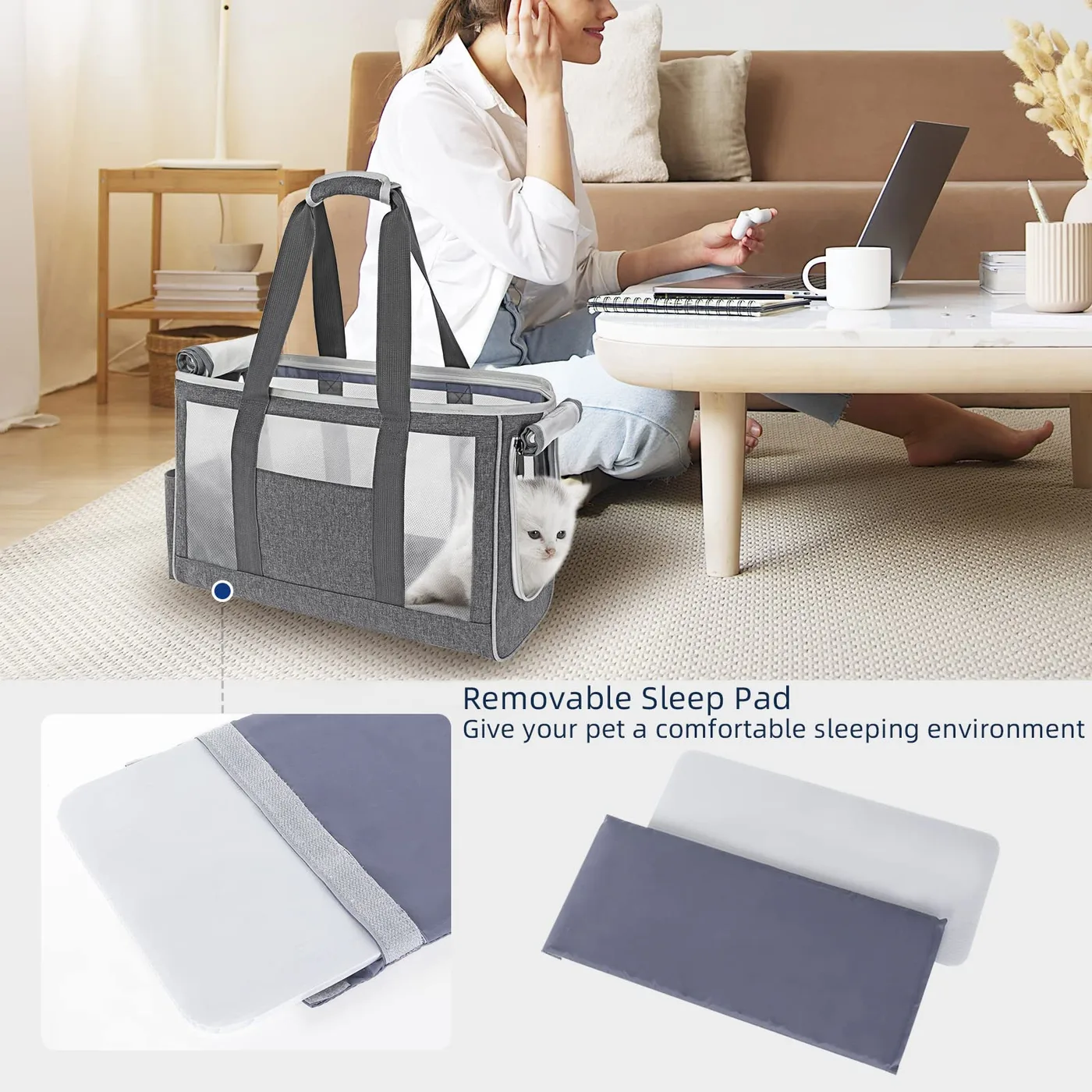
Channel fit is the final filter. Washable covers sell into veterinary clinics, boarding and grooming operators, multi-cat households, and premium retail where the care story is told on the packaging. They are harder to justify in a value channel where the carrying case is bought once and cleaned rarely, and in that channel the money is better spent on a removable pad, which delivers most of the cleanability at a much lower unit cost.
Production capability
- SGS-verified production space of 4,950 m², 149 machines, 7 assembly lines
- Pet carrier and pet bag output since 2014 from a 137-person team
- 200,000 units shipped monthly under BSCI and ISO 9001 systems
People Also Ask
What temperature should a washable cat carrier cover be washed at?
60 °C for a veterinary or boarding application, held for a full cycle, because that is the threshold where vegetative organisms associated with animal soiling are reliably reduced without a chemical disinfectant. A nylon cover must be specified at 40 °C instead.
How many wash cycles should a carrier cover survive?
25 cycles at 60 °C is the standard warranty point, with testing to 50 cycles to establish margin. A domestic carrier washed monthly reaches 25 cycles in about two years; a boarding carrier washed weekly reaches it in six months.
What makes a cat carrier cover stop fitting after washing?
Differential shrinkage between panels above 1.5 %, or cutting from fabric that was not heat-set. Polyester should be heat-set at 180-190 °C before cutting to bring residual shrinkage under 1.5 %.
Which thread should be used on a washable cover?
Bonded polyester, which loses under 10 % tensile strength over 25 cycles at 60 °C. Cotton-wrapped polyester loses 25-40 % because the cotton degrades and the two components shrink by different amounts, sawing at the seam.
Is a washable cover better than a removable pad?
It depends on channel. A pad delivers most of the cleanability at 1.50-2.10 USD; a zip-off cover adds 0.75-1.40 USD but allows the whole skin to be sanitised, which matters for veterinary and boarding operators.
How much does a washable cover add to unit cost?
0.75-1.40 USD for a zip-off architecture, 1.60-2.90 USD for a panel system, 0.30-0.55 USD for a crosslinked coating and 0.03-0.08 USD for bonded thread, all at 500 pieces. Third-party wash validation adds under 1 USD at that quantity.
What is the MOQ for a washable cover carrier?
MOQ 500 pieces per colourway, constrained by the interlining and coating minimum rather than the face fabric. A custom-dyed cover adds a 300-600 kg dye-lot minimum and 12-18 days to the schedule.
Frequently Asked Questions
Does washing at 60 °C damage the carrier frame?
Not if the frame is removable. A zip-off or panel cover separates from the frame before washing, leaving only textile in the machine. Where a semi-rigid panel is sewn in, it must be specified as washer-safe at 60 °C or removed through a separate sleeve.
Can the cover be tumble dried?
Only if the care label states it, and then at 60 °C maximum. A crosslinked PU coating tolerates 25-40 low-temperature tumble cycles; a single-component coating begins to craze and block at 15-25 cycles.
What is ISO 3758 and why does it matter?
ISO 3758 defines the standardised care symbol system for washing, bleaching, drying, ironing and professional care. It is required for the EU market and it removes the ambiguity that prose care instructions create across languages.
Why does a cover twist rather than shrink evenly?
Because panels shrink by different amounts, usually when the face fabric and the interlining have different residual shrinkage. The specification limit is a maximum 1.5 % differential between panels, not just an absolute 3 % limit.
How is coating durability measured after washing?
By hydrostatic head retention. A fluid-resistant cover should hold 400 mm minimum after 25 cycles at 60 °C. A single-component PU coating typically drops below that by cycle 15; a TPU film holds to 60-100 cycles.
Do metal snaps and zip sliders corrode in the wash?
Zinc-alloy bodies develop white corrosion deposits by cycle 10 with detergent and warm water. The correction is a brass or stainless body with nickel-free plating, or a plastic slider on a coil chain.
What causes seam puckering after several washes?
Thread and fabric stabilising at different rates over the first 15 cycles. The prevention is pre-washing the fabric before cutting and setting thread tension so the knot sits between the plies rather than on the surface.
Is an antimicrobial finish necessary on a washable cover?
No, but it adds measurable reduction between washes at 0.15-0.40 USD. It should never be presented as self-cleaning, because that claim is a regulatory exposure in both the EU and the US.
How long does wash validation take?
5-8 working days of laboratory time for 25 cycles at about 1.5 hours per cycle plus drying and conditioning. It should be booked in parallel with the sample, not after it, or the schedule slips two to three weeks.
Can a private label buyer print its own care instructions?
Yes. The care instruction sheet is one of the few pieces of collateral that stays with the product for its full life, and it should be designed rather than printed as an afterthought.
What needle and stitch specification is used?
A 90/14 ball-point needle for 600 D polyester, a lockstitch at 8-10 stitches per inch for panel joining, and a five-thread overlock or 20 mm bound seam where the seam is loaded or visible.
How should the cover be keyed so it is refitted correctly?
With asymmetric snap spacing or a single differently-coloured snap position. A cover refitted rotated by 90 degrees is the most common post-wash complaint and it costs nothing to prevent.
Talk to QUANZHOU JUNYUAN BAGS about a pet carrier program: MOQ 500 pieces per colourway, samples in 6-10 working days, bulk production in 35-50 days under AQL 2.5 inspection.
Get a free quote Request a sample