Cat Carrier for Car Sick: Ventilation and Comfort
A carrier for a car-sick cat needs 25-40 air changes per hour with a cross-flow path, lateral acceleration at the animal's position held under 0.15 g, vibration transmissibility below 1.5 in the 8-14 Hz band, forward-facing orientation within 20 degrees of the vehicle axis, and interior temperature held within 4 °C of cabin air.
Motion sickness in cats is a sensory conflict problem, and a carrier can only address the parts of it that are physically mediated: what the animal sees, what its vestibular system senses, and what it breathes. This page separates those three and gives each a number, because the category is otherwise dominated by products that add padding and make no measurable difference. The vestibular part is the largest and it is addressed by orientation, restraint stiffness and vibration isolation rather than by softness. The visual part is addressed by sightline and by limiting rotational motion, and it pulls against ventilation because an animal that can see out needs an open panel in the direction of travel. The respiratory part is the one this category is named for, and it is a defined exchange rate rather than a mesh panel of unspecified size. Commercial terms follow the standard programme: MOQ 500 pieces per colourway, prototypes in 6-10 working days, bulk production 35-50 days after sample approval, final random inspection to AQL 2.5, T/T 30/70 and FOB Xiamen.
As a pet carrier manufacturer handling cat carrier programmes, our team quotes MOQ 500 pieces per colourway and returns a sewn sample in 6-10 working days.
The Sensory Conflict Mechanism and What a Carrier Can Change
Motion sickness arises when the visual, vestibular and proprioceptive signals disagree. In a vehicle, an animal inside an enclosed carrier receives vestibular and proprioceptive signals indicating motion while receiving little or no visual corroboration, and the conflict produces nausea. The practical implication is that there are two opposite design routes, and mixing them produces the worst outcome.
The first route is to remove the visual signal entirely. If the animal cannot see out, the conflict is between vestibular and proprioceptive input only, which is the smaller mismatch and which many animals tolerate well. This is the route a fully occluded carrier takes, and it is the same mechanism described in calming design.
The second route is to supply a valid visual signal. If the animal can see the horizon or the road ahead, the visual input corroborates the vestibular input and the conflict largely resolves. This route requires a forward sightline of reasonable quality, and it fails badly if the sightline is partial or intermittent — an animal that catches fragments of moving scene through a mesh at an angle is worse off than one that sees nothing.
Mixing the routes is the failure mode. A carrier with a side mesh panel that gives a lateral, moving, uninformative view and no forward view combines the disadvantages of both, and this describes a large share of the products in the category. The design decision has to be one or the other, and it should be stated on the product.
Proprioceptive input is the third variable and it is under-designed. An animal braced against a stable surface receives consistent proprioceptive feedback; one sliding on a smooth pad does not. The requirement is a floor surface with a coefficient of friction of at least 0.45 and lateral containment that keeps the animal from being displaced more than 25-40 mm under a 0.3 g lateral event.
Respiratory input is independent of all three and is often the trigger that makes a marginal case clinical. Cabin air carries fuel and exhaust volatiles, plasticiser and adhesive emissions from trim, and elevated carbon dioxide; a carrier that traps and concentrates those while providing no fresh path will produce nausea in animals that are otherwise unaffected.
| Variable | Route A: occlusion | Route B: sightline | Shared requirement |
|---|---|---|---|
| Visual field | Occluded 70-85% | Forward view, 25-40 degrees | No lateral fragmentation |
| Interior illuminance | 5-30 lux | 40-120 lux | No flicker above 5 Hz |
| Rotational motion | Under 4 degrees peak | Under 4 degrees peak | Restraint stiffness defined |
| Lateral acceleration | Under 0.15 g | Under 0.15 g | Isolation layer specified |
| Air exchange | 25-40 per hour | 25-40 per hour | Cross-flow, not single face |
| Carbon dioxide | Under 1,200 ppm | Under 1,200 ppm | Logged over 30 minutes |
Note that the respiratory and mechanical requirements are identical on both routes. Choose occlusion or a forward sightline and commit to it; a partial lateral view is worse than either.
Orientation, Restraint and Restraint Stiffness
Orientation is the cheapest variable to control and the one most often left to chance. Three parameters matter, and all three are set by the restraint system rather than by the shell.
Axis alignment is the first. The animal's longitudinal axis should be within 20 degrees of the vehicle's direction of travel, whether the animal faces forward or rearward. A carrier placed sideways across a seat puts the animal's axis perpendicular to travel, which maximises lateral acceleration at the head and is the single most common cause of the problem in otherwise well-designed products. Instruction labelling and a defined seat-belt path are what control this in practice.
Facing direction is the second and the evidence is less clean than owners assume. Forward-facing gives a valid visual signal for Route B products; rearward-facing reduces the visual-vestibular mismatch for occluded products and is marginally better on lateral neck loading in a decelerative event. For a Route A product, rearward at 160-200 degrees to the direction of travel is the better default.
Restraint stiffness is the third and it is the parameter that actually governs how much motion the animal experiences. A carrier held loosely on a seat slides and rotates; one held rigidly transmits the vehicle's motion without amplification. The specification is a restraint system with a stiffness of 200-500 N per 100 mm of displacement, which holds the carrier within 30-50 mm of its seated position under a 0.5 g braking event without transmitting a sharp impulse.
Attachment geometry follows. A single seat-belt pass gives rotational freedom about the vertical axis; two passes at points separated by at least 250 mm constrain rotation to under 6 degrees. Where a rigid connection to the seat structure is used instead, the load path should be rated to at least six times the filled mass for a decelerative event, which is 700-900 N for a 12-14 kg loaded package.
Internal restraint is separate and it is a comfort rather than a safety item. An animal free to move inside its compartment will brace against the walls and generate its own proprioceptive noise; a snug compartment at a volume ratio of 1.4-1.8 times body volume, as described in denning geometry, reduces self-generated motion at no cost.
Crash-performance geometry, where a restraint claim is made, is defined by the test bench published by the Center for Pet Safety, and the bench dimensions constrain both the plan area and the attachment geometry. Orientation and restraint stiffness are what govern the motion the animal actually experiences; the shell matters less than the way it is held.
Ventilation: Exchange Rate, Air Path and Contaminant Control
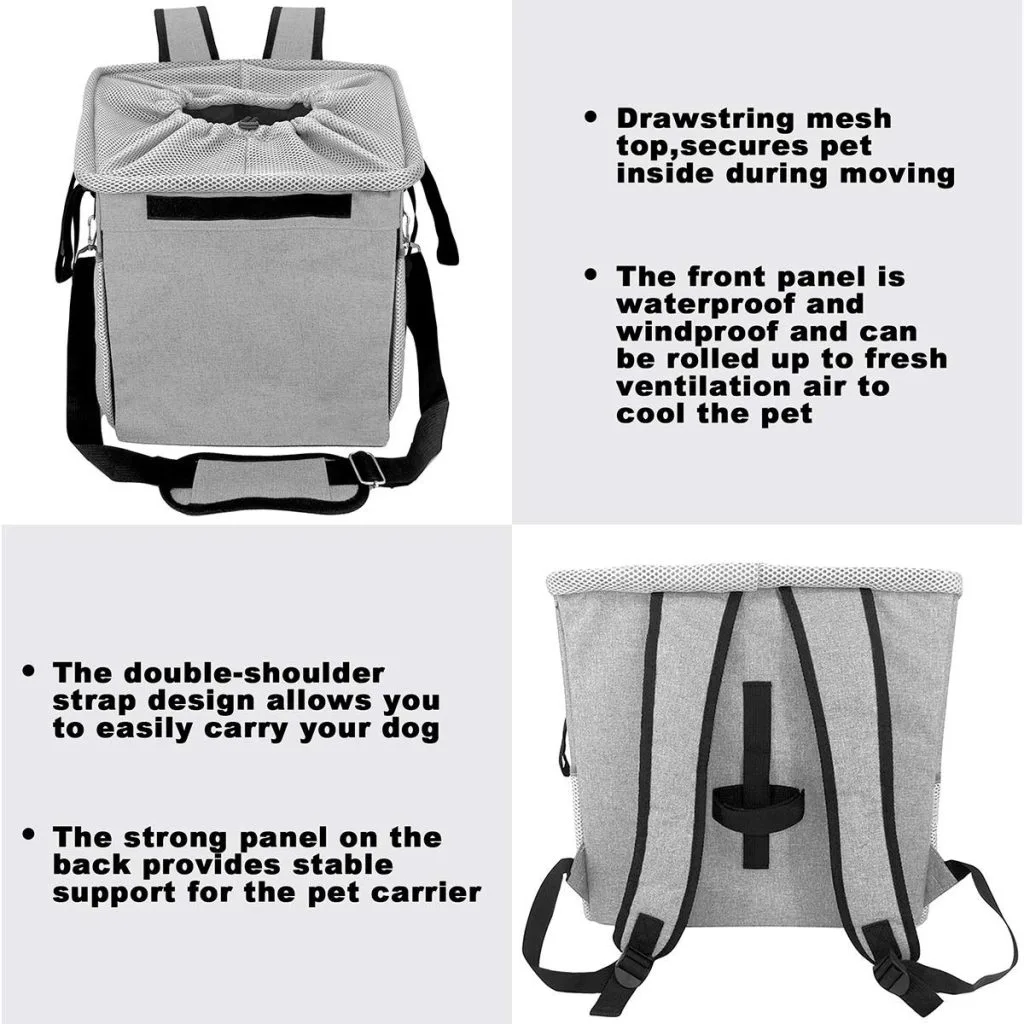
Ventilation in this category is usually specified as a mesh area, which is a poor proxy. The parameter that matters is air changes per hour through the compartment, and it depends on aperture area, aperture position and vehicle air movement rather than on area alone.
Exchange rate is the target: 25-40 air changes per hour with the vehicle's ventilation on a low setting, which is 0.7-1.3 litres per second through a 40-litre compartment. Measured by tracer decay, a carrier with a single 300 x 200 mm front panel achieves 8-16 per hour in still air and 18-28 per hour with the vehicle's fan running, which is below the target; adding an opposed rear panel of similar area roughly doubles both figures.
Air path is the mechanism. Exchange requires an inlet and an outlet on non-adjacent faces, with a height difference of at least 100 mm between them to exploit thermal buoyancy. Two panels on the same face, or on adjacent faces at the same height, produce a much lower exchange rate than their combined area suggests, which is why the area rule fails.
Carbon dioxide is the acceptance measurement and it is easier to run than a tracer test. Logged at the animal's head position over a thirty-minute journey with a thermal mass inside, the acceptance ceiling is 1,200 ppm for this category, which is tighter than the 1,500 ppm used for a general carrier. A compartment meeting 30 air changes per hour typically sits at 700-1,100 ppm.
Contaminant control is the second function of ventilation and the reason the target is higher than for a static environment. Cabin air carries volatile organic compounds from trim and adhesives, and in older vehicles fuel and exhaust vapour; the total volatile organic compound concentration in a closed cabin can reach 0.5-3.0 mg/m³. Dilution is the only mechanism available to a carrier, which is why the exchange target is set where it is.
Filtration is a design option with a real trade-off. A particulate filter over the inlet reduces dust and pollen ingress at the cost of 20-40% of the exchange rate; given the target, a filter should only be used where the aperture area is increased to compensate, and it should be specified with a pressure drop under 15 Pa at the design flow.
Draft is the constraint that stops the exchange rate from being raised further. Local air velocity at the animal's position should stay under 0.15 m/s; above that, convective cooling and noise both become problems. Baffled apertures — an offset outer opening behind the mesh — let the area be increased without the velocity. Specify air changes per hour with opposed inlets and outlets, not mesh area, and verify with carbon dioxide rather than with a calculation.
Vibration Isolation in the Vehicle Band
Vehicle vibration is broadband and its dominant content depends on the vehicle and the road. Isolation is specified as transmissibility in the bands that matter, and the bands differ from those used for a hand-carried product.
The input spectrum has three features. Body resonance sits at 1-2 Hz, engine and driveline input at 20-60 Hz at idle, and road-induced input between 4 and 20 Hz with the peak energy on coarse surfaces at 8-14 Hz and 0.15-0.45 g. A carrier sitting on a seat sees all of it, with the seat cushion already attenuating above about 15 Hz.
The isolation target follows: transmissibility below 1.5 in the 8-14 Hz band and below 2.0 at the 1-2 Hz body resonance, which is where isolation is difficult and where the animal is most sensitive to whole-body motion. Placing the pad system's resonance below 3 Hz is what achieves the first target; the second is addressed by limiting the pad's static deflection rather than by isolation.
Material selection follows the target. A closed-cell elastomer of 8-14 mm at 30-50 kg/m³ gives a resonance of 3.5-5 Hz under a 5 kg load, which is close but usually not low enough; a lower-dynamic-stiffness open-cell or a bonded elastomer with a shaped compression curve gets to 2.5-3.5 Hz. The trade is bottoming: a layer soft enough to reach 2.5 Hz deflects 12-20 mm under static load and needs 25-35 mm of available travel.
Damping is the second variable and it is deliberately moderate. A loss factor of 0.12-0.28 at 10 Hz controls the resonant peak without flattening the falling transmissibility curve above resonance; above 0.35 the isolation in the 8-14 Hz band is lost.
Measurement is a swept sine on a shaker table with the pad loaded by a mass representing the animal, with accelerometers on the base and on the pad surface, reported as transmissibility against frequency from 2 to 30 Hz at three load masses. A road recording is a useful confirmation but not a substitute, because it cannot separate the resonance.
Interaction with restraint is the last item. A stiff restraint raises the system's effective natural frequency by coupling the carrier to the seat; a compliant one lowers it. The isolation figure should therefore be measured with the restraint fitted as it will be used, not with the carrier loose on the bench. Isolation is a transmissibility curve measured with the restraint fitted, and 8-14 Hz is the band that decides it.
Thermal Load Inside a Moving or Parked Vehicle
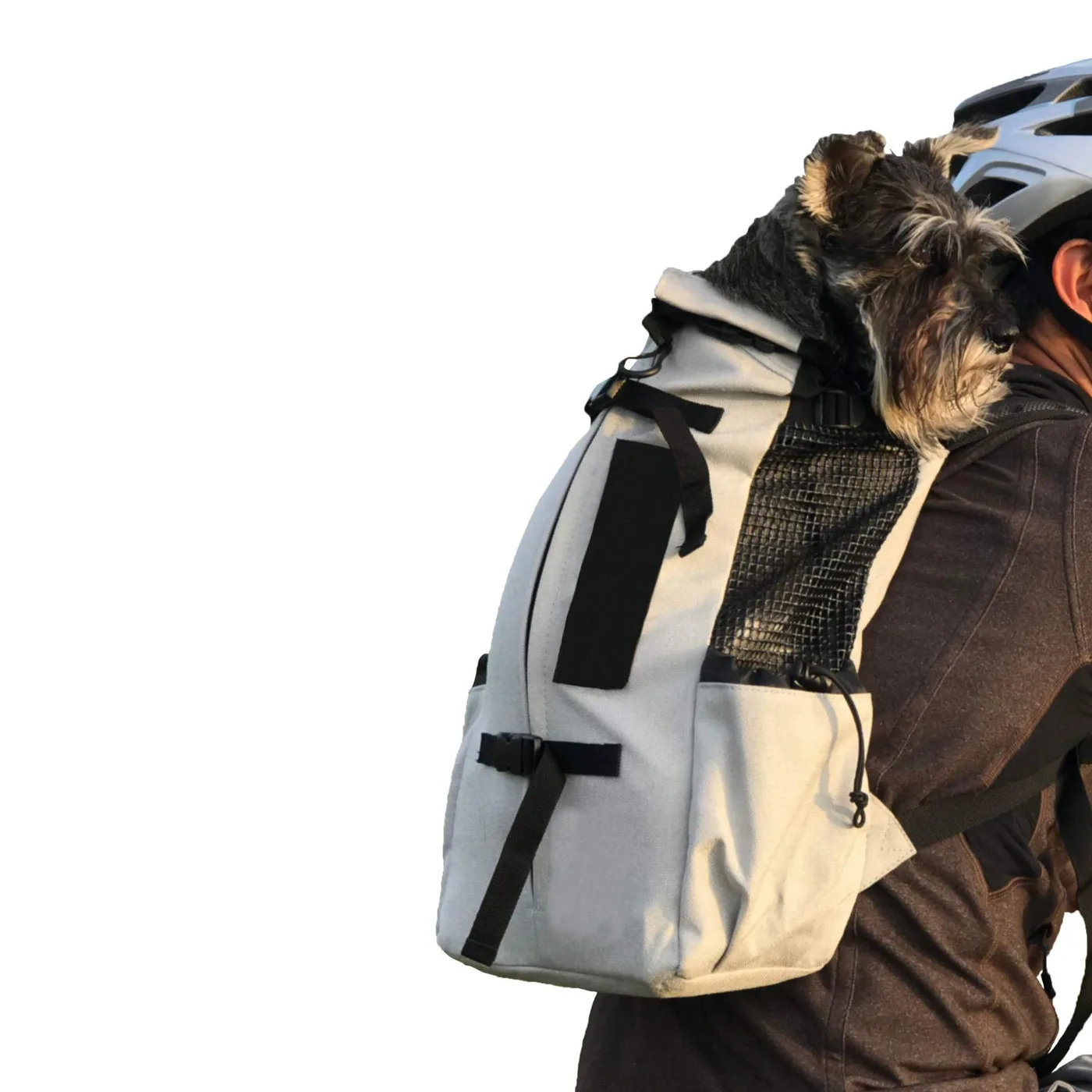
Thermal load is a nausea contributor in its own right, and it interacts with ventilation in an unhelpful direction: the same apertures that supply fresh air also admit solar gain and warm cabin air.
The load has three sources. Solar gain through the shell and apertures is the largest, at 200-600 W/m² on a horizontal surface in direct sun; cabin air temperature is the second, reaching 45-60 °C in a parked vehicle at 30 °C ambient within twenty to thirty minutes; and the animal's own metabolic heat is the third at 15-25 W.
The acceptance target is interior temperature within 4 °C of cabin air during a thirty-minute journey with the vehicle's ventilation running, and no more than 8 °C above cabin air after ten minutes parked with the ventilation off. Both are measurable and both are failed by a dark shell with small apertures.
Solar reflectance is the highest-value intervention. An outer fabric with a solar reflectance of at least 0.55 rejects most of the short-wave load before it reaches the insulation layer; a dark fabric at 0.05-0.15 absorbs it. The change is a colourway decision and it costs nothing in unit terms.
Insulation and ventilation then work in opposite directions and need balancing. Adding 0.35-0.55 clo of insulation reduces the conductive path from hot cabin air but also traps metabolic heat; the practical resolution is insulation on the floor and lower walls, where the hot surfaces are, and reflective and ventilated upper surfaces, where the solar load arrives.
Humidity is the companion parameter and it is often the one that produces the subjective impression of staleness. An animal at 20-30 breaths per minute adds 8-20 g of water vapour per hour to a 40-litre compartment, which without exchange raises relative humidity toward saturation and reduces evaporative cooling; at 25-40 air changes per hour humidity tracks cabin air closely.
Verification is logged rather than calculated: temperature and relative humidity sensors at the animal's head position and at floor level, with a solar irradiance reference outside the vehicle, over a standardised route that includes ten minutes parked. Textile thermal test practice follows published standards work at ASTM International. Solar reflectance is free and dominant; insulation and ventilation then have to be balanced floor against roof.
Odour, Volatiles and Interior Chemistry
Odour is both a nausea trigger and the most common complaint in this category, and it is almost entirely a materials problem rather than a design one. Three sources matter and each has a specification.
The first source is the product itself. New coated fabrics, adhesives and foams emit volatile organic compounds for days to weeks after manufacture, and a closed compartment concentrates them. The specification is an incoming screen on total volatile organic compounds and a formaldehyde limit below 20 mg/kg, plus a finished-goods ventilation period of 48-72 hours before packing.
The second source is retained soiling. Animals that vomit in transit do so repeatedly unless the residue is removed, and residue absorbed into foam cannot be removed. This is the argument for a welded containment tray under the comfort pad in this category specifically: liquid reaches the tray and not the foam, and the tray is rinsed.
The third source is cleaning chemistry. A heavily scented detergent leaves a residue that is itself an odour and, for an animal with a far more sensitive olfactory system than the owner's, a strong one. The routine cleaning specification for this product is a detergent-free rinse for the tray and pad, with detergent used only occasionally.
Absorption and desorption behaviour is the material property that governs all three. Open-cell foam and natural fibres absorb and slowly re-emit; closed-cell foam and coated synthetics do not. The specification for this category is therefore a closed-cell or welded interior with a synthetic face fabric, at a marginal cost over an open-cell build of 0.40-1.60 USD.
Odour assessment is a panel method rather than an instrument method, because the relevant threshold is a cat's, not a sensor's. A trained panel of five or more assesses a sample against a defined scale twenty-four hours after a standard challenge and clean, with acceptance of no more than a slight residual. Instrumental total volatile organic compound screening supports it but does not replace it.
Chemical declarations for all interior textiles follow OEKO-TEX screening criteria, and welfare guidance on managing transport nausea is kept consistent with material published by the American Veterinary Medical Association. Odour is a materials specification: welded containment, closed-cell interiors, a volatile screen and a ventilation period before packing.
Verification: Road Course, Instrumentation and Acceptance
A car-sickness claim is verifiable with equipment most programmes can access, and the protocol is worth running because the failure modes are otherwise invisible until the product is in the field.
The road course is defined first, because results are meaningless without a standard input. A usable course is 20-30 km combining smooth highway at 90-110 km/h, coarse asphalt at 50-70 km/h, a series of ten roundabouts or constant-radius turns at 0.2-0.35 g lateral, and ten braking events at 0.4-0.6 g. Duration 35-45 minutes, with the vehicle's ventilation set to a recorded low setting and the cabin temperature logged.
Instrumentation is the second element. A triaxial accelerometer is fixed to the floor panel at the animal's position, with a sampling rate of at least 200 Hz to capture the 8-14 Hz band cleanly; a carbon dioxide and temperature logger sits at the animal's head position; and a sound level meter logs the full run. Position and orientation are fixed and photographed so the setup can be reproduced.
Acceptance limits are then applied to the logged data: peak lateral acceleration at the animal's position under 0.15 g in the constant-radius turns, root-mean-square vertical acceleration under 0.25 g over the coarse section, interior carbon dioxide under 1,200 ppm throughout, interior temperature within 4 °C of cabin air, and no acoustic transient above 70 dB at the animal's position.
A behavioural arm runs alongside. Ten to fifteen animals are run on the course in the test carrier and in a control carrier in randomised order, with nausea scored on a defined scale from salivation, lip-licking, vocalisation and vomiting. Acceptance is an incidence no more than 40% lower than the control, which is a meaningful and defensible statement; a claim of elimination is not supportable.
Documentation closes the protocol: the course definition, the instrumentation setup, the raw traces and the behavioural scores are retained for three years. Reproducibility is checked by running the same unit twice on consecutive days, with acceptance of a difference under 10% on each logged parameter.
Cost, Material Selection and Programme Planning
A car-sickness-focused build adds 4.80-13.60 USD over a comparable general carrier, and the money is concentrated in the isolation layer, the ventilation package and the containment tray. The restraint hardware, which is the highest-value item behaviourally, is the cheapest.
The breakdown: the isolation layer at 1.40-4.20 USD, the ventilation package of opposed apertures and baffles at 1.10-3.00 USD, the welded containment tray at 1.80-3.60 USD, the restraint and seat-belt path hardware at 0.80-2.40 USD, the reflective outer fabric and light colourway at 0.30-1.20 USD, and the low-emission material selection at 0.20-0.90 USD. Against that, a standard single-face mesh and an open-cell pad are removed.
Material selection should be driven by the measured curves. For the isolation layer, a closed-cell elastomer with a shaped compression curve reaching a resonance of 2.5-3.5 Hz under a 5 kg load is the specification; standard foam at the same thickness reaches 3.5-5 Hz and misses the target. For the interior, a welded coated synthetic with a closed-cell or no absorbent layer is required for the odour specification, which rules out a quilted open-cell lining.
Tooling is modest. The opposed rear aperture needs a pattern change; the baffles need a binding operation rather than a tool; the containment tray needs a high-frequency electrode at 900-2,200 USD on two to three weeks; and the seat-belt path needs a reinforcement pattern at 0.20-0.60 USD per unit. Total tooling for a car-focused variant of an existing shell is under 3,000 USD.
Segmentation matters because there are two distinct products here. Route A, the occluded carrier, suits animals that are already symptomatic and is a small but high-loyalty market; Route B, the forward-sightline carrier, suits prevention and is much larger. Building one product to serve both by adding a roll-back panel is possible at 1.20-3.00 USD, and it is usually the right answer at launch.
Documentation planning should start early. A claim supported by a defined course, instrumented traces and a randomised behavioural arm is defensible in retail copy; the same claim without them is not. Budget for the road-course testing before the copy is written.
Our production team builds vehicle-focused programmes through the SGS-verified production base under ISO 9001 and BSCI coverage, with prototypes in 6-10 working days, bulk production 35-50 days after sample approval, final random inspection to AQL 2.5, T/T 30/70 and FOB Xiamen. The restraint hardware is the cheapest item and the largest effect; the isolation layer and the opposed ventilation path are where the rest of the money goes.
Why brands source here
- Pet carrier programs run since 2014; founding team in sewn goods since 2004
- SGS-verified production floor of 4,950 m² with 137 workers across 7 lines
- Monthly capacity of 200,000 units, audited to BSCI and ISO 9001
People Also Ask
Why do cats get car sick and what can a carrier change?
Sensory conflict between visual, vestibular and proprioceptive signals. A carrier can control orientation, restraint stiffness, vibration transmissibility, air exchange and interior temperature, which are the physically mediated parts.
Should a cat face forward or backward in a car?
Forward for a product giving a valid sightline; rearward at 160-200 degrees to travel for an occluded product. Either way the animal's axis should be within 20 degrees of the direction of travel.
How much ventilation does a car-sick cat need?
25-40 air changes per hour with an inlet and outlet on non-adjacent faces at least 100 mm apart, verified as carbon dioxide under 1,200 ppm over a thirty-minute journey.
Is mesh area enough to specify ventilation?
No. Two panels on the same or adjacent faces at the same height deliver far less exchange than their combined area suggests. Air changes per hour with a cross-flow path is the correct parameter.
What vibration frequency matters in a car?
8-14 Hz carries the peak road energy at 0.15-0.45 g. Transmissibility should be below 1.5 there, which requires the pad system resonance below 3 Hz.
How hot can a carrier get in a parked car?
Cabin air reaches 45-60 °C within twenty to thirty minutes at 30 °C ambient. Acceptance is interior within 4 °C of cabin air while moving and no more than 8 °C above after ten minutes parked.
How is a car-sickness reduction claim verified?
On a defined 20-30 km course with instrumented acceleration, carbon dioxide and temperature, plus a randomised behavioural arm on ten to fifteen animals scored against a control.
Frequently Asked Questions
Why is a sideways carrier worse than a forward one?
It places the animal's axis perpendicular to travel, maximising lateral acceleration at the head. Axis alignment within 20 degrees of the direction of travel is the requirement.
What restraint stiffness should the seat-belt system have?
200-500 N per 100 mm of displacement, holding the carrier within 30-50 mm under a 0.5 g braking event without transmitting a sharp impulse.
Why are two seat-belt passes better than one?
A single pass allows rotation about the vertical axis. Two passes at points at least 250 mm apart constrain rotation to under 6 degrees.
What load rating applies to a rigid seat attachment?
At least six times the filled mass for a decelerative event, so 700-900 N for a 12-14 kg loaded package.
How much travel does an isolation layer need?
25-35 mm of available travel, because a layer soft enough to reach a 2.5 Hz resonance deflects 12-20 mm under static load and will bottom out otherwise.
What loss factor is right for the isolation material?
0.12-0.28 at 10 Hz. Above 0.35 the resonant peak is controlled but transmissibility stops falling, and isolation in the 8-14 Hz band is lost.
Why measure isolation with the restraint fitted?
A stiff restraint couples the carrier to the seat and raises the effective natural frequency, while a compliant one lowers it. Bench measurement without the restraint does not predict the installed result.
Does a particulate filter help or hurt?
It costs 20-40% of the exchange rate. It should only be used with the aperture area increased to compensate, at a pressure drop under 15 Pa at design flow.
What local air velocity is acceptable at the animal?
Under 0.15 m/s. Above that, convective cooling and noise both become problems, which is why baffled apertures are used to raise area without raising velocity.
How much water vapour does an animal add to the compartment?
8-20 g per hour at 20-30 breaths per minute in a 40-litre compartment, which drives relative humidity toward saturation without adequate exchange.
What incoming emission limits apply to materials?
A volatile organic compound screen on incoming fabric and a formaldehyde limit below 20 mg/kg, plus a 48-72 hour finished-goods ventilation period before packing.
Why must routine cleaning be detergent-free?
Detergent residue is itself a strong odour to an animal with a far more sensitive olfactory system, and scented products are the most common cause of repeat soiling.
What reproducibility check applies to the road course?
The same unit is run on consecutive days with acceptance of a difference under 10% on each logged parameter, which validates the course and the instrumentation setup.
What behavioural improvement is a defensible claim?
An incidence no more than 40% lower than a randomised control on a defined nausea scale. A claim of elimination is not supportable and should not be printed.
Talk to QUANZHOU JUNYUAN BAGS about a pet carrier program: MOQ 500 pieces per colourway, samples in 6-10 working days, bulk production in 35-50 days under AQL 2.5 inspection.
Get a free quote Request a sample