Cat Carrier for Car Travel: Safety Standards
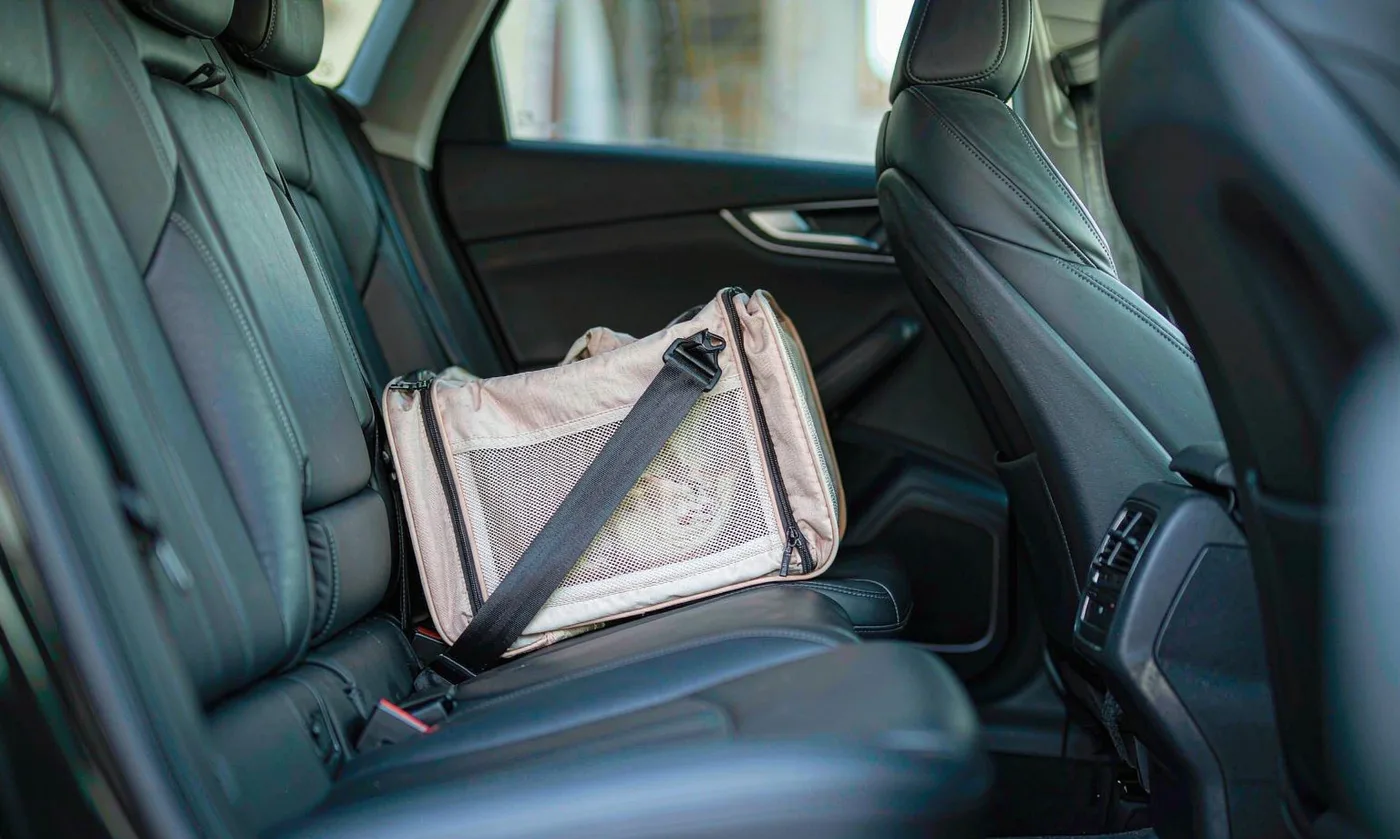
A cat carrier rated for car travel restrains through the vehicle seat belt via anchor webbing rated to at least 3.5 kN, holds the carrier to under 300 mm of forward excursion in a 48 km/h sled pulse of 20-24 g, and keeps the cat contained by an internal tether rated to 1.5 kN. Belt path geometry, not webbing strength, is the usual cause of failure.
This page sets out what a car-travel rating actually requires of a cat carrier, expressed as testable geometry and measured loads rather than as a claim. Vehicle restraint is the most demanding load case a pet carrier will ever see and the one with the least forgiving failure consequence: a carrier that tears at its anchor or rotates under a 20 g pulse becomes a projectile, and so does the animal inside it. The sections below follow the restraint chain in order — belt path, anchor, chassis, internal tether and seat interface — with the sled protocol and its acceptance limits specified in full. Commercial terms follow the standard programme: MOQ 500 pieces per colourway, prototypes in 6-10 working days, bulk production 35-50 days after sample approval, final random inspection to AQL 2.5, T/T 30/70 and FOB Xiamen.
Private label pet bags sit at the centre of most cat carrier briefs we handle: the buyer owns the brand, the barcode and the artwork, while our production team holds the pattern.
Belt Path Geometry and the Anchor Load Case
A seat belt restrains a carrier by pressing it into the seat, and the belt path determines whether that happens or whether the carrier rotates out from under the belt. Geometry is the dominant variable: the same webbing and the same stitching will hold or fail depending on where the belt crosses the chassis and at what angle.
The load case is severe and it is worth stating in numbers. A 5 kg cat in a 1.4 kg carrier is 6.4 kg, and at a 20 g pulse that is roughly 1,250 N of inertial load. Because the restraint is not perfectly rigid and the belt stretches, the practical design figure is 1,000-1,600 N at the anchor, applied over 80-120 ms, in a direction that is usually 10-25 degrees off the vehicle's longitudinal axis. That off-axis component is what rotates carriers out of belts.
Belt path design follows three rules. The belt must cross the carrier at a height between 35% and 60% of its overall height, because a belt crossing near the top tips the carrier forward and a belt crossing near the bottom lets it rotate up and over. The path must be a channel rather than a flat surface — a recess of 15-25 mm or a pair of guide loops that keep the webbing from sliding. And the path must be continuous across the top or the rear face, so the belt loads the chassis rather than a single panel.
Guide loops are the usual implementation and the detail that decides the outcome. A loop of 25 mm webbing, 40-60 mm long, placed so the belt enters and exits at an included angle of 150-170 degrees, keeps the belt located without creating a hard point that abrades it. A loop that is too tight, under 120 degrees, puts the belt into a sharp bend and both damages the belt and creates a rotation axis.
Off-axis behaviour should be tested explicitly rather than inferred. A static pull at 1,200 N applied at 20 degrees off-axis, held 60 seconds, with acceptance of no rotation above 15 degrees and no anchor damage, is a cheap pre-test that catches most geometry faults before a sled run is booked. Belt path geometry is the design variable; once it is wrong, no amount of webbing strength recovers the performance.
Anchor Webbing and Hardware Strength Specifications
Anchor strength is the part of the specification everyone writes down and the part that rarely governs. Webbing rated at 3.5 kN is easy to buy; joining it to a chassis so that 1,200 N does not tear it out is the actual engineering, and it is the same anchor problem discussed for strap systems with higher stakes and less forgiveness.
Webbing specification is straightforward: 25 mm polyester at 1.4-1.8 mm thickness, breaking strength of 6-9 kN, with a safety factor of at least 2.5 against the design load. That gives a working rating of 3.5-4.0 kN, well above the 1.0-1.6 kN the anchor sees. Wider webbing of 38-50 mm is sometimes specified for belt-path loops because it spreads load on the belt and resists abrasion better; it is not needed for strength.
The joint to the chassis is where performance is won. Measured pull-out loads follow the same progression seen elsewhere: a webbing end straight-stitched to a panel reaches 150-300 N; with a load-spreader patch, 450-650 N; with a box-X bar-tack over 20 mm, 600-850 N; wrapped around a structural member, 700-1,000 N; through-bolted to a moulded boss with a backing plate, 900-1,400 N. For a 1,200 N design load, only the last two are adequate, and the through-bolt route is the one used on any carrier making a restraint claim.
| Component | Design load (N) | Minimum rating (N) | Verification |
|---|---|---|---|
| Belt path guide loop | 600-900 | 1,500 | Static pull, 60 s |
| Anchor webbing | 1,000-1,600 | 3,500 | Tensile to break |
| Anchor-to-chassis joint | 1,000-1,600 | 2,400 | Diagonal pull test |
| Hardware at anchor | 1,000-1,600 | 2,500 | Proof load |
| Internal tether | 600-900 | 1,500 | Dynamic pull |
| Shell at load path | 1,000-1,600 | No failure | Sled test |
Hardware at the anchor must be metal. Polymer hardware in a restraint path is not acceptable at any rating, because its strength is temperature- and rate-dependent in ways that a 20 g pulse will find. A 25 mm steel or alloy D-ring or a sewn loop with a steel triglide, rated to 2.5 kN or better, at 0.40-1.20 USD.
Stitch specification follows the pattern that works everywhere else: 8-10 stitches per inch, box-X patterns rather than straight rows, and webbing ends folded back 25-30 mm and hot-knife sealed. One additional requirement applies here: the stitch thread should be a bonded polyester or nylon of a size matched to the webbing, because an anchor that fails at the thread rather than at the webbing has wasted the webbing's strength entirely.
Conditioning matters more in this application than in any other. A wet set and a set aged at 70 °C for seven days are both run, because a restraint anchor has to work in a carrier that has been rained on and in one that has sat in a hot car for three summers. A restraint chain is only as strong as its joint to the chassis, and the joint is a stitching and geometry problem rather than a webbing problem.
Sled Test Protocol: Pulse, Excursion and Acceptance
The sled test is the acceptance gate for any carrier making a car-travel claim, and it is the only test that exercises the whole restraint chain at once. Everything else is a component test; this is the product test.
The pulse is the specification that makes results comparable. Independent pet-restraint programmes commonly run a frontal sled pulse with a delta-V near 48 km/h and a peak acceleration of 20-24 g over 80-120 ms, using a standard vehicle seat and a standard belt. A carrier tested at a lower delta-V or a softer pulse will produce impressive-looking results that do not transfer, so the pulse must be stated on every report.
Excursion is the primary acceptance criterion: the maximum forward displacement of the carrier's leading edge, measured from high-speed video against a calibrated reference. Working acceptance for the cat class is under 300 mm of forward excursion and under 150 mm of lateral excursion, with the carrier remaining in contact with the seat throughout. Rotation is measured in the same run and should stay under 30 degrees.
| Measure | Acceptance | Method | Failure consequence |
|---|---|---|---|
| Forward excursion | Under 300 mm | High-speed video | Contact with seat ahead |
| Lateral excursion | Under 150 mm | High-speed video | Rotation out of belt |
| Rotation | Under 30 degrees | Video, two planes | Belt override, ejection |
| Anchor integrity | No failure | Post-test inspection | Carrier becomes projectile |
| Chassis integrity | No opening, no tear | Post-test inspection | Animal ejection |
| Surrogate containment | Fully retained | Weighted surrogate | Animal injury |
The surrogate matters as much as the carrier. A test run with an empty carrier or with a sandbag of the wrong shape tells you little, because the load distribution and the centre of mass drive the rotation. A surrogate of the correct mass, with its centre of mass at the height a cat's sits — roughly 35-45% of the carrier's interior height — and with some compliance, is required for the result to mean anything.
Repeated runs and multiple seat geometries are the closing requirements. A carrier should be tested on at least two seat types — a flat bench and a contoured bucket — because belt geometry differs and a carrier that passes on one can fail on the other. Two units per configuration, since a single run cannot distinguish a good design from a lucky one.
Independent programmes publish their protocols and results, and cross-checking a design against published methodology from the Center for Pet Safety is the usual way to establish that a protocol is credible rather than convenient. A sled result without a stated pulse, a stated seat and a stated surrogate is not a result.
Chassis Behaviour Under Crash Load
The chassis sees the same 1,000-1,600 N that the anchor does, applied through the belt path and reacted by the seat, and it fails in ways that differ between soft and rigid constructions. Understanding the difference determines where reinforcement goes.
Soft-sided chassis fail by local collapse and by zipper burst. Under a 20 g pulse the panels deform, the belt path digs in, and the zipper — which is loaded in a direction it never sees in normal use — separates. Two controls address both: a belt-path channel that is reinforced with a structural band of 25 mm webbing running the full width of the carrier, and a secondary closure over the main aperture so that a zipper which does separate does not create an opening. The band is the more important of the two, because it also stops the belt from cutting into the panel.
Rigid chassis fail differently: they do not deform much, but they concentrate load at the belt contact and can crack at a rib root or at the split line. The control is local reinforcement at the belt path — a thicker section or a moulded channel — plus a radius at the belt contact of at least 10 mm so the belt is not loaded over a sharp edge. A rigid shell also transmits more of the pulse to the animal, which is why an energy-absorbing layer between the shell and the interior is worth specifying: 8-15 mm of closed-cell foam at the belt-path face.
Zipper direction deserves specific attention because it is the most common single failure. A zipper loaded in peel — the two tapes pulled apart perpendicular to the chain — separates at a fraction of the load it carries in shear. In a crash the main aperture zipper is loaded in exactly that direction. The remedies are a storm flap over the zipper line carrying the load in the fabric rather than in the chain, and a zipper specified with a chain rated for the cross-load case rather than for the closure case.
Interior volume loss is the secondary acceptance criterion. A carrier that survives the pulse but has collapsed to 60% of its volume has injured the animal even though the product did not fail. Interior volume should be measured before and after, with acceptance of a volume loss under 15% and no hard contact point introduced into the occupant space. Chassis performance in a crash is judged by three things: it stays closed, it does not collapse, and it does not create a hard surface where there was not one before.
Secondary Restraint: the Internal Tether
Even a well-restrained carrier lets the animal move inside it, and in a pulse the animal becomes the load. An internal tether connects the cat's harness to the chassis so that the animal's inertia is taken by the structure rather than by the carrier wall, and it is the difference between a contained occupant and one thrown against the door.
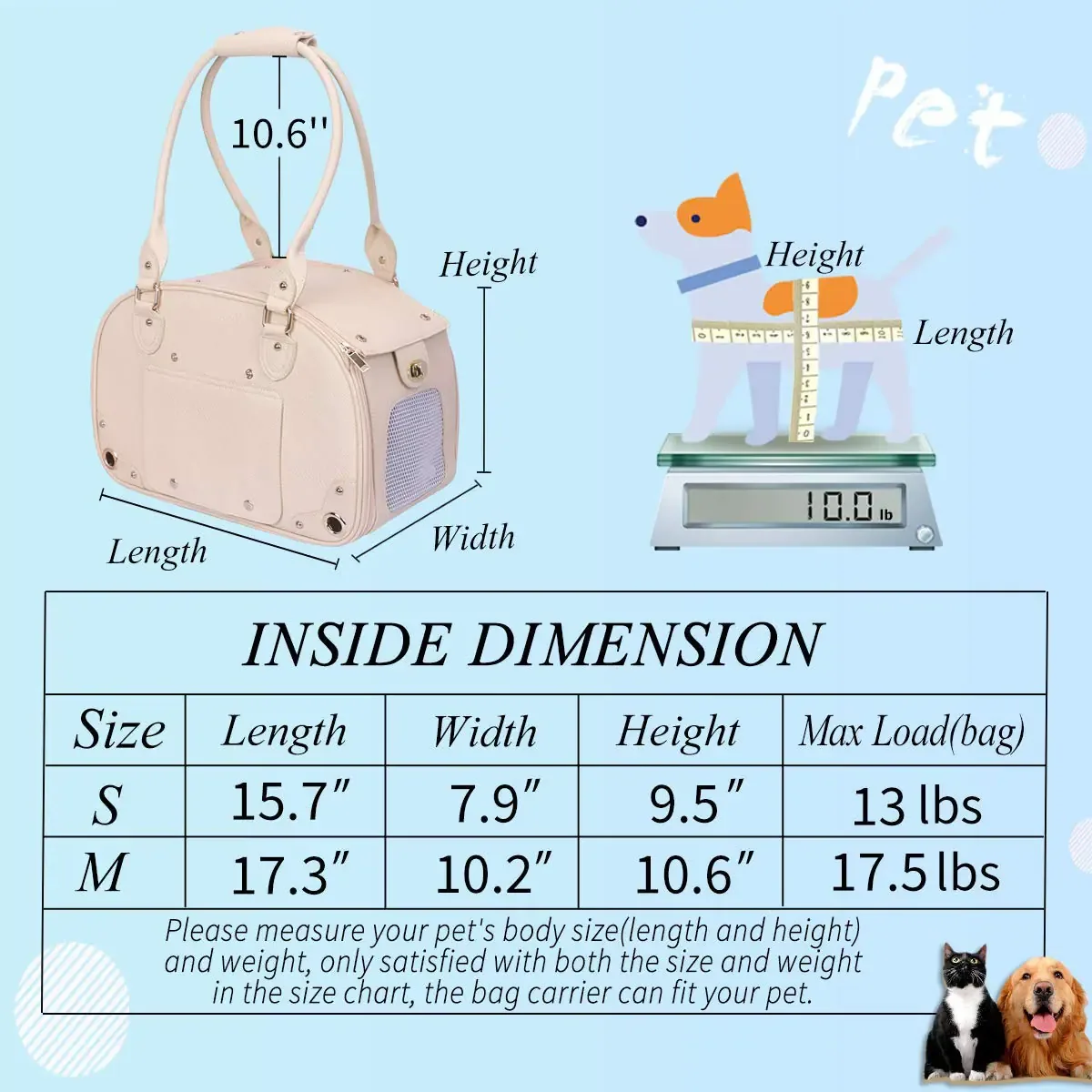
Specification follows from the same arithmetic as the anchor. A 5 kg cat at 20 g produces roughly 1,000 N; a safety factor of 2.5 gives a tether rating of 1.5-2.5 kN, which is a 12-16 mm webbing or a 4-6 mm cord in a high-tenacity fibre. The tether should be short enough that the animal cannot reach the carrier wall: a length giving 100-200 mm of movement from the tether's anchor point.
The tether's anchor to the chassis is the weak point in most designs and it should be treated exactly like a belt anchor: spreader patch, box-X bar-tack, and a joint rated above the webbing. A tether stitched to a single panel will tear out at 150-300 N, which is a quarter of what the tether itself can carry and a fifth of what the load requires.
Harness compatibility is a practical requirement that is usually left to the customer. A tether terminating in a carabiner or a clip that fits a standard harness — a gate opening of 12-18 mm and a rating above 1.5 kN — works with what owners already own. A tether terminating in a proprietary fitting forces the purchase of a matching harness and, in practice, means the tether is never used.
Storage when not in use is the last requirement and it is a safety one. A loose tether inside the occupied space is a strangulation and entanglement hazard, particularly for a cat that will play with anything. The tether should have a stowage pocket or a clip point outside the animal's reach, and the instruction sheet should say so explicitly.
The tether is also the reason a carrier should never be restrained by its carrying handle. A handle is rated for vertical lift, not for a 20 g longitudinal pulse, and a handle used as a belt anchor fails at a few hundred newtons. The internal tether is what converts a restrained box into a restrained animal, and it is the least expensive component in the safety chain.
Vehicle Seat Interface: Fit Across Seat Geometries
A restraint system only works if it fits the seat it is used on, and vehicle seat geometry varies more than most carrier designers expect. Belt anchor positions, seat cushion angle, seat back rake and the presence of side bolsters all change how a carrier behaves under load, and a design validated on one seat can behave badly on another.
Belt geometry is the primary variable. The angle at which the lap belt leaves its anchor varies from roughly 20 to 55 degrees below horizontal across the vehicle fleet, and belt webbing length varies enough that a carrier must be positionable anywhere along a 400-700 mm range. A belt path that works at one angle can rotate the carrier at another, which is why the off-axis static pull test covered earlier should be run at two angles rather than one.
Seat cushion angle and depth determine whether the carrier sits flat. A contoured bucket seat with a pronounced bolster will hold a carrier on its side rather than on its base, and a carrier restrained while lying on its side behaves completely differently from one restrained upright. The specification response is to mark the correct orientation on the product and to design the belt path so that it is only usable in the upright orientation — a path that physically cannot be threaded when the carrier is on its side.
Seat back rake affects the rear-face contact. A carrier restrained against a reclined seat back has less reaction surface and more freedom to rotate forward. Testing on a seat set to a reclined position as well as an upright one is a cheap addition and it catches designs that pass only in the favourable case.
Airbag and deployment zones are a documentation requirement rather than a design one, but they belong on the instruction sheet: a carrier restrained in a front passenger seat interacts with a passenger airbag, and the recommendation for rear-seat placement should be stated. The same sheet should state that the carrier is not a child restraint and is not certified to any child-seat standard, which is a legal disclaimer most programmes need.
Finally, the belt itself is a component in the system and the instruction should specify its condition: a belt with visible webbing damage or a buckle that does not latch cannot restrain a carrier regardless of the carrier's design. Seat interface variability is the reason a car-travel rating has to be tested on more than one seat and documented for the worst case.
Documentation, Labelling and Standard References
A restraint claim generates documentation obligations that a non-safety product does not have, and the documentation is where most programmes are weakest. Three documents matter: the permanent product label, the instruction sheet and the test report.
The permanent label should state the rated mass range, the restraint method, the correct orientation, and a reference to the instruction sheet. It should be sewn in rather than printed on a hang tag that gets discarded, and it should survive the same washing and abrasion testing as the rest of the product. A label that falls off removes the only in-field record of how the product is meant to be used.
The instruction sheet carries the full content: a diagram of the belt path, the orientation requirement, the maximum rated mass, the tether instruction and its stowage warning, the rear-seat recommendation and the airbag warning, the disclaimer that the product is not a child restraint, and an inspection instruction telling the owner to retire the carrier after any collision. That last item is the one most often omitted and the one with the clearest consequence: a carrier that has absorbed a 20 g pulse has been structurally worked and should not be used again.
The test report should state the pulse, the seat type, the surrogate mass and geometry, the number of units tested, and the measured excursion and rotation values — not a pass/fail statement. A report that says "passed" without values cannot be compared with anything and will not satisfy a retailer's technical reviewer. Independent programmes such as the Center for Pet Safety publish methodology that makes a credible protocol easy to write, and general conditioning and textile test practice follows published standards work at ASTM International.
Transport welfare framing for the animal itself is normally cross-checked against guidance published by the American Veterinary Medical Association, which covers duration, ventilation and temperature limits during vehicle transport. That guidance does not specify restraint hardware, but it sets the conditions the hardware has to work within.
Record retention closes the section. Test reports, the sled video and the inspection records for each production lot should be retained for the life of the product plus a defined period, because a restraint claim is the one claim that generates litigation rather than returns. Documentation is part of the safety system: a well-tested carrier with a lost report is a liability, and a well-documented one is a defence.
Cost, Tooling and Programme Notes
A restraint-capable build adds 3.60-9.40 USD to unit cost over a comparable non-rated carrier. The breakdown: belt path guides and reinforcement at 0.80-2.20 USD, anchor webbing and rated hardware at 0.90-2.40 USD, chassis reinforcement and the secondary closure at 1.00-2.60 USD, the internal tether and its anchor at 0.40-1.20 USD, and documentation and labelling at 0.50-1.00 USD — the last of which is a real cost when the instruction sheet runs to multiple languages.
Sled testing is the budget item programmes underestimate. A single sled run at an independent facility costs 800-2,500 USD depending on the seat and instrumentation, and a credible programme needs at least four runs: two seat geometries, two units each. Add the static pre-tests and the conditioning sets and a restraint validation programme runs 6,000-18,000 USD before a single production unit exists. That cost is why restraint claims should be concentrated on one or two sizes rather than spread across a full range.
Tooling impact is modest on the soft route and meaningful on the rigid one. A soft chassis needs only pattern changes and a reinforcement band; a rigid shell needs a revised tool section at the belt path, which on an existing tool is a 3,000-8,000 USD modification and on a new tool is free if specified at design.
Inspection for restraint programmes is more involved than a standard AQL 2.5 run. Two additions are standard: a proof load at 60% of the anchor rating on two samples per lot, and a visual verification that every box-X bar-tack and every spreader patch is present and complete — a missing spreader patch is invisible from outside and reduces anchor strength by half. Our production team builds restraint programmes through the SGS-verified production base under ISO 9001 and BSCI coverage, with prototypes in 6-10 working days, bulk production 35-50 days after sample approval, T/T 30/70 and FOB Xiamen. A restraint claim is the most expensive claim a carrier programme can make and the only one that has to be defended with video.
Why brands source here
- Pet carrier programs run since 2014; founding team in sewn goods since 2004
- SGS-verified production floor of 4,950 m² with 137 workers across 7 lines
- Monthly capacity of 200,000 units, audited to BSCI and ISO 9001
People Also Ask
How much force does a cat carrier anchor see in a crash?
Roughly 1,000-1,600 N. A 6.4 kg combined mass at a 20 g pulse gives about 1,250 N of inertial load, applied over 80-120 ms and usually 10-25 degrees off the vehicle's longitudinal axis.
Where should the seat belt cross a cat carrier?
Between 35% and 60% of its overall height, in a channel of 15-25 mm or a pair of guide loops. Near the top it tips the carrier forward; near the bottom it lets the carrier rotate up and over.
What excursion limit applies in a sled test?
Under 300 mm forward and 150 mm lateral, with rotation under 30 degrees, in a pulse of 20-24 g over 80-120 ms at a delta-V near 48 km/h on a standard seat and belt.
Why do soft carriers fail crash tests at the zipper?
The main aperture zipper is loaded in peel rather than shear and separates at a fraction of its closure rating. A storm flap carrying the load in fabric, plus a chain rated for cross-load, fixes it.
What rating does an internal tether need?
1.5-2.5 kN, from a 5 kg cat at 20 g giving about 1,000 N with a safety factor of 2.5. Length should allow only 100-200 mm of movement from its anchor point.
Can the carrying handle be used as a belt anchor?
No. A handle is rated for vertical lift and fails at a few hundred newtons under a longitudinal pulse. Only dedicated belt-path anchors should be used.
Why must a restraint carrier be tested on more than one seat?
Belt anchor angles vary from 20 to 55 degrees below horizontal across the vehicle fleet and bucket-seat bolsters can hold a carrier on its side. A design that passes on one seat can fail on another.
Should a carrier be retired after a collision?
Yes. A carrier that has absorbed a 20 g pulse has been structurally worked, and the instruction sheet must say so. Retiring it is the only safe option after any collision.
Frequently Asked Questions
What webbing rating is required for a restraint anchor?
25 mm polyester at 1.4-1.8 mm with a breaking strength of 6-9 kN, giving a working rating of 3.5-4.0 kN against a 1.0-1.6 kN design load — a safety factor of at least 2.5.
Which anchor joint construction is adequate for 1,200 N?
Only two: webbing wrapped around a structural member with a box-X bar-tack, at 700-1,000 N, or a through-bolt to a moulded boss with a backing plate, at 900-1,400 N. Straight-stitched ends reach only 150-300 N.
Why must anchor hardware be metal?
Polymer hardware strength is temperature- and rate-dependent in ways a 20 g pulse will find. Use a 25 mm steel or alloy fitting rated to 2.5 kN or better, at 0.40-1.20 USD.
What guide loop angle is correct?
An included angle of 150-170 degrees. Under 120 degrees the belt takes a sharp bend, which damages the belt and creates a rotation axis.
Why is thread specification important at the anchor?
An anchor that fails at the thread rather than at the webbing has wasted the webbing's strength. Use bonded polyester or nylon sized to the webbing, at 8-10 stitches per inch in a box-X pattern.
What conditioning sets apply to restraint anchors?
A wet set and a set aged at 70 °C for seven days, because the anchor has to work in a carrier that has been rained on and in one that has sat in a hot car for several summers.
Why does the surrogate's centre of mass matter?
Load distribution and centre of mass drive rotation. A sandbag of the wrong shape gives results that do not transfer; the surrogate needs correct mass with its centre at roughly 35-45% of interior height.
How is interior volume loss measured?
Before and after the sled run, with acceptance of under 15% loss and no hard contact point introduced into the occupant space. Volume collapse injures the animal even when the product does not fail.
What tether termination should be specified?
A carabiner or clip fitting a standard harness, with a gate opening of 12-18 mm and a rating above 1.5 kN. A proprietary fitting means the tether is never used.
Why does the tether need a stowage point?
A loose tether in the occupied space is a strangulation and entanglement hazard, particularly for a cat that will play with anything. Stow it outside the animal's reach and say so in the instructions.
How should the belt path enforce correct orientation?
By making it impossible to thread when the carrier is on its side. Combined with an orientation mark on the product, that prevents the most common misuse on contoured bucket seats.
What disclaimers belong on the instruction sheet?
That the product is not a child restraint and is not certified to any child-seat standard, plus the rear-seat and airbag recommendation and the instruction to retire the carrier after any collision.
What should a sled test report contain?
The pulse, the seat type, the surrogate mass and geometry, the number of units, and the measured excursion and rotation values. A report that says only passed cannot be compared or defended.
What does a restraint validation programme cost?
6,000-18,000 USD before production: 800-2,500 USD per sled run with at least four runs across two seat geometries, plus static pre-tests and conditioning sets.
Talk to QUANZHOU JUNYUAN BAGS about a pet carrier program: MOQ 500 pieces per colourway, samples in 6-10 working days, bulk production in 35-50 days under AQL 2.5 inspection.
Get a free quote Request a sample