Cat Carrier Sling: Comfortable and Secure
A cat sling carries the animal against the handler's torso with no rigid box, which makes three requirements non-negotiable: a hammock base holding deflection under 12 mm so the spine is supported, a two-stage closure because escape lands the cat directly on the handler, and a cross-body load path rated to 6 kg. Thirty wash cycles validate the shell.
The sling is the least structured format in the category and the one with the least forgiveness for getting it wrong, because there is no shell between the animal and the handler and no rigid geometry dictating where anything goes. Every requirement tends to be resolved in the pattern and the base rather than in hardware, and the two failure modes - an unsupported spine and an escape into the handler's clothing - are both consequences of treating the product as an accessory rather than as a carrying structure. Eight sections follow: the classification of proximity carry, hammock base engineering, containment and two-stage closure, load path and the weight ceiling, the thermal problem created by carrying an animal against a human body, whole-product washability, pattern development for a curved pouch from flat panels, and the test additions the format demands. Programme terms are standard: MOQ 500 pieces per colourway, prototypes in 6-10 working days, bulk production 35-50 days after golden sample approval, final random inspection at AQL 2.5, T/T 30/70 payment and FOB Xiamen loading.
The difference between one dog carrier factory and another is rarely the stitch count - it is whether the cat carrier pattern survives a 1.5x static load without permanent set.
Proximity Carry: What This Format Actually Is
A sling is defined by one characteristic: the animal sits against the handler's torso and is held there by a pouch of textile rather than by an enclosure resting on a surface. Everything else in the classification follows from the consequences of that proximity.
The first consequence is that there is no independent base, and this has implications for how the product behaves when set down, since a sling placed on a surface offers its occupant no stability whatsoever. In every other carrier format the floor is a discrete component with defined stiffness; here the animal is supported by a panel draped across the handler's hip or abdomen, and its stiffness comes either from its own construction or from being pressed against the handler. Designing to rely on the handler's body is a mistake, because handlers vary and because a product that works only when worn tightly fails when worn loosely.
The second is that the animal is in contact with a large moving surface. Transmitted motion during walking arrives directly rather than being filtered through a suspension system, and this changes both comfort and behaviour. Some animals tolerate it well and some do not, so the product should damp where it can.
The third consequence concerns escape geometry, and it is the reason slings attract disproportionate attention in incident reports. When a cat exits any other carrier it enters open floor space. When it exits a sling it enters the volume occupied by the handler, typically climbing upward toward the neck and shoulder, and the handler's instinctive reaction is to grab, which usually makes things worse.
The fourth is that size and fit interact with the handler rather than being fixed. A sling sized generously for a large-framed handler hangs differently on a small one, and the same pouch that sits correctly at the hip on one person sits across the abdomen on another, changing both accessibility and containment.
Distinguishing genuine slings from soft shoulder bags matters for specification. If the product has any structure capable of standing as a box, even poorly, it belongs to the shoulder family and should be specified there. A true sling cannot stand unaided, and the entire specification follows from that.
The Hammock Base and Spinal Support Without a Box
The defining engineering task in a sling is providing support without creating rigidity, because the panel has to conform to the handler's body and simultaneously support the animal along the length of its spine.
Start with why support matters. A cat carried unsupported sits with its spine flexed around whatever surface the pouch provides, and because the surface is curved and compliant, that flexion is uncontrolled and sustained for the whole journey. Sustained spinal flexion of that kind is uncomfortable at best and, for an animal with any spinal sensitivity, actively harmful.
The answer is a hammock: a panel that distributes the animal's mass across a broad span and holds a shallow catenary rather than collapsing to the handler's contour, and which remains load-bearing even when the wearer has the strap adjusted loosely. Practically this means a composite panel - typically 6-10 mm of closed-cell foam laminated to both faces, or a moulded EVA insert of 3-5 mm with a textile cover - spanning between two anchors carried in tension by the strap.
Tension is doing the work. Because the hammock is suspended rather than supported, its deflection depends on panel stiffness and on how taut the suspension is, so the load path has to be continuous from one strap end through the hammock to the other rather than terminating at each side of the pouch. A hammock sewn into the pouch without reaching the strap is simply a soft lining with no structural role.
The acceptance figure used here is deflection below 12 mm under rated load measured at the pouch centre when the product is worn on a test form, with load spread over the area a sitting cat occupies rather than concentrated. Twelve millimetres is generous compared with the figures used in rigid formats, which is appropriate: some conformity is the point of this product.
A last point on geometry: the hammock should be wider at the rear and slightly narrower at the front, matching the animal's outline rather than being a simple rectangle. This small change measurably improves how evenly the animal is supported and reduces the tendency to slip toward one end.
| Construction | Typical deflection at 6 kg | Cost index | Wash behaviour | Best use |
|---|---|---|---|---|
| Double-face textile over 8 mm foam | 9-12 mm | 100 | Dries slowly, needs an open cover | Comfort-led products |
| Moulded EVA insert, 4 mm, textile cover | 6-9 mm | 135 | Removable and quick drying | Default specification |
| Laminated composite reaching the strap | 5-8 mm | 160 | Washes whole | Frequent-wash programmes |
| Pocketed rigid board | 3-5 mm | 115 | Traps water, not recommended | Discontinued approach |
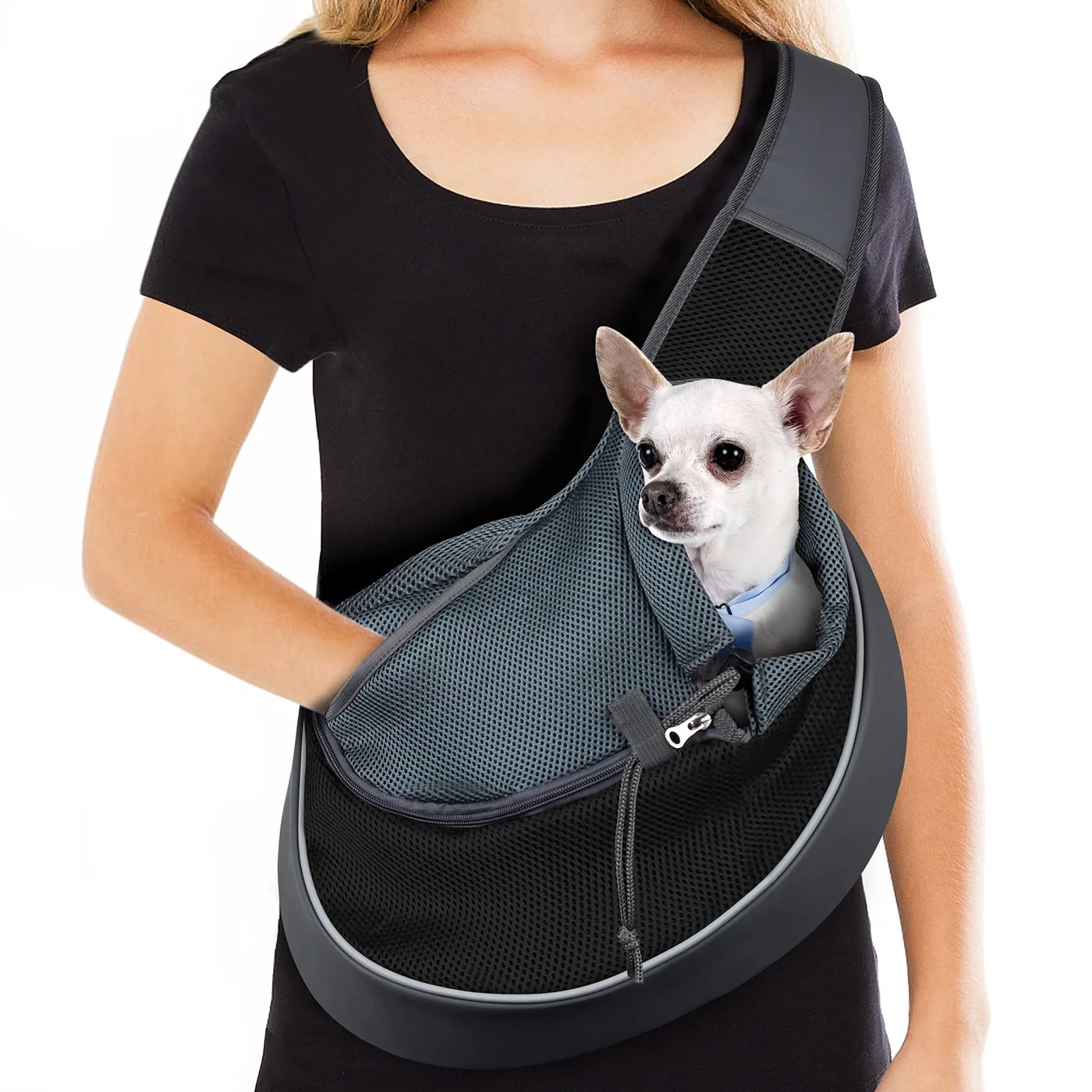
Containment: Why Two Closure Stages Are Mandatory
This is the section most likely to be skipped by a brand team unfamiliar with the behaviour, and it is the one that produces incidents. A single closure on a sling is not adequate, and the reasoning is specific.
Consider the geometry of escape. The animal sits in a pouch opening upward and inward, bounded on one side by the handler's torso. Any gap in the closure is therefore not an exit to open air but an exit to a climbable surface leading upward. Cats climb rather than flee when startled, and the natural direction is toward the handler's shoulder and head, which is precisely where the handler cannot see or reach calmly.
Two stages change the failure probability from single to compound. The primary stage is a closure that keeps the pouch shape and creates the main barrier - normally a zipper running along the pouch mouth, ideally curved rather than straight, since a straight run under tension from a filled pouch is harder to keep closed than a curved one. The secondary stage is a mechanical restraint independent of the primary: a clip through the slider pull, an over-top strap with a side-release buckle, or a fold-over flap with press-studs.
Zipper orientation deserves specific guidance here. Because the animal presses outward against the line from inside, a coil chain oriented so its opening faces away from the pouch interior performs far better than one facing inward, and the storm flap should sit between the animal and the slider rather than outside it.
An additional control sits above the secondary closure in some designs: a partial upper net or gusset panel that limits how far upward the animal can travel even if both stages somehow fail. It costs little, it is invisible in most presentations, and it converts a serious escape into an awkward but manageable one.
A small operational addition pays back disproportionately here: a handling instruction card showing how to load and clip the animal while the pouch is still off the body. Because the single most dangerous moment in this format is transfer rather than carry, and because it happens before any closure is engaged, instruction design is part of the safety engineering rather than an afterthought.
Finally, the interior tether point is mandatory in this format rather than optional. Clipping the animal before opening a sling is the single most valuable control available to a handler managing proximity escape risk, and the anchor construction elsewhere in this range applies unchanged.
Load Path and the Realistic Weight Ceiling
Slings distribute load differently from shoulder bags because the pouch rests against the torso rather than hanging from a point, and that gives the format both its comfort advantage and its hard limit.
The advantage is real. Because the pouch bears partly on the hip and abdomen rather than entirely on the shoulder, a sling carrying 4 kg is generally more comfortable than a shoulder bag carrying the same. Load is shared across a large contact area, and the strap's role becomes holding the assembly in place rather than suspending it. The gain is largest for smaller handlers, who typically struggle most with concentrated single-point shoulder loads.
The limit follows from the same physics once past that point. Beyond about 6 kg of animal, the pouch begins to pull away from the torso under its own moment, load transfers back into the strap, and the handler ends up carrying a shoulder bag with worse geometry. Sizing above that figure does not make the product stronger; it makes it behave like the wrong product.
Strap width can be relaxed slightly against the shoulder-bag figures, since less load passes through it, with 38-50 mm being comfortable at typical loadings. Padding can also be reduced for the same reason, which is part of why the format is lighter overall.
Cross-body geometry remains the standard routing, and for good reason: it holds the pouch against the torso, which is exactly where this format wants the load. A single-shoulder routing puts the pouch in tension away from the body, undoing the entire advantage.
The fourth is sizing honesty, which this format pays for more than most because its usable range sits inside the middle of the cat population. Products marketed for "cats up to 9 kg" invite exactly the purchase that produces a bad review, since above 6 kg the pouch stops behaving as intended. Stating 3-6 kg and naming the alternative format costs nothing and protects the rating.
Weight banding should therefore be stated plainly in documentation, typically 3-6 kg of animal, and it should not be stretched upward for commercial reasons. Programmes serving larger cats are better served by directing those customers to the backpack or tote families, where the geometry supports what is being carried.
The Thermal Problem Created by Carrying Against a Body
Carrying an animal against a human torso creates a heat load no other format faces, and it is routinely underestimated because nobody notices it in a showroom. Human core temperature is well above the temperature at which a furry animal starts accumulating heat, and the contact area in this format is large.
Quantify it first. Skin temperature at the torso surface under clothing sits near 33-35 °C, and a pouch pressed against it receives conducted heat continuously. Meanwhile the animal's own metabolic output adds perhaps 8-12 watts for a mid-size cat, all of it trapped in the pouch volume with only the outer face available for exchange.
The available face is the one pointing away from the handler, and it is typically less than half the pouch surface. Ventilation strategy therefore concentrates there: large apertures on the outer face with 22-30% effective open area, plus whatever can be delivered at the top edge without compromising containment.
A separation layer helps substantially. A 6-10 mm closed-cell foam barrier between handler and animal slows conduction enough to matter and costs little, which is one reason the hammock panel is built as a composite rather than as a simple lining. Programmes selling into warm climates should consider doubling that thickness in the handler-facing layer.
Measurement closes it, as elsewhere: a two-hour test at 30 °C ambient with the pouch worn against a heated form simulating skin temperature, accepting interior rise below 5 °C at the animal's position. Products that fail usually fail at the handler-facing face rather than at the ambient one.
Washability as a Primary Rather Than a Secondary Requirement
Slings are washed far more often than any other carrier format, because the pouch is in contact with animal and handler together and because the products are usually smaller and more clearly textile. A sling is effectively a garment, and it has to be specified the way garments are specified.
Everything removable or nothing should be the rule. Either every insert - hammock foam, base stiffener, mat - lifts out through a closure so the shell goes in a domestic machine, or the product is designed to be washed whole with those elements permanently enclosed. The worst answer is a permanently enclosed board in a pocket that partially traps water and takes days to dry.
Drying behaviour deserves specific attention for that reason. Closed-cell foam does not retain water, but a textile sleeve does, and an insert whose cover holds moisture will smell within a season. Specifying open-structured covers over closed-cell cores and keeping panel counts low addresses this directly.
Temperature sets the cycle count requirement. A domestic 40 °C cycle is the realistic upper bound for printed or coated components, though 60 °C gives far better hygiene where materials allow, and the specification should state the figure at which thirty-cycle validation was run rather than leaving it implicit.
Validation then covers dimensional change within 3% measured both along length and across width, since pouch panels behave differently in the two directions once a curved seam is involved, colour change grade 4 or better, seam integrity above 85% retention, no foam degradation after tumble or line drying, and no loss of water resistance beyond one grade. Thirty cycles approximates two years of monthly washing, which is the realistic service life.
Developing a Curved Pouch From Flat Panels
Pattern development for this format is where the difference between a competent and an excellent product shows up, because a pouch that fits a torso cannot be cut flat and expected to behave. Three techniques do the work.
Darting converts flat panel into developed curve. Darts are placed where they are least visible and where they do not fall across the animal's contact zone, typically toward the strap ends and along the lower edge, and they must be pressed rather than merely sewn or they create ridges inside the pouch.
Gusseting adds volume where the animal needs it rather than uniformly. A single wide gusset running the length of the pouch is usually superior to two narrow ones at the ends, because it increases depth through the middle where the animal sits while keeping the ends tidy against the handler.
Binding and edge finishing matter more than usual here because there is no structure holding anything in plane, so every edge is working. A bound edge with adequate width and a slightly elastic binding behaves well; a narrow turned edge curls out of plane within weeks and starts looking untidy immediately.
Seam placement then follows the composite panel. Where a laminated hammock meets the shell, seam allowances should be oriented so that the bulk does not press into the animal's contact zone, and where an insert is removable, the closure must be reachable without inverting the whole product, which is the difference between a feature customers use and one they ignore.
Behavioural fit deserves a note alongside fit grading, because the two interact. Animals that tolerate proximity carry settle into the pouch and stop moving, which improves stability for the handler considerably, while animals that do not tolerate it brace continuously and make the product feel heavier and less stable than its weight suggests. Nothing in the pattern can resolve the second case, but partial visual screening - raising the pouch wall on the outward side - measurably increases the proportion of cats that settle.
Finally, fit grading across handler sizes is a real but bounded problem. Because the pouch drapes, one size covers a wide range of torsos, and the adjustability should instead be carried in the strap - where the range costs nothing - rather than in pouch volume where it would compromise containment.
Test Additions and Programme Notes
Five additions cover what the standard protocol misses for this format, and all are cheap to run at development.
Hammock deflection is measured on a worn form rather than on a bench: rated load distributed over the sitting area, deflection logged at pouch centre, acceptance below 12 mm with full recovery. Because the result depends on suspension tension rather than only on panel stiffness, the strap length and form dimensions used must be recorded as part of the method.
Two-stage closure testing verifies that both stages are independent. Each is tested to the escape standard in isolation with the other open, rather than testing them together, since that is the only way to establish that neither is decorative.
Thermal testing against a heated form at 33-35 °C for two hours at 30 °C ambient, accepting less than 5 °C interior rise at the animal's position, reflects the handler-facing heat load that makes this format distinctive.
Wash validation runs thirty cycles at the stated temperature, using the whole assembled product rather than component swatches, because many failures in this format are assembly-level - differential shrinkage between the hammock cover and shell, for instance.
Cost lands at 11-20 USD FOB, making this the lowest unit-cost format in the cat range and the one carrying the least tooling, usually just clicker dies and printed art. Textile inputs are screened against restricted-substance criteria published by OEKO-TEX, and handling welfare framing is cross-checked against guidance from the American Veterinary Medical Association. Programme terms close unchanged: prototypes in 6-10 working days, bulk 35-50 days, AQL 2.5, T/T 30/70, FOB Xiamen. Related reading includes washable cover hygiene and the page on shoulder bag hands-free design.
Production capability
- SGS-verified production space of 4,950 m², 149 machines, 7 assembly lines
- Pet carrier and pet bag output since 2014 from a 137-person team
- 200,000 units shipped monthly under BSCI and ISO 9001 systems
People Also Ask
What makes a sling different from a soft shoulder bag?
It cannot stand unaided and carries the animal against the torso in a pouch rather than a restable enclosure. If any structure lets it stand as a box, specify it as a shoulder bag instead.
Why does a sling need a stiff base panel?
An unsupported cat sits with its spine flexed around a compliant surface for the whole journey. A composite hammock of 6-10 mm foam or 3-5 mm moulded EVA holds deflection under 12 mm.
Why must a sling have two closures?
Escape exits onto the handler, and a startled cat climbs upward toward the neck. Two independent stages make failure compound rather than single, and neither should be decorative.
How much weight can a sling carry?
3-6 kg of animal. Beyond about 6 kg the pouch pulls away from the torso and the load transfers back into the strap, making it behave like a poor shoulder bag.
Does carrying a cat against the body overheat it?
It can. Torso skin sits near 33-35 °C and contact area is large, so a foam separation layer plus 22-30% effective open area on the outer face are required, verified against a heated form.
Can the whole sling be machine washed?
Either every insert removes so the shell washes alone, or it is designed to wash whole with closed-cell cores permanently enclosed. A board trapped in a pocket that holds water is the worst option.
How much does a cat sling cost to produce?
11-20 USD FOB, the lowest in the cat range, with tooling limited to clicker dies and printed art, at MOQ 500 pieces per colourway.
Frequently Asked Questions
Why should the sling not rely on the handler's torso for stiffness?
Handlers vary and fit varies. A product that works only when worn tightly fails when worn loosely, so the hammock must carry support independently of the body.
How does suspension tension affect deflection?
Directly. Because the hammock is suspended rather than supported, deflection depends on panel stiffness and on how taut the suspension is, so the load path must run continuously through to the strap.
Why should the hammock be wider at the rear?
To match the animal's outline rather than being rectangular, which improves evenness of support and reduces the tendency of the animal to slip toward one end of the pouch.
What form should the main closure take?
A zipper along the pouch mouth, ideally curved rather than straight, since a straight run under tension from a filled pouch is harder to keep closed.
How should the zipper chain be oriented?
With the opening facing away from the pouch interior, because the animal presses outward from inside, and the storm flap belongs between the animal and the slider rather than outside.
What is the value of an upper net panel?
It limits how far upward the animal can travel if both stages fail, converting a serious escape into an awkward but manageable one for very little cost.
Is the interior tether optional in this format?
No. Clipping the animal before opening is the most valuable control available given proximity escape risk, and the anchor must reach the load-bearing strap rather than end in face fabric.
Why is a sling more comfortable than a shoulder bag at the same weight?
Because the pouch bears partly on the hip and abdomen rather than entirely on the shoulder, spreading load over a large contact area so the strap holds rather than suspends.
Can strap width be reduced against shoulder-bag figures?
Yes, to around 38-50 mm, because less load passes through the strap. Padding can be reduced for the same reason, which is part of why the format is lighter overall.
Why is cross-body routing standard for slings?
It holds the pouch against the torso, which is where this format wants load. Single-shoulder routing puts the pouch in tension away from the body and undoes the advantage.
What thickness of separation layer is used?
6-10 mm of closed-cell foam between handler and animal, doubled in warm-climate programmes, since conduction from torso skin is continuous throughout the journey.
Why validate whole rather than component swatches?
Because the failures are assembly-level: differential shrinkage between hammock cover and shell, or seam distortion caused by different recovery rates after washing.
How is hammock deflection measured?
On a worn form rather than a bench, with strap length and form dimensions recorded as part of the method, since suspension tension contributes to the result alongside panel stiffness.
What is the recommended animal weight band?
3-6 kg, stated plainly in documentation. Larger cats should be directed to the backpack or tote families where the geometry supports what is being carried.
Talk to QUANZHOU JUNYUAN BAGS about a pet carrier program: MOQ 500 pieces per colourway, samples in 6-10 working days, bulk production in 35-50 days under AQL 2.5 inspection.
Get a free quote Request a sample