Cat Carrier Soft Sided: Lightweight Design
A soft sided cat carrier for the 3.5-7 kg class should land at 900-1,500 g empty, which is a weight budget of 22-34 grams per litre of usable interior volume. That is achieved with a 300-420D shell fabric at 120-180 g/m², a hollow PP or foam-cored floor board of 4-6 mm, and a frameless spring-hoop structure replacing sewn-in frames.
This page treats lightweight soft-sided construction as an engineering budget rather than a list of light materials. Every gram removed from fabric, board or hardware has to be paid for somewhere: in tear strength, in floor deflection, in handle pull strength or in the shape retention that customers judge within seconds of picking the product up. The method is to allocate a grams-per-litre target, spend it against measured component masses, and then verify that the reduction did not move any structural acceptance limit. Four components carry almost all of the opportunity — shell fabric, floor board, frame and hardware — and each is covered with the trade-off, the cost and the verification. Commercial terms follow the standard programme: MOQ 500 pieces per colourway, prototypes in 6-10 working days, bulk production 35-50 days after sample approval, final random inspection to AQL 2.5, T/T 30/70 and FOB Xiamen.
Choose a pet bag supplier that keeps the cat carrier pattern card on file for at least twelve months, so a repeat order matches the approved sample instead of drifting.
Setting the Weight Budget: Grams per Litre of Usable Volume
Weight targets expressed as a total mass are useless for design because they do not scale with size. A 900 g carrier is either a triumph or an overbuild depending on whether it holds 30 litres or 55. The metric that does drive decisions is grams of empty product per litre of usable interior volume, and for the cat class the working band is 22-34 g/L.
Usable volume is the figure that matters and it is not the geometric volume. Subtract the floor board thickness, the pad, the interior pocket projections and the dead space behind tapered ends. In practice a carrier with a nominal 48-litre envelope reports 40-42 litres of usable volume, and specifying against the nominal figure produces a product that looks light on paper and feels heavy in the hand.
The budget is allocated before any material is chosen. For a 42-litre usable volume at 28 g/L the total is 1,176 g, and a reasonable split is shell and lining fabrics at 34%, floor and structure at 26%, hardware and trim at 18%, pad and interior fittings at 14%, and assembly consumables — thread, binding, adhesive, seam tape — at 8%. That last line is the one programmes forget: thread and binding on a carrier of this size contribute 60-110 g, and a heavier thread specification moves the number more than a fabric downgrade saves.
| Component group | Target mass (g) | Share | Reduction lever |
|---|---|---|---|
| Shell and lining fabrics | 380-430 | 34% | Denier and coating weight |
| Floor board and structure | 290-330 | 26% | Hollow or foam-cored board |
| Hardware and trim | 190-230 | 18% | Component count, alloy choice |
| Pad and interior fittings | 150-180 | 14% | Quilt weight, pocket count |
| Assembly consumables | 85-110 | 8% | Thread count, binding width |
| Total | 1,095-1,280 | 100% | 26-30 g/L |
The budget has a floor. Below about 20 g/L in this class the product stops holding its shape when empty, which is the first thing a retail customer and a buyer both notice, and the floor board is usually the component that has been cut to get there. A weight target is an allocation problem: the number only has meaning once it has been spent against measured component masses.
Fabric Denier and Grammage: Removing Mass Without Losing Tear Strength
Fabric is the largest line in the budget and the easiest to reduce badly. The instinct is to drop from 600D to 300D and take the 40% mass saving, but denier reduction costs tear strength disproportionately, and tear strength is what stops a claw puncture from becoming a panel failure.
The measured relationship for polyester woven fabrics is roughly linear between grammage and tensile strength, but closer to quadratic between grammage and tear resistance. Halving the grammage halves the tensile figure and cuts the tear figure by 55-65%. Since cat-carrier field failures are puncture-and-tear failures rather than tensile ones, denier reduction has to be compensated structurally rather than accepted.
Two constructions do that compensation well. Ripstop grids — a heavier yarn at 8-12 mm intervals in both directions — restore tear resistance for 8-15 g/m² of added mass, which is a fraction of what the denier reduction saved. A ripstop 300D at 140 g/m² outperforms a plain 420D at 180 g/m² on tear and is 40 g/m² lighter. The second route is a coating: 20-30 g/m² of TPU dry solids binds yarns against propagation and adds liquid resistance at the same time, though it stiffens the hand.
| Specification | Grammage (g/m²) | Tear (N) | Mass per carrier (g) | Notes |
|---|---|---|---|---|
| 600D polyester, PU coated | 240-280 | 55-70 | 520-610 | Reference, overbuilt for cats |
| 420D polyester, PU coated | 170-200 | 38-48 | 370-440 | Balanced default |
| 300D ripstop, TPU coated | 135-160 | 42-55 | 290-350 | Best mass-to-tear ratio |
| 210D ripstop, silicone | 95-120 | 26-34 | 210-260 | Lightest, needs a liner |
Coating chemistry is part of the mass decision and not separate from it. PU coatings at 25-35 g/m² are the default and the lightest option; TPU at the same weight costs 15-30% more and resists hydrolysis, which matters for a product that will be wiped down repeatedly. Silicone finishes save a further 5-10 g/m² but reduce printability and seam strength.
Lining fabric is where mass is often lost twice. A separate printed lining adds 90-140 g and exists mostly for appearance; a single-shell construction with a bonded backer achieves the same visual result for 25-40 g. The cheapest grams in any soft-sided carrier are the ones removed from a component that was only ever carrying appearance.
Frameless Structure: Perimeter Wire, Spring Hoop and Tensioned Panels
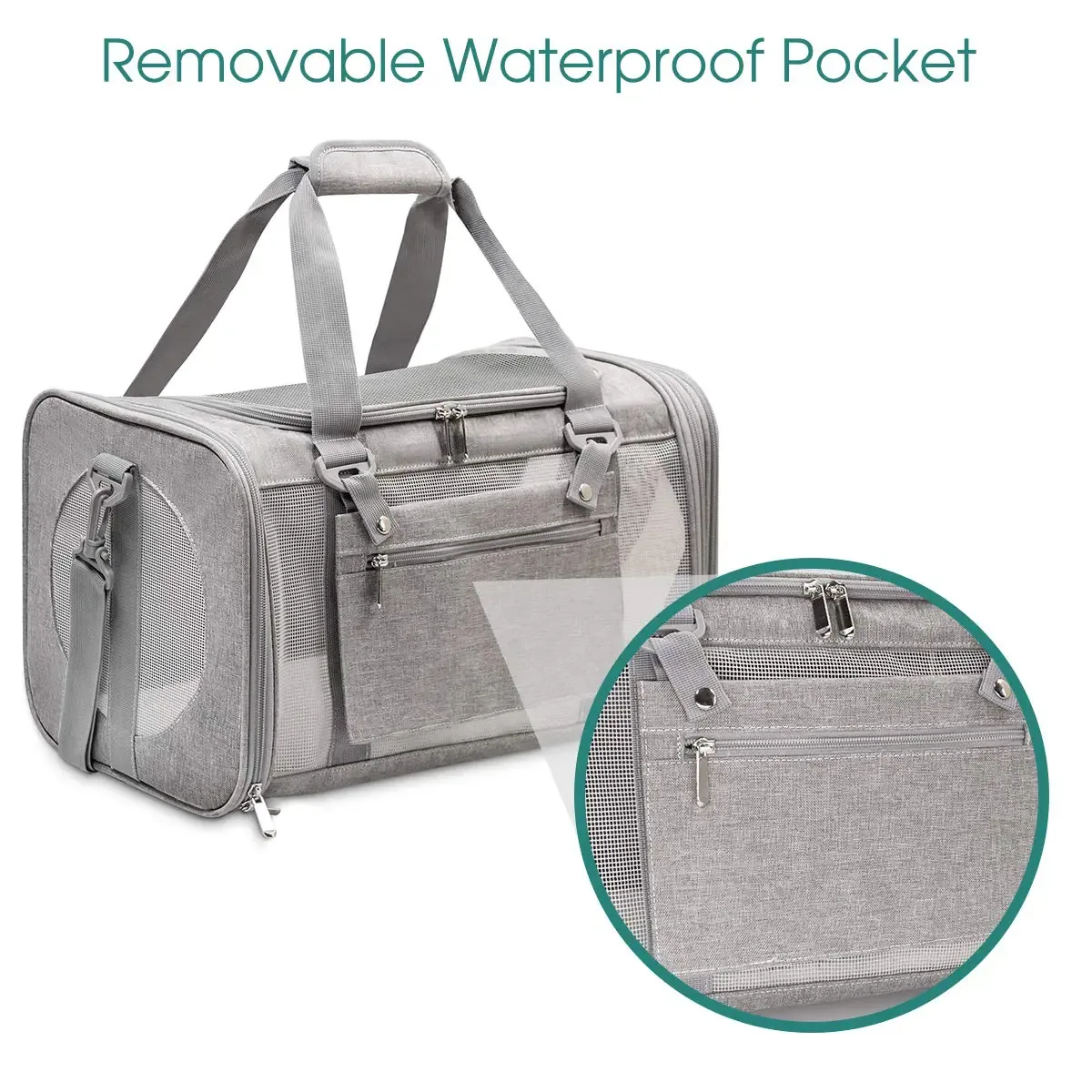
Soft-sided carriers hold their shape either by a frame or by tension, and the frame is usually the heavier answer. A sewn-in steel or polymer frame at the base perimeter plus verticals contributes 180-320 g in this class; a tensioned-panel structure with a spring hoop contributes 60-140 g for comparable shape retention, and it collapses less predictably under load.
The spring hoop is the standard mechanism: a continuous elastic steel or glass-fibre rod of 3-5 mm diameter, run through a sleeve at the panel perimeter, pre-loaded into a shallow arc. The hoop puts the panel into membrane tension, so the fabric carries load rather than bending, and the assembly gains stiffness without mass. Rod diameter is set by the buckling load, and for a 45-55 cm span a 4 mm steel rod or a 5 mm pultruded glass-fibre rod is the working choice.
Pre-load geometry matters more than rod diameter. A hoop with a rise of 5-8% of its span gives visible shape without fighting the fabric; a rise above 12% produces a carrier that resists closing and stresses the zipper chain at the corners. The sleeve should be a separate binding of 20-25 mm with the ends bar-tacked, because a hoop that escapes its sleeve turns the carrier into a wire cage in one cycle.
Tensioned panels need one additional control that framed structures do not: seam creep. Under sustained load a woven panel relaxes and the shape sags, so the acceptance test is not an instantaneous measurement but a 24-hour loaded soak with a shape check afterwards. A carrier that holds 42 litres when new and 38 after a week has failed regardless of its initial appearance.
Where a ridged base is required — and most cat programmes do require it — a perimeter wire of 2.5-3.5 mm spring steel in a bound sleeve gives the base its outline at 70-120 g against 200-300 g for a moulded frame. The wire route allows the product to be packed flat for freight, which is worth more than the mass saving on bulky products. Frameless construction trades predictable collapse for mass and freight volume, and the trade is worth making when the tension path is engineered rather than assumed.
Lightweight Floor Boards: Hollow PP, Honeycomb and Foam-Cored Options
The floor board is the heaviest single component in most soft-sided carriers and the one whose reduction is most visible to the cat. A board that flexes is felt immediately: cats brace against a moving surface, and the resulting behaviour — refusal to settle, digging, bracing at the corners — is the most common source of returns in the category.
Deflection, not strength, is the governing criterion. A board strong enough not to break can still be too flexible to be acceptable, and the accepted limit for the cat class is deflection under 4 mm across the floor span at a 10 kg distributed load, with a point-load check at 150 N through a 40 x 40 mm pad. Those two numbers, not a bending strength figure, should appear on the specification.
| Construction | Thickness (mm) | Mass (g) | Deflection at 10 kg | Cost (USD) |
|---|---|---|---|---|
| Solid PP board | 4.0-5.0 | 320-430 | 2-3 mm | 1.10-1.90 |
| Hollow PP flute board | 5.0-8.0 | 180-260 | 3-5 mm | 0.85-1.50 |
| PP honeycomb, skinned | 6.0-10.0 | 140-210 | 2-4 mm | 1.60-2.90 |
| EVA foam-cored laminate | 8.0-12.0 | 200-300 | 4-7 mm | 1.20-2.20 |
| Corrugated PP with rail | 4.0 + 12 mm rail | 210-290 | 2-3 mm | 1.40-2.40 |
Hollow flute board is the default at 0.85-1.50 USD and gives an acceptable result when the flute direction runs across the short span. It has two failure modes worth specifying against: creep under sustained load, and edge crush where the board meets the shell seam. Both are controlled by a bound edge — a 20 mm binding or a polymer U-channel glued and stitched — which adds 25-45 g and turns a marginal board into a durable one.
Honeycomb with a bonded skin is the best mass-to-deflection option and the most expensive. It also gives a flat, wipe-clean surface directly, which removes the need for a separate floor liner and recovers 60-100 g elsewhere in the budget. Programmes that specify honeycomb should specify the skin bond separately, because delamination at the skin is the common defect and it is invisible until the board is loaded.
Removability deserves a note. A board in a sewn-in sleeve cannot be replaced and cannot be cleaned underneath; a board in a hook-and-loop-closed sleeve adds 15-30 g of closure hardware and gives the owner access for cleaning, which for a cat carrier used for vet trips is worth the mass. Floor board selection is a deflection decision with a mass constraint, and the acceptance criterion has to be written in millimetres.
Hardware Mass Audit: Zippers, Buckles and the Cost of Trim
Hardware contributes 190-230 g in a typical soft-sided cat carrier, and the reduction available is real but smaller than it looks. The audit is worth running because it is fast: weigh every component, rank by mass, and ask what each one is carrying.
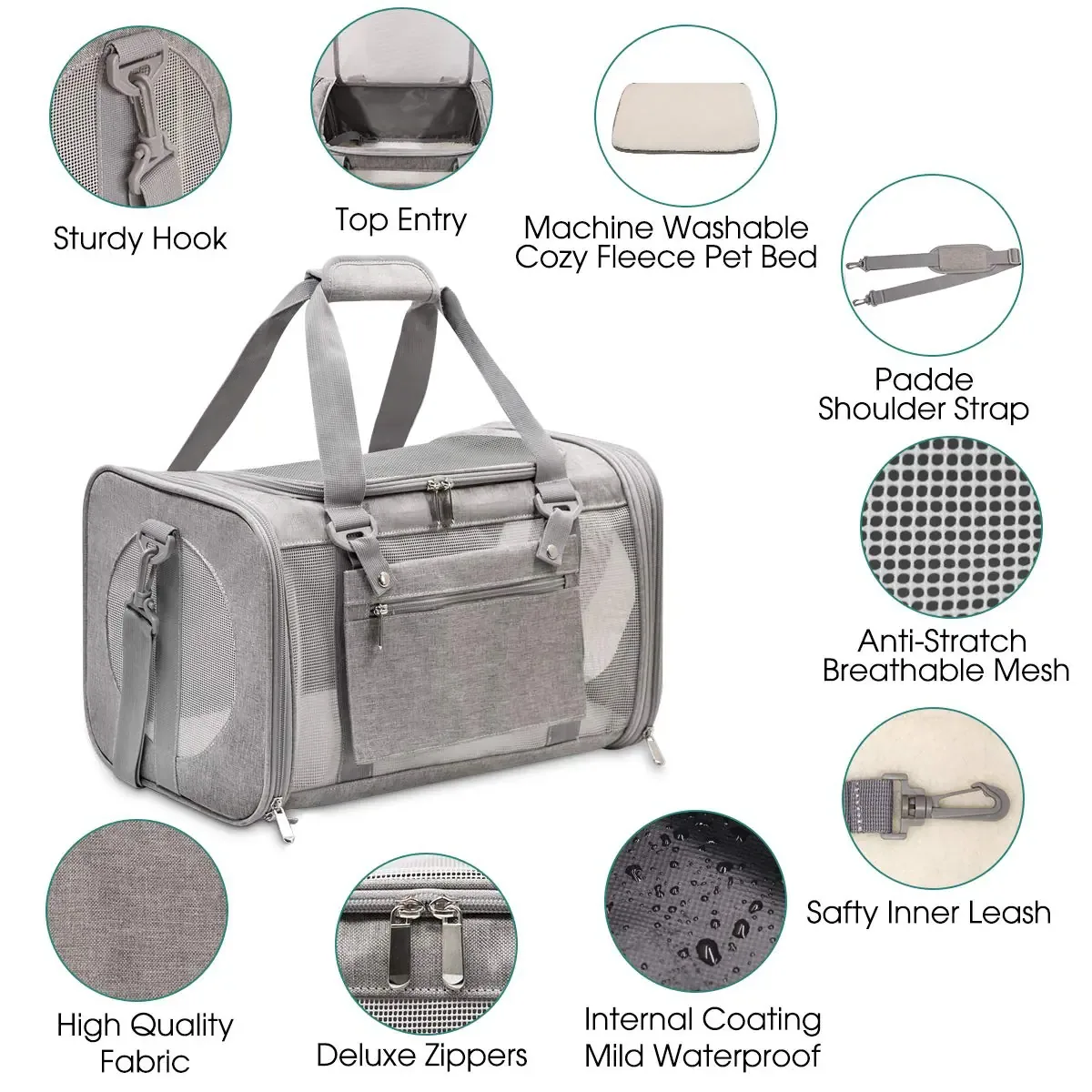
Zippers dominate the line. A #8 coil zipper at 1,100 mm of total chain length contributes 55-85 g with its sliders; dropping to #5 saves 20-35 g but reduces the chain's resistance to the specific failure cats produce — a claw hooked under the tape, loaded sideways. The working compromise is #5 on low-load openings such as pocket and expansion zippers and #8 on the main aperture, which keeps mass down where it can be and strength up where it cannot.
Buckles and adjusters are the second line and the easiest to over-specify. A 25 mm acetal buckle weighs 8-14 g against 18-28 g for a metal-cam version of the same rating; a plastic ladderlock saves 4-8 g over an alloy one. Where the load path carries only strap tension rather than a drop or a crash load, polymer hardware is correct and the saving is free. Where the hardware is in a safety path — a seat-belt anchor, a shoulder strap under crash load — the mass saving is not available and should not be attempted.
Trim is where programmes lose grams invisibly. Every binding, every label, every decorative webbing loop, every rivet and every reinforced corner patch adds mass, and they are specified one at a time by different people. A trim audit that removes decorative webbing loops, reduces binding width from 22 mm to 18 mm outside the load paths, and consolidates three labels to one recovers 40-70 g at no functional cost.
Thread deserves separate mention because it is invisible in both senses. Moving from a 40s to a 60s thread and reducing seam allowance from 12 mm to 10 mm outside the structural seams saves 20-40 g, but the stitch density has to be held at 8-10 stitches per inch or the seam strength drops. A hardware audit is a component-by-component justification exercise: anything that cannot name the load it carries is a candidate for removal.
Verifying Structure at Reduced Mass
Reducing mass moves acceptance limits, and the only way to know where the new limits are is to re-run the structural protocol against the lightened sample rather than against the original one. Three tests carry most of the information: floor deflection, handle and strap pull, and a loaded drop.
Floor deflection is measured on a supported-span rig with the board in its assembled state, loaded to 10 kg distributed and then to 150 N point load through a 40 x 40 mm pad, with a dial gauge at mid-span. Acceptance is under 4 mm distributed and under 6 mm point, held for 60 seconds with under 1 mm of permanent set after unloading. The same test run after a seven-day 40 °C soak catches creep that a fresh-board test will not.
Handle and strap pull testing is where lightweighting fails most often, because the load path from handle to shell passes through fabric that has just been made thinner. A handle pull at 4x rated load — 400 N for the 10 kg class — held 60 seconds, and a shoulder strap pull at 250 N, with acceptance of no stitch elongation above 2 mm and no tear at the anchor. Where the anchor is a webbing loop stitched to a single panel, the fix is a load-spreader patch of 200-300 g/m² at 80 x 80 mm rather than a heavier shell fabric overall, which is the cheaper way to buy the same strength.
Drop testing at reduced mass is counter-intuitive and worth stating: a lighter carrier often survives better, because impact energy scales with total mass. A 1,100 g carrier dropped from 0.8 m carries roughly 30% less energy than a 1,500 g one. The test is still run, six orientations onto concrete, but the usual finding is that the lightened product passes more easily and the interesting failures move to the components that did not lose mass — the board, the hoop and the zipper chain.
Shape retention closes the set and is the test most often skipped. An empty carrier is photographed against a reference grid, loaded to 10 kg for 24 hours, unloaded, and re-photographed after one hour of recovery. Acceptance is a volume loss under 5%. Method references for conditioning and textile testing follow practice published by ASTM International, and all textiles and coatings are screened against OEKO-TEX criteria before the mass reduction is signed off.
What Mass Reduction Buys: Carry Comfort and Freight
The engineering case for lightweighting is not the number on the specification sheet; it is what the number does downstream. Two effects dominate, and both are worth quantifying before a programme commits to an aggressive target.
Carry comfort is the first. A cat carrier is carried by the handle in short bursts and by a shoulder strap for longer periods, and in both cases the perceived load is the combined mass of carrier and cat. At a 5 kg cat, moving the carrier from 1,500 g to 1,100 g reduces total carried mass by 6%, which is below the threshold most people notice. Moving it from 1,500 g to 900 g reduces it by 10%, which is at the threshold. The practical conclusion is that aggressive lightweighting pays off in shoulder-carried configurations and in the loaded-and-unloaded handling a customer does at home, and pays very little for the person carrying a 5 kg cat across a car park.
Freight is the second and usually the larger effect. Soft-sided carriers are bulky and ship by volume rather than by mass, so a weight reduction alone does not change freight cost. What changes freight cost is the dimensional consequence: a frameless, lighter structure can be nested or compressed for shipping, and reducing board thickness from 8 mm to 5 mm on a 500-piece order recovers measurable carton volume. Programmes that combine lightweighting with a pack-flat or nested carton design typically recover 12-20% of freight cost, which at current rates exceeds the entire unit cost of the material removed.
Retail presentation is the third effect and the one buyers care about. A carrier that holds shape at 26 g/L reads as a quality product; one that slumps at 22 g/L reads as cheap regardless of its materials. The weight target therefore has to be set alongside a shape-retention acceptance limit, not independently of it.
There is also a downstream durability consideration that justifies a conservative target for some programmes. Lighter fabrics abrade through faster at the contact points — the base corners, the handle grip, the strap contact — and a carrier sold into a rental, clinic or multi-cat household will see far more cycles than a single-pet retail unit. Lightweight is a specification with an application: the target that suits an occasional-use retail carrier is not the target for a daily-use professional one.
Cost, Tooling and Programme Notes
Lightweighting a soft-sided cat carrier is unusual among engineering changes in that it is close to cost-neutral. The materials that save mass — ripstop constructions, hollow board, polymer hardware — are not systematically more expensive than the heavier alternatives, and some are cheaper. Hollow flute board at 0.85-1.50 USD undercuts solid PP board at 1.10-1.90 USD; polymer buckles cost less than alloy ones. The net effect of a well-executed lightweight redesign is typically a unit cost change of -0.40 to +0.60 USD against a mass reduction of 15-25%.
The costs that do appear are in development rather than in materials. A ripstop fabric may need a separate colour-matching run, which at 500 pieces per colourway is a real constraint on how many colourways a programme can carry. A honeycomb board needs a die tool at 800-2,200 USD if the shape is non-standard. A frameless hoop structure needs one more sampling round than a framed one, because pre-load geometry is adjusted empirically rather than calculated.
MOQ is 500 pieces per colourway, and lightweight programmes should note that material availability tightens at lower deniers: 210D and 300D ripstop constructions have fewer colour and coating options than 600D, so the colourway plan should be settled before the fabric is ordered. Lead times are unchanged: prototypes in 6-10 working days, bulk production 35-50 days after sample approval.
Inspection needs one addition for lightweight builds. Because the acceptance margins are tighter, AQL 2.5 inspection on a lightened product should include a floor deflection check on a sample of five units per lot and a shape-retention check on two, with measured values recorded rather than pass/fail so that drift is visible. Our production team runs these checks through the SGS-verified production base under ISO 9001 and BSCI coverage, and terms are T/T 30/70 against FOB Xiamen loading. A lightweight specification is only safe when the inspection plan measures the margins it removed.
Production capability
- SGS-verified production space of 4,950 m², 149 machines, 7 assembly lines
- Pet carrier and pet bag output since 2014 from a 137-person team
- 200,000 units shipped monthly under BSCI and ISO 9001 systems
People Also Ask
How much should a soft sided cat carrier weigh?
900-1,500 g empty for the 3.5-7 kg cat class, which works out at 22-34 grams per litre of usable interior volume. Below about 20 g/L the product stops holding its shape when empty.
What fabric denier is best for a lightweight cat carrier?
A 300D ripstop at 135-160 g/m² with a TPU coating of 20-30 g/m² gives the best mass-to-tear ratio. Plain 420D at 170-200 g/m² is the balanced default; 600D is overbuilt for cats.
Why does reducing denier hurt tear strength more than tensile strength?
Tensile strength falls roughly linearly with grammage but tear resistance falls closer to quadratically, so halving grammage cuts tear by 55-65%. Cat-carrier field failures are puncture-and-tear, not tensile.
Can a soft carrier hold shape without a frame?
Yes, with a spring hoop of 3-5 mm in a bound sleeve pre-loaded to a rise of 5-8% of span, which puts the panel into membrane tension. The acceptance test is a 24-hour loaded soak, not an instantaneous measurement.
Which floor board gives the best weight-to-deflection result?
Skinned PP honeycomb at 6-10 mm, running 140-210 g at 2-4 mm deflection. Hollow flute board at 5-8 mm is the cost-effective default but needs a bound edge to resist creep and edge crush.
How is floor deflection specified and measured?
Under 4 mm at a 10 kg distributed load and under 6 mm at a 150 N point load through a 40 x 40 mm pad, held 60 seconds on a supported-span rig, with under 1 mm permanent set and a repeat after a seven-day 40 °C soak.
Does lightweighting change freight cost?
Only through dimensions. Soft carriers ship by volume, so the saving comes from nesting or pack-flat cartons and thinner boards, which typically recover 12-20% of freight cost on a 500-piece order.
Frequently Asked Questions
What counts as usable interior volume?
Geometric volume less the floor board, the pad, interior pocket projections and the dead space behind tapered ends. A carrier with a 48-litre nominal envelope typically reports 40-42 litres of usable volume.
How should the mass budget be split?
Shell and lining fabrics 34%, floor and structure 26%, hardware and trim 18%, pad and interior fittings 14%, and assembly consumables such as thread, binding and seam tape 8%.
How much mass do thread and binding actually add?
60-110 g on a carrier of this size. A heavier thread specification can move the total more than a fabric downgrade saves, which is why it belongs on the budget sheet.
What coating weight is recommended on a lightweight shell?
20-30 g/m² of dry solids. TPU costs 15-30% more than PU at the same weight but resists hydrolysis through repeated wipe-downs, which suits a product used for vet trips.
Is a separate lining fabric worth its mass?
Rarely. A printed lining adds 90-140 g for appearance only; a single-shell construction with a bonded backer achieves the same visual result for 25-40 g.
What hoop rise is correct for a frameless panel?
5-8% of span. Above 12% the carrier resists closing and stresses the zipper chain at the corners, and the sleeve must be a separate 20-25 mm binding with bar-tacked ends.
Why is a bound edge specified on hollow flute board?
It controls both creep under sustained load and edge crush where the board meets the shell seam. A 20 mm binding or polymer U-channel costs 25-45 g and turns a marginal board into a durable one.
Should the floor board be removable?
Yes where the product is used for clinical trips. A hook-and-loop-closed sleeve adds 15-30 g of closure hardware and gives the owner cleaning access underneath the board.
Which zipper sizes belong on a lightweight build?
#5 on low-load openings such as pockets and expansion panels, #8 on the main aperture. Cats hook a claw under the tape and load it sideways, which is a failure a #5 chain resists poorly.
Where is polymer hardware not acceptable?
In any safety path — seat-belt anchors and shoulder straps under crash load. Those keep metal hardware regardless of the mass penalty; polymer is correct where only strap tension is carried.
How much mass does a trim audit recover?
40-70 g, by removing decorative webbing loops, reducing binding width from 22 mm to 18 mm outside load paths, and consolidating three labels into one.
What is the handle pull acceptance for the 10 kg class?
400 N held 60 seconds, with no stitch elongation above 2 mm and no tear at the anchor. The fix for a lightened shell is a 200-300 g/m² load-spreader patch at 80 x 80 mm rather than heavier fabric overall.
How is shape retention verified after lightweighting?
Photograph an empty carrier against a reference grid, load to 10 kg for 24 hours, unload, and re-photograph after one hour of recovery. Acceptance is a volume loss under 5%.
What is the typical unit cost effect of a lightweight redesign?
Roughly -0.40 to +0.60 USD against a 15-25% mass reduction, because ripstop constructions, hollow board and polymer hardware are not systematically more expensive than the heavier alternatives.
Talk to QUANZHOU JUNYUAN BAGS about a pet carrier program: MOQ 500 pieces per colourway, samples in 6-10 working days, bulk production in 35-50 days under AQL 2.5 inspection.
Get a free quote Request a sample