Cat Carrier Veterinary Clinic: Professional Use
A clinic-grade cat carrier needs a welded seamless interior with radiused corners of 25-40 mm, materials compatible with accelerated hydrogen peroxide, sodium hypochlorite at 1:32 and quaternary ammonium at label concentration, a removable base tray, and validation to 1,500 clean-down cycles. It must open fully from the top for examination without removing the animal.
A carrier used in a veterinary clinic is medical equipment adjacent rather than a travel accessory, and it is specified against an infection control protocol rather than against a journey. That changes almost every decision: the interior has to survive disinfection at label concentration several times a day, the geometry has to permit examination and treatment without removing a stressed animal, and the materials have to tolerate the specific agents a clinic uses rather than a generic claim of being wipeable. This page sets out the specification as a clinic would write it — agents and concentrations, cycle counts, contact times, surface geometry, and the validation evidence behind each — with the numbers a purchasing specification can quote. Commercial terms follow the standard programme: MOQ 500 pieces per colourway, prototypes in 6-10 working days, bulk production 35-50 days after sample approval, final random inspection to AQL 2.5, T/T 30/70 and FOB Xiamen.
In a private label pet carrier brief for cat carrier, the artwork file and the label compliance text are the two items that most often delay a first shipment.
What a Carrier Actually Sees in a Clinic
A clinic subjects a carrier to a combination of loads that a consumer product never meets, and the loads occur in the same hour rather than over a year. Writing them down as numbers is the first step, because the material specification follows directly from them.
Disinfection frequency is the first load. A carrier used as a holding enclosure in a busy practice is cleaned between patients, which is 6-20 disinfection cycles per day and 1,500-5,000 per year. That is two orders of magnitude more than a consumer product sees in its life, and it is the number that sets the coating and seam specification.
Chemical load is the second and it is specific rather than generic. A clinic uses a defined set of agents at defined concentrations: accelerated hydrogen peroxide, sodium hypochlorite diluted 1:32 or 1:10, a quaternary ammonium compound, a biguanide, or a peracetic acid blend. Each attacks materials differently, and a material compatible with one is not necessarily compatible with another.
Biological load is the third. A carrier holds an animal that may be shedding a pathogen, and the surfaces are contaminated with saliva, urine, faeces, blood and hair. The specification consequence is that every surface has to be reachable and every crevice has to be cleanable, because a surface that cannot be disinfected is a reservoir.
Physical load is the fourth and it is harder than in consumer use. A stressed cat claws, urinates and throws its weight against the closure; the carrier is carried, stacked and sometimes dropped. Closure strength and mesh specification are set by this load rather than by a journey.
Workflow load is the fifth and the least obvious. A carrier in a clinic is a restraint device, an examination position and a transport container in sequence, often within ten minutes. The geometry has to serve all three, which is why a top-opening design with a removable lid is the clinical standard.
These five loads together exclude most consumer designs. A clinic carrier is specified against a disinfection protocol and a workflow, and the protocol is what determines the materials.
Disinfectant Compatibility: Agents and Concentrations
Compatibility is the core specification and it has to be stated agent by agent, at the concentration a clinic actually uses, over a defined number of cycles. A generic "chemical resistant" claim is worthless here because the agents differ so much.
Accelerated hydrogen peroxide is the most common clinic agent and the mildest on materials. Used at label concentration with a contact time of 3-10 minutes, it is an oxidising agent that attacks some dyes and degrades some polyurethane coatings slowly. Most TPU and polyolefin surfaces tolerate it at 1,500 cycles; PVC coatings stiffen.
Sodium hypochlorite is the aggressive one. At a 1:32 dilution it is roughly 1,500-1,600 ppm available chlorine and it is used where a parvovirus or a similar resistant organism is a concern; at 1:10 it is around 5,000 ppm and is reserved for outbreak control. Hypochlorite oxidises dyes, attacks some coatings and corrodes metal hardware, and it is the agent most likely to end a carrier's life.
| Material | Accelerated H2O2 | NaOCl 1:32 | Quaternary ammonium | Biguanide | Peracetic blend |
|---|---|---|---|---|---|
| PU coating, 30 g/m² | Fair, slow hydrolysis | Poor | Fair | Good | Poor |
| TPU coating, 30-40 g/m² | Good | Fair | Good | Good | Fair |
| PVC coating | Poor, stiffens | Poor, plasticiser loss | Poor | Fair | Poor |
| Polyolefin coating | Excellent | Good | Excellent | Excellent | Good |
| Polypropylene tray | Excellent | Excellent | Excellent | Excellent | Excellent |
| Stainless hardware | Good | Fair, pits | Good | Good | Fair |
| Acetyl hardware | Good | Good | Good | Good | Fair |
Quaternary ammonium compounds are the gentlest on materials and the most likely to leave a residue. A quat film builds up over cycles, and it is both a compatibility problem — the film attracts soil — and an efficacy one, because a surface with residue is harder to wet. The protocol response is a rinse step, and the specification response is a surface smooth enough to rinse clean.
Contact time matters as much as concentration, and this is where a specification is often wrong. A disinfectant needs a defined wet contact time to achieve its claimed kill, and a surface that dries in 60 seconds does not achieve it. The practical guidance for clinical surface disinfection is published by the CDC for general principles and by professional bodies such as the American Veterinary Medical Association for practice-level protocols.
Corrosion of hardware is the second-order failure and it is specific to chlorine. A stainless zipper slider or a plated hook pits under repeated hypochlorite exposure and eventually fails; an acetyl or a nickel-free coated component does not. Where a clinic uses hypochlorite routinely, the hardware specification should exclude bare stainless.
Colour change is the visible consequence and it is specified, not accepted. The target is grey-scale 4 or better after 1,500 cycles, which effectively rules out light colours and certain dye classes on a surface that will see hypochlorite.
Compatibility is agent-specific, concentration-specific and cycle-counted: name the agent, the dilution and the number of cycles, and test all three together.
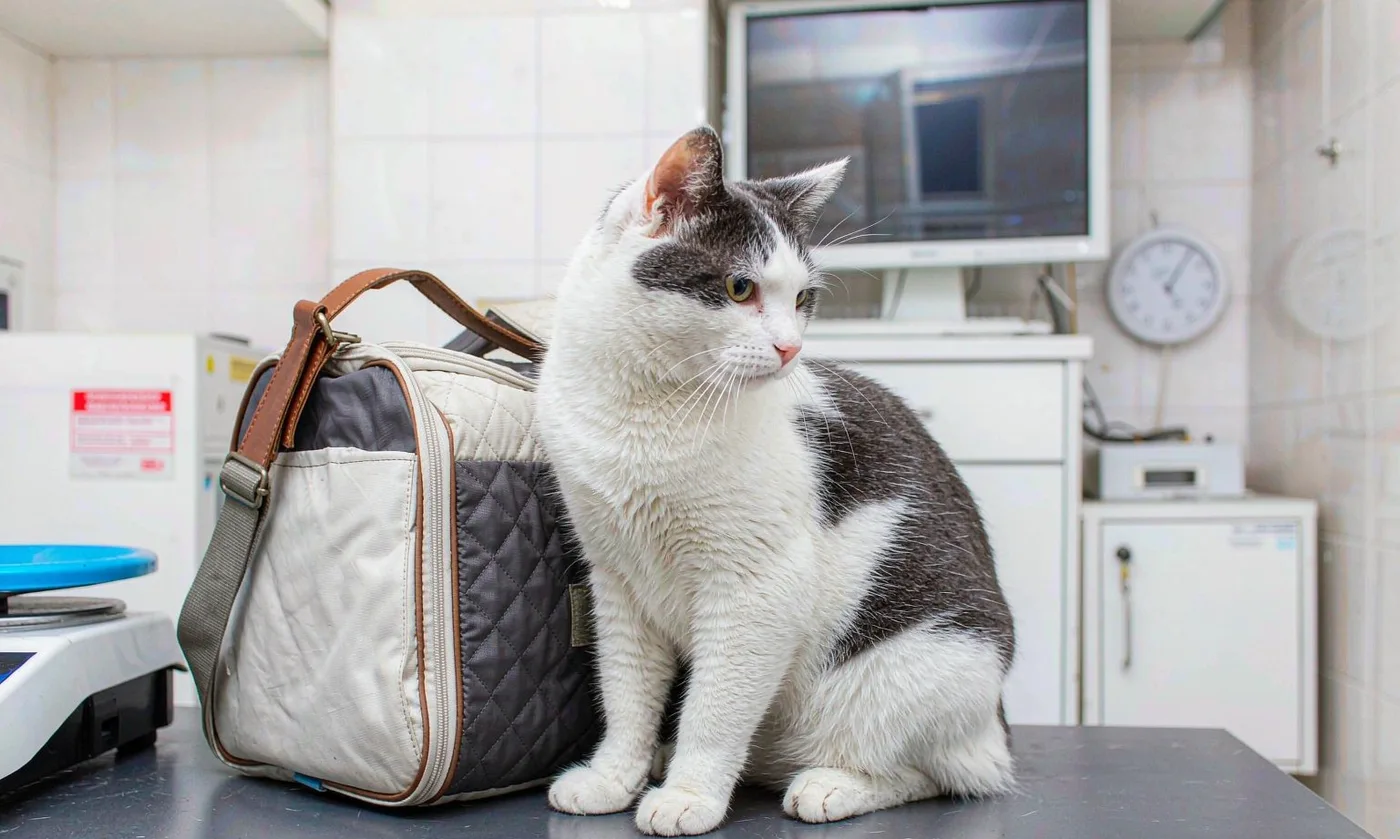
Surface Geometry for Clean-Down
A surface that cannot be reached cannot be disinfected, and in a clinical setting that is the whole problem. Geometry is therefore as much a specification as material, and it is where most consumer-derived designs fail.
Seams are the first issue. A sewn seam is a perforation line and a soil trap: fluid wicks into the stitch holes, and the seam cannot be wiped clean. The clinical specification is a high-frequency-welded or thermally bonded seam, which has no perforations and a smooth profile, at a cost premium of 0.40-1.20 USD over a sewn and taped seam.
Corners are the second issue. A square interior corner accumulates soil and cannot be wiped clean with a cloth; a radiused corner of 25-40 mm can. Every interior corner, including the wall-to-floor junction, should be radiused, and the floor should have no separate mat that can be lifted to reveal an uncleanable gap.
Crevices are the third issue and they are the ones designers introduce without noticing. A zipper chain, a hook-and-loop tape, a pocket flap, a strap tail, a label edge and a trim binding are all crevices. The clinical rules are: no exposed zipper chain without a cover flap, no hook-and-loop on a horizontal surface where soil can settle, no interior pockets, and no sewn-on labels on interior surfaces.
| Feature | Cleanable | Risk | Clinical alternative | Cost delta USD |
|---|---|---|---|---|
| Sewn seam | No | Wicking, soil trap | Welded or bonded seam | +0.40-1.20 |
| Square interior corner | No | Accumulation | Radius 25-40 mm | +0.10-0.40 |
| Exposed zipper chain | No | Soil in elements | Cover flap 20-30 mm | +0.15-0.45 |
| Hook-and-loop, horizontal | Poor | Hair and soil | Vertical placement or clip | +0.00-0.30 |
| Interior pocket | No | Reservoir | None | -0.20-0.60 |
| Fabric floor mat | Poor | Absorbs fluid | Polypropylene tray | +1.80-4.20 |
| Sewn-in label, interior | Poor | Edge reservoir | Printed or exterior label | +0.02-0.10 |
| Mesh panel, uncoated | Poor | Soil in weave | Coated mesh, 320 g/m² | +0.40-1.10 |
The removable tray is the component that makes a clinical carrier serviceable and it should be considered standard. A moulded polypropylene tray at 1.80-4.20 USD holds fluid, lifts out for cleaning or disposal, and can be replaced when it becomes scratched — because a scratched surface is a surface that can no longer be disinfected, and that is the point at which most clinical carriers should be retired.
Scratch resistance therefore deserves a specification, since it defines service life. A tray that resists a defined abrasion test without visible scratching retains its cleanability; one that scratches deeply in the first hundred cycles becomes a reservoir. Closed-cell polypropylene or a high-gloss thermoformed surface performs better here than a matte textured one.
Drainage is the last geometric element and it is useful in a clinic for a different reason than in grooming: a carrier used for an animal that has urinated or been bathed needs to be emptied without being carried to a sink. A welded spout of 12-20 mm at the lowest corner with a screw closure rated to hold 400 ml under a 20 N side load costs 0.40-1.00 USD.
Geometry decides cleanability: welded seams, radiused corners, no crevices and a replaceable tray are what make a surface disinfectable rather than merely wipeable.
Clinical Workflow: Access, Restraint and Examination
A carrier in a clinic is used as a restraint device before it is used as a container, and the workflow determines the geometry more than any other requirement. The sequence a veterinary nurse actually performs is: receive the carrier, assess the animal, examine or treat, then return or admit.
Top access is the first requirement and it distinguishes a clinical design from a travel one. A fully removable or fully hinged top allows an examination, an injection or a scan without taking the animal out, which is safer for the handler and less stressful for the cat. The specification is a top aperture of at least 85% of plan area with a closure that releases one-handed.
Partial opening is the second requirement and it is the detail that gets missed. A nurse often needs to open only part of the top — to reach a forelimb for venepuncture, or to offer food — and a lid that is either fully open or fully closed forces the animal to be either exposed or inaccessible. A two-stage closure, or a lid with a partial-open position, addresses it.
Restraint is the third requirement. An internal restraint panel that can be positioned to hold the animal to one part of the interior, rated 150-250 N and stowable flat, allows safe handling of a fractious cat. Combined with a top aperture it is what makes a carrier usable as a restraint rather than as a box.
| Step | Requirement | Feature | Specification | Failure if absent |
|---|---|---|---|---|
| Receive and assess | See the animal without opening | Large viewing panel | Over 30% of side area | Unnecessary opening |
| Examine in situ | Full top access | Removable or hinged lid | Over 85% of plan area | Animal removed, risk |
| Venepuncture | Partial limb access | Two-stage lid or port | 120-200 mm opening | Full exposure |
| Restrain fractious cat | Partial confinement | Internal restraint panel | 150-250 N rated | Handler injury risk |
| Weigh the animal | Carrier tare known | Printed tare weight | ±50 g | Incorrect dosing |
| Imaging | Radiolucent base | No metal in base | Polymer base only | Repeat exposure |
| Transfer to kennel | Safe hand-off | Two-handled base | Handles rated 400 N | Drop risk |
A radiolucent base is the requirement most often overlooked and it is cheap to provide. If a radiograph is taken with the animal still in the carrier, any metal in the base — a frame, a rivet, a base board with metal fixings — produces an artefact and a repeat exposure. The specification is a base with no metal content within the plan area, which is a design constraint rather than a cost item.
Tare weight printed on the carrier is a small feature with a real clinical consequence. A cat is weighed by weighing the carrier and subtracting the tare, and a tare that is wrong or unstated produces a dosing error. A printed or moulded tare accurate to plus or minus 50 g costs nothing and should be standard.
Handles are a handler-safety item. A loaded carrier is lifted repeatedly, often one-handed, and a handle that tears out is an injury and a dropped animal. Two handles positioned for a two-person lift, each rated to 400 N and bar-tacked at the attachment, is the working specification.
A clinical carrier is a restraint device first: full top access, partial opening, an internal restraint panel and a radiolucent base.
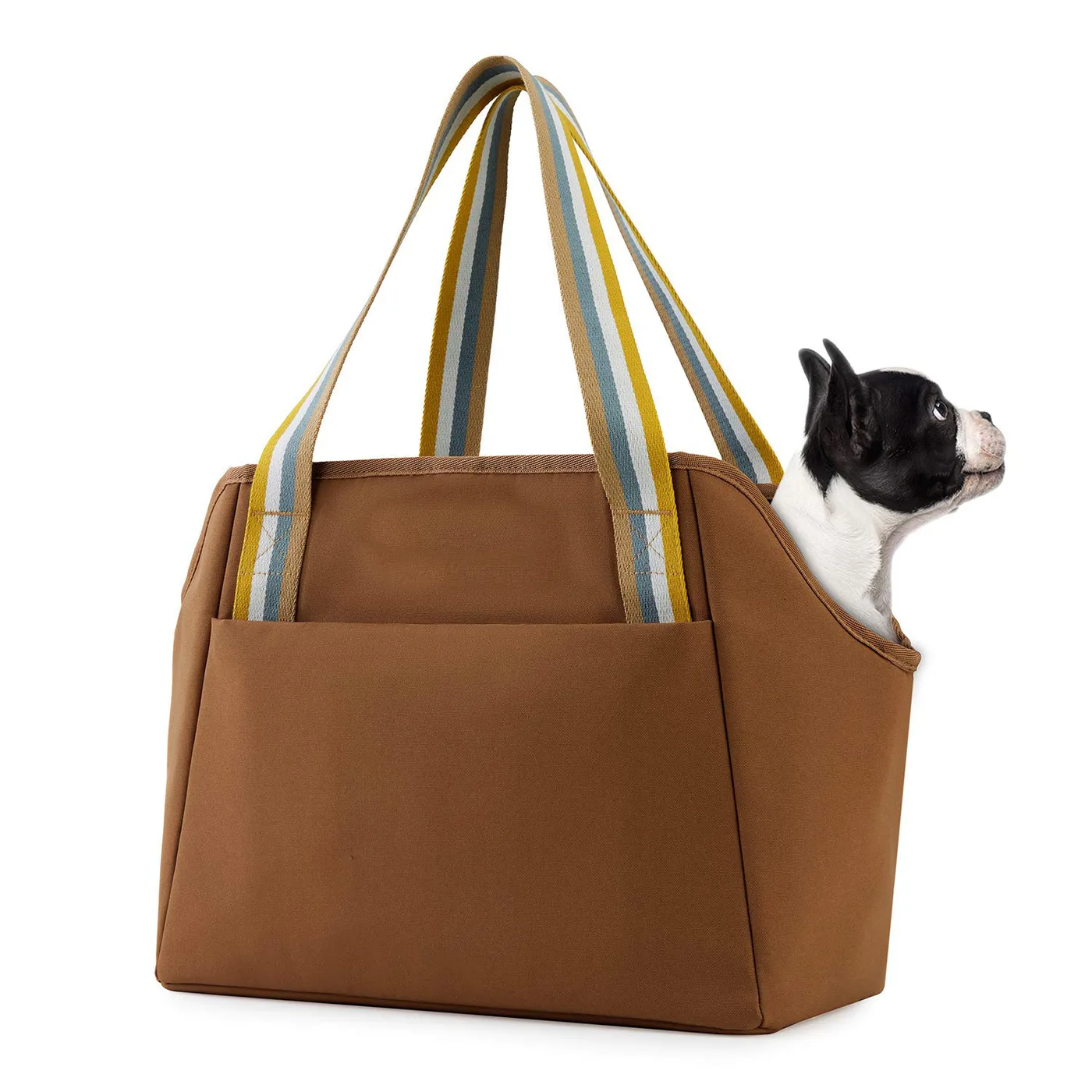
Containment Under Stress and Escape Prevention
A cat in a clinic is more motivated to escape than a cat at home, and it is better at it. Containment is specified against a stressed animal rather than a calm one, and the failure mode is an animal loose in a clinical area, which is a safety and an infection control incident.
Closure strength is the first requirement. A zipper or a latch on a clinical carrier should resist a sustained outward load from a cat of 8 kg pushing or clawing, which in practice means a closure tested at 200-400 N with no disengagement and no progressive opening. A reverse-coil zipper with an auto-lock slider and a secondary hook-and-loop or clip closure is the standard answer.
Progressive opening is the failure mode to test for specifically. A zipper can be pushed open tooth by tooth by a cat working from inside, even where the slider itself does not move, and that failure is not caught by a simple pull test. The test is a sustained internal load of 100-200 N applied at a corner for 10 minutes with no gap opening.
Mesh specification follows from clawing. An uncoated polyester mesh is shredded by a determined cat in minutes; a vinyl-coated polyester mesh at 320 g/m² resists it. The test is a defined scratch load applied repeatedly at the same point, with acceptance of no penetration at 500 cycles.
| Test | Load | Duration | Acceptance | Common failure |
|---|---|---|---|---|
| Closure pull | 200-400 N outward | 60 s | No disengagement | Slider unzips |
| Progressive opening | 100-200 N at a corner | 10 min | No gap over 5 mm | Chain walks open |
| Claw resistance, mesh | Defined scratch load | 500 cycles | No penetration | Uncoated mesh shreds |
| Lid retention | 150 N upward | 60 s | Lid retained | Hinge or clip yields |
| Handle attachment | 400 N per handle | 60 s | No tear-out | Stitch pull-out |
| Base drop | 10 kg from 300 mm | 3 drops | No base failure | Tray cracks |
| Restraint panel | 150-250 N | 60 s | No release | Hook-and-loop peels |
Secondary containment is worth specifying because it costs little. A clip or a short strap independent of the main closure means a single-point failure does not release the animal, and it is the feature most often added after an incident rather than before.
Quiet operation is a welfare feature that also helps containment. A closure that opens with a loud zip or a metal click startles an already stressed animal, which increases the escape attempt. A fabric-covered chain and a soft-close latch are small details that reduce the reaction.
Scent is the last consideration and it is specific to a clinic, where a carrier is used by many animals in sequence. A material that retains odour — an open-cell foam, an uncoated fabric — makes the next patient more stressed. A closed-cell, non-absorbent surface with a rinse step in the protocol is the answer.
Containment is tested as a sustained internal load at a corner, not as a straight pull, because progressive opening is how a determined cat actually gets out.
Clean-Down Validation and Cycle Testing
A clinical claim is a cycle count, and the cycle has to be defined as the complete protocol rather than as a wipe. This is where a supplier's evidence either supports a purchasing specification or does not.
The cycle is: remove visible soil, apply detergent, rinse, apply the clinic's disinfectant at label concentration, maintain wet contact for the stated time, rinse where the agent requires it, and dry. One cycle takes 4-8 minutes by hand. The protocol runs 1,500 cycles for a clinic-grade claim and 500 for a consumer-grade one.
Acceptance limits across the run: no coating cracking or delamination, colour change no worse than grey-scale 4, no seam or weld opening, no closure that has stopped functioning, water hold still above 300 ml where a tray is specified, and no surface that fails a rinse-clean test. Inspection at 25%, 50%, 75% and 100% with measured values rather than pass/fail.
| Parameter | Clinic grade | Consumer grade | Measured at | Failure mode |
|---|---|---|---|---|
| Cycles | 1,500 | 500 | 25/50/75/100% | Coating breakdown |
| Agents in sequence | Detergent plus two disinfectants | Detergent plus one | Each cycle | Chemical attack |
| Contact time | Label, 3-10 min | Label | Each cycle | Under-disinfection |
| Colour change | Grey-scale 4 or better | Grey-scale 3-4 | Each inspection | Dye oxidation |
| Surface integrity | No crack or delamination | No crack | Each inspection | Hydrolysis |
| Closure function | Full function retained | Full function | Each inspection | Corrosion, wear |
| Rinse-clean test | Under 1.5 g soil retained | Under 3.0 g | At 50% and 100% | Surface roughening |
Microbial efficacy is a separate question from material compatibility and it should not be confused with it. A surface can survive 1,500 disinfection cycles and still fail to be disinfected if it is scratched or if soil is retained. Where a claim is made, the appropriate evidence is a surface recovery test after a simulated contamination and clean-down, not a material compatibility test alone.
Accelerated testing is legitimate but has to be calibrated. Running cycles back to back without the drying time a real clinic allows understates some degradation and overstates others; the usual compromise is a defined rest interval, and the correlation is checked once against a real-use sample before the protocol is relied on.
Component-level testing runs alongside: a zipper cycle test of 3,000 operations with disinfectant applied at 500-cycle intervals, a restraint panel test of 1,000 engagements, and a tray scratch test at 500 cycles with a disinfectant hold check after each hundred.
Documentation closes the item. A validation report naming the agents, the concentrations, the contact times, the cycle count and the measured results at each inspection point is what a clinic's infection control lead will ask for, and a supplier who cannot produce it will not be specified. Test methods follow published practice from ASTM International.
A clinic-grade claim is 1,500 complete cycles with named agents and measured results at four inspection points — not a wipe test.
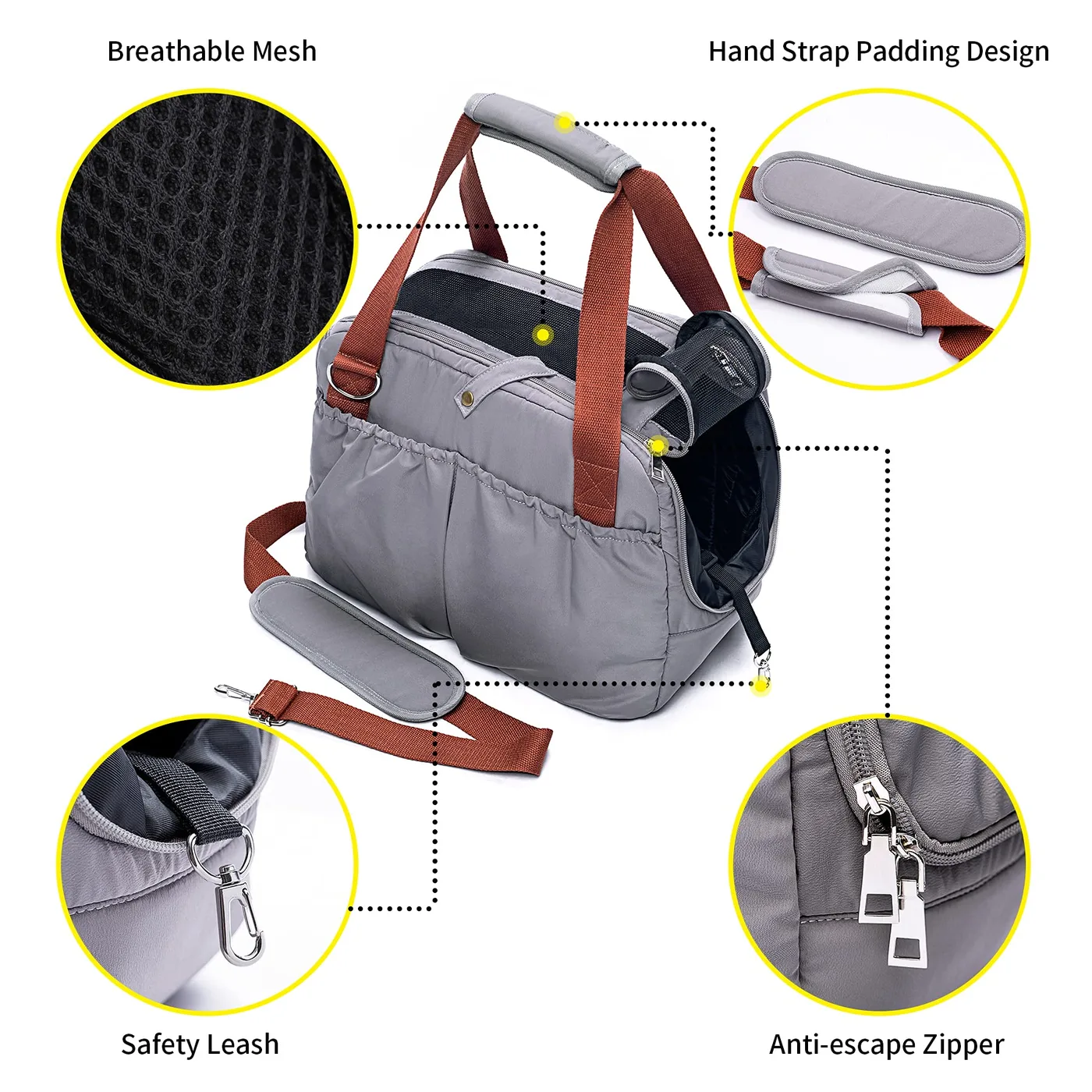
Cross-Contamination Control and Isolation Use
Where a clinic admits an animal with a suspected infectious condition, the carrier becomes part of the isolation chain, and the requirements shift from cleanability to containment of contamination. Not every carrier in a practice needs this, but the ones designated for isolation do.
Dedicated units are the simplest control and the one most practices use. A carrier assigned to isolation is marked as such, is not moved to general areas, and is cleaned under the isolation protocol. Marking should be permanent and obvious — a colour-coded panel or a moulded colour rather than a stick-on label that will be disinfected off.
Disposable liners are the second control and they are worth designing for. A carrier that accepts a disposable absorbent liner removes the need to clean the interior after a contaminated case: the liner is bagged and the carrier is disinfected. The design requirement is a smooth interior with no features that tear the liner, plus a retaining method that works without adhesive.
Portability of the decontamination step matters. A tray that lifts out and can be immersed or bagged, and an interior with no fixed absorbent layer, means a contaminated unit can be returned to service in minutes rather than hours.
| Feature | Control provided | Design requirement | Cost USD | Priority |
|---|---|---|---|---|
| Colour-coded dedicated unit | No cross-use | Moulded or sewn, permanent | 0.10-0.60 | High |
| Disposable liner compatibility | No interior cleaning | Smooth interior, no snags | 0.00-0.20 | High |
| Removable, immersible tray | Full decontamination | Sealed polymer tray | 1.80-4.20 | High |
| No absorbent fixed layer | No reservoir | Closed-cell materials only | 0.20-0.80 | High |
| Single-material interior | Agent compatibility | One polymer family | 0.00-0.40 | Medium |
| Smooth exterior, no fabric | Exterior wipe-down | Coated shell | 0.40-1.40 | Medium |
Absorbent materials are the specific exclusion in an isolation unit. Any open-cell foam, any fabric padding and any uncoated textile in the interior can hold fluid and organism, and no surface disinfection reaches it. The specification is closed-cell or solid polymer throughout the interior.
Exterior cleanability is the requirement most often missed, because attention goes to the interior. A carrier carried through a clinical area has a contaminated exterior, and a fabric shell with a texture or a trim that holds soil is a contamination vector. A coated, smooth exterior that can be wiped is the clinical specification.
Protocol alignment is the last step and it is the clinic's to make, but the supplier should support it with a written cleaning instruction naming the compatible agents and their contact times, and stating clearly which agents are excluded. That document is part of the product.
In isolation use the priorities are a dedicated marked unit, a removable immersible tray and no absorbent material anywhere in the interior.
Procurement: Specification, Quantities and Programme Notes
A clinic procurement differs from a retail one in three respects: the specification is written by the infection control lead rather than the buyer, the quantities are smaller, and the evidence requirement is higher. Understanding all three shortens the process considerably.
The specification should be written to be testable. Rather than "easy to clean", it should state: welded interior seams, interior corner radius 25-40 mm, compatible with accelerated hydrogen peroxide and sodium hypochlorite at 1:32 for 1,500 cycles, closure tested to 300 N with no progressive opening over 10 minutes, and a removable polymer tray. Six measurable clauses replace a paragraph of intent, and each can be quoted against.
Cost for a clinic-grade build runs 18.40-32.60 USD FOB Xiamen at MOQ 500, against 11.80-16.40 USD for a mid-tier consumer carrier. The additions are the welded interior at 1.80-3.60 USD, the polymer tray at 1.80-4.20 USD, compatible coatings at 1.00-2.40 USD, the closure and restraint package at 1.20-2.80 USD, and the drainage and hardware upgrades at 0.60-2.20 USD.
| Element | Consumer mid-tier USD | Clinic grade USD | Delta USD | Driver |
|---|---|---|---|---|
| Shell fabric and coating | 6.80-9.40 | 9.20-13.60 | +2.40-4.20 | Polyolefin over PU |
| Interior, welded and radiused | 0.80-2.40 | 1.80-3.60 | +1.00-1.20 | No sewn seams |
| Removable polymer tray | 0.30-0.70 | 1.80-4.20 | +1.50-3.50 | Replaceable, immersible |
| Closure and restraint package | 1.00-2.20 | 1.20-2.80 | +0.20-0.60 | Auto-lock, restraint panel |
| Hardware, corrosion-rated | 0.80-1.60 | 1.40-2.60 | +0.60-1.00 | Hypochlorite exposure |
| Validation and documentation | 0.20-0.60 | 0.90-2.40 | +0.70-1.80 | 1,500-cycle protocol |
| Total FOB Xiamen | 11.80-16.40 | 18.40-32.60 | +6.60-16.20 | At MOQ 500 |
Quantity is the practical constraint, because a clinic programme rarely reaches the 500-unit MOQ in a single order. The workable answers are a group purchasing arrangement across several practices, a distributor stocking programme, or a standard build shared with a grooming or boarding programme so the volume consolidates across channels.
Evidence is what closes the sale, and it should be offered rather than requested. A validation report naming agents and cycle counts, a restricted-substance declaration against the criteria published by OEKO-TEX, a load test supporting the weight claim, and a written cleaning instruction naming compatible and excluded agents together make a specification pack that an infection control lead can approve.
Service life and retirement criteria should be stated, because a clinical carrier has a defined end. The practical criterion is surface condition: once the tray or the interior shows deep scratching that cannot be cleaned, the unit should be retired rather than disinfected harder. A replaceable tray extends the carrier's life by making that criterion apply to a component rather than to the whole unit.
Our production team builds clinic-grade programmes through the SGS-verified production base under ISO 9001 and BSCI coverage, with prototypes in 6-10 working days, bulk production 35-50 days after sample approval, final random inspection to AQL 2.5, T/T 30/70 and FOB Xiamen. Write the procurement spec as six measurable clauses and offer the validation evidence before it is asked for.
Production capability
- SGS-verified production space of 4,950 m², 149 machines, 7 assembly lines
- Pet carrier and pet bag output since 2014 from a 137-person team
- 200,000 units shipped monthly under BSCI and ISO 9001 systems
People Also Ask
What makes a cat carrier suitable for veterinary clinic use?
Welded seamless interior with radiused corners, a removable polymer tray, compatibility with accelerated hydrogen peroxide and hypochlorite at 1:32 over 1,500 cycles, and a closure tested to 300 N with no progressive opening.
Which disinfectants damage carrier materials?
Sodium hypochlorite is the most aggressive, oxidising dyes, degrading coatings and pitting stainless hardware. Accelerated hydrogen peroxide attacks PU slowly and PVC coatings stiffen under both.
Why should interior seams be welded rather than sewn?
A sewn seam is a perforation line: fluid wicks into the stitch holes and the seam cannot be wiped clean. A welded or bonded seam has no perforations, at 0.40-1.20 USD more.
How many clean-down cycles should a clinical carrier survive?
1,500 for a clinic-grade claim against 500 for consumer grade. A cycle is remove soil, detergent, rinse, disinfectant at label concentration with full contact time, rinse and dry.
Why is a removable tray important in a clinic?
It holds fluid, lifts out for immersion or disposal, and can be replaced when scratched. Because a scratched surface can no longer be disinfected, a replaceable tray sets the service life.
What does a radiolucent base mean and why does it matter?
No metal within the plan area of the base, so a radiograph taken with the animal in the carrier has no artefact. Metal fixings or a frame cause a repeat exposure.
How is escape prevention tested for a clinical carrier?
A sustained internal load of 100-200 N applied at a corner for 10 minutes with no gap over 5 mm. A straight pull test misses progressive opening, which is how a cat actually gets out.
How much does a clinic-grade cat carrier cost?
18.40-32.60 USD FOB Xiamen at MOQ 500, against 11.80-16.40 USD for a mid-tier consumer carrier. The welded interior, polymer tray and validation add 6.60-16.20 USD.
Frequently Asked Questions
How often is a clinic carrier disinfected?
6-20 times per day in a busy practice, or 1,500-5,000 cycles a year. That is two orders of magnitude more than a consumer product sees in its life and it sets the coating specification.
What dilution of sodium hypochlorite is used in clinics?
1:32, around 1,500-1,600 ppm available chlorine, for routine use and 1:10, around 5,000 ppm, for outbreak control. Both exclude PVC coatings and bare stainless hardware.
Why is contact time part of the specification?
A disinfectant needs a defined wet contact time, typically 3-10 minutes, to achieve its claimed kill. A surface that dries in 60 seconds does not achieve it.
Why is quaternary ammonium residue a problem?
A quat film builds up over cycles, attracts soil and makes a surface harder to wet, which reduces the next disinfection. The protocol response is a rinse step.
What corner radius is cleanable?
25-40 mm at every interior corner including the wall-to-floor junction. A tighter corner accumulates soil and cannot be wiped clean with a cloth.
Which interior features should be designed out?
Interior pockets, sewn-in labels, horizontal hook-and-loop tape, exposed zipper chains and fabric floor mats. Each is a crevice or an absorbent reservoir.
What is a two-stage lid and why is it useful?
A lid with a partial-open position, giving a 120-200 mm opening. It allows venepuncture on a forelimb without exposing the whole animal.
Why print the tare weight on the carrier?
A cat is weighed by weighing the carrier and subtracting the tare. A tare that is wrong or unstated produces a dosing error, so it should be accurate to plus or minus 50 g.
Why must a clinical handle be rated?
A loaded carrier is lifted repeatedly, often one-handed, and a handle that tears out is an injury and a dropped animal. Two handles rated to 400 N each, bar-tacked at the attachment.
What mesh specification resists a determined cat?
Vinyl-coated polyester at 320 g/m², tested to 500 scratch cycles at a defined load with no penetration. An uncoated polyester mesh is shredded in minutes.
Why use a disposable liner in isolation cases?
It removes the need to clean the interior after a contaminated case: the liner is bagged and the carrier is disinfected. The design needs a smooth interior with no features that tear it.
What materials are excluded from an isolation unit?
Any open-cell foam, fabric padding or uncoated textile in the interior, because each can hold fluid and organism that no surface disinfection reaches.
When should a clinical carrier be retired?
When the tray or interior shows deep scratching that cannot be cleaned. A replaceable tray extends the carrier's life by applying that criterion to a component rather than the whole unit.
How can a clinic reach the 500-unit MOQ?
Through a group purchasing arrangement across practices, a distributor stocking programme, or a standard build shared with a grooming or boarding programme so volume consolidates.
Talk to QUANZHOU JUNYUAN BAGS about a pet carrier program: MOQ 500 pieces per colourway, samples in 6-10 working days, bulk production in 35-50 days under AQL 2.5 inspection.
Get a free quote Request a sample