Cat Carrier Waterproof: Rain Protection
A waterproof cat carrier needs a face fabric with a hydrostatic head of at least 1,500 mm, and 3,000-5,000 mm for a product sold on a waterproof claim, plus taped or welded seams, a storm flap over every closure, and a spray-test rating of grade 4 under ISO 4920. Water resistance without seam sealing is not waterproofing: needle holes leak at roughly 300 mm of head.
Rain protection on a cat carrier is an assembly problem, not a fabric problem. A 5,000 mm fabric sewn with a standard lockstitch and a #5 zip will let water through at the seams and at the closure long before the fabric itself is challenged, which is why a fabric-only specification produces a product that fails in the first real downpour and generates the worst kind of review. Our production team specifies waterproofing as five linked decisions: coating or membrane type, seam sealing method, closure protection, floor construction and drainage, and durability of the finish over time. Each has a measurable threshold and each interacts with breathability, which is the constraint that stops a carrier from being simply a sealed box. Commercial terms follow the standard programme: MOQ 500 pieces per colourway, prototypes in 6-10 working days, bulk production 35-50 days after sample approval, final random inspection to AQL 2.5, T/T 30/70 and FOB Xiamen.
Most buyers ask a pet bag supplier the same opening question: can the cat carrier line be reordered in the original colour six months later? The answer depends on dye-lot control, not on goodwill.
Waterproof versus Water-Resistant: The Measurements That Separate Them
Two words are used interchangeably in this category and they describe measurably different performance. Water-resistant means the surface sheds light water for a short time. Waterproof means the assembly resists water penetration under a stated hydrostatic pressure for a stated duration. The gap between them is where most product claims live, and it is where most returns come from.
The primary measurement is hydrostatic head, expressed in millimetres of water column. A specimen is clamped under a rising column of water and the height at which the third drop penetrates the reverse face is recorded. An untreated 600 D polyester woven fabric fails at 100-300 mm because water passes through the interstices between yarns. A PU-coated 600 D polyester reaches 1,000-2,000 mm. A two-component crosslinked coating reaches 3,000-5,000 mm, and a laminated TPU film reaches 8,000-15,000 mm. As a practical rule, 1,500 mm is the threshold at which a fabric survives sustained light rain under a light load, and 3,000-5,000 mm is the threshold for a kneeling load or heavy rain.
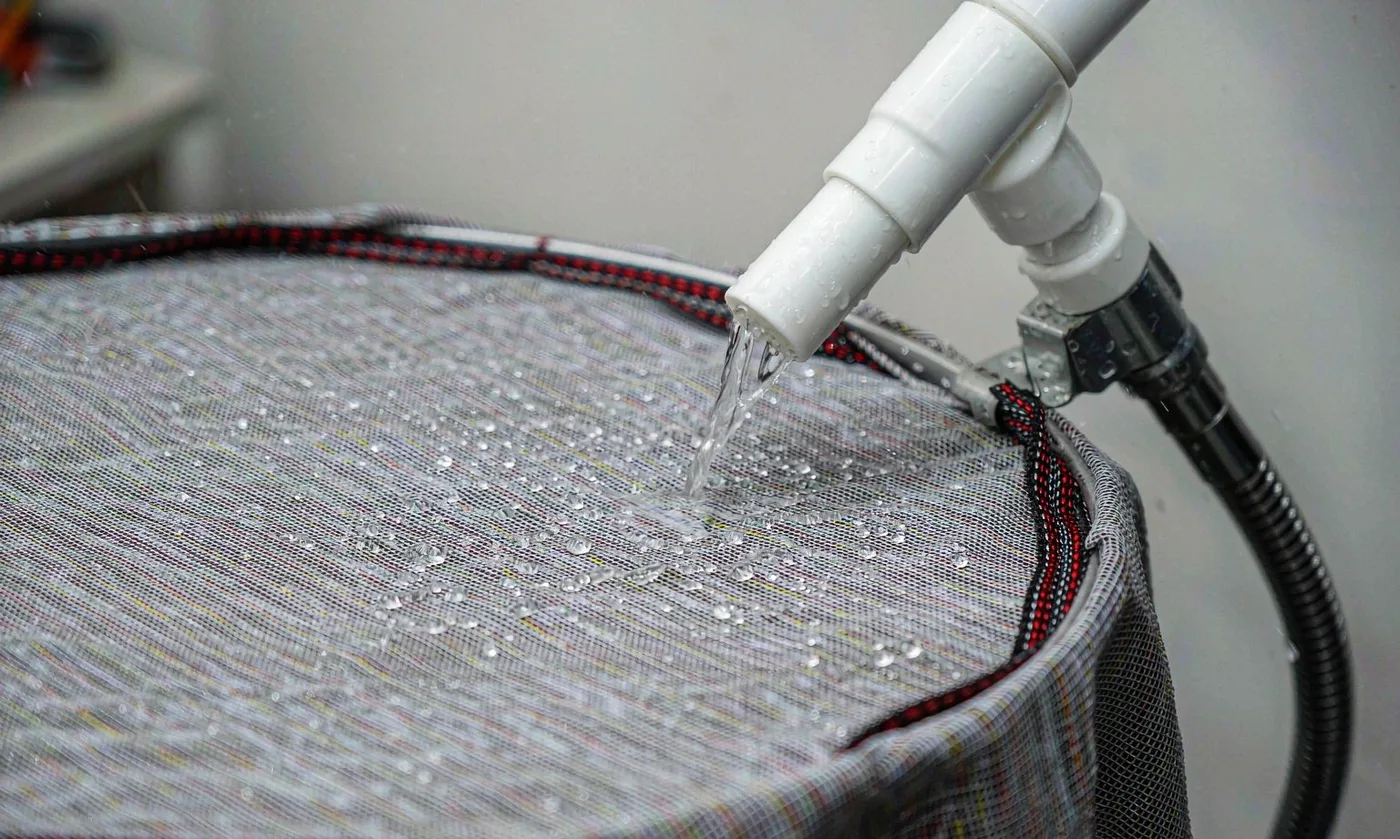
The second measurement is the spray test, standardised as ISO 4920, in which 250 ml of water is sprayed at a 45-degree mounted specimen and the wetting pattern is graded 0 to 5 against a photographic standard. Grade 4 means slight random wetting, grade 5 means no wetting. This test measures the surface finish rather than the barrier, and it is the test that degrades first in service: a new DWR finish gives grade 5, and after 20 wash cycles or 300 hours of abrasion it falls to grade 2-3 even though the underlying coating is intact.
The third measurement is the one usually omitted and the one that decides field performance: whole-article water penetration. This is a rain-room test in which the finished carrier is exposed to a spray of 1.5-2.5 l/min per square metre for 30-60 minutes from above and at 45 degrees, and the interior is inspected for moisture. A carrier built from 5,000 mm fabric with untaped seams will show dampness at the seam lines within 8-15 minutes, because a lockstitch seam leaks at roughly 300 mm of head regardless of the fabric rating.
| Performance level | Hydrostatic head | Spray grade | Seam treatment | Rain-room result, 30 min | Cost delta |
|---|---|---|---|---|---|
| Shower resistant | 600-1,000 mm | 3-4 | None | Damp at seams from 8 min | baseline |
| Showerproof | 1,500-2,500 mm | 4 | Taped main seams | Damp at closures from 20 min | +0.45-0.85 USD |
| Waterproof, light duty | 3,000-5,000 mm | 4-5 | All seams taped or welded | Dry at 30 min, damp at zip by 45 min | +1.10-1.80 USD |
| Waterproof, sustained | 8,000-15,000 mm | 5 | Welded shell, flapped closures | Dry at 60 min | +2.40-3.60 USD |
The table is the quoting grid. Note that the cost step from showerproof to waterproof is dominated by labour for seam sealing rather than by the fabric, which is why waterproofing is a better value addition on a smaller carrier than on a large one.
Coating and Membrane Options: PU, TPU, PVC and Film Laminates
Four barrier technologies are available for a carrier shell, and the choice is a balance between hydrostatic performance, weight, flexibility, durability and chemical compliance. Each has a specific failure signature that shows up in a particular market or season.
Polyurethane coating applied to the reverse face of the woven fabric is the default. A single-component PU at 20-30 g/m² gives 1,000-2,000 mm at a weight penalty of about 25 g/m² and a cost of 0.35-0.60 USD per carrier. A two-component crosslinked version at 30-45 g/m² gives 3,000-5,000 mm for 0.65-1.10 USD. PU is flexible, quiet and printable, and it is the right choice for a soft-sided carrier. Its weakness is hydrolysis: in a hot humid climate, PU coatings lose integrity over 24-48 months of storage, becoming tacky and then flaking.
Thermoplastic polyurethane film laminated rather than coated gives 8,000-15,000 mm at 0.15-0.25 mm thickness, and it is the correct specification for a genuine waterproof claim. TPU does not hydrolyse in the same way PU does, it stays flexible down to -20 °C, and it can be high-frequency welded, which means seams can be joined without needle holes. It costs 1.60-2.80 USD per carrier and it is stiffer, which changes the hand of a soft carrier noticeably.
Polyvinyl chloride coating is the cheapest route to a high hydrostatic head and is common on low-price carriers. It reaches 5,000-10,000 mm at 0.40-0.70 USD. Two problems argue against it. It is stiff and it cold-cracks: a standard PVC-coated fabric becomes brittle at 0 °C and cracks at -10 °C under flex, which is a real problem for a carrier used in a northern winter. And it normally requires plasticisers, several of which are restricted, so a PVC spec has to be documented against the REACH candidate and restriction lists maintained at echa.europa.eu rather than assumed compliant.
A microporous or hydrophilic membrane laminated between a face fabric and a thin tricot backing is the premium option and the only one that is both waterproof and breathable. It reaches 10,000-20,000 mm with a moisture vapour transmission rate of 5,000-15,000 g/m²/24 h. It costs 3.20-5.00 USD per carrier, it needs a bonded rather than sewn construction to avoid wicking at the needle holes, and it is justified only where the carrier is used for long journeys in the rain. For most programmes, a welded TPU shell with adequate mesh ventilation is the better engineering answer at half the cost.
Seam Sealing and Welded Construction
Seams are the leak path, and there are two ways to deal with them: seal the needle holes after sewing, or eliminate the needle holes entirely. The first is cheaper and universally applicable; the second produces a genuinely waterproof shell and is increasingly the standard for a premium rain product.
Seam sealing with tape involves applying a thermoplastic tape of 18-22 mm width over the sewn seam under heat and pressure. The machine parameters matter more than the tape specification: a hot-air welder running at 400-550 °C with a nip pressure of 2.5-4.0 bar and a feed rate of 2.5-5.0 m/min produces a bond of 8-15 N/50 mm. Too little heat and the tape lifts in the wash; too much and the face fabric scorches or the coating melts. Every production run we release is checked with a pull test on five tape samples per line per shift, and with a water-column test on a 100 mm sealed strip at the start and end of the run.
Tape selection follows the coating. A PU tape is used on a PU-coated fabric and a TPU tape on a TPU film; mixing them produces a bond that looks acceptable and fails at 3-5 N/50 mm. Three-layer tapes with an elastic core are used on stretch panels, and where a seam passes through a corner or a junction of three panels, a pre-cut patch is applied first because tape will not negotiate a compound angle without wrinkling and leaving a channel.
High-frequency welding eliminates the seam entirely. Two thermoplastic plies are placed between electrodes and a 27.12 MHz field at 1.5-4.0 kW for 0.6-2.0 s melts the interface, producing a joint that is as strong as the parent material and completely watertight. It works only on materials with a sufficient dielectric loss factor, which means PVC and TPU weld well, PU coatings weld inconsistently, and uncoated polyester does not weld at all. For a fully waterproof carrier our production team designs the shell as a welded TPU assembly with a small number of sewn, taped panels where geometry requires it.
Ultrasonic welding at 20-35 kHz is the third option, faster than high-frequency welding and better for small, precise joints such as a window perimeter or a handle attachment. It produces a narrower weld, typically 3-8 mm, which is aesthetically cleaner but structurally lower in peel strength, so it is used for detail work rather than for the main shell seams.
Closure Protection: Zippers, Storm Flaps and Roll-Top Openings
Every opening in a waterproof carrier is a designed leak, and the closure is where a waterproof specification either holds or fails. Three approaches are used, in ascending order of performance and cost.
A water-resistant zip is the minimum. A coated coil zip, in which the chain is extruded with a polyurethane jacket, sheds water from the chain itself and reaches roughly 800-1,500 mm at the closed chain. It costs 0.55-1.10 USD more than a standard coil zip depending on length. It is not waterproof under pressure: water passes between the coils under a sustained head or under a load pressing the flap onto the chain, and it will weep after 15-30 minutes in heavy rain.
A storm flap is the standard addition and the cheapest effective measure. A 30-45 mm flap of shell fabric, folded over the zip line and held with hook-and-loop or with low-profile snaps at 120-180 mm pitch, moves the water path around the closure rather than through it. It costs 0.25-0.50 USD. The design detail that determines success is the flap geometry: it must overhang the zip line by at least 15 mm and it must be anchored at both ends, or wind-driven rain will lift it and drive water behind it.
A roll-top opening is the only closure that is reliably waterproof without a moulded component, and it is borrowed from dry-bag construction. Two faces of coated fabric are rolled together three to four turns and clipped with a side-release buckle, producing a closure that withstands immersion to 0.5-1.0 m for 30 minutes. It costs 0.85-1.50 USD, it adds 80-120 mm of height to the opening, and it slows access to 8-15 seconds, which is the reason it is used on travel and outdoor carriers and rarely on a vet-visit product.
Where a rigid door or a moulded frame is involved, as on a hard-shell carrier, the closure is a gasket rather than a zip. A closed-cell EPDM or silicone gasket of 4-8 mm cross-section, compressed 20-30 % by the latch, gives an IPX4 to IPX6 equivalent performance. Gasket compression set is the long-term failure: a low-grade foam gasket loses 30-50 % of its recovery force within 12-18 months and starts to leak, which is why silicone or EPDM is specified over PVC foam.
Floor Design: Ponding, Drainage and the Welded Tray
Rain does not only fall from above. A carrier set down on a wet pavement, in a wet car boot or on a muddy verge takes water from below, and the floor is the surface least often specified for it. The floor also has to deal with the water that the cat brings in, and with any accident, which makes it the most heavily loaded surface in the whole product.
The first decision is the floor material. A coated 600 D fabric floor will abrade through its coating at the contact points within 6-12 months of normal use, because a 4-6 kg cat imposes 40-60 N over a small contact area and grit accelerates the loss. The standard solution is a 900 D or 1,200 D base fabric with a heavier coating of 45-60 g/m², or a moulded tray. Our production team specifies a 900 D floor as standard on any waterproof carrier and a welded TPU tray as an upgrade at 1.20-2.10 USD.
The second decision is ponding versus drainage. A fully sealed floor with a 15-25 mm upstand at the perimeter holds 400-900 ml of water, which protects the ground below the carrier and keeps the interior dry, but it means any spill has to be tipped out. A drained floor with two or three 6-8 mm grommets at the low corners sheds water immediately and lets an accident drain away, at the cost of allowing water in if the carrier stands in a puddle deeper than 8 mm. The correct choice is application-driven: a sealed tray for a carrier used on wet ground, a drained floor for a carrier used in a vehicle or a boat.
The third decision is the floor-to-wall joint, which is the single most common leak point in a fabric carrier. A sewn corner joint can be taped only with a pre-cut patch and even then it is the first place to fail; a welded corner joint is watertight by construction. Where a carrier has a removable floor panel, the joint relies on compression alone, and the practical mitigation is a 10-15 mm upstand on the panel with the shell fabric folded over it, which converts a butt joint into a shingle joint.
Finally, the floor needs feet. Four to six moulded feet of 5-10 mm height lift the carrier out of standing water, protect the coating from abrasion on rough ground and reduce conductive heat loss to a cold wet surface. They cost 0.08-0.20 USD and they are the cheapest durability improvement available in this category.
The Breathability Conflict: Condensation in a Sealed Shell
A shell that keeps rain out also keeps vapour in, and for a cat the consequence is measurable. A 4-6 kg cat at rest evaporates 8-20 g of water per hour through respiration and skin, and a stressed cat pants, which raises that to 25-50 g per hour. In a fully sealed carrier of 40-60 litres at 15 °C ambient, that vapour will saturate the interior air within 25-50 minutes and then start condensing on the coolest surface, which is usually the window or the floor.
The engineering answer is not to make the shell breathable but to move enough air. The requirement is a minimum of two mesh panels on opposing faces with a total open area of 120-200 cm², positioned so that at least one is high and one is low, which establishes a convective loop. A single panel of the same area produces roughly half the exchange because there is no through-path. Mesh open area is the specification number to write down: a standard polyester mesh at 1.2 mm aperture gives 55-65 % open area, and a no-see-um mesh at 0.6 mm gives 35-45 %.
There is a direct tension here with rain protection, because a mesh panel is a hole. Three mitigations are used. A storm panel is a coated fabric flap that covers the mesh and is held open by a hook-and-loop tab or a press stud, giving the user a choice. A louvre is a set of overlapping coated fabric bands over a mesh opening, which sheds falling rain while allowing lateral airflow, and it costs 0.35-0.70 USD. And a hydrophobic mesh, in which the monofilament is coated with a fluorocarbon-free water repellent, sheds droplets down to 0.5 mm while retaining 80-90 % of its open area, at 0.20-0.45 USD.
Condensation is also managed from the inside. A moisture-absorbent pad under the floor liner, using 80-150 g of silica or a superabsorbent nonwoven, will hold 100-250 ml of liquid and prevents the floor from becoming wet from condensation alone. It adds 0.30-0.70 USD and it is the difference between a carrier that is dry after a two-hour journey and one that is damp.
Durability of Waterproofing: Abrasion, Hydrolysis, Cold Crack and DWR Loss
Waterproofing is the performance attribute that degrades fastest in service, and a specification that quotes only as-delivered numbers will over-promise. Four mechanisms drive the loss, and each maps to a specific test and a specific mitigation.
Abrasion removes the surface finish and thins the coating. On a Martindale-type tester, a PU-coated 600 D fabric loses 30-50 % of its hydrostatic head by 10,000 rubs and fails below 1,000 mm by 20,000 rubs. A TPU film of 0.20 mm retains above 5,000 mm at 20,000 rubs. The practical consequence is that waterproofing should be specified on the areas that matter and reinforced on the areas that abrade, which means a heavier coating on the base and the lower 100 mm of the side panels.
Hydrolysis is chemical and it is the mechanism that kills carriers in storage. Polyester-based PU absorbs moisture and the ester links cleave, producing a tacky surface and eventually a coating that flakes off. At 70 °C and 95 % relative humidity, an accelerated test of 7-14 days approximates 24-48 months of tropical storage. The mitigation is a polyether-based PU or a TPU, both of which are substantially more hydrolysis resistant, at a cost premium of 0.25-0.60 USD. For any programme shipping to a humid market, this upgrade pays for itself in avoided claims.
Cold crack is the winter failure. A PVC-coated fabric at a standard plasticiser level becomes stiff at 0 °C and cracks when flexed at -10 °C. PU-coated polyester remains flexible to -30 °C and TPU to -40 °C. The test is a mandrel bend at temperature, and the specification should state the minimum service temperature, which for a product sold in northern Europe or northern North America should be -20 °C.
DWR loss is the loss of the surface finish rather than the barrier, and it is what the customer notices first because the fabric stops beading and starts wetting out. A fluorocarbon-free DWR at 8-15 g/m² gives spray grade 5 as delivered and grade 2-3 after 20 washes or 300 hours of light abrasion. It is restorable by tumble drying at 60 °C for 10 minutes, which reorients the finish, and that instruction should be printed on the care label. Chemical restrictions on fluorinated compounds are tightening in both the EU and several US states, so our production team specifies fluorocarbon-free chemistry by default and documents it against the restriction process published at ECHA.
Testing, Documentation and Programme Planning
A waterproof claim needs a test report behind it, and the set is small enough to be affordable at a 500-piece order. The reports that matter are hydrostatic head on the fabric, spray test on the finished fabric, seam strength and seam leakage on the construction, and a rain-room or shower test on the finished article. Together they cost 250-600 USD at a third-party laboratory and they convert a claim into evidence.
Test standards are published by the International Organization for Standardization, and the relevant water-resistance methods are listed at iso.org, which also allows a buyer to specify the same method to any supplier and compare results. Our production team runs hydrostatic head and spray testing in-house on every fabric lot and sends the finished article for third-party verification on the first bulk run of a new programme, then annually thereafter.
Chemical documentation is the second half of the file. For a waterproof carrier the substances of concern are plasticisers in PVC, per- and polyfluoroalkyl substances in a DWR finish, and any biocide in an antimicrobial treatment applied to a wet surface. Each needs a declaration or a test report. For a product sold in California, the Proposition 65 listing administered by the state is an additional consideration, and the current list is published at oehha.ca.gov. This is the single most common reason a shipment is held at a US port, and it is avoidable with a bill-of-materials review before production rather than after.
Programme economics follow the tier structure in the first section. At 500 pieces, showerproof adds 0.45-0.85 USD, light-duty waterproof 1.10-1.80 USD, and sustained waterproof 2.40-3.60 USD, with the labour for seam sealing dominating the middle tier. MOQ is 500 pieces per colourway. Samples take 6-10 working days and bulk production runs 35-50 days after approval, with welded construction adding 5-8 days for tooling of the welding electrodes, which is a one-time 400-900 USD charge amortised over the programme.
The recommendation for most brands is to specify showerproof-plus: a 3,000 mm fabric, taped main seams, a storm-flapped zip, a 900 D floor with 6 mm feet, and two opposing mesh panels with hydrophobic treatment. That combination survives a genuine downpour, keeps the carrier breathable enough for a two-hour journey, and lands about 1.60 USD above a standard shell, which is a defensible retail premium of 5-8 USD.
Order and quality terms
- MOQ 500 pieces per colourway; samples in 6-10 working days
- Bulk production 35-50 days after approval; AQL 2.5 inspection standard
- T/T 30/70 terms, FOB Xiamen, full document set per shipment
People Also Ask
What hydrostatic head is needed for a waterproof cat carrier?
1,500 mm is the minimum for sustained light rain and 3,000-5,000 mm is the threshold for a genuine waterproof claim under load. A laminated TPU film reaches 8,000-15,000 mm, and an untreated woven fabric fails at 100-300 mm.
Does a waterproof carrier need taped seams?
Yes. A lockstitch seam leaks at roughly 300 mm of head regardless of fabric rating, so a 5,000 mm fabric with untaped seams shows dampness at the seam lines within 8-15 minutes in a rain-room test.
Can a waterproof cat carrier still breathe?
Not through the shell. Breathability is delivered by two mesh panels on opposing faces with 120-200 cm² total open area, positioned high and low to create a convective loop, optionally protected by a storm flap or hydrophobic mesh.
What is the difference between a PU coating and a TPU film?
PU coating gives 1,000-5,000 mm at 0.35-1.10 USD and hydrolyses over 24-48 months in humid storage. TPU film gives 8,000-15,000 mm at 1.60-2.80 USD, welds without needle holes and resists hydrolysis and cold crack to -20 °C.
Is PVC coating a problem on a pet carrier?
Yes, on two counts. It stiffens at 0 °C and cracks at -10 °C under flex, and it normally requires plasticisers that must be documented against the REACH restriction lists rather than assumed compliant.
How does a DWR finish wear out?
A fluorocarbon-free DWR at 8-15 g/m² gives spray grade 5 as delivered and falls to grade 2-3 after 20 washes or 300 hours of light abrasion. Tumble drying at 60 °C for 10 minutes reorients the finish and restores beading.
How much does waterproofing add to carrier cost?
0.45-0.85 USD for showerproof, 1.10-1.80 USD for light-duty waterproof with taped seams, and 2.40-3.60 USD for a welded sustained-waterproof shell, all at 500 pieces. Seam-sealing labour dominates the middle tier.
Should a waterproof carrier floor be sealed or drained?
Sealed with a 15-25 mm upstand for use on wet ground, draining through two or three 6-8 mm grommets for use in a vehicle or boat. A sealed tray holds 400-900 ml; a drained floor lets an accident run out.
Frequently Asked Questions
What is hydrostatic head and how is it measured?
It is the height of a water column, in millimetres, at which the third drop penetrates the reverse face of a clamped specimen. It is the primary measurement separating water-resistant from waterproof performance.
What is the ISO 4920 spray test?
A standardised spray test in which 250 ml of water is sprayed at a specimen mounted at 45 degrees and the wetting pattern is graded 0 to 5. Grade 4 is slight random wetting and grade 5 is no wetting.
Why does a waterproof carrier still get damp inside?
Usually condensation rather than ingress. A 4-6 kg cat evaporates 8-20 g of water per hour, or 25-50 g when panting, which saturates a 40-60 litre interior within 25-50 minutes without adequate air exchange.
What welding parameters are used for a TPU shell?
High-frequency welding at 27.12 MHz, 1.5-4.0 kW and 0.6-2.0 s dwell, giving a joint as strong as the parent material. Ultrasonic welding at 20-35 kHz is used for detail work with a narrower 3-8 mm weld.
What temperature does seam tape need?
A hot-air welder at 400-550 °C with 2.5-4.0 bar nip pressure and 2.5-5.0 m/min feed produces an 8-15 N/50 mm bond. Too little heat lifts in the wash, too much scorches the face fabric.
How long does a waterproof coating last in storage?
A polyester-based PU coating degrades over 24-48 months in tropical storage through hydrolysis; an accelerated test at 70 °C and 95 % RH for 7-14 days approximates that. A polyether PU or TPU resists it at 0.25-0.60 USD more.
What is a roll-top closure and when is it used?
Two coated fabric faces rolled three to four turns and clipped, borrowed from dry-bag construction, which withstands immersion to 0.5-1.0 m for 30 minutes. It adds 80-120 mm and 8-15 seconds to access, so it suits travel rather than vet-visit products.
Do waterproof carriers need feet?
Yes. Four to six moulded feet of 5-10 mm lift the carrier out of standing water, protect the floor coating from abrasion and cut conductive heat loss, at 0.08-0.20 USD per set.
What chemical documentation is needed for a waterproof carrier?
Declarations or test reports for plasticisers in PVC, PFAS in the DWR finish and any biocide in an antimicrobial treatment, plus a bill-of-materials review. For California, the Proposition 65 list is checked before production.
How much does third-party waterproof testing cost?
250-600 USD for the set of hydrostatic head, spray test, seam strength and seam leakage, plus a rain-room test on the finished article. At 500 pieces that is under 1.20 USD per carrier.
What is the MOQ and lead time for a waterproof carrier?
MOQ 500 pieces per colourway, samples in 6-10 working days and bulk in 35-50 days after approval. Welded construction adds 5-8 days and a one-time electrode tooling charge of 400-900 USD.
Can a private label buyer specify its own waterproof tier?
Yes, and it should. The tier structure maps directly to retail price positioning, and specifying the hydrostatic head, seam treatment and closure protection in the tech pack is what prevents a downgrade during value engineering.
Talk to QUANZHOU JUNYUAN BAGS about a pet carrier program: MOQ 500 pieces per colourway, samples in 6-10 working days, bulk production in 35-50 days under AQL 2.5 inspection.
Get a free quote Request a sample