Dog Carrier Backpack for Large Dogs: Design Considerations
A carrier built for the large-dog class is dimensioned from a weight envelope of 25-45 kg, a chest girth of 80-110 cm and a back length of 60-80 cm. Those numbers set a rated working load of 45 kg, shoulder webbing at 50 mm, a moulded or laminated base board of 4-5 mm, and ventilation open area of at least 30% of the compartment surface. Structural release requires a static test at 4x rated load and 20,000 dynamic cycles at 1.5 G.
This page treats the large-dog carrier as a load-rated structure. It sets the body-parameter envelope first, then derives harness geometry, frame system, base structure and ventilation area from it, and finishes with the test protocol, material upgrades and production planning consequences of building at this scale. Every figure is a specification number rather than a marketing one: rated load, webbing width, board thickness, open-area percentage, cycle count and drop height. Commercial terms follow the standard program: MOQ 500 pieces per colourway, prototypes in 6-10 working days, bulk production 35-50 days after sample approval, final random inspection to AQL 2.5, T/T 30/70 payment and FOB Xiamen loading. Large-format carriers consume roughly two and a half times the fabric of a small-dog model and need heavier sewing equipment, so the cost and capacity consequences are covered in the final section.
In a private label pet carrier brief for dog carrier backpack, the artwork file and the label compliance text are the two items that most often delay a first shipment.
Body Parameter Envelope: Weight, Chest Girth and Back Length
Design for the large-dog class begins with three body measurements, taken in a standing animal rather than a sitting one, because a sitting animal presents a shorter back and a deeper chest that will not match the pattern once the dog stands up. Weight sets the load rating. Chest girth, measured behind the front legs at the widest point, sets interior width. Back length, measured from the base of the neck to the base of the tail, sets interior length.
Across the large-dog population those three figures cluster into a usable envelope: 25-45 kg, 80-110 cm chest girth, 60-80 cm back length. Interior dimensions are then derived with ease: interior width at chest girth divided by pi plus 40-60 mm of clearance, giving 295-410 mm; interior length at back length plus 80-120 mm so the animal can shift position, giving 680-920 mm. A carrier that satisfies the arithmetic but ignores the distribution will still fit badly, because weight and girth are correlated but not proportionally — a heavily muscled 32 kg dog can have a wider chest than a lean 40 kg one.
Height is the fourth parameter and the one most often omitted. Interior height should be at least 55% of the shoulder height of the target animal so it can stand with its head below the top panel, and at least 40% so it can lie down with its elbows under it. For a dog of 60-70 cm shoulder height, that puts interior height at 330-430 mm. Below that, the animal cannot adopt a natural posture and will refuse to settle, which is a design failure that no amount of padding fixes.
| Weight class | Chest girth (cm) | Back length (cm) | Rated load (kg) | Webbing (mm) | Base board (mm) |
|---|---|---|---|---|---|
| 25-30 kg | 80-90 | 60-66 | 30 | 38-50 | 3.0-4.0 |
| 30-35 kg | 88-98 | 64-72 | 35 | 50 | 4.0 |
| 35-40 kg | 95-105 | 70-78 | 40 | 50 | 4.0-5.0 |
| 40-45 kg | 100-110 | 74-80 | 45 | 50-75 | 5.0 |
| 45-50 kg | 105-115 | 78-85 | 50 | 75 | 5.0-6.0 |
The rating in the fourth column is the number every downstream decision depends on, and it is deliberately set above the animal's body weight. A 35 kg dog moving inside a carrier generates transient loads well above its static weight when it shifts, scrambles or braces against a sudden stop. Rating the structure at the top of the class rather than at the animal's nominal weight is what keeps seams and hardware inside their working range. The rated load, not the animal's weight, is the figure that belongs on the tech pack and on the test report.
Load Distribution and Harness Geometry
Carrying 35 kg on a human back is a solved problem in expedition pack design, and the same geometry applies here with one complication: the load is live and it moves. The harness has to carry a static rated load, transfer most of it to the wearer's hips, and remain stable when the animal shifts 30 mm to one side without warning.
Load split is the first specification. A well-built large-format harness transfers 70-80% of the load through the hip belt and 20-30% through the shoulder straps. Reaching that split requires a hip belt of at least 75 mm width with a moulded or laminated stiffener, positioned so that the belt's centre line passes through the wearer's iliac crest. A hip belt that sits on the soft tissue above the crest slides down under load and the split collapses to the shoulders, which is the point at which wearers report the product as unusable.
Shoulder straps at this scale are 50 mm minimum with 10-12 mm of closed-cell foam, tapering to 40 mm at the neck where the strap has to clear the trapezius. Webbing tensile strength should be rated at least 3x the design load per strap — roughly 12-15 kN for a 45 kg class — and the strap-to-body attachment should be a load-path seam rather than a decorative one, sewn as a boxed-X pattern over a reinforcement patch of 100 x 120 mm.
A sternum strap and a load-lifter pair are not optional at this scale. The sternum strap, 20-25 mm with an elastic section, holds the shoulder straps at the correct spacing and prevents the outward rotation that lets the load swing. Load lifters, running from the top of the shoulder straps to the frame at a 30-45 degree angle, pull the load's centre of gravity toward the wearer's spine and reduce the rearward moment by a measurable margin. Without them, a 40 kg load feels substantially heavier than it is and the wearer leans forward to compensate.
Live-load stability is addressed inside the compartment rather than on the harness. A non-slip floor with a coefficient of friction above 0.5 against the pad, plus a low centre of gravity achieved by keeping the animal's platform below the wearer's shoulder line, reduces the magnitude of lateral transients. An internal tether anchored to a bar-tacked patch rated at 1.5 kN stops the animal from shifting far enough to generate the overturning case in the first place.
Frame Systems: Sheet, Stay and Moulded Shell Options
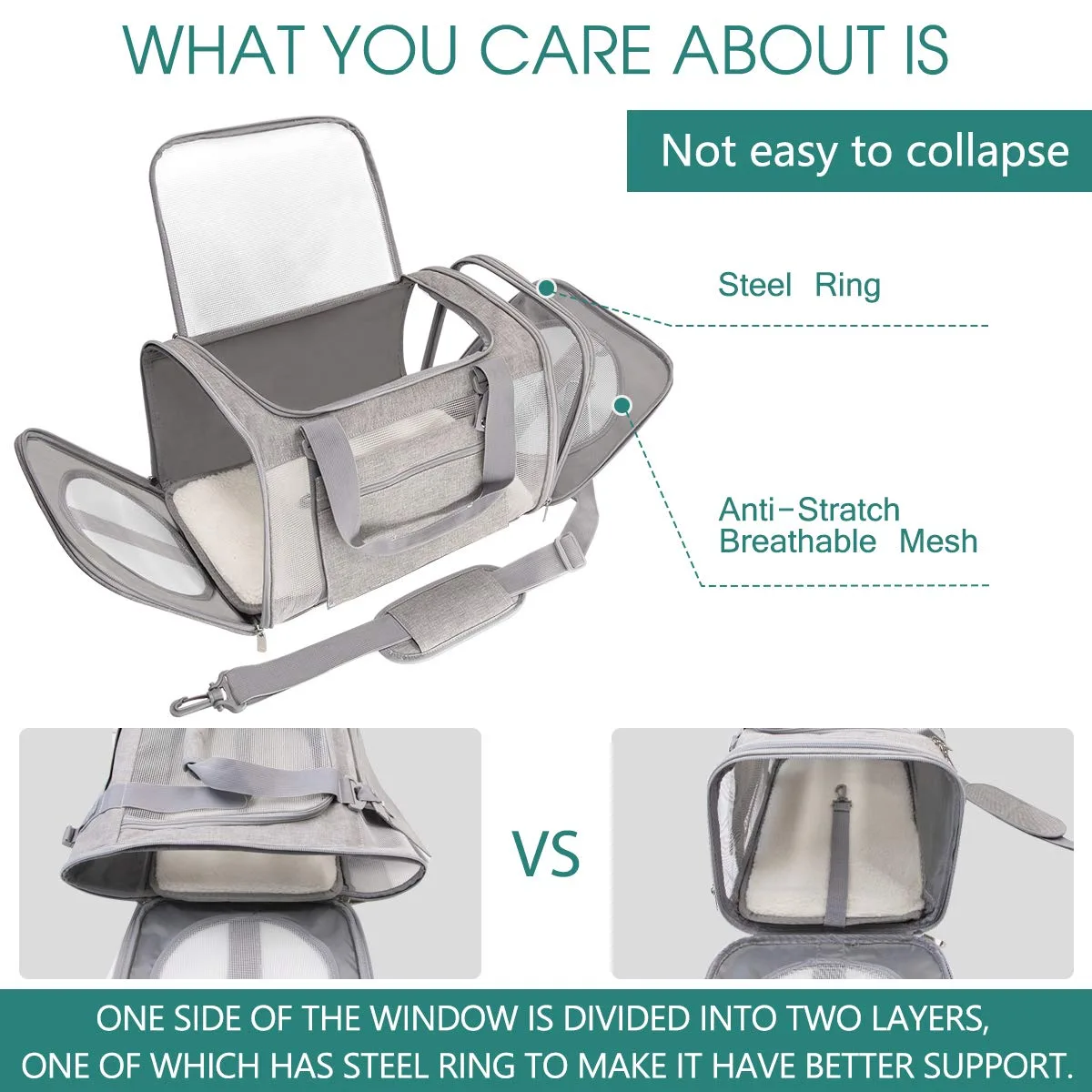
At the large-dog scale the compartment needs a frame, because fabric alone cannot hold shape under 35-45 kg of moving load. Three frame systems are used and the choice is driven by packability, cost and how much torsional stiffness the design needs.
A laminated frame sheet is the most common. A 2.5-3.5 mm HDPE or PP sheet, die-cut to the back panel profile and inserted into a dedicated sleeve between the lining and the shell, gives adequate vertical stiffness and modest torsional control. Cost is 0.60-1.40 USD per unit, and the sheet can be removed for flat packing. Its weakness is that it does not control twist: a frame sheet carrier with a 40 kg load will wrack noticeably when the wearer turns, and the wracking is felt as instability.
Aluminium stays are the middle option. Two 6061-T6 flat or formed stays of 8-10 mm width and 2.0-3.0 mm thickness, run vertically on either side of the spine channel and linked by a horizontal stay at the lumbar, give real torsional control for 1.80-3.20 USD. Weight penalty is 120-260 g. Stays need to be formed to the wearer's back curve rather than left flat — a flat stay against a curved back creates a pressure point that wearers describe as a bar digging in — and the forming die is a tooling cost of 400-900 USD per profile.
A moulded structural shell is the engineered solution. The back panel and base are formed as one EVA or PP component, with integral ribbing giving stiffness where it is needed and flexibility where it is not. Torsional and vertical stiffness are both excellent, and the part can carry the foot structure, the frame and the hip-belt attachment in one piece. Tooling is 8,000-20,000 USD and unit cost 2.50-5.00 USD, so this route only makes sense above roughly 5,000 units, but it is the only one that handles a 45 kg live load without visible wracking.
Spine clearance is a requirement shared by all three systems. A channel of 40-60 mm width and 15-20 mm depth along the centre line keeps the frame off the wearer's vertebral processes; without it, the frame contacts the spine directly and the carrier is uncomfortable within minutes regardless of padding thickness.
Base Structure: Board Thickness, Foot Design and Load Spreading
The base carries the entire animal's weight and does it at a single point of contact whenever the carrier is set down. On a 45 kg class carrier, that means the base structure has to survive repeated impact loads of 45 kg concentrated over a few square centimetres, plus the dynamic load of an animal jumping down onto it from inside.
Board thickness is derived from span. A compartment base spanning 400-500 mm needs 4.0-5.0 mm of HDPE or PP to limit deflection under 45 kg to less than 8 mm; at 3.0 mm the same span deflects 15-25 mm, which feels like a hammock to the animal and transfers the load into the seams rather than the board. Where a moulded base with integral ribbing is used, wall thickness can drop to 2.5-3.0 mm because the ribs carry bending stiffness, but only if the ribs are at least 8 mm deep on a 40-50 mm pitch.
Foot design determines whether the base survives abrasion. Four moulded feet of 25-35 mm diameter and 6-10 mm height in TPU or EVA lift the base off the ground, spread point loads, and give a stable footprint. Feet bonded rather than riveted avoid penetration of the shell, but the adhesive has to survive the same hydrolytic ageing the rest of the product does; riveted feet need a 20 mm washer behind the shell. A carrier without feet abrades through the base fabric in 30-60 days of daily use.
Load spreading into the shell is the detail that fails in production. The board sits in a sleeve whose seams carry the animal's weight into the side panels; if the sleeve is sewn to the lining only, the whole load hangs off a lining seam rated for nothing. The sleeve should be captured in the same seam as the shell-to-base joint, with a 15 mm allowance and a bar-tack at each corner. In static testing, this is the joint that fails first when it is under-specified.
Interior floor finish completes the base specification. A removable tray of moulded EVA or a PU-coated panel with sealed seams lets the carrier be cleaned after an accident; a fixed fabric floor cannot be adequately cleaned and will hold odour. Coefficient of friction of the floor surface should exceed 0.5 so the animal is not sliding on every turn, and the pad should be a separate washable item with a declared absorption capacity rather than a bonded layer that cannot be replaced.
Ventilation Area: Computing Open Area Against Metabolic Load
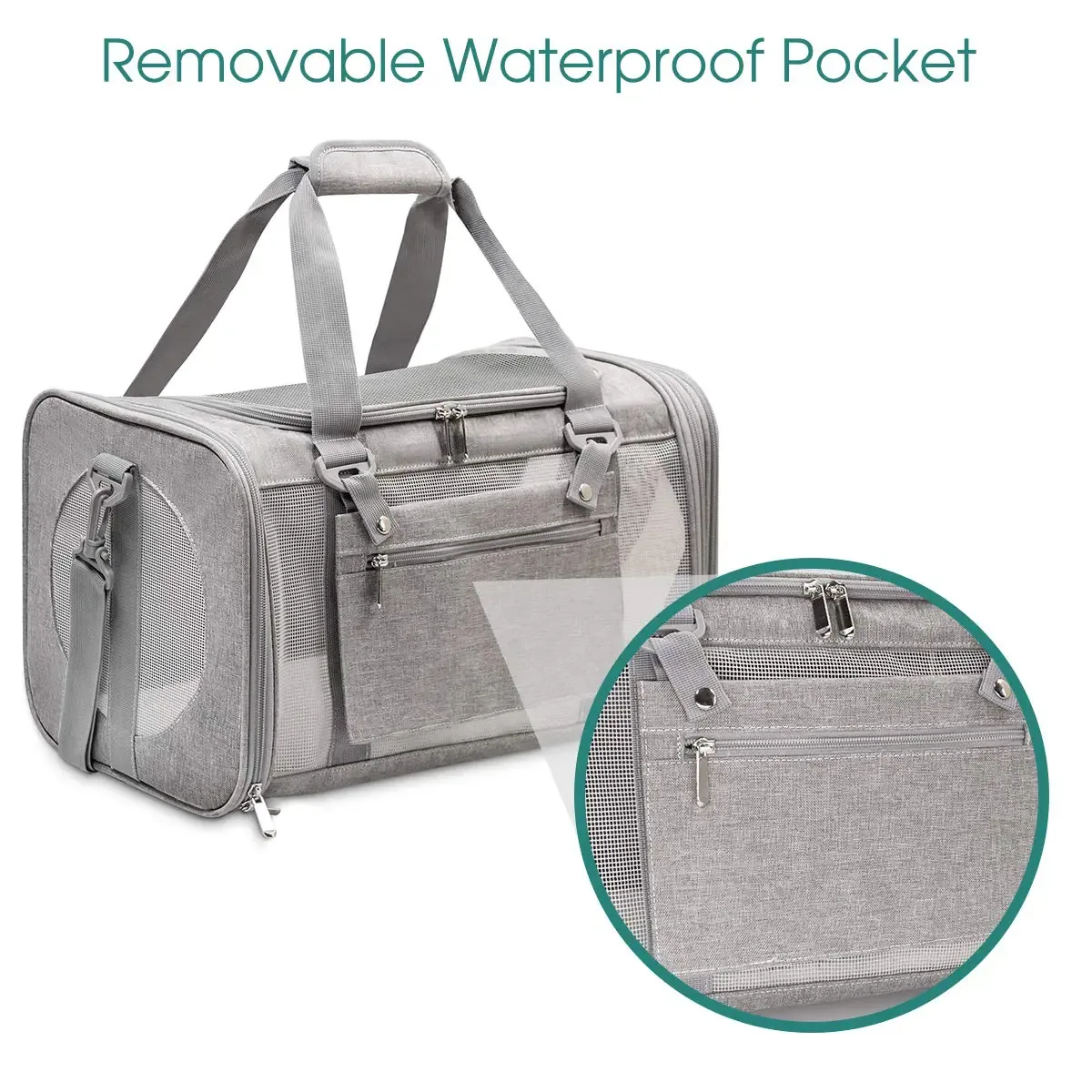
Large dogs generate substantial metabolic heat and have a poor surface-area-to-mass ratio for dumping it, so ventilation in this class is a thermal engineering question rather than a question of adding mesh panels. The specification is open area as a percentage of compartment surface, and the number that works in production is 30-35% for a 25-45 kg animal in temperate conditions, rising to 40% for hot-climate markets.
Open area is computed, not estimated. Mesh is characterised by its open-area fraction, typically 35-55% for a knitted polyester mesh at 250-350 g/m², so a panel of 0.12 m² of 45% open mesh contributes 0.054 m² of effective open area. The compartment's total internal surface is calculated from its dimensions — for a 380 x 800 x 400 mm interior, roughly 1.30 m² — and the sum of effective open areas is divided by it. Designers who specify "three mesh panels" without doing this arithmetic routinely land at 15-20% effective open area and then wonder why the product runs hot.
Airflow path matters as much as open area. Mesh on opposite faces with a clear path between them gives cross-ventilation; three panels clustered on the front face give almost no flow because there is no pressure differential to drive it. The minimum working configuration is a low intake at the front or base and a high exhaust at the top or rear, exploiting the stack effect created by the animal's own heat. Intake area should equal exhaust area within 20%, or the smaller side becomes the limiting restriction.
Claw and abrasion resistance constrains mesh choice at this scale. A 40 kg dog can put real force into a mesh panel, and lightweight mesh tears; the specification for large-dog carriers is a heavy monofilament or coated polyester mesh at 350-450 g/m² with a burst strength above 800 kPa, tested to a standard bursting route. Ventilation claims and animal welfare guidance in this area are commonly cross-referenced against material published by the American Veterinary Medical Association, and structural test practice against methods published by ASTM International.
One operational note closes the section: ventilation and containment conflict. Every square centimetre of open area is a square centimetre the animal can potentially work at with teeth or claws, so open panels should be backed by a closable flap for transport through airports and veterinary waiting rooms, and the flap's own open area should be counted as zero in the calculation.
Testing Protocol: Static Load, Dynamic Cycling and Drop
Structural release for the large-dog class runs four tests in sequence on the same units, so that accumulated damage is reflected in the result. The first is static load: the carrier is loaded to 4x its rated load — 180 kg for a 45 kg class — and held for 24 hours. Acceptance is no seam failure, no hardware deformation, and residual deflection under 5 mm after unloading. Testing to 4x rather than 2x is deliberate: it compresses years of creep and transient overload into one day and exposes under-rated webbing and hardware immediately.
Dynamic cycling is second. The carrier is loaded to rated load plus 20% and cycled vertically at 1.5 G peak acceleration for 20,000 cycles, then inspected. This is the test that finds stitch fatigue at the shoulder-strap attachment and progressive elongation at the hip-belt anchor. Acceptance is no stitch breakage, no bar-tack displacement beyond 2 mm, and no elongation beyond 3 mm at any load-bearing seam.
Drop testing is third and is where base structures fail. Six drops from 600 mm onto concrete, in the orientations that load the base and the corners, with the carrier at rated load. Acceptance is no split seams, no cracked moulded components, and no board fracture. A moulded base that passes at 23 °C may fracture at -10 °C, so a cold-conditioned drop set is run for programmes shipping to cold climates.
Lateral transient is the fourth test and the one specific to a live load. A 30% offset load is applied and released 500 times to simulate an animal shifting position, measuring lateral deflection at the top of the compartment. Acceptance is recovery to within 5 mm of the original position and no permanent deformation of the frame. Frame sheets routinely fail this test; stays and moulded shells pass it.
Documentation closes the protocol. Each test report carries the unit's production lot, the conditioning temperature and humidity, and the measured values rather than pass/fail only. Retailers that carry large-dog products increasingly ask for this data before listing, and a test report with measured numbers is far more persuasive than a certificate with a stamp.
Material and Hardware Upgrades at the Large-Dog Scale
Scaling a small-dog pattern up does not work, because three material parameters behave non-linearly with size. Fabric tension under load scales with span, so a shell that is adequate at 300 mm span is not adequate at 800 mm. Seam load scales with the supported mass. And hardware rated for a 10 kg product is not rated for a 45 kg one, with no intermediate option in most supplier catalogues.
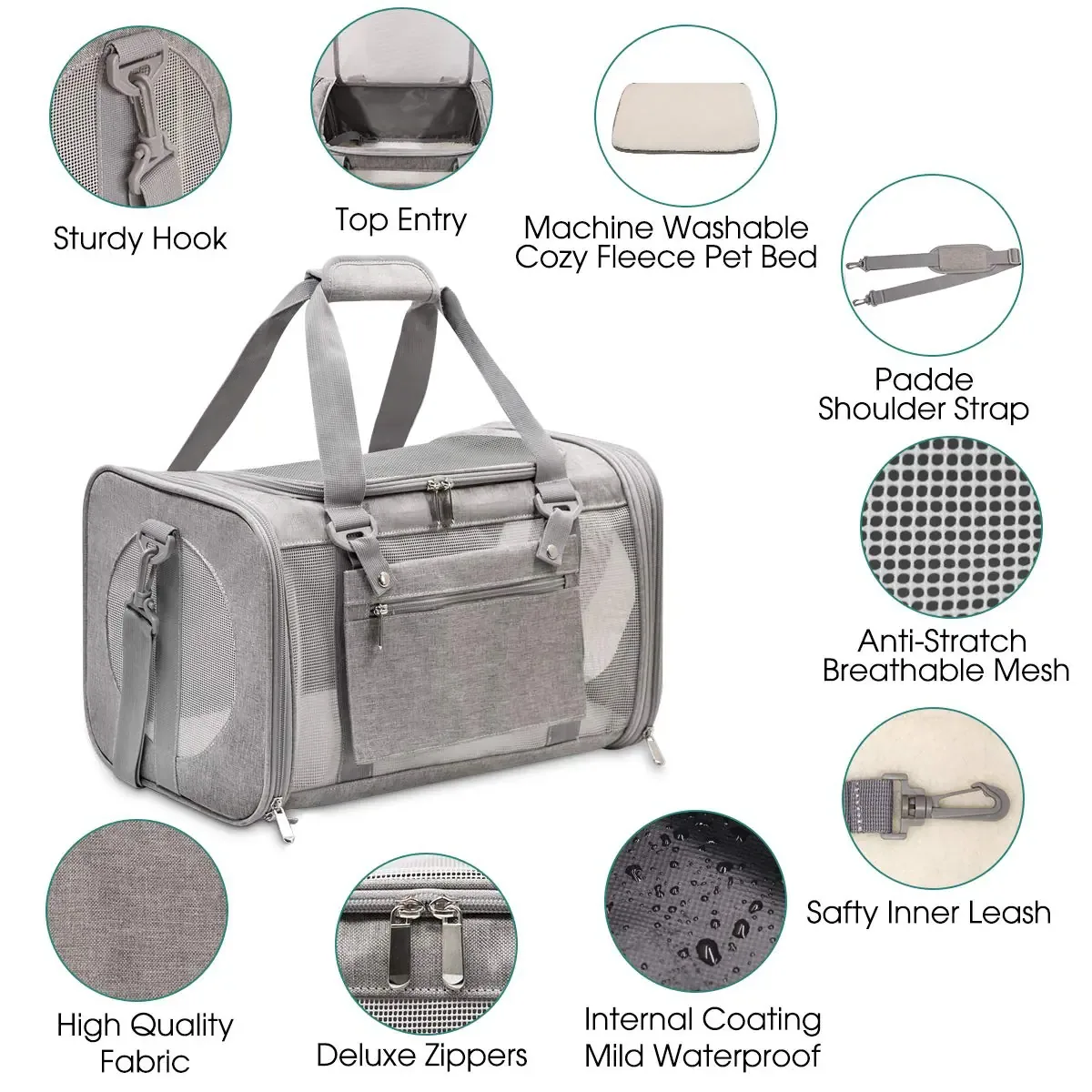
Shell fabric moves to 900D or 1000D polyester or nylon with a PU or TPU coating, against 600D for the small-dog class. Tear strength should be 60 N or better in both directions, tested to a standard tongue-tear route, and abrasion resistance above 15,000 Martindale cycles. The heavier fabric costs 25-40% more per metre and, because the panels are larger, the cost delta per unit is larger still.
Hardware is upgraded across the board. Shoulder-strap hardware moves to 50 mm acetal or aluminium with a working load of 2.5-4.0 kN; base feet and frame hardware move to 304 stainless rivets on 20 mm washers; zippers, where used in a structural role, move to #8 or #10 with metal or heavy-moulded teeth. Zippers in particular are often overlooked: a #5 coil zip that is perfectly adequate on a 6 kg carrier will separate under the hoop stress of a 40 kg load.
Thread and stitch specification change too. Bonded polyester Tex 60 for structural seams against Tex 40 at small scale, an 20/125 or 22/140 needle, and stitch density of 7-9 per inch — lower than the small-scale figure, because a higher density perforates heavy fabric and reduces its effective tear strength. Seam efficiency, measured as seam strength divided by fabric strength, should stay above 80%.
Padding is the one area where less is more. Thick foam under a 40 kg load compresses and becomes unstable; the specification is 10-12 mm of closed-cell foam at 45-60 kg/m³ density in the harness, and 8-10 mm of the same in the base, against 15-20 mm of softer foam at the small-dog scale. Higher density at lower thickness gives a stable platform and a longer service life, because low-density foam takes a compression set within months under this load.
Production Planning: Cutting, Sewing and Cost at Large Format
Large-format carriers change the production plan in three ways: material consumption, equipment and line balance. A 45 kg class carrier consumes 2.4-3.0 m² of shell fabric against 0.9-1.2 m² for a small-dog model, so per-unit material cost is roughly 2.5x. Marker efficiency improves with size — large panels nest better than small ones, typically 84-88% against 74-80% — which recovers part of that, but not most of it.
Equipment is the harder constraint. Assembling 1000D fabric with Tex 60 thread through 5-6 layers requires a compound-feed or walking-foot machine with a large hook and a servo motor capable of consistent penetration, not the light single-needle machines that handle small-format work. Bar-tack stations need the throat depth to reach into an 800 mm compartment. On a line configured for small carriers, large-format work either slows the line substantially or has to be moved to a dedicated station, and that scheduling decision belongs in the quotation rather than in the production meeting.
Line time reflects this. A small-dog carrier runs 18-25 minutes of direct labour; a large-dog carrier with a frame, a hip belt and a moulded base runs 45-70 minutes. At a 200,000-unit monthly capacity across the network, a large-format programme consumes roughly 2.5x the line-hours per unit, which is why capacity planning for these programmes uses unit-equivalents rather than piece counts.
Cost and schedule follow. Unit cost for a large-dog carrier with a frame sheet and a moulded base typically lands at 28-45 USD FOB against 12-18 USD for a small-dog model, and the components with long lead times change: moulded bases and aluminium stays both need tooling before the sewing line can start. The commercial framework is unchanged — MOQ 500 pieces per colourway, prototypes in 6-10 working days, bulk production 35-50 days after approval, final random inspection to AQL 2.5, T/T 30/70 and FOB Xiamen — but the tooling path has to begin several weeks before the sampling path. Planning the tooling and the pattern in parallel is what keeps a large-format programme on its 35-50 day bulk window.
Production capability
- SGS-verified production space of 4,950 m², 149 machines, 7 assembly lines
- Pet carrier and pet bag output since 2014 from a 137-person team
- 200,000 units shipped monthly under BSCI and ISO 9001 systems
People Also Ask
What weight range counts as a large dog for carrier design?
The working envelope is 25-45 kg with a chest girth of 80-110 cm and a back length of 60-80 cm. Structures are rated at the top of the class rather than at the animal's nominal weight, because a moving animal generates transients well above its static weight.
How wide should shoulder straps be on a large dog carrier?
50 mm minimum with 10-12 mm of closed-cell foam, tapering to 40 mm at the neck. Webbing tensile strength should be at least 3x the design load per strap, roughly 12-15 kN for a 45 kg class.
How thick should the base board be?
4.0-5.0 mm of HDPE or PP for a span of 400-500 mm, which limits deflection under 45 kg to under 8 mm. At 3.0 mm the same span deflects 15-25 mm and transfers load into the seams instead.
How much ventilation does a large dog carrier need?
30-35% effective open area for temperate markets and 40% for hot climates. Effective open area is the mesh panel area multiplied by the mesh open fraction, not the panel area alone.
What static load test applies to a large dog carrier?
Four times the rated load held for 24 hours — 180 kg for a 45 kg class. Acceptance is no seam failure, no hardware deformation and residual deflection under 5 mm after unloading.
Do large dog carriers need a frame?
Yes at that scale. A laminated frame sheet gives vertical stiffness but poor torsional control; aluminium stays or a moulded structural shell are needed to stop the carrier wracking under a 35-45 kg live load.
Why do large dog carriers cost much more to produce?
They consume 2.4-3.0 m² of shell fabric against 0.9-1.2 m², need walking-foot machines and deep-throat bar-tack stations, and run 45-70 minutes of direct labour against 18-25 minutes for a small model.
Frequently Asked Questions
How is interior height determined?
At least 55% of the target animal's shoulder height so it can stand with its head below the top panel, and at least 40% so it can lie with its elbows under it. For a 60-70 cm shoulder height that gives 330-430 mm.
What load split should the harness achieve?
70-80% through the hip belt and 20-30% through the shoulder straps. That requires a hip belt of at least 75 mm with a stiffener positioned on the iliac crest; if it rides up, the split collapses onto the shoulders.
Are load lifters and sternum straps necessary?
At this scale, yes. Load lifters at 30-45 degrees pull the centre of gravity toward the spine, and the sternum strap stops the outward rotation that lets the load swing.
Which frame system gives the best torsional control?
A moulded structural shell, at 8,000-20,000 USD tooling and 2.50-5.00 USD per unit. Aluminium stays give good control for 1.80-3.20 USD; a laminated frame sheet controls vertical stiffness only.
How are aluminium stays formed?
Formed to the wearer's back curve rather than left flat, since a flat stay against a curved back creates a pressure point. Forming dies run 400-900 USD per profile.
What foot specification suits a 45 kg carrier?
Four moulded feet of 25-35 mm diameter and 6-10 mm height in TPU or EVA. Bonded feet avoid shell penetration; riveted feet need a 20 mm washer behind the shell.
How is the base board sleeve attached?
Captured in the same seam as the shell-to-base joint with a 15 mm allowance and a bar-tack at each corner. Sewing the sleeve to the lining alone hangs the whole load off a non-load-rated seam.
What mesh specification resists a large dog?
A heavy monofilament or coated polyester mesh at 350-450 g/m² with burst strength above 800 kPa. Lightweight mesh at 250-300 g/m² tears under this class of animal.
How should ventilation panels be placed for airflow?
Low intake at the front or base and a high exhaust at the top or rear, exploiting the stack effect, with intake and exhaust areas within 20% of each other. Panels clustered on one face give almost no flow.
What dynamic cycling test is used?
Rated load plus 20%, cycled vertically at 1.5 G peak for 20,000 cycles. Acceptance is no stitch breakage, bar-tack displacement under 2 mm and seam elongation under 3 mm.
How is a live shifting load simulated?
A 30% offset load applied and released 500 times, measuring lateral deflection at the top of the compartment. Recovery must be within 5 mm with no permanent frame deformation.
Why is stitch density lower on heavy shells?
7-9 stitches per inch against 8-10 on light fabric, because high density perforates heavy fabric and lowers its effective tear strength. Seam efficiency should stay above 80%.
What zipper size is required at this scale?
#8 or #10 with metal or heavy-moulded teeth where the zipper plays a structural role. A #5 coil zip that is fine at 6 kg will separate under the hoop stress of a 40 kg load.
What padding density is used under heavy load?
10-12 mm of closed-cell foam at 45-60 kg/m³ in the harness and 8-10 mm in the base. Low-density foam takes a compression set within months under this load.
Talk to QUANZHOU JUNYUAN BAGS about a pet carrier program: MOQ 500 pieces per colourway, samples in 6-10 working days, bulk production in 35-50 days under AQL 2.5 inspection.
Get a free quote Request a sample