Pet Carrier Bandana: Stylish Accessory
A pet bandana is specified by four numbers: fabric weight of 90-140 gsm, dimensional shrinkage capped at 3% over five domestic washes, an edge finish holding 40 N or more in peel, and a breakaway neck closure releasing at 25-50 N. Print fastness is grade 4 to rubbing and washing, and no drawstring or free cord is permitted anywhere on the product.
A bandana is the cheapest item in the accessory range and one of the easiest to get wrong, because it is cut on the bias, printed on a substrate that moves, and worn around the neck where a closure failure becomes a safety issue. This page sets out the specification in manufacturing terms: the triangle geometry that makes a bandana sit correctly rather than slide round the neck, the fabric and print choices that hold colour through repeated washing, the four edge finishes and what each costs and survives, and the shrinkage control that decides whether a bandana still fits after a month. It also covers the neck closure as a safety component with a measured release band, and the test protocol behind it. Commercial terms are standard: MOQ 500 pieces per colourway, prototypes in 6-10 working days, bulk production 35-50 days after sample approval, final random inspection to AQL 2.5.
A custom pet carrier brief for pet carrier accessory is quoted against three variables before the sample is cut: fabric weight, hardware grade and print method.
Triangle Geometry: Proportion, Drop and How It Sits
A bandana is a triangle worn point-down, and its geometry determines whether it stays in place or slides round the neck within minutes. Two dimensions govern that: the top edge, which sets how much of the neck circumference is covered, and the drop from the top edge to the point, which sets where the weight sits.
The top edge is sized at 1.1-1.4 times the neck circumference. Below 1.1 the bandana is tight and rides up; above 1.4 it bunches and the fold collapses. For a 30 cm neck that gives a top edge of 33-42 cm, which is the single most important number on the specification and the one most often chosen for appearance rather than for fit.
Drop is the second dimension and it is proportional to the top edge rather than independent. A drop of 0.45-0.60 times the top edge puts the point at the sternum without letting it swing into the animal's field of view or into food. A longer drop looks better on a photograph and is worse in use.
| Block | Neck circumference | Top edge | Drop | Hypotenuse | Fabric per unit | Roll width utilisation |
|---|---|---|---|---|---|---|
| XS | 18-24 cm | 22-30 cm | 12-16 cm | 18-24 cm | 0.014-0.024 m² | 88-94% |
| S | 24-32 cm | 30-42 cm | 16-23 cm | 24-34 cm | 0.024-0.048 m² | 90-95% |
| M | 32-42 cm | 42-55 cm | 23-30 cm | 34-44 cm | 0.048-0.083 m² | 91-96% |
| L | 42-54 cm | 55-70 cm | 30-38 cm | 44-54 cm | 0.083-0.133 m² | 89-94% |
| XL | 54-68 cm | 70-88 cm | 38-46 cm | 54-64 cm | 0.133-0.202 m² | 86-92% |
| XXL | 68-84 cm | 88-110 cm | 46-56 cm | 64-74 cm | 0.202-0.308 m² | 82-89% |
Cut orientation is the manufacturing decision that decides whether the geometry survives washing. A triangle cut on the straight grain holds its shape but is stiff and does not drape. One cut on the true bias drapes beautifully and distorts in the first wash, because the bias direction has the highest extension in a woven fabric. The compromise used here is a 15-20 degree off-grain cut, which gives 60-70% of the drape of a true bias at 25-35% of the distortion.
Nesting on the cutting table is the cost lever. A triangle nests with another triangle inverted, so a marker built for pairs achieves 86-96% fabric utilisation against 55-64% for triangles laid individually. On a fabric at 2.60-6.80 USD per metre that difference is worth 0.14-0.42 USD per unit, which on this product is a meaningful share of the unit cost.
The fold at the top edge is a construction detail worth specifying. A single-turn fold of 10-14 mm gives a clean edge and enough substance to hold a snap or a channel; a double-turn fold of 8-10 mm is flatter and is used where the bandana is worn under a collar. The fold is pressed before stitching rather than after, because pressing after stitching creases the print.
Size the top edge at 1.1-1.4 times neck circumference, cut 15-20 degrees off grain, and nest triangles in inverted pairs for 86-96% utilisation.
Fabric Selection: GSM, Weave and Drape
Fabric weight for a bandana sits in a narrow band. Below 90 gsm the fabric is transparent when printed, shows the coat through it, and tears at the point. Above 140 gsm it is stiff, sits away from the neck, and is warm to wear in summer. The working range is 90-140 gsm with the volume centred on 110-130.
Weave and fibre are separate choices. Cotton poplin at 110-130 gsm is the traditional answer: it prints well with pigment or reactive dyes, it is soft, and it has the drape a bandana is expected to have. Its weakness is shrinkage and slow drying. Polyester at 90-120 gsm dyes by sublimation, holds colour better, dries in a third of the time and shrinks less, at the cost of a slightly synthetic hand.
Blends are the practical middle. A 65/35 polyester-cotton at 110-130 gsm takes a pigment print acceptably, shrinks less than cotton and dries faster, and it is the volume choice where a programme wants a natural hand with polyester behaviour.
| Fabric | GSM | Shrinkage, 5 washes | Drying time | Drape index | Tear strength | Cost (USD/m) | Print route |
|---|---|---|---|---|---|---|---|
| Cotton poplin | 110-130 | 2.8-4.6% | 72-120 min | 100 | 9-14 N | 2.60-4.90 | Pigment or reactive |
| Cotton lawn | 90-110 | 3.0-5.0% | 64-104 min | 108 | 6-10 N | 2.90-5.40 | Reactive |
| Polyester poplin | 90-120 | 0.6-1.4% | 22-38 min | 84 | 16-24 N | 1.90-3.60 | Sublimation |
| TC blend 65/35 | 110-130 | 1.4-2.6% | 44-72 min | 92 | 12-18 N | 2.30-4.30 | Pigment |
| Recycled PET poplin | 100-125 | 0.7-1.5% | 24-40 min | 86 | 15-22 N | 3.40-6.80 | Sublimation |
| Bamboo viscose | 120-140 | 3.4-5.8% | 78-126 min | 104 | 7-12 N | 4.20-8.10 | Reactive |
Tear strength is included because the point of a bandana is the failure location. It is the part that catches on things, and a fabric at 6-10 N tears at the point where one at 16-24 N does not. For that reason polyester is specified on every bandana above the economy tier despite its lower drape index.
Drape index is measured as the deflection of a 100 mm cantilevered strip under its own weight, normalised to cotton poplin at 100. The practical consequence of a low index is a bandana that stands away from the neck rather than lying on it, which reads as cheap and is more likely to catch.
Drying time is a comfort item that becomes a durability item in practice. A bandana that stays damp for two hours after a walk in the rain grows odour and mildew, and a cotton bandana at 72-120 minutes will still be damp when it is put away. Polyester at 22-38 minutes is dry before that, which is why it dominates the volume tiers.
Specify 90-140 gsm with tear strength of 12 N or more, and prefer polyester or a blend where drying time and shrinkage matter more than hand feel.
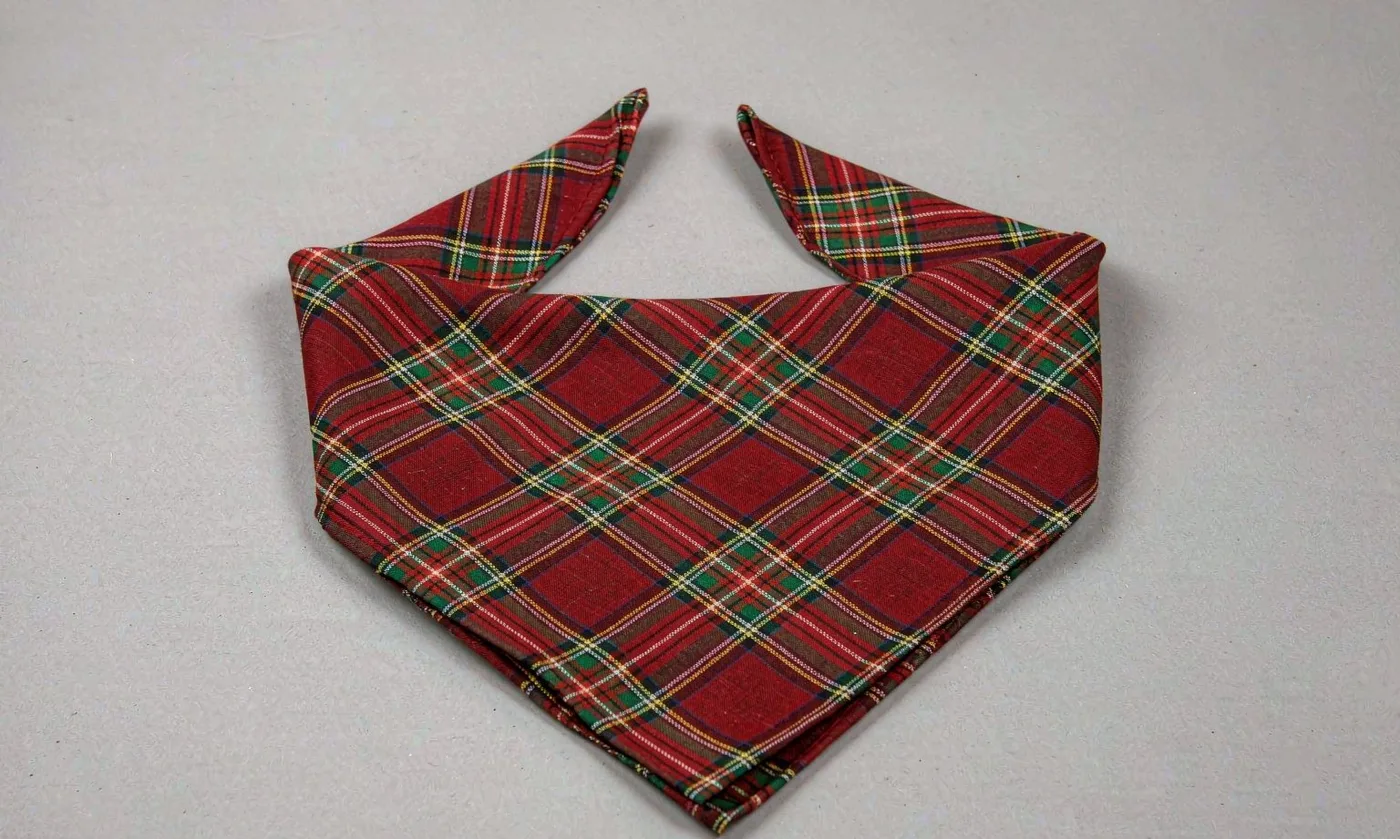
Print Methods: Sublimation, Pigment and Reactive
Print method follows fibre, and the choice is made at fabric selection rather than afterwards. Three routes cover the range and they differ in colour range, fastness, cost and minimum quantity.
Sublimation works on polyester only. A disperse dye is printed to transfer paper and heat-pressed into the fibre at 190-210 degrees, where it becomes part of the polymer rather than a layer on it. The result is the best fastness available — grade 4-5 to washing and 4-5 to rubbing — at full colour with no minimum and no screens.
Pigment printing works on any fibre. A pigment is bound to the surface with a resin, cured at 150-170 degrees, and it is the cheapest route with the widest substrate choice. Its weakness is hand feel and rubbing fastness: a heavy pigment build gives grade 3-4 dry and 2-3 wet, which is below the acceptance on this product unless it is kept light.
| Route | Substrate | Temperature | Wash fastness | Rub fastness | Minimum | Cost (USD/unit) | Colour range |
|---|---|---|---|---|---|---|---|
| Sublimation, sheet fed | Polyester only | 190-210 C | 4-5 | 4-5 | 1 unit | 0.34-0.78 | Full colour |
| Sublimation, roll to roll | Polyester only | 190-210 C | 4-5 | 4-5 | 50-200 m | 0.16-0.36 | Full colour |
| Pigment, screen | Any | 150-170 C | 3-4 | 3-4 dry, 2-3 wet | 100-300 units | 0.22-0.52 | 1-8 spot colours |
| Pigment, digital | Any | 150-170 C | 3-4 | 3-4 dry, 2-3 wet | 1 unit | 0.42-0.94 | Full colour |
| Reactive, screen | Cellulosic | Steam fixation | 4-5 | 4-5 | 200-500 units | 0.38-0.86 | 1-8 spot colours |
| Woven jacquard label | Polyester yarn | n/a | 4-5 | 4-5 | 500-1,000 units | 0.10-0.28 | Up to 8 |
Registration on a triangle is the practical problem that no substrate choice solves. A design placed centrally on a triangle reads as off-centre unless it is positioned relative to the worn orientation rather than the geometric centroid, and the offset is typically 8-16 mm toward the top edge. Artwork is set up on a placement guide per size block rather than scaled from one size.
Bleed is the second practical problem. A printed edge on a triangle that is then hemmed loses 10-14 mm of the design, so artwork carries a bleed of 15-20 mm beyond the cut line and a safe area of 12-18 mm inside the hem. A design that runs to the cut line without bleed shows white at the fold after hemming, which is the most common artwork defect on this product.
Cure verification is a production control rather than a laboratory one. A pigment print that is under-cured fails rubbing fastness; one that is over-cured is brittle and cracks at the fold. Cure is checked by a wash test on two units per 500 produced rather than by a timer, because oven temperature and belt speed both drift.
Match the route to the fibre, carry 15-20 mm of bleed and a 12-18 mm safe area, and verify cure by wash test on two units per 500 rather than by oven settings.
Edge Finishing: Overlock, Bound, Rolled and Laser
The edge is where a bandana fails, and there are four finishes available with different costs, appearances and lives. The choice interacts with the fabric: some finishes that work well on polyester are poor on cotton, and one of them removes the option of a printed edge entirely.
An overlock edge is the fastest and cheapest, at 0.04-0.10 USD, and it is the standard on a promotional bandana. It resists fraying adequately on a polyester and poorly on a cotton lawn, and it is visually a raw edge. A rolled hem is the traditional finish, at 0.12-0.28 USD, giving a narrow clean edge that drapes well and survives washing on any fibre.
A bound edge uses a folded tape over the raw edge, at 0.18-0.40 USD, and it is the most durable option as well as the one that lets a bandana carry a contrast colour. A laser-cut and heat-sealed edge works on synthetic fabrics only, at 0.06-0.14 USD, with no stitching at all — and it is the only finish that cannot be used on a cotton or a high-cotton blend.
| Finish | Peel or seam strength | Fraying after 10 washes | Appearance | Works on cotton | Cost (USD) | Suits |
|---|---|---|---|---|---|---|
| Overlock, 3-thread | 18-32 N | Slight on polyester, marked on cotton | Raw | Poorly | 0.04-0.10 | Promotional |
| Overlock, 4-thread | 26-44 N | Slight | Raw | Acceptably | 0.06-0.14 | Economy, volume |
| Rolled hem, single turn | 40-62 N | None | Clean, narrow | Yes | 0.12-0.28 | Standard |
| Bound edge, tape | 54-86 N | None | Clean, contrast option | Yes | 0.18-0.40 | Preferred, retail |
| Laser cut and sealed | n/a, sealed | None if sealed correctly | Modern, flat | No | 0.06-0.14 | Polyester only |
| Bias binding, self fabric | 48-74 N | None | Traditional | Yes | 0.22-0.46 | Premium |
Peel strength is measured by gripping the finish and the body in separate jaws and separating them at 100 mm per minute, with acceptance at 40 N or more. The overlock rows fail that threshold, which is why they are confined to promotional product where a short service life is understood.
Sealing quality on a laser-cut edge is the variable that decides whether the finish works. Under-sealed and it frays; over-sealed and it beads into a hard ridge that is uncomfortable against the neck. The process window is narrow, at 1.5-3.0 seconds of dwell at a set temperature, and it is verified by a fray check on five units per 500 rather than by visual inspection.
The point of the triangle is the stress concentration for every finish. Regardless of which one is used, the point receives a reinforcement: a bar-tack of 8-12 mm, or on a bound edge a mitred corner with a back-stitch. Without it the point is where the bandana starts to come apart, and it is the first thing a customer notices.
Require peel strength of 40 N or more, reinforce the point with a bar-tack on every finish, and restrict laser cutting to polyester with a dwell window of 1.5-3.0 seconds.
Shrinkage, Dimensional Stability and Wash Performance
Shrinkage is the defect that generates returns on this product more than any other, because a bandana is bought by neck size and a bandana that shrinks 5% does not fit the neck it was bought for. The control is a combination of pre-treatment, pattern allowance and a measured acceptance.
The mechanism is the release of tension put into the fabric during weaving and finishing. A woven cotton can carry 4-7% of latent shrinkage, and the first wash releases most of it. The two controls available are pre-shrinking the fabric before cutting, which costs 0.10-0.24 USD per unit, and washing the finished product, which costs 0.06-0.16 USD and also softens the hand.
Pattern allowance is the alternative and it is less satisfactory. Cutting oversize to allow for shrinkage means the product is the wrong size when new and the right size after a wash, which is defensible on a garment and confusing on an accessory sold by measurement. This programme uses pre-shrinking rather than allowance.
| Fabric | Untreated | Pre-shrunk | Pre-shrunk plus sanforised | Garment washed | Acceptance | Verdict |
|---|---|---|---|---|---|---|
| Cotton poplin | 2.8-4.6% | 1.6-2.8% | 0.9-1.8% | 0.6-1.4% | 3% maximum | Needs treatment |
| Cotton lawn | 3.0-5.0% | 1.8-3.1% | 1.0-2.0% | 0.7-1.6% | 3% maximum | Needs treatment |
| Polyester poplin | 0.6-1.4% | 0.4-1.0% | n/a | n/a | 3% maximum | Passes untreated |
| TC blend 65/35 | 1.4-2.6% | 0.9-1.8% | 0.6-1.3% | 0.5-1.1% | 3% maximum | Marginal untreated |
| Bamboo viscose | 3.4-5.8% | 2.0-3.4% | 1.2-2.2% | 0.8-1.7% | 3% maximum | Needs treatment |
| Recycled PET | 0.7-1.5% | 0.5-1.1% | n/a | n/a | 3% maximum | Passes untreated |
The acceptance is 3% in either direction after five domestic washes at 40 degrees with a tumble dry, measured on the top edge because that is the dimension that governs fit. A bandana is marked with the size it will be after washing rather than the size it is when new, and the label states the neck range on that basis.
Skew is the related defect and it is more visible than shrinkage. A triangle whose point moves off centre after washing reads as twisted, and skew of more than 4% is noticeable on a printed design with a straight edge. The control is the off-grain cut described earlier plus a skew check on the finished marker, with acceptance at 3% or less.
Wash performance of the print is tested alongside dimensional change, because a customer washes the whole product once rather than testing substrate by substrate. A printed bandana is washed five times and assessed for colour change at grade 4, for staining at grade 4, and for any visible cracking or loss of the print at the fold.
Pre-shrink to 3% or better measured on the top edge after five washes, label the washed size, and hold skew at 3% or less because it is more visible than shrinkage.
Neck Closure: Tie-On, Snap and the Safety Case
A bandana goes around the neck, which makes its closure a safety component rather than a fastening. The requirement is the same one that governs a breakaway collar: hold under normal wear, release under a snag, and never present a loop or a cord that can catch.
Three closures are available. A tie-on bandana has no hardware and is the traditional answer; its safety case rests on the knot slipping under load, which it does at 40-90 N depending on fabric friction. A snap closure gives a consistent, measured release and is repeatable. A channel and collar pass-through uses the animal's own collar, which cannot be snagged separately.
The release band for a snap closure on this product is 25-50 N, measured at 0, 45 and 90 degrees. Below 25 N the bandana comes off during play; above 50 N it holds in a snag longer than is acceptable. The band is narrower than a collar band because there is no lead attached and the consequence of a release is only a lost bandana.
| Closure | Release at 0 degrees | Release at 90 degrees | Repeatable | Adjustability | Cost (USD) | Verdict |
|---|---|---|---|---|---|---|
| Tie-on, no hardware | 40-90 N, friction dependent | 52-118 N | No | Full | 0.00-0.06 | Acceptable, traditional |
| Two-part snap | 25-50 N | 34-64 N | Yes | None, sized | 0.18-0.42 | Preferred |
| Snap plus elastic insert | 22-44 N | 30-58 N | Yes | 20-40 mm | 0.26-0.54 | Preferred, growing animals |
| Channel for collar | n/a, no closure | n/a | n/a | Full | 0.08-0.18 | Safest, needs a collar |
| Adhesive tab | 12-28 N | 16-36 N | No, degrades | None | 0.04-0.12 | Excluded, unreliable |
| Drawstring cord | n/a | n/a | n/a | Full | 0.02-0.08 | Prohibited |
A drawstring is prohibited outright. A free cord at the neck is a strangulation and entanglement hazard, it is prohibited in children's upper outerwear for exactly that reason, and a bandana is the product where a decorative cord is most tempting. There is no version of this product with a functioning drawstring; where the appearance is wanted, a stitched faux cord is used.
The channel closure is the safest option and it is under-used. The bandana's top edge is folded into a channel through which the animal's existing collar passes, so there is no additional closure at all and nothing to catch. It requires the animal to wear a collar, which is why it is offered alongside the snap version rather than instead of it.
Hardware on a bandana carries the same chemical obligations as anywhere else. A snap is tested for nickel release to the 0.5 micrograms per square centimetre per week limit under REACH and for lead content to the 100 ppm limit, with declarations issued against ECHA guidance. A snap is small, but it sits against the neck.
Use a two-part snap releasing at 25-50 N or a collar channel, prohibit drawstrings absolutely, and test the snap for nickel release even though it is small.
Test Protocol and Safety Thresholds
The bandana protocol is shorter than a harness protocol but it is not optional, because the product is worn at the neck and washed repeatedly. Six checks cover it at 620-1,420 USD per colourway, running 14-26 working days.
Dimensional stability is the first and it is measured on three units washed five times at 40 degrees with a tumble dry. Acceptance is 3% maximum change in the top edge and 3% maximum skew. Colour change and staining are assessed on the same units at grade 4.
Edge integrity is the second and it is a physical test rather than a visual one. The finish is separated from the body at 100 mm per minute on five units with acceptance at 40 N, and the point reinforcement is pulled with acceptance at 30 N with no stitch failure.
| Test | Condition | Sample | Threshold | Failure sought | Cost (USD) |
|---|---|---|---|---|---|
| Dimensional stability | 5 washes at 40 C, tumble | 3 units | 3% change, 3% skew | Out-of-size bandana | 90-190 |
| Colour change and staining | Same units, grey scale | 3 units | Grade 4 | Fading or transfer to coat | 60-130 |
| Edge peel strength | 100 mm/min | 5 units | 40 N minimum | Finish separating | 70-150 |
| Point reinforcement | Pull to failure | 5 units | 30 N, no stitch failure | Point opening | 50-110 |
| Closure release | 0, 45, 90 degrees | 5 units | 25-50 N band | Holding under snag | 110-240 |
| Chemical panel | CPSIA, REACH, OEKO-TEX | Per colourway | Per limit | Lead, nickel, azo | 240-600 |
| Small parts check | Tension and torque | 5 units | No detachment under 70 N | Ingestible component | 60-140 |
The small parts check applies to any bandana with an applied component — a snap, a stud, a decorative charm — and it is performed at 70 N of tension and 0.45 Nm of torque with acceptance of no detachment. A component that comes off a bandana is at mouth height for the animal, which is why the threshold exists and why decorative charms are discouraged.
Colour transfer to a light coat is the specific risk on this product and it is assessed by a wet-rub test against a white coat simulant after five washes, not only as received. A saturated dark print on a cotton poplin is the combination most likely to fail, and it is the one that gets the repeat test.
The textile declaration is issued against OEKO-TEX criteria and the chemical panel against CPSIA limits under the consumer framework administered by the U.S. Consumer Product Safety Commission. Records and one retained unit per lot are held for 24 months.
Run dimensional stability, edge peel, closure release and the chemical panel together at 620-1,420 USD, and assess colour transfer wet after washing rather than as received.
Cost, Set Coordination and Production Planning
A bandana is the lowest-cost item in the accessory range and the one with the highest ratio of artwork effort to unit value. That ratio drives the planning: the artwork is the expensive part and it has to be amortised across a volume, which is what the MOQ is really for.
Unit content is modest. Fabric at 0.014-0.308 m² depending on block, plus an edge finish, a closure and a print, lands at 0.62-2.14 USD at 500 units and 0.48-1.62 at 2,000. The variable that moves it most is the print route, with roll-to-roll sublimation at 0.16-0.36 against digital pigment at 0.42-0.94.
Artwork setup is the non-recurring item and it is per design rather than per colourway. A design prepared to the placement guide with bleed and safe areas, separated and proofed, costs 120-380 USD and takes 2-5 working days. A programme running twelve designs pays 1,440-4,560 USD before a single unit is cut.
| Element | 500 units | 2,000 units | 5,000 units | Note |
|---|---|---|---|---|
| Fabric, 0.048 m² at 110 gsm | 0.14-0.30 | 0.11-0.24 | 0.10-0.20 | Nested in pairs |
| 0.22-0.94 | 0.16-0.52 | 0.14-0.38 | Route dependent | |
| Edge finish | 0.06-0.40 | 0.05-0.32 | 0.04-0.27 | Overlock to bound |
| Closure | 0.00-0.54 | 0.00-0.44 | 0.00-0.37 | Tie to snap |
| Cut and sew labour | 0.20-0.42 | 0.16-0.34 | 0.14-0.29 | Cut, hem, press, pack |
| Content subtotal | 0.62-2.14 | 0.48-1.62 | 0.42-1.51 | |
| Amortised artwork and setup | 0.24-0.76 | 0.06-0.19 | 0.02-0.08 | 120-380 per design |
| Landed unit cost | 0.86-2.90 | 0.54-1.81 | 0.44-1.59 | Before duty and freight |
Coordination with a carrier, collar or leash adds the same matching obligation that applies across the range: Delta-E 1.5 between the bandana ground and the coordinating fabric, under three illuminants. A bandana is the hardest component to match because it is printed rather than dyed, and a printed ground drifts with the print run as well as with the fabric lot.
The control is a printed reference swatch held alongside the coordinating fabric master, measured on the same instrument at the same time. A print run measured at Delta-E 1.8 against the fabric is corrected at the press rather than sorted afterwards, because sorting a triangle by shade is slower than printing another run.
Scheduling is standard with one addition. Fabric runs 12-24 days and pre-shrinking adds 3-6 days, so the fabric is ordered at sample approval alongside the hardware. Sampling takes 6-10 working days and bulk production 35-50 days after approval, with final random inspection to AQL 2.5. Dimensional stability, closure release and edge integrity sit in the critical class, and print registration in the major class.
Amortise artwork across the volume rather than the colourway, hold a printed reference swatch against the fabric master, and put dimensional stability in the critical class at inspection.
Order and quality terms
- MOQ 500 pieces per colourway; samples in 6-10 working days
- Bulk production 35-50 days after approval; AQL 2.5 inspection standard
- T/T 30/70 terms, FOB Xiamen, full document set per shipment
People Also Ask
How big should a pet bandana be?
The top edge should be 1.1-1.4 times neck circumference, so 33-42 cm for a 30 cm neck, with a drop of 0.45-0.60 times the top edge. Below 1.1 it rides up; above 1.4 it bunches.
What fabric weight suits a pet bandana?
90-140 gsm, centred on 110-130. Below 90 gsm the fabric is transparent and tears at the point; above 140 it is stiff and warm.
How much shrinkage is acceptable?
3% maximum on the top edge after five domestic washes at 40 degrees with a tumble dry, with skew also held at 3% or less.
Which print method lasts longest?
Sublimation on polyester, at grade 4-5 to washing and rubbing. Pigment printing reaches grade 3-4 dry and 2-3 wet and is below acceptance at a heavy build.
What edge finish is most durable?
A bound tape edge at 54-86 N peel strength, or a rolled hem at 40-62 N. A three-thread overlock reaches 18-32 N and fails the 40 N acceptance.
Why is a drawstring prohibited on a bandana?
A free cord at the neck is a strangulation and entanglement hazard. Where the appearance is wanted, a stitched faux cord is used with no function.
What release force should a bandana closure have?
25-50 N at 0 degrees and 34-64 N at 90 degrees for a two-part snap. Below 25 N it comes off in play; above 50 N it holds too long under a snag.
How much artwork setup does a bandana programme need?
120-380 USD per design for placement, bleed, separation and proofing, taking 2-5 working days. Twelve designs cost 1,440-4,560 USD before cutting starts.
Frequently Asked Questions
Why is a bandana cut off grain rather than on the true bias?
A true bias drapes beautifully but distorts in the first wash because that direction has the highest extension in a woven fabric. A 15-20 degree off-grain cut gives 60-70% of the drape at 25-35% of the distortion.
How does nesting affect bandana cost?
Triangles nested in inverted pairs achieve 86-96% fabric utilisation against 55-64% laid individually, worth 0.14-0.42 USD per unit.
Why is tear strength specified on this product?
The point of the triangle is the failure location because it catches on things. A cotton lawn at 6-10 N tears there where a polyester at 16-24 N does not.
What is drape index and why does it matter?
The deflection of a 100 mm cantilevered strip under its own weight, normalised to cotton poplin at 100. A low index gives a bandana that stands away from the neck and catches more often.
Why does drying time appear in the specification?
A bandana damp for two hours after a walk grows odour and mildew before it is put away. Polyester dries in 22-38 minutes against 72-120 for cotton.
Why is artwork placed off the geometric centroid?
A design on the centroid reads as low once worn. The offset is typically 8-16 mm toward the top edge, and it is set per size block rather than scaled.
How much bleed does bandana artwork need?
15-20 mm beyond the cut line, with a safe area of 12-18 mm inside the hem, because hemming removes 10-14 mm of the design.
Why is cure checked by wash test rather than by oven settings?
Oven temperature and belt speed both drift. An under-cured pigment fails rubbing fastness and an over-cured one cracks at the fold, so the check is two units per 500 washed.
What dwell window applies to a laser-cut edge?
1.5-3.0 seconds at the set temperature. Under-sealed it frays and over-sealed it beads into a hard ridge uncomfortable against the neck.
Why is the point of the triangle reinforced on every finish?
It is the stress concentration regardless of edge type. A bar-tack of 8-12 mm, or a mitred corner with a back-stitch on a bound edge, prevents the point opening first.
Why is pre-shrinking preferred to a pattern allowance?
An allowance means the product is the wrong size when new and right after a wash, which is confusing on an accessory sold by measurement. Pre-shrinking costs 0.10-0.24 USD per unit.
What makes a collar channel the safest closure?
The bandana passes onto the animal's existing collar, so there is no additional closure and nothing to catch. It is offered alongside the snap version because it requires a collar.
Why is a small parts check run on a bandana?
Any detached component is at mouth height for the animal. Applied parts are pulled at 70 N and torqued at 0.45 Nm with no detachment permitted.
Why is a bandana the hardest component to colour match?
Its ground is printed rather than dyed, so it drifts with the print run as well as with the fabric lot. A printed reference swatch is measured against the fabric master on the same instrument.
Talk to QUANZHOU JUNYUAN BAGS about a pet carrier program: MOQ 500 pieces per colourway, samples in 6-10 working days, bulk production in 35-50 days under AQL 2.5 inspection.
Get a free quote Request a sample