Pet Carrier Collar: Coordinated Look
A coordinated collar is specified by a width rule and a release rule. Width is set at neck circumference divided by 12, giving 25 mm for a 30 cm neck, and neck contact pressure is held at or below 1.2 N/cm². A breakaway collar separates at 30-60 N and must not release below 40 N in normal use.
A collar carries more engineering per gram than any other item in the accessory range, because it sits on the neck, it holds identification permanently, and in the breakaway variant it is required to fail on demand. This page sets out the specification in manufacturing terms: the width-to-circumference rule that keeps neck pressure inside a safe band, the release force engineering behind a breakaway collar that separates under a snag but not under a lead, and the buckle families that have to be operable with one hand while holding an animal. It also covers D-ring and tag-ring weld integrity, edge finishing against coat wear, reflective and identification integration, and the test protocol with numeric thresholds. Commercial terms are standard: MOQ 500 pieces per colourway, prototypes in 6-10 working days, bulk production 35-50 days after sample approval, final random inspection to AQL 2.5.
Custom pet carrier development for pet carrier accessory starts with a tech pack: dimensions, fabric weight, hardware finish and the target test standard.
Width-to-Circumference Ratio and Neck Load Distribution
A collar is a band loaded in tension around a structure that does not tolerate point loading. The engineering question is how wide the band has to be for the load to be spread far enough, and the answer is a ratio rather than a fixed width: width in millimetres at or above neck circumference in centimetres divided by 12.
That rule produces 15 mm for a 20 cm neck, 25 mm for a 30 cm neck and 40 mm for a 50 cm neck, and it works because it holds contact area roughly proportional to the perimeter the load is distributed around. A collar specified at a fixed 20 mm across the whole range is over-wide on a small neck, where it is bulky and abrades the jaw, and under-wide on a large one, where it concentrates load.
Contact pressure is the measured quantity behind the rule. Under a steady lead pull of 1.2 times animal weight, a correctly proportioned collar holds neck contact pressure at 0.4-1.2 N/cm². The same collar at half the correct width doubles that, and above roughly 2.4 N/cm² the collar begins to bear on the trachea rather than on the muscle of the neck.
| Neck circumference | Minimum width | Contact area | Pressure at 1.0x weight | Pressure at 1.2x weight | Verdict at half width |
|---|---|---|---|---|---|
| 18-22 cm | 15 mm | 27-33 cm² | 0.3-0.5 N/cm² | 0.4-0.6 N/cm² | 0.8-1.2, acceptable |
| 24-30 cm | 20-25 mm | 48-75 cm² | 0.4-0.7 N/cm² | 0.5-0.8 N/cm² | 1.1-1.6, marginal |
| 32-40 cm | 27-33 mm | 86-132 cm² | 0.5-0.8 N/cm² | 0.6-1.0 N/cm² | 1.4-2.0, poor |
| 42-52 cm | 35-43 mm | 147-224 cm² | 0.6-0.9 N/cm² | 0.7-1.1 N/cm² | 1.8-2.4, fails |
| 54-66 cm | 45-55 mm | 243-363 cm² | 0.7-1.0 N/cm² | 0.8-1.2 N/cm² | 2.2-2.8, fails |
| 68-82 cm | 57-68 mm | 388-558 cm² | 0.8-1.1 N/cm² | 0.9-1.3 N/cm² | Not offered |
Taper is the refinement that makes the rule work in production. A collar that is uniformly wide looks heavy on a small neck, so the load-bearing section keeps the full width while the ends taper 30-40% over the last 60-90 mm. The taper is cut into the pattern rather than achieved by skiving, because a skived edge loses the sealed edge that stops fraying.
Stiffness interacts with width. A stiff collar bridges rather than conforms, so the effective contact area is smaller than the geometric one and the pressure is higher than the table suggests. On collars above 35 mm the specification therefore calls for a softer construction: a two-layer build with a 1.5-2.5 mm foam interlayer at 35-55 kg/m³, which restores conformance at the cost of 0.14-0.32 USD.
Sizing is expressed as an adjustable range rather than a nominal, because a collar is bought by measurement and returned if it does not span the measurement. Each block carries 8-14 cm of adjustment, and the blocks overlap by 2-4 cm so an animal at a boundary is covered by two blocks rather than none.
Set width at neck circumference divided by 12, hold neck pressure at or below 1.2 N/cm², and overlap size blocks by 2-4 cm so no measurement falls into a gap.
Breakaway versus Fixed: Release Force Engineering
A breakaway collar is required to do two opposite things: hold under the loads of normal use and release under a snag. Both are force thresholds and the specification is the band between them, which is narrow and has to be measured rather than assumed.
The lower threshold is set by normal use. A collar has to survive a lead pull, a hand on the collar, and an animal backing out of a gap, which between them reach 35-70 N on a medium animal. Release below that range means the collar comes off during ordinary handling, and release is measured as separation rather than as opening.
The upper threshold is set by the snag case. A collar caught on a branch or a fence has to release before the load rises to a level that causes injury, and the working figure used in this programme is 60-140 N depending on size block. Between the two thresholds sits the band: 30-60 N for small blocks and 60-120 N for large ones, with the requirement that the collar does not separate below its lower figure.
| Block | Animal mass | Release band | Release at 45 degrees | Release at 90 degrees | Must not release below | Mechanism |
|---|---|---|---|---|---|---|
| XS | Under 4 kg | 30-50 N | 34-56 N | 40-64 N | 28 N | Two-part snap |
| S | 4-9 kg | 40-70 N | 45-78 N | 52-90 N | 36 N | Two-part snap |
| M | 9-18 kg | 60-100 N | 66-112 N | 78-128 N | 54 N | Two-part snap |
| L | 18-30 kg | 80-130 N | 88-146 N | 104-166 N | 72 N | Reinforced snap |
| XL | 30-45 kg | 100-160 N | 110-178 N | 130-204 N | 90 N | Reinforced snap |
| Fixed, no breakaway | Any | n/a | n/a | n/a | n/a | Buckle only |
Direction matters and it is why the table carries three columns. A two-part snap loaded along its axis releases at its nominal figure; loaded at 45 degrees it needs 10-16% more; loaded at 90 degrees it needs 28-40% more. A collar whose release is specified only axially will hold in the geometry of a real snag, which is rarely axial.
Two mechanisms are available. A two-part snap uses two interlocking moulded halves that separate above a threshold, and it is re-settable by hand. A sacrificial stitch releases a sewn closure above a threshold and has to be replaced. The snap is preferred at 0.22-0.52 USD because a re-settable mechanism is used correctly and a sacrificial one is often re-sewn incorrectly or left broken.
Cycle life is the property that separates a good mechanism from a bad one. A two-part snap is tested for 500 engage-release cycles plus 2,000 sub-threshold load applications, with the release force re-measured at intervals. Acceptance is a drift of 10% or less from the original figure; a snap drifting 18-26% is a sign of a moulded part that is wearing at the catch.
Specify release as a band measured at 45 and 90 degrees as well as axially, and require release force drift within 10% over 500 cycles plus 2,000 sub-threshold loads.
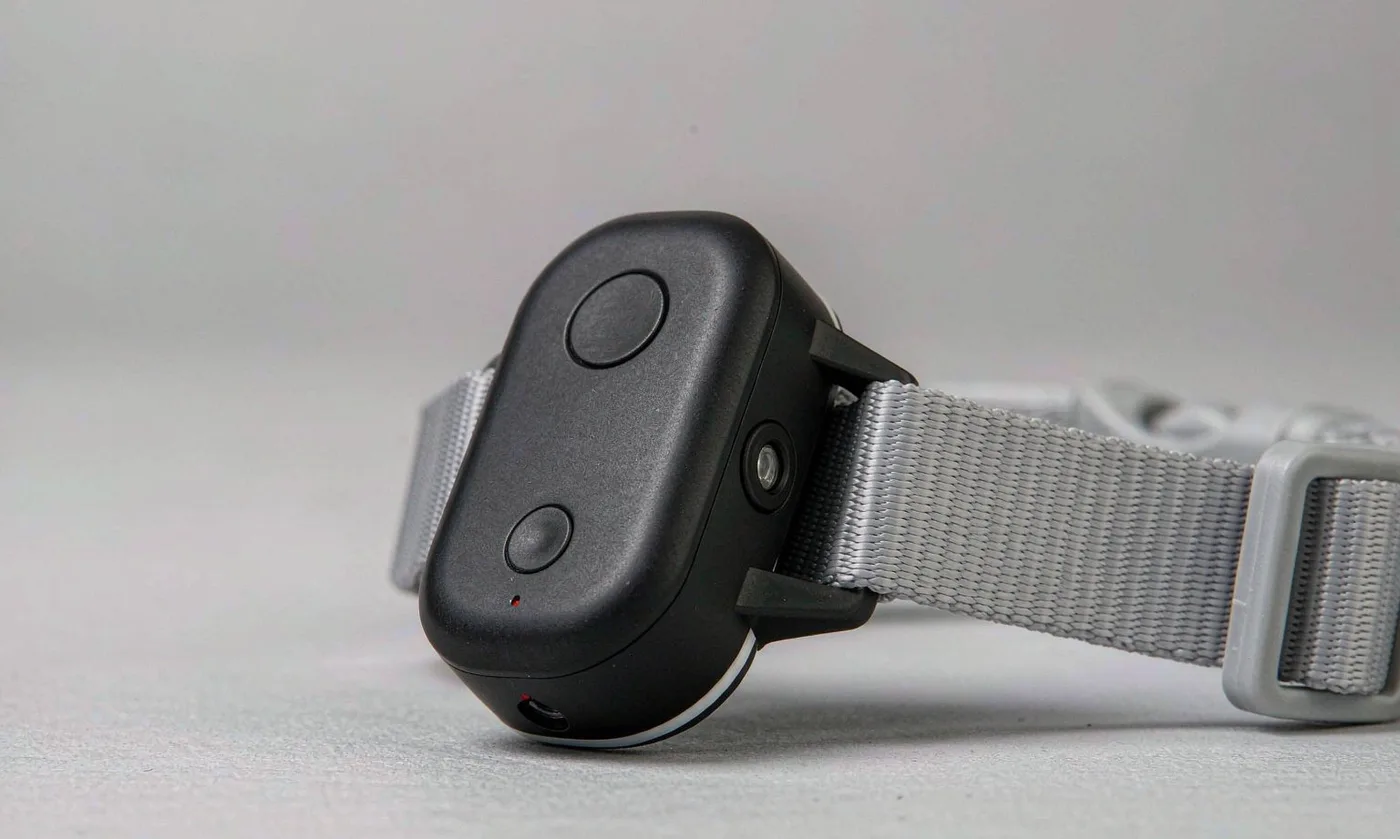
Buckle Families and One-Handed Operation
A collar buckle has to be opened and closed by an adult using one hand, while the other hand is occupied. That requirement eliminates several mechanisms that are perfectly serviceable on a bag, and it sets a numeric band on the operating force just as it does on a clip gate.
A side-release buckle is the volume standard. Two moulded parts engage with an audible click and release by pinching two tabs, at an operating force of 14-32 N and a body rating of 1.8-3.8 kN depending on size and material. Its weakness is that a pinch release can be worked by a determined animal's paw, and it is also the mechanism most easily released by catching on something.
A two-part snap for a breakaway collar is a different mechanism with the same hand requirement, at 18-38 N to separate deliberately. A roller buckle is the traditional answer, at a much higher rating but requiring two hands and a threaded strap end, and it is now restricted to working and service applications in this programme.
| Family | Operating force | Body rating | One-handed | Paw-release risk | Cycle life | Cost (USD) | Suits |
|---|---|---|---|---|---|---|---|
| Side-release, acetal | 14-26 N | 1.8-2.6 kN | Yes | Medium | 6,000-10,000 | 0.16-0.34 | Standard, small blocks |
| Side-release, reinforced | 18-32 N | 2.8-3.8 kN | Yes | Low | 8,000-14,000 | 0.28-0.58 | Standard, large blocks |
| Two-part breakaway snap | 18-38 N | 1.2-2.2 kN | Yes | Low | 500 plus 2,000 loads | 0.22-0.52 | Breakaway collars |
| Magnetic clasp | 8-16 N | 0.6-1.1 kN | Yes | High | 4,000-8,000 | 0.34-0.72 | Light dress collars only |
| Roller buckle, metal | 28-52 N | 3.4-5.2 kN | No | Very low | Above 20,000 | 0.42-0.94 | Working and service |
| Centre-bar buckle | 24-44 N | 3.0-4.6 kN | No | Very low | Above 20,000 | 0.36-0.82 | Working and service |
A magnetic clasp is the one to be careful with. It operates at a pleasingly low force and closes itself, which is why it appears on dress collars, but at 0.6-1.1 kN it is not adequate for a collar that takes a lead, and its high paw-release risk makes it unsuitable for an animal left unsupervised. It is specified only where the collar is decorative and the lead attaches elsewhere.
Operating force is verified with a force gauge at the point of maximum leverage, and it is measured on wet hands as well as dry. A buckle that takes 22 N dry can take 34 N wet, because a wet moulded surface has a different friction coefficient and a wet finger slides off the tab. Any buckle above 32 N in either condition fails the one-handed requirement.
Audible and tactile confirmation is a specification item rather than a nicety. A closure that clicks is verified by a user without looking, which matters when the other hand is occupied; a closure that does not is checked visually or not at all. The click is produced by the catch geometry and it is confirmed on 10 units per lot by a simple operator panel.
Require 14-32 N operating force measured wet as well as dry, an audible closure, and a body rating of 2.8-3.8 kN on blocks above 18 kg.
D-Ring, Tag Ring and Weld Integrity
A collar carries two rings and they do different jobs. The D-ring takes the lead and is on the load path. The tag ring carries identification and is not. Confusing the two is a common specification error, and it produces either an over-heavy collar or a tag ring that is pulled off in the first week.
The D-ring is specified by its weld. A welded steel ring rated at 2.0-3.4 kN is standard for a walking collar, and the weld is the failure point rather than the wire: a butt weld with full penetration holds, while an incomplete weld holds 40-60% of the wire rating and looks identical from outside. Weld integrity is therefore verified destructively on three units per lot with a visual fracture check.
Placement is the second decision. A D-ring centred on the collar puts the pull on the front of the neck and works well for a calm animal; one positioned 15-25 mm off centre rotates the collar so the ring sits at the side at rest, which keeps the front of the neck clear. Both are used and the choice is made per programme rather than by default.
| Component | Material | Wire | Rating | Weld type | Weld check | Cost (USD) | Use |
|---|---|---|---|---|---|---|---|
| D-ring, welded | Stainless 304 | 3.0-3.5 mm | 2.4-3.4 kN | Butt, full penetration | 3 units per lot, destructive | 0.28-0.62 | Lead attachment |
| D-ring, welded | Carbon steel, plated | 3.0-3.5 mm | 2.0-2.8 kN | Butt, full penetration | 3 units per lot, destructive | 0.18-0.40 | Lead attachment, economy |
| D-ring, cast | Zinc alloy | n/a | 1.4-2.2 kN | Not welded | Radiograph sample | 0.14-0.32 | Small blocks only |
| Tag ring, split | Stainless 304 | 1.0-1.4 mm | 0.3-0.6 kN | Butt | Visual at 10x | 0.04-0.10 | Identification |
| Tag ring, welded | Stainless 304 | 1.2-1.6 mm | 0.6-1.0 kN | Butt | Visual at 10x | 0.06-0.14 | Identification, heavy tags |
| Floating tag plate | Brass or steel | n/a | n/a | Riveted or sewn | Pull test | 0.10-0.26 | Flat identification |
The tag ring is deliberately light. At 0.3-1.0 kN it will not survive a lead being clipped to it, and that is intentional: a user who clips the lead to the tag ring has made an error, and a ring that fails safely under that error is better than one that holds and then fails at a worse moment. The instruction set states which ring takes the lead.
Attachment to the collar body is where the load actually transfers. The D-ring sits in a webbing loop closed with a bar-tack group of 28-36 mm, and the group is rated above the ring so the ring is the designed weak point rather than the seam. On a collar above 35 mm wide the loop is doubled, because a single thickness of webbing at that width allows the ring to roll.
Corrosion on the ring is a visibility issue as well as a strength one. A stainless 304 ring runs 96 hours of neutral salt spray with no base metal corrosion; a plated carbon steel ring runs 48 hours to grade 8. Given the price difference of 0.10-0.22 USD, stainless is specified on every collar above the economy tier because a rusting ring next to identification is the most visible failure available.
Specify a welded stainless D-ring at 2.4-3.4 kN with destructive weld verification at three units per lot, and keep the tag ring light and clearly labelled for identification only.
Edge Finish, Binding and Coat Wear
A collar is in contact with the same patch of coat and skin for months, and the failure it produces is not dramatic: a thinning of the coat at the neck and, in worse cases, a contact dermatitis. Both are driven by edge geometry and by the material's surface, and both are addressed by specification.
Edge geometry is the first control. A cut webbing edge is sharp at the microscopic level and abrades; a heat-sealed edge is harder and can be sharper still. The specification calls for a sealed edge with a minimum radius of 0.5 mm and no burr, achieved by a controlled sealing cycle rather than by a hot knife passed by hand, and it is verified at 10x on eight units per lot.
Binding is the alternative and it is used on collars above 25 mm. A folded binding tape over the edge gives a soft, rounded contact surface, adds 0.12-0.28 USD, and removes the abrasion problem entirely. Its cost is that it adds a second substrate to the colour-matching problem, which is why binding is often specified in a neutral tone rather than an exact match.
| Finish | Edge radius | Coat wear grade | Friction against coat | Added cost | Colour risk | Suits |
|---|---|---|---|---|---|---|
| Cut edge, unsealed | Under 0.1 mm | 2 | High | None | None | Excluded |
| Heat-sealed edge | 0.3-0.6 mm | 3 | Medium | 0.02-0.06 | None | Economy, narrow collars |
| Sealed plus rounded | 0.5-1.0 mm | 4 | Low | 0.06-0.14 | None | Standard |
| Bound edge, tape | 1.0-1.8 mm | 4-5 | Low | 0.12-0.28 | Delta-E 1.5 | Preferred above 25 mm |
| Bound edge, padded | 1.6-2.6 mm | 5 | Very low | 0.24-0.52 | Delta-E 1.5 | Working, long wear |
| Silicone-coated edge | 0.8-1.4 mm | 4 | Very low | 0.18-0.38 | Delta-E 1.8 | Wet-climate use |
Coat wear grade is measured on a rubbing rig against a standard coat simulant for 8,000 cycles, graded 1 to 5 where 5 is no visible effect. Grade 3 or better is the acceptance for a collar worn continuously, and grade 4 is specified where the collar is worn by a short-coated breed or by an animal with a known sensitivity.
Moisture is the accelerant. A wet collar against skin for hours produces maceration, and a collar that dries slowly stays wet. Drying time is therefore measured: a collar wetted to saturation has to return to within 5% of its dry weight in 90 minutes at 25 degrees and 55% relative humidity, which excludes heavy foam constructions from continuous-wear products.
Material surface is the third control. A smooth woven polyester has a lower friction coefficient against coat than a brushed one, and it also holds less moisture and less dirt. Where a brushed or natural material is specified for appearance, it is used as an outer decorative layer over a smooth structural core rather than as the contact surface.
Require a minimum edge radius of 0.5 mm, coat wear grade 3 or better, and drying to within 5% of dry weight in 90 minutes.
Reflective, Identification and Trim Integration
A collar carries identification and, increasingly, reflective material, and both have to be integrated without compromising the structural specification. The common error is to add them as though they were free, which changes the width, the stiffness and the edge geometry all at once.
Reflective is applied in three ways. A woven reflective yarn in the webbing gives a coefficient of 90-150 cd/(lx.m²), is fully integrated, and cannot peel. An applied tape gives 330-420 and is visible but adds a layer. A printed reflective ink gives 60-120, is the cheapest, and loses 30-45% of its performance after 20 washes.
The specification for a collar states 150 cd/(lx.m²) after 20 domestic wash cycles, which the woven yarn meets at the top of its range and the printed ink does not meet at all. Where a programme wants the appearance of an integrated reflective without the woven yarn cost, the applied tape is used on the outer face only, clear of the contact surface.
| Option | As-new value | After 20 washes | Integration | Effect on stiffness | Cost (USD) | Verdict |
|---|---|---|---|---|---|---|
| Woven reflective yarn | 90-150 cd/(lx.m²) | 88-96% retained | Full | None | 0.18-0.42 | Preferred |
| Applied glass-bead tape | 330-420 cd/(lx.m²) | 58-72% retained | Surface | Slight | 0.12-0.34 | Preferred for visibility |
| Microprismatic film | 560-700 cd/(lx.m²) | 72-86% retained | Surface | Moderate | 0.28-0.62 | Premium |
| Printed reflective ink | 60-120 cd/(lx.m²) | 55-70% retained | Surface | None | 0.06-0.16 | Below threshold |
| Engraved tag, stainless | n/a | n/a | Tag ring | n/a | 0.24-0.58 | Preferred |
| Printed tag, aluminium | n/a | n/a | Tag ring | n/a | 0.08-0.20 | Economy, wears |
Identification is a durability question more than a legibility one. An engraved stainless tag remains legible after 24 months of wear; a printed aluminium one loses legibility at 6-14 months depending on the coating. Given a difference of 0.16-0.38 USD on a product whose purpose is permanent identification, engraving is the correct default.
Tag placement relative to the buckle matters acoustically and mechanically. A tag hanging directly under the chin rattles on every step; one placed 40-70 mm to the side of the buckle is quieter and is less likely to be caught. The floating tag plate in the earlier table addresses the same issue by lying flat against the collar rather than hanging.
Weight at the ring is the last integration item. A heavy tag on a light collar swings and pulls the collar round, so tag mass is limited to 6 g on blocks under 9 kg and 14 g above. This is a specification that is almost never written down and is frequently the cause of a collar that will not stay in position.
Specify 150 cd/(lx.m²) after 20 washes, prefer woven reflective yarn or applied tape over printed ink, and cap tag mass at 6 g below 9 kg and 14 g above.
Test Protocol with Numeric Thresholds
The collar protocol is short because the product is simple, and every item in it has a number rather than a judgement. Seven checks cover the failure modes that generate returns, at a total of 640-1,520 USD per style per colourway.
Tensile is the base check. The collar is assembled, closed and pulled to destruction along its length at 100 mm per minute, with acceptance at 2.0 kN minimum for a small block and 3.4 kN for a large one. Failure is required to occur at the buckle or the ring rather than at the webbing or the stitch, because those are the components designed to be the weak points.
Breakaway release is measured in three directions on five units, at 0, 45 and 90 degrees, with a gauge and a controlled rate. Acceptance is inside the band for the block with a spread of no more than 12% across the five units, and no separation below the lower threshold.
| Test | Condition | Sample | Threshold | Failure mode sought | Cost (USD) |
|---|---|---|---|---|---|
| Assembly tensile | 100 mm/min, in line | 5 units | 2.0-3.4 kN by block | Webbing or stitch failure | 80-170 |
| Breakaway release | 0, 45, 90 degrees | 5 units | Band, spread under 12% | Holding above band | 110-240 |
| Buckle operating force | Dry and wet hands | 5 units | 14-32 N | Above 32 N wet | 50-110 |
| D-ring weld | Destructive pull | 3 units per lot | 2.4 kN, full penetration | Incomplete weld | 60-130 |
| Salt spray | 48 h stainless, 96 h steel | 3 units | Grade 8, no base corrosion | Rusting at ring | 120-260 |
| Coat wear | 8,000 cycles, simulant | 3 units | Grade 3 minimum | Edge abrasion | 90-190 |
| Colour fastness | Rub, wash, light, sweat | Per colourway | Grade 4, light 4-5 | Dye transfer to coat | 180-420 |
| Nickel release | EN 1811 | 2 units | 0.5 ug/cm²/wk | Dermatitis exposure | 70-160 |
Colour fastness carries an extra consequence on this product that it does not on others: dye transfer goes onto a light-coloured coat, where it is immediately visible and difficult to remove. Wet rubbing is therefore held at grade 3-4 minimum and perspiration at grade 4, and a dark saturated colourway on a collar is tested twice, once as received and once after a domestic wash.
Chemical compliance is issued as a panel per colourway against OEKO-TEX criteria for the textile components and REACH annex limits for the metal ones. The nickel release figure of 0.5 micrograms per square centimetre per week applies to a collar more directly than to any other product in the range, because it is worn continuously and against skin, and declarations are issued against ECHA guidance. Lead content is checked to the 100 ppm limit under the consumer framework administered by the U.S. Consumer Product Safety Commission.
Re-verification is annual per colourway at 340-790 USD, and the production team holds the lot records and one retained unit per lot for 24 months at the SGS-verified production base. Test methods are referenced to ASTM International practice.
Require failure at the buckle or ring rather than the webbing, hold breakaway spread under 12% across five units, and test dark colourways twice because dye transfer lands on the coat.
Colour Coordination, Cost and Programme Planning
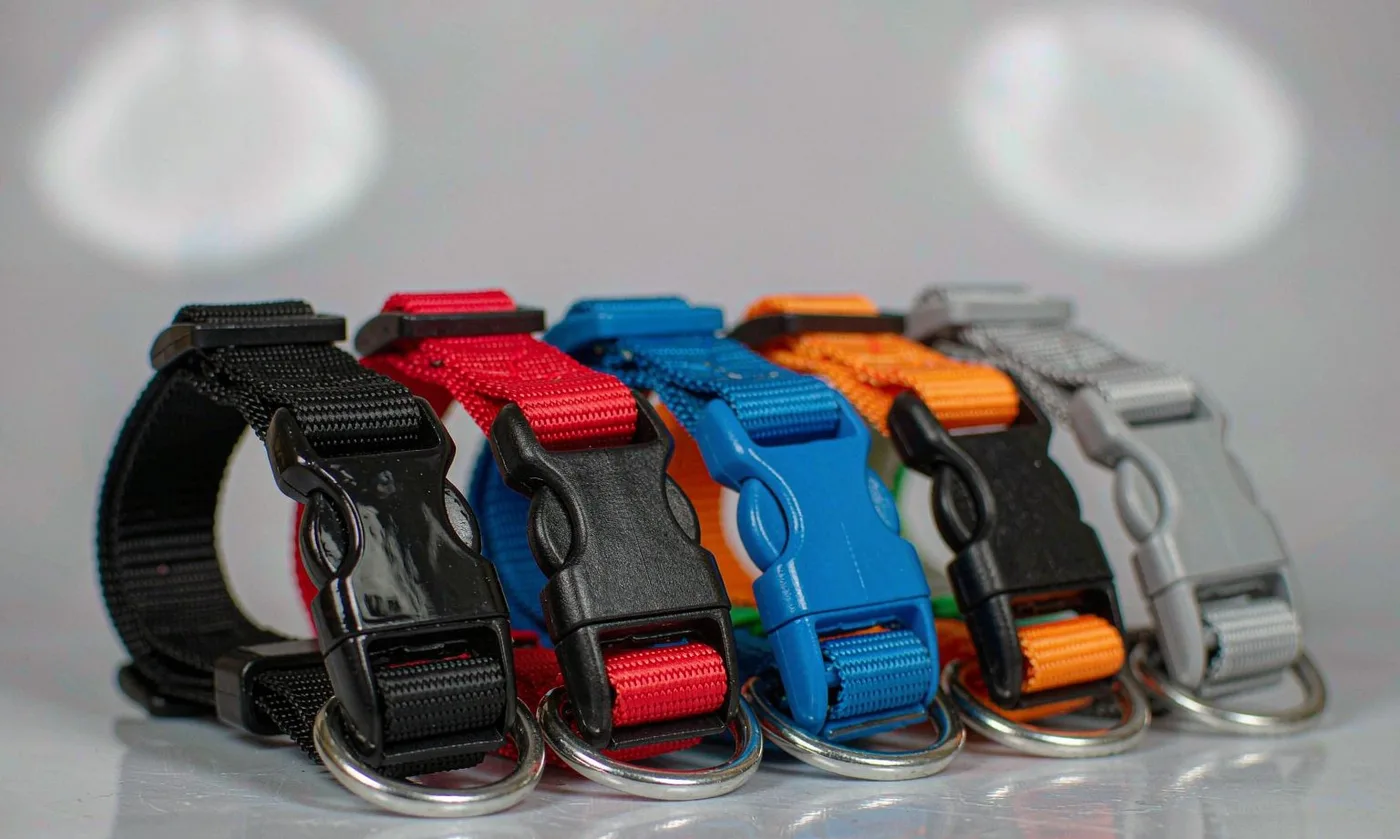
A coordinated collar is bought to match something else — a carrier, a leash, a harness — and the coordination requirement is what distinguishes it from a commodity collar. It changes the specification, the ordering pattern and the inspection plan.
The matching target is Delta-E 1.5 between the collar webbing and the coordinating item, measured under three illuminants, with hardware plating at Delta-E 1.2. On a collar this is harder than it looks because the collar is narrow and viewed close up, and because the collar often uses a different substrate construction from the item it matches — a webbing against a fabric, for instance.
The practical solution is to specify the collar webbing from the same dye lot as the coordinating item wherever the volumes allow, and to accept a wider tolerance where it does not. Where a collar webbing and a leash webbing come from the same lot, the achieved match is Delta-E 0.4-0.9; from different lots of the same specification it is 0.9-1.8.
| Element | 500 units | 2,000 units | 5,000 units | Note |
|---|---|---|---|---|
| Webbing and binding | 0.52-0.94 | 0.42-0.76 | 0.36-0.64 | Width graded by block |
| Buckle | 0.28-0.58 | 0.23-0.47 | 0.19-0.40 | Reinforced above 18 kg |
| Rings, D plus tag | 0.32-0.76 | 0.26-0.62 | 0.22-0.52 | Stainless welded |
| Reflective and trim | 0.18-0.42 | 0.15-0.34 | 0.12-0.29 | Woven yarn or tape |
| Labour and stitch | 0.42-0.86 | 0.35-0.70 | 0.30-0.60 | Bar-tack plus binding |
| Content subtotal | 1.72-3.56 | 1.41-2.89 | 1.19-2.45 | |
| Amortised engineering | 1.30-3.10 | 0.33-0.78 | 0.13-0.31 | Dips, tooling, testing |
| Landed unit cost | 3.02-6.66 | 1.74-3.67 | 1.32-2.76 | Before duty and freight |
Scheduling follows the standard structure with the dye lot as the controlling constraint. Sampling takes 6-10 working days and bulk production 35-50 days after sample approval, but the collar webbing and the coordinating item's webbing are ordered together at approval so they share a lot. Ordering them separately is the most common cause of a coordination failure that is discovered at packing.
Size ratio within a colourway is the planning decision that most affects waste. A collar range sells in a different ratio from a harness range because neck circumference distributes differently from chest girth; the ratio used here is 12/22/32/22/8/4 from XS to XXL. A buyer with a different mix specifies it at order stage because it changes the cutting plan and the effective MOQ per block.
Inspection runs to AQL 2.5 with release force and weld integrity in the critical class and colour match in the major class. That split is deliberate: a collar outside its release band is a safety defect, while a collar one shade off is a commercial one, and conflating them either fails good lots or passes bad ones.
Order collar and coordinating webbing from one lot at approval, set the size ratio at order stage, and split critical and major classes at AQL 2.5.
Why brands source here
- Pet carrier programs run since 2014; founding team in sewn goods since 2004
- SGS-verified production floor of 4,950 m² with 137 workers across 7 lines
- Monthly capacity of 200,000 units, audited to BSCI and ISO 9001
People Also Ask
How wide should a dog collar be?
At least neck circumference in centimetres divided by 12, so 25 mm for a 30 cm neck and 40 mm for a 50 cm neck. The rule holds neck contact pressure at or below 1.2 N/cm².
What release force should a breakaway collar have?
30-50 N on an XS block rising to 100-160 N on XL, measured at 0, 45 and 90 degrees. It must not separate below 28 N on the smallest block.
Why is release force measured at an angle?
A two-part snap loaded at 45 degrees needs 10-16% more force and at 90 degrees 28-40% more. Specified axially only, it holds in the geometry of a real snag.
What operating force should a collar buckle need?
14-32 N, measured with wet hands as well as dry. A buckle taking 22 N dry can take 34 N wet, and anything above 32 N fails the one-handed requirement.
How strong should a collar D-ring weld be?
2.4 kN minimum on a welded stainless ring, verified destructively on three units per lot with a visual fracture check for full penetration.
Why is the tag ring deliberately weaker?
At 0.3-1.0 kN it fails safely if a lead is clipped to it by mistake. A ring that holds and then fails later is worse than one that fails immediately.
What edge finish prevents coat wear?
A sealed edge with a radius of 0.5 mm minimum, or a bound tape edge above 25 mm width. Coat wear is graded on 8,000 rubbing cycles with grade 3 as the minimum.
How much reflective performance should a collar carry?
150 cd/(lx.m²) after 20 domestic wash cycles. Woven reflective yarn retains 88-96% after washing; printed reflective ink starts at 60-120 and does not meet the threshold.
Frequently Asked Questions
Why is a fixed collar width across a size range a poor specification?
A single width is over-wide on a small neck, where it abrades the jaw, and under-wide on a large one, where it concentrates load above 2.4 N/cm².
What does tapering the collar ends achieve?
The load-bearing section keeps full width while the ends taper 30-40% over the last 60-90 mm, so the collar looks lighter without reducing contact area.
Why does a wide collar need a foam interlayer?
A stiff collar bridges rather than conforms, so the effective contact area is smaller than the geometric one. A 1.5-2.5 mm interlayer at 35-55 kg/m³ restores conformance at 0.14-0.32 USD.
How much adjustment should each collar block carry?
8-14 cm, with blocks overlapping by 2-4 cm so an animal at a boundary is covered by two blocks rather than none.
What is the lower release threshold set by?
Normal use: a lead pull, a hand on the collar and an animal backing out of a gap reach 35-70 N on a medium animal, so the collar must hold above that.
Why is a re-settable breakaway preferred over a sacrificial stitch?
A sacrificial stitch has to be replaced after release and is often re-sewn incorrectly or left broken. A two-part snap is re-settable by hand at 0.22-0.52 USD.
How much can a breakaway mechanism drift over its life?
Acceptance is 10% or less after 500 engage-release cycles plus 2,000 sub-threshold load applications. Drift of 18-26% indicates a moulded part wearing at the catch.
When is a magnetic clasp acceptable?
Only on decorative collars where the lead attaches elsewhere. At 0.6-1.1 kN it cannot take a lead load and its paw-release risk is high.
Why is stainless specified for the D-ring?
It runs 96 hours of salt spray with no base metal corrosion against 48 hours to grade 8 for plated carbon steel, at a difference of 0.10-0.22 USD. A rusting ring is the most visible failure on the product.
What causes an incomplete weld to be missed?
It looks identical to a full-penetration weld from outside but holds only 40-60% of the wire rating, which is why the check is destructive rather than visual.
Why is drying time part of the specification?
A wet collar against skin for hours causes maceration, so a saturated collar has to return to within 5% of dry weight in 90 minutes at 25 degrees and 55% humidity.
Why are dark colourways tested twice?
Dye transfer from a collar lands on a light coat, where it is visible and hard to remove. Wet rubbing is held at grade 3-4 and the test repeats after a domestic wash.
How much tag mass can a collar carry?
6 g on blocks under 9 kg and 14 g above. Overweight tags swing and pull the collar round, which is a common cause of a collar that will not stay in position.
What size ratio is used for a collar range at MOQ 500?
12/22/32/22/8/4 from XS to XXL, which differs from a harness ratio because neck circumference distributes differently from chest girth.
Talk to QUANZHOU JUNYUAN BAGS about a pet carrier program: MOQ 500 pieces per colourway, samples in 6-10 working days, bulk production in 35-50 days under AQL 2.5 inspection.
Get a free quote Request a sample