Pet Carrier Base: Reinforcement Solutions
A carrier base is specified by material, thickness and deflection under load. A 1.2 mm polypropylene board spanning 300 mm deflects 11 mm under 15 kg; a 3 mm EVA laminate with corner bolsters brings that to 5 mm. Hold 24-hour creep deflection under 8 mm.
The base is the component that decides whether a carrier feels solid or cheap, and it is the one most often under-specified because it is hidden. This page treats it as a structural panel: how load actually reaches the base, why the failure mode is creep rather than breakage, and how polypropylene sheet, polyethylene sheet, EVA laminate and honeycomb constructions compare on stiffness, mass and cost. It gives the deflection calculation — span, thickness and support condition against a stated load — and sets out the three attachment constructions with their failure signatures. Corner and edge design, moisture ingress and hydrolytic delamination are covered because they are what actually ends a base service life, and the testing section covers static load, creep, drop and cycle methods. The supply section closes with cutting, MOQ and inspection. Programme terms: MOQ 500 pieces per colourway, prototypes in 6-10 working days, bulk production 35-50 days after sample approval, final random inspection to AQL 2.5, T/T 30/70 and FOB Xiamen.
Pet carrier OEM builds to your drawing, while pet carrier ODM adapts an existing pet carrier accessory platform and removes the tooling cost. Both start from the same tech pack.
Why Bases Deform: Load Path and Creep
A carrier base almost never breaks. It bends, and then it stays bent. Understanding why is the whole of base engineering, because the two failure modes call for completely different fixes.
The load path is shorter than most people assume. An animal does not load the base uniformly; it loads it through four contact points, and when lying down, through a broad but off-centre area. The shell fabric between the animal and the board spreads that load a little, but the board itself sees a concentrated load over a span — the distance between its supports, which are normally the base rails or the perimeter seam. Span is the variable that governs everything, because deflection rises with the cube of span and only linearly with load.
Halving the span reduces deflection eightfold. Doubling the board thickness reduces it by a factor related to the stiffness of the section, and for a flat sheet that is also a cubic relationship. That is why the two cheapest structural improvements on a sagging base are, in order, adding a support under the middle of the span, and increasing thickness — and why changing to a nominally stronger material usually does less than either.
Creep is the reason a base that was fine on day one sags by month six. Thermoplastics continue to deform under a sustained load: the strain increases with time at constant stress, faster at higher temperature. A polypropylene board that deflects 6 mm the instant a load is applied may deflect 9 mm after 24 hours and 12 mm after six months, and when the load is removed it recovers only part of that. The permanent part is the creep set, and it is what the customer sees as a permanently dished floor.
Temperature accelerates creep sharply. A carrier left in a hot vehicle at 50 °C will take a year's worth of creep in an afternoon, which is why the creep test is run at an elevated temperature rather than at ambient, and why a base specification written only as an instantaneous deflection figure is not a specification.
The consequence for design is that the base must be specified on a 24-hour creep figure at temperature, not on a bounce-back figure measured in a showroom.
Reinforcement Materials Compared
Five constructions cover the market and they are genuinely different materials, not grades of one material. Choosing between them is a stiffness-per-gram and cost-per-stiffness exercise.
Polypropylene homopolymer sheet is the default. It is cheap, it is light at 0.91 g/cm³, it is chemically inert, it welds and it does not absorb water. Its stiffness is moderate, and it creeps more than the alternatives. It is supplied 0.8-2.0 mm and is cut on a die press or a router.
High-density polyethylene sheet is slightly heavier, softer and much more impact resistant. It creeps more than polypropylene, so it is chosen for a base that will be knocked rather than loaded — a boot liner, a crate tray — and avoided where sustained load is the issue.
EVA laminate is a closed-cell ethylene vinyl acetate sheet, usually 3-6 mm, laminated to a fabric face. On its own it is not stiff enough for a long span, but bonded to a polypropylene sheet it creates a sandwich that is dramatically stiffer than either part, exactly as a structural sandwich should be. It also adds cushioning and it kills the drum-like sound a bare polypropylene board makes.
Honeycomb polypropylene is a twin-wall extruded sheet with a fluted or hexagonal core. It delivers the highest stiffness per gram of anything in the list, it is moisture-proof if the edges are sealed, and it is the right choice for a large platform where mass matters. Its weakness is edge crush: an unsealed edge collapses under point load, so the perimeter must be capped.
Aluminium or composite appears on premium wheeled platforms where the base also carries the wheel and trolley fittings. It is stiff, it does not creep measurably, and it costs several times more and adds mass. It is justified only where the base is a structural chassis rather than a floor.
| Construction | Thickness | Mass per 0.1 m² | Deflection under 15 kg | 24-hour creep at 40 °C | Relative cost |
|---|---|---|---|---|---|
| PP sheet | 1.2 mm | 110 g | 11 mm | 3.4 mm | 1.0 |
| PP sheet | 2.0 mm | 182 g | 4.2 mm | 1.3 mm | 1.5 |
| HDPE sheet | 2.0 mm | 192 g | 5.1 mm | 2.6 mm | 1.6 |
| PP plus EVA sandwich | 1.2 + 3 mm | 196 g | 5.0 mm | 1.1 mm | 1.9 |
| Honeycomb PP, sealed edge | 6.0 mm | 126 g | 3.1 mm | 0.6 mm | 2.3 |
| Aluminium, formed tray | 1.0 mm | 270 g | 1.8 mm | 0.0 mm | 4.8 |
Read the middle columns together: the honeycomb panel beats the 2 mm solid sheet on both deflection and mass, and it only loses on cost. Where a programme can absorb a 2.3× material cost, honeycomb is the best structural answer for a large platform.
Thickness, Span and Deflection: The Calculation
Base specification is best handled as a calculation with a target, because it turns an argument about feeling into a number anyone can check.
The target used is 8 mm total deflection under the rated load at the longest span, including 24-hour creep at 40 °C. Eight millimetres is the point at which an animal visibly sits in a dish and at which a wheeled platform begins to drag. Below 4 mm the base feels rigid; above 12 mm the carrier is uncomfortable and the door starts to bind.
The calculation itself is straightforward for a flat sheet simply supported on two edges: deflection is proportional to load times span cubed, divided by the product of the material modulus and the second moment of area of the section. In practice nobody computes it by hand — the useful part is the proportionalities, which tell a designer where to spend.
Span dominates. A 15 kg load on a 300 mm span deflects eight times more than the same load on a 150 mm span. Adding a central support rail, or moving the perimeter seam inward so the effective span shortens, is worth more than any material change and costs almost nothing.
Thickness is cubic. Going from 1.2 mm to 2.0 mm sheet — a 67% increase — reduces deflection by roughly 78%. That is the single most cost-effective change on an under-stiff base, and it is why the first question to ask about a sagging floor is what thickness is in there now.
Material modulus matters least. Polypropylene, HDPE and EVA sit within a factor of about three of each other in modulus, while span and thickness each act cubically. Changing material is therefore the last resort, not the first, and it is usually motivated by impact, moisture or noise rather than by stiffness.
Sandwich beats solid. Bonding 3 mm of EVA to a 1.2 mm sheet moves the neutral axis out and raises the second moment of area by far more than the added mass would suggest, which is why the sandwich row in the table beats the 2 mm solid sheet on creep despite similar deflection. The condition is that the bond must be continuous — a sandwich with a partial bond delaminates and performs worse than the thin sheet alone.
Load position matters as much as load size. The same animal sitting over a support produces a fraction of the deflection it produces at mid-span, which is why a base that tests well with a distributed load can still fail in service. Testing is therefore done at the worst case, at mid-span, and the rating is stated for that condition rather than for a favourable one.
Attachment: Slip-In, Bonded and Riveted Constructions
How the board is held in the carrier determines whether it can be replaced, whether it stays flat, and where it fails. Three constructions cover the field.
Slip-in pocket is the standard for a soft carrier: the board drops into a fabric pocket at the base, usually closed with hook-and-loop or with a fabric flap. It is replaceable, it is washable if the board comes out, and it is the construction that lets a brand sell a reinforcement upgrade to an existing platform. Its failure mode is the board rotating inside the pocket and presenting its edge rather than its face, which happens when the pocket is more than 4 mm larger than the board in either dimension. The pocket tolerance should be 2-3 mm.
Bonded construction laminates the board to the base fabric with a hot-melt film or a spray adhesive. It gives the flattest result and the best load spread, because the fabric cannot slide relative to the board, and it is the only construction where the base fabric contributes to stiffness. Its failure mode is delamination: the bond hydrolyses in warm humid storage, and a delaminated base bubbles and then creases. Bonded boards are not replaceable, which is why they are used on premium platforms with a warranty rather than on entry ones.
Riveted or bolted construction is used where the base carries hardware — wheel mounts, trolley sockets, skid feet. It is the stiffest and the most durable, and it concentrates stress at the fastener, which is why every riveted hole is backed with a washer or a moulded reinforcement plate. A rivet pulled through a 1.2 mm polypropylene sheet is the classic failure of a cheap wheeled platform, and the fix is a 2 mm backing plate rather than a bigger rivet.
Which to choose. Slip-in for replaceability and for retrofit programmes, bonded for flatness on a premium platform, riveted only where the base is a chassis. Many platforms use two: a bonded main board plus slip-in corner bolsters.
Corners, Edges and Moisture Ingress
Bases fail at their edges far more often than in their middle, for three reasons that are all designable.
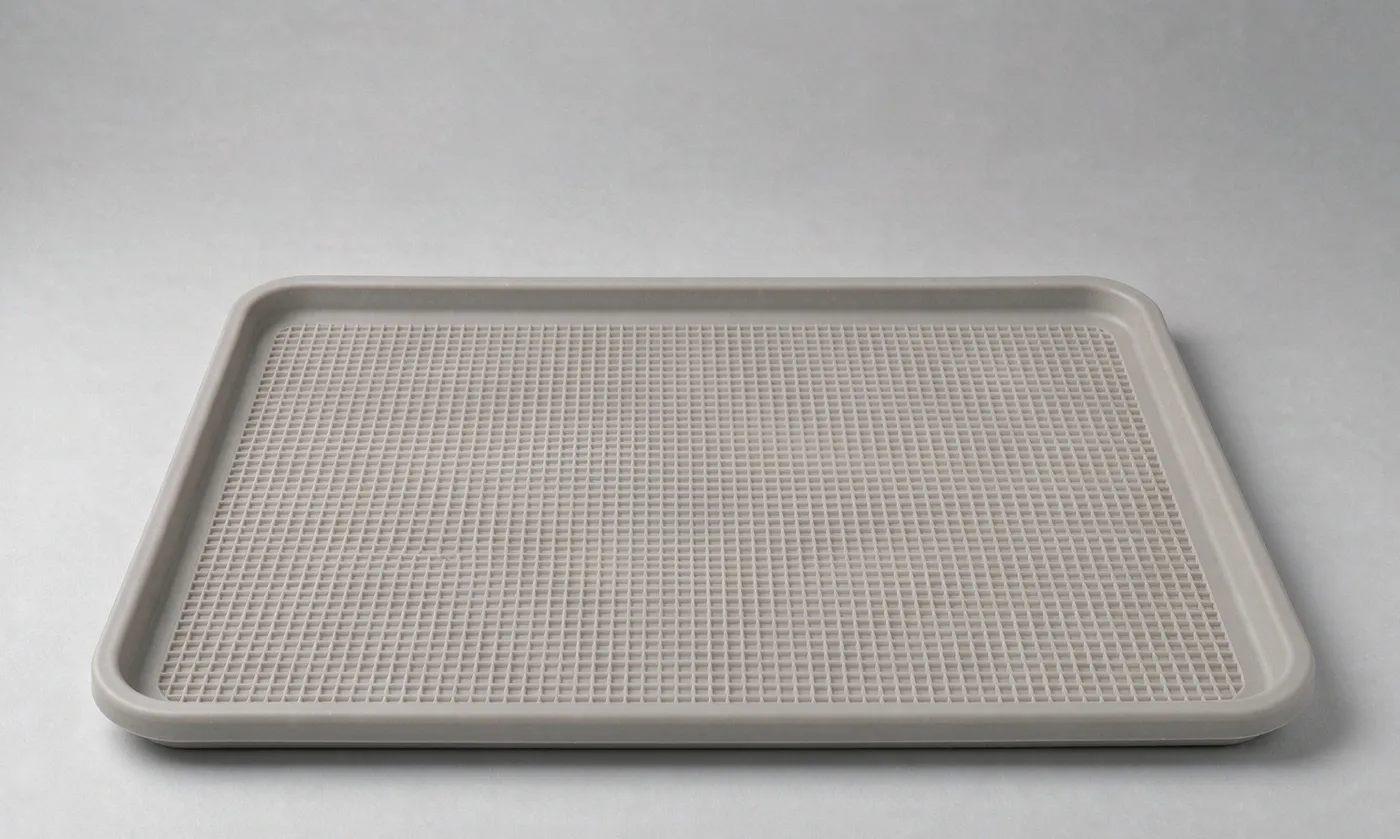
Corner crush. When a carrier is put down hard, the corner takes the impact and the board buckles locally. Once a corner has buckled it stays buckled, and the board no longer sits flat in the pocket, which starts a cycle of point loading. The remedy is a corner bolster: a moulded or die-cut piece that wraps the corner and spreads the load over 40-60 mm instead of a point. A bolster costs a few cents and it is the highest-return item in base design.
Edge sealing on honeycomb. A honeycomb panel is stiff because of its core, and an open edge lets the core collapse under any concentrated load. Edges are sealed with an extruded PP cap or with a hot-melt-filled channel. An unsealed honeycomb base is worse than a solid sheet of the same mass, because it deludes the designer into expecting stiffness it does not have in service.
Moisture ingress. A board in a fabric pocket will get wet from a spill, from a wet animal, or from a wash. Solid polypropylene and HDPE are unaffected. Honeycomb traps water in the flutes and, once inside, it cannot be dried out and it eventually grows mould — which is the strongest argument for sealed edges on any honeycomb base. Bonded laminates are the most exposed: water reaching the adhesive interface delaminates it, and a delaminated board is finished.
Drainage and venting. Where a base is likely to get wet, four 4 mm drainage holes at the low points and a vented pocket fabric let it dry. This is a small addition and it is the difference between a base that survives an accident and one that has to be replaced after it.
Testing: Static Load, Creep, Drop and Cycle
Four tests cover a base, and they measure four different things. Running one of them and calling it structural testing is how a sagging floor reaches the market.
Static deflection. The board is supported on its real support geometry — not on two knife edges, because the real condition is a fabric pocket — and loaded at the centre with the rated mass. Deflection is read after 60 seconds. The pass figure is the design target, normally 5-8 mm at rated load.
Creep. The same set-up holds the load at 40 °C for 24 hours and deflection is read again. The increase over the static figure is the creep component, and the pass figure is 2 mm or less at 24 hours. This is the test that separates materials that look identical in a showroom and it is the one most often skipped.
Drop. The assembled carrier, loaded to its rated mass, is dropped flat onto a concrete surface from 300 mm, six times. The pass criterion is no permanent deformation of the board and no failure at the attachment. A 300 mm drop is used rather than a metre because a carrier is put down, not thrown, and a test that is too severe leads to over-design.
Cycle. The carrier is loaded and unloaded 5,000 times at a rate of about ten per minute, with deflection read at intervals. A board that creeps badly under static load usually fails here earlier, because cyclic loading accelerates creep. The endpoint is a permanent set of 3 mm or less.
Method references. Flexural properties of the sheet itself are measured by the plastics flexural method published by ASTM, which is what generates the modulus figure used in the calculation. Finished-goods testing of the sort above is normally run to an internal protocol, with the quality system around it certified to ISO 9001.
Retrofit and Upgrade Paths for Existing Platforms
A sagging base on a shipped platform is one of the few defects that can be fixed after the fact, and the retrofit is a genuine product rather than an apology. Three paths exist.
Thicker drop-in board is the simplest. If the original was 1.2 mm, a 2.0 mm replacement in the same pocket drops deflection by roughly 78% and usually fits without modification, because pocket tolerance is normally generous enough to absorb 0.8 mm. This is the highest-volume retrofit and the easiest to sell, because it is described in one sentence.
Sandwich upgrade is the stronger answer where the pocket will not take a thicker sheet: a 1.2 mm board with 3 mm EVA bonded to it, at roughly the same total thickness as a 2.0 mm sheet but with better creep behaviour and better cushioning. It is also quieter, which customers notice.
Add-on bolster set addresses the corner rather than the span. Four moulded bolsters that drop into the pocket corners stop the corner buckling that starts most base failures, and they are the cheapest retrofit of the three at a fraction of a board cost.
The measurement before the sale. A retrofit programme needs a measurement protocol, because shipping the wrong board is worse than shipping none. The customer measures the pocket internally to the nearest millimetre, in both dimensions and at the narrowest point, and the board is cut 2 mm under. Where a pocket has stretched, the board is cut to the measured size rather than to the nominal drawing size — this is the one case in the whole accessory programme where the replacement is deliberately cut to a customer measurement rather than to a template.
Sourcing Replacement Boards: MOQ, Cutting and Inspection
Replacement boards are cut components, and the economics are governed by the cutting method rather than by the material.
Cutting. Boards are cut on a steel-rule die for volumes above about 1,000 pieces and on a CNC router below that. A die costs in the low hundreds of dollars and lasts for tens of thousands of cuts; a router needs no tooling and is slower. For a replacement programme that will run 500 pieces a year, routing is usually the right choice even though unit cost is higher, because the tooling never pays back.
Corner radius is specified on every board, at 8-12 mm. A square-cornered board punctures the pocket fabric at the corners, and it is the commonest cause of a pocket that has worn through. Radiused corners cost nothing and prevent it.
MOQ. 500 pieces per colourway, which for a board is interpreted as 500 pieces per specification — thickness and material — because boards are usually black or natural and have no colourway in the usual sense. A range of three thicknesses in one material meets the commitment together. Sampling takes 6-10 working days and bulk production 35-50 days after approval.
Inspection. AQL 2.5 applies. Board-specific defect definitions: a thickness deviation beyond 5% is critical, a delaminated laminate is critical, a dimensional deviation beyond 2 mm is major, and a rough or burred cut edge is major because it abrades the pocket. Static deflection is verified on three boards per lot against the stated support geometry, and creep is verified on one board per lot over 24 hours at temperature.
Packing. Boards ship flat and stacked, never rolled, with a corner protector at two corners. A board that has been bent to fit a carton will not recover. Our production team cuts replacement boards to template on the same SGS-verified production base that runs the carrier programme, on T/T 30/70 and FOB Xiamen terms.
Why brands source here
- Pet carrier programs run since 2014; founding team in sewn goods since 2004
- SGS-verified production floor of 4,950 m² with 137 workers across 7 lines
- Monthly capacity of 200,000 units, audited to BSCI and ISO 9001
People Also Ask
How thick should a pet carrier base board be?
1.2 mm polypropylene is the entry specification and is only adequate to about 8 kg at a 300 mm span. 2.0 mm solid, or a 1.2 mm plus 3 mm EVA sandwich, is correct above that, and honeycomb 6 mm is the choice where mass matters.
Why does my carrier base sag?
Creep. Thermoplastics keep deforming under sustained load, faster when warm, so a board that deflects 6 mm immediately may reach 12 mm after six months and only partly recover. It is a material behaviour, not a defect.
Can I replace the base board in a carrier?
Yes, if it is a slip-in pocket construction. Measure the pocket internally to the nearest millimetre and order the board cut 2 mm under. A bonded board cannot be replaced; a riveted one can, if the fasteners are accessible.
What is the best material for a carrier base?
Polypropylene sheet for cost and chemical resistance, a polypropylene plus EVA sandwich for stiffness and quietness, and sealed-edge honeycomb polypropylene where stiffness per gram matters on a large platform.
How much deflection is acceptable?
8 mm total under rated load including 24-hour creep at 40 °C is the working limit. Below 4 mm feels rigid; above 12 mm the animal sits in a visible dish and the door begins to bind.
Do honeycomb bases hold up?
Yes, if the edges are sealed. Honeycomb gives the best stiffness per gram in the category, but an unsealed edge crushes under point load and open flutes trap water that cannot be dried out.
What causes corner damage on a carrier base?
Point impact when the carrier is put down hard, which buckles the board locally and starts a cycle of point loading. Four moulded corner bolsters that spread load over 40-60 mm prevent it for a few cents.
Frequently Asked Questions
What is the minimum order for replacement base boards?
MOQ 500 pieces per specification, meaning thickness and material, since boards carry no colourway in the usual sense. A range of three thicknesses in one material meets the commitment together.
How long does a replacement board take?
Prototypes in 6-10 working days, bulk production 35-50 days after sample approval. Boards cut on a router need no tooling and start faster; a steel-rule die adds setup but cuts faster above about 1,000 pieces.
What corner radius should a board have?
8-12 mm on every corner. A square-cornered board punctures the pocket fabric, and that is the commonest reason a pocket wears through before the board does.
Should a replacement board be thicker than the original?
Yes, usually one step. A board is replaced because it sagged, and moving from 1.2 mm to 2.0 mm cuts deflection by roughly 78% for a modest cost increase and normally fits the same pocket.
How is creep tested?
By holding the rated load at 40 °C for 24 hours on the real support geometry and reading the deflection again. The increase over the immediate figure is the creep component, and the pass figure is 2 mm or less.
Why does a bonded base delaminate?
Because the adhesive hydrolyses in warm humid storage or when water reaches the interface from a spill. It is irreversible, which is why bonded boards are used on premium platforms with a warranty rather than on entry ones.
What drop height is used in testing?
300 mm onto concrete, six times, with the carrier loaded to rated mass. A carrier is put down rather than thrown, and a test that is too severe pushes the design into over-engineering.
How much pocket clearance should a slip-in board have?
2-3 mm. More than 4 mm and the board can rotate inside the pocket and present its edge instead of its face, which is the standard failure of a slip-in construction.
Are drainage holes worth adding?
Yes where the carrier will get wet. Four 4 mm holes at the low points plus a vented pocket fabric let the base dry instead of staying damp, which matters most on a bonded or honeycomb construction.
Why is a riveted base stronger but still a failure point?
Because the fastener concentrates stress and pulls through thin sheet. Every riveted hole needs a washer or a moulded backing plate; a 2 mm plate is the fix, not a bigger rivet.
Can honeycomb boards be used in a washable carrier?
Only with sealed edges. Open flutes trap water that cannot be dried out and eventually grow mould, which is the strongest argument for edge sealing on any honeycomb base.
How are board lots inspected?
To AQL 2.5, with a thickness deviation beyond 5% and a delaminated laminate classified as critical, a dimensional deviation beyond 2 mm and a burred cut edge as major. Static deflection is checked on three boards and creep on one per lot.
Talk to QUANZHOU JUNYUAN BAGS about a pet carrier program: MOQ 500 pieces per colourway, samples in 6-10 working days, bulk production in 35-50 days under AQL 2.5 inspection.
Get a free quote Request a sample