Pet Carrier Life Jacket: Water Safety
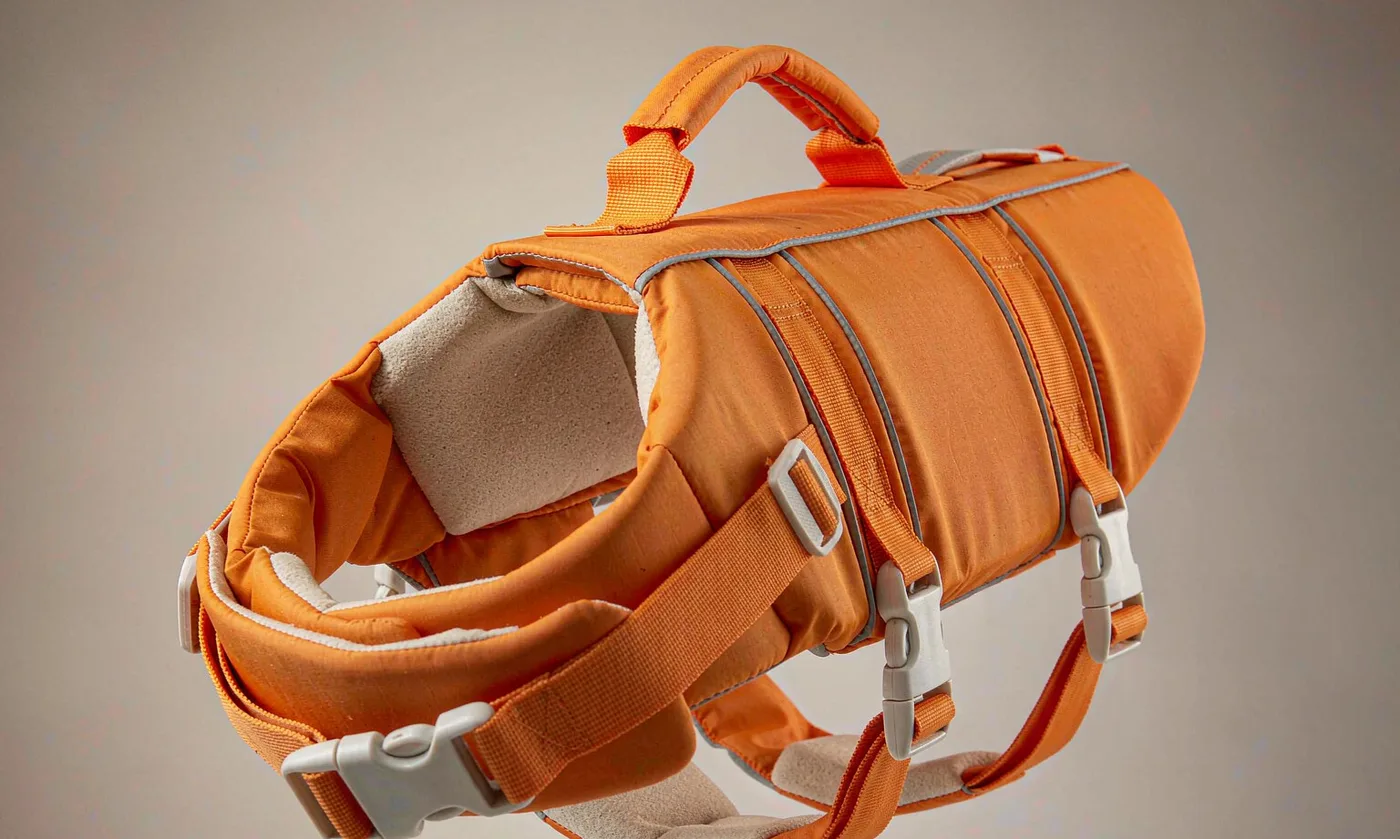
A dog flotation aid is dimensioned from 1.4-2.2 N of net buoyancy per kilogram of body mass, delivered by closed-cell foam at 25-45 kg per cubic metre giving 9.5-9.7 N of lift per litre. The rescue handle is rated 1,200-2,500 N and buoyancy must fall less than 5% after 24 hours submerged.
A flotation aid is the one accessory where the engineering can be reduced to a single number, and that number is net buoyancy. Everything else — foam selection, panel placement, hardware load path, shell coating and fit — exists to deliver that number reliably after a season of salt, chlorine and ultraviolet exposure, and to let a handler lift the animal back onto a boat or a bank without the product failing. This page sets out the calculation, then the material and construction decisions that follow from it: which closed-cell foam grades hold their buoyancy, how the panels are distributed so the animal floats level rather than nose-down, what the handle and D-ring actually have to carry, which coatings survive chlorinated and salt water, and how reflective and visibility systems are specified for open water. It closes with the documentation a distributor needs and the customisation routes open on a private-label programme. Commercial terms follow the standard structure: MOQ 500 pieces per colourway, prototypes in 6-10 working days, bulk production 35-50 days after sample approval, final random inspection to AQL 2.5, T/T 30/70 and FOB Xiamen.
Working as a pet carrier manufacturer on pet carrier accessory ranges means the technical file is shared before any quotation: pattern, bill of materials, test report and packing specification.
Sizing Buoyancy: The Load Calculation Behind a Flotation Aid
Flotation is a force balance, and it is worth doing explicitly because almost every undersized product on the market comes from a designer skipping it. The question is how much upward force is needed to hold the animal's shoulder line and head at the surface, and that force is not the same as the animal's weight.
A companion animal in water displaces most of its own mass because body density is close to that of water, typically in the range of 0.96-1.04 grams per cubic centimetre depending on coat, fat and lung volume. A dense, short-coated, muscular animal with empty lungs is near or above 1.0 and sinks slowly; a coated animal with air in the coat and lungs floats. The residual force the product must supply is therefore small compared with body weight, but it is not zero and it is not optional.
The working specification is 1.4-2.2 N of net buoyancy per kilogram of body mass. The lower figure keeps the spine line at the surface for a calm animal in fresh water. The upper figure covers a tired animal in a chop, a dense breed, and the freeboard needed to keep the muzzle clear. Salt water helps by roughly 2.5%, which is inside the safety margin rather than something to design against.
| Size | Body mass (kg) | Net buoyancy required (N) | Foam volume needed (L) | Panel area at 22 mm (cm2) | Assembly mass (g) | Reference breeds |
|---|---|---|---|---|---|---|
| XS | 2-5 | 4-9 | 0.5-1.0 | 230-450 | 180-320 | Chihuahua, Toy Poodle |
| S | 5-11 | 9-20 | 1.0-2.2 | 450-990 | 300-520 | Jack Russell, Corgi |
| M | 11-22 | 20-40 | 2.2-4.3 | 990-1,950 | 500-880 | Cocker Spaniel, Border Collie |
| L | 22-36 | 40-66 | 4.3-7.0 | 1,950-3,180 | 860-1,380 | Labrador, Golden Retriever |
| XL | 36-58 | 66-104 | 7.0-11.0 | 3,180-5,000 | 1,340-2,100 | German Shepherd, Newfoundland |
Volume follows from the force. A closed-cell foam at 30 kilograms per cubic metre displaces one litre of water and weighs 30 grams, so it delivers about 9.5 N of net lift per litre in fresh water and 9.7 N in sea water. A 30-kilogram dog needing 42-66 N therefore needs 4.4-7.0 litres of foam, which at a panel thickness of 22 millimetres is 2,000-3,180 square centimetres of panel area.
That area is the design constraint that catches people out. A jacket that looks proportionate often carries 40-60% of the foam area it needs, because the panels are styled for a silhouette rather than sized for a force. The fix is either thicker panels, at the cost of bulk and mobility, or a higher-lift foam, which does not exist at a useful price — so the honest answer is more panel area.
Distribution is the second half of the calculation and it is not captured by the total. Panels placed high on the neck lift the head but tip the animal forward; panels placed only on the back roll it. The working distribution is 55-65% of total volume under the chest and ribcage, 30-40% along the spine behind the shoulders, and 0-8% as a small chin or neck support on breeds that need it.
1.4-2.2 N per kilogram, delivered at 9.5-9.7 N per litre of foam, distributed 55-65% under the chest and 30-40% along the spine.
Closed-Cell Foam Selection and Buoyancy Retention
The foam is the product. Everything else is a carrier, and specifying the foam by density, cell structure and compression set is the decision that determines whether the jacket still floats in its second season.
Two chemistries dominate. Cross-linked polyethylene foam at 25-45 kilograms per cubic metre has a fine closed cell structure, absorbs under 1% water by volume over 24 hours, and recovers 92-98% after compression. Ethylene-vinyl acetate foam is softer and more comfortable but absorbs 2-6% and recovers 78-92%, which matters because absorbed water is weight that displaces nothing.
Density is a cost and comfort lever as much as a buoyancy one. At 25 kilograms per cubic metre the foam is light and gives 9.6 N per litre, but it compresses 12-22% under the strap load and loses lift as it compresses. At 45 it gives 9.4 N per litre, compresses 4-9% and costs 30-55% more per litre. The practical choice is 30-38 for most programmes.
| Grade | Density (kg/m3) | Net lift (N/L) | 24 h absorption | Compression set | Cost index | Suits |
|---|---|---|---|---|---|---|
| XPE, low density | 25-30 | 9.6-9.7 | Under 1% | 12-22% | 85 | Light-use, packable |
| XPE, standard | 30-38 | 9.5-9.6 | Under 1% | 6-12% | 100 | General programme |
| XPE, high density | 38-45 | 9.4-9.5 | Under 0.5% | 4-9% | 130-155 | Working, rescue |
| EVA closed cell | 40-70 | 9.2-9.5 | 2-6% | 8-20% | 70-95 | Comfort-led, low cost |
| EPE bead foam | 18-28 | 9.7 | 4-14% | 22-40% | 45-65 | Not recommended |
| Nitrile or neoprene | 50-140 | 8.5-9.4 | 1-4% | 6-14% | 210-330 | Thermal plus flotation |
Absorption is the property that separates a flotation foam from a comfort foam, and it is tested rather than assumed. The standard check submerges a 100 by 100 millimetre sample at one metre depth for 24 hours and measures mass gain and buoyancy loss. Acceptance is under 2% mass gain and under 5% loss of net buoyancy. Bead foams fail this routinely, which is why they appear in cheap products and disappear from serious ones.
Depth matters and it is rarely tested. A foam that absorbs 0.8% at one metre can take 3-9% at three metres, because pressure forces water into cells that are closed but not perfectly so. For a product sold for boating and dock diving, testing at 2-3 metres rather than 1 is worth the extra 40-90 USD.
Panel construction is the third variable. A single thick panel is cheaper to cut and more efficient per gram, but it hinges at one line and restricts the shoulder. Two or three segmented panels sewn into channels move with the animal and cost 0.35-1.20 USD more in cutting and sewing time. On sizes L and XL, segmentation is what makes the jacket wearable for more than twenty minutes.
Cross-linked polyethylene at 30-38 kilograms per cubic metre, absorption under 2% in 24 hours, buoyancy loss under 5%, and segmented panels on sizes L and XL.
Buoyancy Testing: Method, Sampling and Acceptance
A buoyancy claim has to be measured, and the measurement is simple enough that there is no excuse for skipping it. The test apparatus is a tank, a load cell and a harness; the method is to submerge the jacket and record the upward force at a defined depth.
The procedure: the jacket is soaked for 30 minutes, weighed, then fully submerged on a harness attached to a load cell above the water, and the tension recorded once the reading stabilises. The result is net buoyancy in newtons. The same jacket is re-tested after 24 hours submerged and again after a compression cycle, and the three readings give initial buoyancy, retained buoyancy and recovery.
Acceptance is set from the sizing table rather than from a round number. A size L jacket specified at 42-66 N must measure at least 42 N in the initial test and at least 95% of that after 24 hours. A product that measures 44 N initially and 38 N after 24 hours fails the retention criterion even though it passes the initial one.
| Test | Condition | Sample | Acceptance | Frequency | Cost (USD) | Failure indicates |
|---|---|---|---|---|---|---|
| Initial net buoyancy | 30 min soak, surface | 5 per size per lot | At or above spec minimum | Per lot | 35-90 | Under-sized panels |
| 24-hour retention | 1 m depth, 24 h | 3 per size per lot | Loss under 5% | Per lot | 60-150 | Open cell foam |
| Depth retention | 2-3 m, 4 h | 2 per size per design | Loss under 8% | Per design | 70-160 | Pressure absorption |
| Compression recovery | 50% compression, 22 h | 3 per foam lot | Recovery 92-98% | Per foam lot | 40-100 | Wrong grade |
| Level-float check | Weighted form in tank | 1 per size per design | Spine within 15 deg | Per design | 120-300 | Panel distribution |
| Handle static load | 1,200-2,500 N, 60 s | 5 per lot | No failure, no tear | Per lot | 45-110 | Load path |
| Salt and chlorine soak | 7 days, then retest | 2 per design | Loss under 5% | Per season | 90-220 | Foam or coating |
The level-float check is the one that is most often skipped and most often needed. A jacket can hit its buoyancy number and still float the animal nose-down, because the total is right and the distribution is wrong. Mounting a weighted form of the correct mass and shape in a tank and photographing the float angle costs 120-300 USD and settles the question.
Sampling should be risk-weighted in the same way as elsewhere in the range. New foam lot, new panel pattern or new size: test every lot. Stable running product: initial buoyancy per lot, retention per month, full matrix per quarter. Our production team holds test records by foam lot number, so a drift in buoyancy can be traced to a material receipt rather than guessed at.
Third-party verification is worth having for a product in this category, because the claim is safety-adjacent and a buyer will ask. An independent laboratory report on initial buoyancy and 24-hour retention costs 240-780 USD and is the single document that moves a flotation product from an assertion to a specification.
Measure initial buoyancy per lot, retention per month, and the full matrix per quarter; require 95% retention after 24 hours and a level-float angle within 15 degrees.
Rescue Handle, D-Ring and the Hardware Load Path
The handle is the component that turns a flotation aid into a rescue device, and it is also the component most likely to fail, because the load path from a wet animal dangling over a gunwale runs through a few square centimetres of fabric.
The load is not the animal's weight in air. A handler lifting a waterlogged animal out of the water applies a dynamic load with a jerk factor, and the handle sees that load concentrated at two stitch points. The working specification is 1,200-2,500 N static for 60 seconds with no failure and no tear propagation, which gives a margin of roughly four to eight times a 30-kilogram animal's weight.
The load path is what determines whether that number is achievable. A handle stitched only to the shell fabric will tear out at 300-700 N regardless of how strong the webbing is, because the failure is in the fabric, not the handle. The correct construction carries the handle webbing under the foam panels and stitches it to a reinforced spine band that runs the length of the jacket.
| Component | Specification | Rating | Attachment | Test | Failure mode to avoid |
|---|---|---|---|---|---|
| Rescue handle | 25 mm polyester webbing | 1,200-2,500 N | Under panels to spine band | 60 s static | Fabric tear-out |
| Spine reinforcement band | 50 mm webbing or doubled shell | 1,800-3,200 N | Runs full jacket length | Tensile | Localised pull |
| Leash D-ring | Stainless or zinc alloy, 25 mm | 900-1,800 N | To spine band | Pull at 100 mm/min | Ring distortion |
| Buckle set | 20-25 mm side release | 280-620 N | To spine band | Pull and 200 cycles | Creep open under load |
| Belly strap | 20-25 mm webbing, adjustable | 500-1,100 N | Through panel channels | Tensile | Jacket riding up |
| Reflective tape | 15-25 mm retroreflective | 300-500 cd/lx/m2 | Stitched or welded | Coefficient and adhesion | Peeling in salt water |
| Grab loop, secondary | 20 mm webbing at neck | 600-1,200 N | To collar band | Static | Not needed but cheap |
Corrosion is the hardware risk specific to this product. A zinc-alloy buckle on a jacket used in sea water shows white corrosion in 30-90 days and red rust in 90-180, and a seized buckle is a product that cannot be removed. Stainless steel or a marine-grade coated alloy costs 0.55-1.90 USD more per jacket and removes the failure entirely, which is why it should be the default on any product positioned for boating.
The D-ring is frequently overloaded by misuse rather than by design. A ring rated at 900-1,800 N is not a towing point and should not be presented as one; the marking should say so, and a towing application needs a separate reinforced point with its own rating. Our production team writes that distinction into the instructions rather than leaving it to the buyer.
Buckle creep is the quiet failure. A side-release buckle under sustained load in a wet, gritty environment can walk open over 10-30 minutes even though it passes a 280-620 N static test. A test that holds load for 30 minutes rather than 60 seconds finds it, and a buckle with a secondary locking tab does not exhibit it.
Handle webbing carried under the panels into a full-length spine band, tested at 1,200-2,500 N for 60 seconds, with marine-grade hardware and a 30-minute creep check on every buckle.
Shell Fabric, Coating and Resistance to Chlorine and Salt
The shell does not float the animal but it decides how long the foam stays dry and how long the product looks acceptable. It has to resist abrasion from sand and decking, shed water quickly, survive chlorine and salt, and hold its colour under ultraviolet exposure.
The base fabric is almost always a polyester or nylon woven at 300-600 denier with a polyurethane or thermoplastic polyurethane coating. Polyester has better ultraviolet resistance and lower water uptake at 0.4-1.2%; nylon has better abrasion resistance but takes up 2-5% water and yellows faster. For a product that lives outdoors, polyester is the correct default.
Coating is the waterproofing and the failure point. A polyurethane coating at 20-40 grams per square metre gives a hydrostatic head of 1,500-5,000 millimetres and bonds well, but hydrolyses in 18-36 months in warm humid storage. Thermoplastic polyurethane at 30-60 grams per square metre gives 3,000-10,000 millimetres and lasts 4-8 years, at 0.35-1.10 USD more per jacket.
| Shell | Weight (g/m2) | Hydrostatic head (mm) | Abrasion cycles | Chlorine resistance | UV retention at 300 h | Cost index |
|---|---|---|---|---|---|---|
| Polyester 300D, PU | 150-190 | 1,500-3,000 | 8,000-15,000 | Fair | 78-88% | 100 |
| Polyester 600D, PU | 230-300 | 2,000-5,000 | 15,000-28,000 | Fair | 80-90% | 130-165 |
| Polyester 600D, TPU | 250-330 | 3,000-10,000 | 20,000-40,000 | Good | 84-93% | 165-215 |
| Nylon 420D, PU | 190-250 | 1,800-4,000 | 18,000-32,000 | Poor | 62-78% | 115-150 |
| Nylon 840D, TPU | 320-420 | 4,000-12,000 | 30,000-60,000 | Good | 70-84% | 210-280 |
| Ripstop polyester, TPU | 140-200 | 2,500-7,000 | 12,000-24,000 | Good | 82-91% | 150-195 |
Chlorine is the aggressive one and it is under-tested. A jacket used daily in a pool sees 1-3 ppm chlorine at 26-30 degrees, and a polyurethane coating in those conditions embrittles in 6-18 months while the stitching thread loses 20-40% of its strength. The test is a 7-day soak at 50-100 ppm followed by a retest of coating adhesion and seam strength, and it costs 90-220 USD.
Salt is gentler on the coating and harsher on the hardware. A 7-day salt soak followed by a freshwater rinse and a hardware function check is the practical test, and it should include a salt-fog exposure on the metal components at 24-48 hours according to the standard corrosion method referenced by ASTM International.
Drying behaviour is a design property rather than a material one. A jacket with a mesh drain panel at the lowest point of each foam channel empties in 20-60 minutes hung up; a sealed one holds water for 6-18 hours and grows mould in the foam channel. Two mesh panels of 60-120 square centimetres each cost 0.20-0.55 USD and are the difference between a product that survives a season and one that is thrown away.
Polyester 600D with a thermoplastic polyurethane coating, mesh drain panels at the low point of each foam channel, and a 7-day chlorine soak retest per season.
Visibility Systems for Open Water
Visibility is the part of a flotation aid that protects the handler as much as the animal. An animal in the water presents a very low visual signature: a head and a few centimetres of back, against a surface that is moving and reflecting. The product has to add signature in three ways at once.
Colour is the first and cheapest. A high-chroma yellow, orange or red at a chromaticity outside the sea-sky colour range is detectable at 300-900 metres in daylight from a boat, against 80-200 metres for a neutral or dark colour. The specification should be written as a chromaticity target and a contrast ratio against a defined background, not as a colour name.
Retroreflective material is the second and it works when the sun does not. A tape with a coefficient of 300-500 cd per lux per square metre returns a headlight or a searchlight and is visible at 80-150 metres; a marine-grade tape at 500-1,000 is visible at 150-300 metres. Placement matters more than area: tape at the top of the back and on both flanks returns from any angle, and tape on the belly returns nothing.
| Element | Specification | Day detection (m) | Night detection (m) | Adds (USD) | Service life | Note |
|---|---|---|---|---|---|---|
| High-chroma shell colour | Chromaticity target, contrast over 3:1 | 300-900 | n/a | 0-0.30 | 2-4 seasons | Fades before fabric fails |
| Retroreflective tape, standard | 300-500 cd/lx/m2 | n/a | 80-150 | 0.35-0.90 | 1-3 seasons | Peels in salt if welded poorly |
| Retroreflective tape, marine | 500-1,000 cd/lx/m2 | n/a | 150-300 | 0.85-2.10 | 3-6 seasons | Stitched, not welded |
| Contrast panel at neck | Light colour on top surface | 150-400 | n/a | 0.15-0.45 | 2-4 seasons | Reads from above |
| Whistle or sound marker | 90-110 dB at 1 m | n/a | 50-200 | 0.30-0.85 | Long | Needs a secure pocket |
| Reflective piping on handle | 200-400 cd/lx/m2 | n/a | 40-100 | 0.12-0.35 | 1-3 seasons | Finds the handle in the dark |
Placement geometry is worth stating because it is where programmes waste money. A total reflective area of 120-220 square centimetres distributed as two flank bands of 15-25 millimetres and one dorsal band of 25-40 millimetres performs better than 400 square centimetres concentrated on the back panel, because the flanks are what faces a searchlight from a boat at water level.
Attachment method decides service life. A welded reflective tape on a coated shell peels in salt water in one to three seasons; the same tape stitched with a 12-16 spi lockstitch lasts three to six. Stitching perforates the coating and needs a seam seal, which is 0.10-0.28 USD, and it is worth it.
One caution belongs in this section: visibility features are product features, not safety guarantees, and the documentation should describe measured performance rather than an outcome. A statement of detection range under defined conditions is defensible; a statement that a jacket prevents a drowning is not, and our production team does not print one.
High-chroma shell plus 120-220 square centimetres of marine-grade retroreflective tape distributed across both flanks and the dorsal line, stitched and seam-sealed.
Fit, Sizing and Escape Prevention
A flotation aid that comes off is worse than none, because the handler believes the animal is protected. Fit is therefore a structural requirement, and it is the area where a five-size programme either works or fails.
Three dimensions govern fit: chest girth at the widest point, neck girth at the base, and back length from withers to tail base. Chest girth is the load-bearing one and the one that decides whether the jacket stays on; back length decides whether the panels sit over the right part of the anatomy.
Adjustment range has to absorb the variation within a size band. A band covering 12-18 centimetres of chest girth with 8-14 centimetres of adjustment from the strap system covers the population inside the band without overlapping so far into the next band that the two sizes become interchangeable. Overlapping more than about 25% of the range creates returns from customers who buy the wrong size and then blame the fit.
| Size | Chest girth (cm) | Neck girth (cm) | Back length (cm) | Adjustment range (cm) | Strap count | Body mass (kg) |
|---|---|---|---|---|---|---|
| XS | 30-40 | 20-28 | 22-30 | 6-9 | 2 | 2-5 |
| S | 38-52 | 26-36 | 28-38 | 8-11 | 2 | 5-11 |
| M | 50-68 | 34-46 | 36-50 | 10-13 | 3 | 11-22 |
| L | 66-88 | 44-58 | 48-64 | 12-15 | 3 | 22-36 |
| XL | 86-112 | 56-72 | 62-82 | 14-18 | 3 | 36-58 |
Escape prevention is a geometry problem with two known failure modes. The first is the jacket riding forward over the shoulders when the animal is lifted, which is prevented by a belly strap that passes behind the ribcage rather than across the soft abdomen, plus a second strap at 40-60% of back length. The second is the neck opening stretching under a forward pull, which is prevented by a non-elastic collar band with a defined circumference.
Deep-chested breeds deserve a note because they break the standard grade. A chest that is deep relative to its width needs a longer belly strap and a higher collar band, and a standard pattern will ride up. A deep-chest variant with 3-6 centimetres more belly strap length covers the group without a sixth size.
Fit verification is cheap: a girth form at the midpoint of each band, a 30-minute wear trial on a weighted form, and a lift test on the handle with the form loaded to the top of the band. Three checks at 180-420 USD per size and they catch the pattern errors that generate the majority of size-related returns.
Five sizes with 8-15 centimetres of adjustment, a belly strap passing behind the ribcage, a non-elastic collar band, and a deep-chest variant for the breeds that break the grade.
Documentation, Marking and Programme Terms
A flotation aid sits close enough to safety equipment that the documentation burden is higher than for most accessories, even though no mandatory animal flotation standard applies in the major markets. The obligations come from general product safety, from substance restrictions, and from the claims the brand chooses to print.
In the European Union the General Product Safety Regulation requires traceability, identification of the economic operator and instructions in the language of each market. In the United States the Consumer Product Safety Commission administers the consumer product safety framework, and while a pet flotation aid is not a Coast Guard-approved personal flotation device, the distinction must be unmistakable on the packaging: a pet jacket is an aid, not a certified life-saving device, and implying otherwise is both a regulatory and a liability problem.
Chemical documentation runs in parallel and it is where a shipment can be held. Restricted substance screening against the European regime is documented through ECHA for REACH purposes, and California requires an assessment against the Proposition 65 list published by OEHHA. Textile components are additionally declared against OEKO-TEX criteria, because most retail buyers ask for it by name.
| Item | Market | Issued by | Lead time | Cost (USD) | Renewal |
|---|---|---|---|---|---|
| Traceability and operator label | EU, UK | Brand plus factory code | 0 days | 0.01-0.05 | None |
| Instructions, market language | EU, UK, US | Brand | 3-8 days | 0.06-0.24 | Per revision |
| Buoyancy test report | All | In-house or third party | 5-30 days | 60-780 | Per design or lot |
| REACH restricted substance screen | EU, UK | Third-party lab | 8-20 days | 150-540 | Annual or per material |
| Proposition 65 assessment | US, California | Third-party lab | 8-20 days | 140-480 | Annual |
| OEKO-TEX textile declaration | Retailer-driven | Third-party lab | 10-25 days | 180-620 | Annual |
| Claim review by brand counsel | All | Brand | 3-12 days | n/a | Per claim |
The marking on the product itself should state the size band, the body-mass range the buoyancy was dimensioned for, the care instruction and the manufacturer identifier. Stating the mass range is the single most useful line on the label, because it is the number a customer actually needs and it is the number that connects the product back to the buoyancy calculation.
Companion-animal health and transport guidance published by the American Veterinary Medical Association is a useful reference for the care and supervision instructions that accompany a water product, particularly on rinsing, drying and skin inspection after use. Our production team references it in the instruction template without reproducing medical advice, which is outside the scope of a manufacturer document.
Programme terms: MOQ 500 pieces per colourway, prototypes in 6-10 working days, bulk production 35-50 days after sample approval, final random inspection to AQL 2.5 including the buoyancy and handle checks from the matrix above, T/T 30/70 and FOB Xiamen. Work runs through the SGS-verified production base under ISO 9001 and BSCI coverage, with 4,950 square metres, 137 staff and seven lines supporting 200,000 units of monthly output. State measured buoyancy and the mass band it was dimensioned for, and keep the language on aid rather than certified rescue device.
Production capability
- SGS-verified production space of 4,950 m², 149 machines, 7 assembly lines
- Pet carrier and pet bag output since 2014 from a 137-person team
- 200,000 units shipped monthly under BSCI and ISO 9001 systems
People Also Ask
How much buoyancy does a dog life jacket need?
1.4-2.2 N of net buoyancy per kilogram of body mass. A 30 kg dog needs 42-66 N, which at 9.5 N per litre of closed-cell foam means 4.4-7.0 litres of foam.
What foam is used in a dog flotation aid?
Cross-linked polyethylene at 30-38 kg per cubic metre. It absorbs under 1% water in 24 hours and loses under 5% buoyancy, against 2-6% absorption for EVA and 4-14% for bead foam.
How is buoyancy tested?
The jacket is soaked, submerged on a load cell and the upward force recorded, then retested after 24 hours at one metre. Acceptance is at or above the specified minimum with under 5% loss.
How strong should a rescue handle be?
1,200-2,500 N static for 60 seconds, with the webbing carried under the foam panels into a full-length spine band. A handle stitched only to the shell tears out at 300-700 N.
What size range does a five-size programme cover?
Chest girth from 30 to 112 cm with 8-15 cm of adjustment per band, covering body masses of 2-58 kg. Deep-chested breeds need a variant with 3-6 cm more belly strap.
Should a pet life jacket have reflective tape?
Yes, 120-220 square centimetres on both flanks and the dorsal line at 500-1,000 cd per lux per square metre, stitched and seam-sealed. Flank placement returns from water level.
Is a dog life jacket a certified life-saving device?
No. It is a flotation aid and the packaging must not imply certification. Documentation should state measured buoyancy and the body-mass band it was dimensioned for.
Frequently Asked Questions
Why is more panel area needed than designers expect?
Because foam delivers 9.5-9.7 N per litre and the panels are usually styled for a silhouette. A jacket that looks proportionate often carries 40-60% of the required area, and there is no higher-lift foam at a usable price.
Why is panel distribution as important as total buoyancy?
Panels high on the neck tip the animal forward; back-only panels roll it. The working split is 55-65% under the chest and ribcage, 30-40% along the spine behind the shoulders.
Does salt water change the buoyancy calculation?
It adds about 2.5% of lift, which sits inside the safety margin. Design to the fresh-water figure so the product performs in pools and lakes as well as at sea.
Why test buoyancy at depth rather than at the surface?
Pressure forces water into cells that are closed but not perfectly so. A foam taking 0.8% at one metre can take 3-9% at three, which matters for diving and boating products.
What does a level-float check find that buoyancy does not?
Wrong distribution. A jacket can hit its total and still float the animal nose-down; mounting a weighted form and measuring the float angle within 15 degrees settles it for 120-300 USD.
Why do zinc-alloy buckles fail on this product?
Sea water produces white corrosion in 30-90 days and red rust in 90-180, and a seized buckle cannot be removed. Marine-grade hardware costs 0.55-1.90 USD more and removes the failure.
What is buckle creep and how is it found?
A buckle walking open over 10-30 minutes under sustained wet, gritty load despite passing a static test. Holding load for 30 minutes instead of 60 seconds finds it; a secondary locking tab prevents it.
Why is polyester preferred over nylon for the shell?
Polyester takes up 0.4-1.2% water and holds 78-90% of colour after 300 hours of ultraviolet exposure, against 2-5% and 62-78% for nylon. Nylon wins on abrasion but loses outdoors.
How long does a polyurethane coating last in a pool?
6-18 months at 1-3 ppm chlorine before embrittling, with stitching losing 20-40% of strength. Thermoplastic polyurethane lasts 4-8 years at 0.35-1.10 USD more per jacket.
Why are mesh drain panels worth specifying?
A jacket with drainage empties in 20-60 minutes hung up; a sealed one holds water 6-18 hours and grows mould in the foam channel. Two panels cost 0.20-0.55 USD.
Should reflective tape be welded or stitched?
Stitched with a 12-16 spi lockstitch plus a seam seal. Welded tape on a coated shell peels in salt water within one to three seasons; stitched lasts three to six.
How much size overlap is too much?
More than about 25% of the girth band. Two sizes that are nearly interchangeable produce returns from customers who buy the wrong one and then blame the fit.
What is the single most useful line on the label?
The body-mass range the buoyancy was dimensioned for. It is the number a customer needs and the number that connects the product back to the calculation.
What is the difference between an aid and a certified device?
A certified personal flotation device is approved for human life saving under a regulatory scheme; a pet jacket is not. Packaging must not imply otherwise, and claim wording should be reviewed by the brand's counsel.
Talk to QUANZHOU JUNYUAN BAGS about a pet carrier program: MOQ 500 pieces per colourway, samples in 6-10 working days, bulk production in 35-50 days under AQL 2.5 inspection.
Get a free quote Request a sample