Pet Carrier Rain Cover: Weather Protection
A carrier rain cover is specified by fabric, coating rating, seam construction and retention. A 210T polyester ripstop with a 3,000 mm polyurethane coating and taped seams keeps water out in sustained rain. The hem must resist 15 N of pull, and vent area should stay above 4% of the cover.
A rain cover is a cut-and-sewn barrier with a retention problem, and it is judged on the one occasion it is needed, which makes it worth specifying properly. This page covers it as a manufacturing item: how face fabric, coating weight and seam construction combine into a hydrostatic figure that means something, why the hem and not the fabric is where most covers fail, and how a cover can be waterproof and still leave the animal dry but overheated if ventilation is ignored. It covers fit geometry and retention against wind, window panels and reflective trim, and the three ageing mechanisms that end a cover service life — coating hydrolysis, ultraviolet degradation and cold cracking of a transparent window. Production, MOQ and inspection close it out. Programme terms: MOQ 500 pieces per colourway, prototypes in 6-10 working days, bulk production 35-50 days after sample approval, final random inspection to AQL 2.5, T/T 30/70 and FOB Xiamen.
As a pet carrier manufacturer handling pet carrier accessory programmes, our team quotes MOQ 500 pieces per colourway and returns a sewn sample in 6-10 working days.
Rain Cover as a System, Not a Fabric
The first thing to establish is that a rain cover is not a waterproof fabric cut into a shape. It is a system of four elements that fail independently: the face fabric, the coating, the seams and the retention. A cover can be built from a fabric rated at 5,000 mm and still let water in, because the water went through a seam or around a hem rather than through the cloth.
Face fabric carries the coating and takes the abrasion. It contributes almost nothing to waterproofness on its own — an uncoated woven polyester will pass water in seconds — but it determines how long the coating lasts, because it is the substrate the coating is bonded to and it is what abraded against a car boot.
Coating does the waterproofing. Polyurethane is the mainstream choice: it is flexible, it is cheap, and it can be applied at a controlled weight to reach a target hydrostatic figure. Polyvinyl chloride is cheaper still and stiffer, and it is avoided on a pet product because of plasticiser content. Thermoplastic polyurethane is the premium option: better abrasion and better low-temperature flexibility, at two to three times the cost.
Seams are the leak path. Every needle hole in a coated fabric is a hole through the coating, and a chain of holes is a wick. Seam sealing is not optional on a cover that is sold as waterproof — it is the difference between a product that works and one that does not, and it is the element most often omitted to save a few cents.
Retention is what keeps the cover on the carrier. A waterproof cover that blows off is not weather protection. Retention is specified as a force: the cover must resist a stated pull at the hem and a stated uplift at the top, and it is tested as a force rather than assessed by looking at it.
Ventilation is the element most often forgotten, and it is the one with an animal welfare dimension. A sealed cover over a carrier in warm weather is a greenhouse, and the guidance on heat and ventilation issued by the American Veterinary Medical Association is the reference most brands use when they set their own minimum vent area.
Face Fabric and Coating: Specifying Waterproofness
Waterproofness is measured, not described, and there are two different measurements that are routinely confused.
Hydrostatic head measures the water pressure a fabric resists before it leaks. A sample is clamped over a column of water that is raised until three drops penetrate, and the result is reported in millimetres of water column. It is the coating test and it is the figure that belongs on a specification. The method is published by the ISO standards for coated fabrics.
Spray rating measures how well the surface sheds water, reported on a 0-100 scale where 100 is no wetting. It is a finish test, not a coating test, and it is what deteriorates first in service: a cover can still resist 3,000 mm of pressure while its surface has stopped beading, and it will then wet out on the outside, lose breathability and feel damp.
Fabric choice. 190T and 210T polyester taffeta are the entry fabrics, cheap and light at 55-75 g/m². Ripstop versions, with a grid of heavier yarns every 5-8 mm, add tear resistance for a few grams and are worth it on a cover that will be folded and stuffed repeatedly. 300T is lighter and packs smaller and snags more easily. Above that, a 210-denier Oxford is heavier and much tougher, used on wheeled-platform covers where abrasion from wheels is the failure.
Coating weight is what buys the hydrostatic figure. Roughly: 1,000 mm for shower resistance, 3,000 mm for sustained rain, 5,000 mm for a cover that will sit against a wet surface under load. There is no benefit to specifying above 5,000 mm on a carrier cover, because the seams and the hem will fail before the fabric does, and a heavier coating is stiffer and more prone to hydrolysis.
Durable water repellent. A DWR finish on the outer face makes water bead and keeps the face from wetting out. Modern finishes are PFAS-free and are specified as such, because perfluorinated chemistry is restricted in most markets. A PFAS-free finish wets out sooner than the old chemistry did, which is the reason a cover should be sold with a care instruction to re-proof rather than washed and assumed to still work.
| Fabric | Mass | Coating | Hydrostatic head | Spray rating, as new | Packed volume | Relative cost |
|---|---|---|---|---|---|---|
| 190T polyester taffeta | 58 g/m² | PU 1,000 mm | 1,000 mm | 90 | 0.35 L | 1.0 |
| 210T polyester ripstop | 72 g/m² | PU 3,000 mm | 3,000 mm | 95 | 0.42 L | 1.3 |
| 210T polyester ripstop | 75 g/m² | TPU 3,000 mm | 3,000 mm | 98 | 0.44 L | 2.6 |
| 300T polyester ripstop | 62 g/m² | PU 2,000 mm | 2,000 mm | 92 | 0.30 L | 1.5 |
| 210D Oxford | 165 g/m² | PU 5,000 mm | 5,000 mm | 95 | 0.85 L | 2.1 |
Note that the packed volume roughly doubles between the lightest and the heaviest option. For a cover that lives in a pocket, 300T is the right answer even at a lower hydrostatic figure, because a cover left at home is not weather protection at all.
Seams, Hems and Closures: Where Water Actually Enters
If a cover leaks, it leaks at a seam. Three construction decisions control that, and all three are cheap.
Seam sealing. Two methods are used. A taped seam applies a thermoplastic tape over the stitched seam with heat and pressure; it is the standard method, it is durable, and it needs a flat seam to bond to. A welded seam joins the fabric by high-frequency or hot-air welding with no needle holes at all; it is flatter and lighter and it needs a thermoplastic coating that will weld, which polyurethane does. Welding costs more in tooling and less in labour. Taped is the default; welded is used where pack volume matters, because it lies flatter.
Tape width is 18-22 mm and it must fully cover the stitch line with 4 mm of margin each side. Tape applied over a wavy seam bridges and lifts, which is why the seam is sewn straight and flat before taping rather than afterwards. Tape adhesion is verified by a peel test at the end of the line, not by a visual check.
Hem. The hem is where a cover fails mechanically. A shock cord in a tunnel hem with a toggle is the standard: 3-4 mm braided elastic with a natural rubber core, extending 1.8× relaxed and retaining above 88% of its recovery force after 2,000 cycles. A cheaper polypropylene-core elastic falls below 70% after 800 cycles, and that is the cover that fits when new and sags after a season. The tunnel must be wide enough that the cord moves freely — a tight tunnel turns the hem into a fixed band and the cover cannot be pulled on.
Closures and anchors. A cover needs at least one positive anchor beyond the hem, or wind will lift it. Two webbing straps with side-release buckles passing under the carrier, tensioned to 15 N each, is the standard arrangement. A single strap at the front with a clip to a D-ring is the minimum. The anchor is specified as a force: the cover must resist a 30 N uplift at the top panel without exposing the carrier.
Storm flap. Where the cover has an opening for a handle or a strap, that opening needs a flap over it. A cover with a hole for a trolley handle and no flap is a funnel, and it is the commonest cause of a wet interior on an otherwise sound cover.
Fit Geometry and Retention
A cover is fitted to a carrier, and the fit is a three-dimensional problem because carriers are boxes with rounded corners and protrusions.
Patterning. The cover is patterned from the carrier shell drawing, with 15-25 mm of ease in each dimension. Too little ease and the cover cannot be pulled on over the corners; too much and it flaps, catches wind and chafes the shell. The ease is not uniform: it is largest over the top panel where the handle protrudes and smallest at the hem where retention happens.
Corner treatment. Corners are the highest-stress area on a cover and the place where fabric wears through first. A cover patterned with a darted corner follows the carrier shape and spreads the load; a cover made from a simple box pattern with a seam at the corner concentrates it. Where the carrier has a reinforced corner, the cover should carry a matching patch of heavier fabric at that point.
Protrusions. Handles, wheels, trolley tubes and mesh panels all protrude. Each needs either a clearance hole with a storm flap or a shaped allowance. The error to avoid is cutting a clearance hole without a flap; the second error is cutting one so tight that it tears when the cover is pulled on.
Sizing across platforms. A cover range covers platforms by size band rather than by model, with three or four sizes. Each size is validated against the largest and the smallest carrier in its band, because a cover that fits the middle of a band usually does not fit either end. Where a platform is unusual in shape, a model-specific cover is justified and it is usually priced as a premium item.
Retention testing. Two figures are measured. Uplift: a 30 N vertical pull at the top panel must not expose the carrier. Lateral: a 15 N horizontal pull at the hem must not shift the cover more than 20 mm. Both are run on a wet cover on a wet shell, because wet fabric behaves differently from dry.
Ventilation Against Water Ingress
There is a direct conflict between keeping water out and letting air through, and resolving it is the most interesting part of cover design.
Why it matters. A sealed cover over a carrier restricts the only heat path the animal has. In warm weather the interior temperature rises quickly, and the rise is faster when the cover is dark and in sun. A cover is therefore always specified with vent area, never as a sealed bag.
Where vents go. A vent works by having an inlet and an outlet at different heights, so air can cross. Two vents, one low at the front and one high at the back, exchange far more than one vent of the same total area. Vents on the sides at the same height exchange almost nothing.
How vents stay dry. Three constructions work. A storm-flap vent is an opening covered by a flap of fabric that overlaps downward, so rain running down the outside passes over it — this is the cheapest and the most effective. A mesh-backed vent uses a coated mesh panel, which sheds most rain and passes air; it is used where the vent must be large. A labyrinth vent is a folded channel that lets air in but not driven rain; it is the most expensive and the most effective in wind.
How much. The programme minimum is 4% of the cover surface as effective vent area, split across at least two non-adjacent faces. Below 2% the interior temperature rise becomes significant within twenty minutes; above 8% water starts to enter in driven rain unless the vents are baffled.
Conflicting with a window. A transparent window panel is not a vent. It is sealed, and a cover with a large window and small vents performs worse thermally than one with no window and the same vents. Where a window is required for the animal to see out, the vent area should be increased to compensate.
Windows, Reflective Trim and Visibility
Two visibility features are commonly specified and both have failure modes worth knowing.
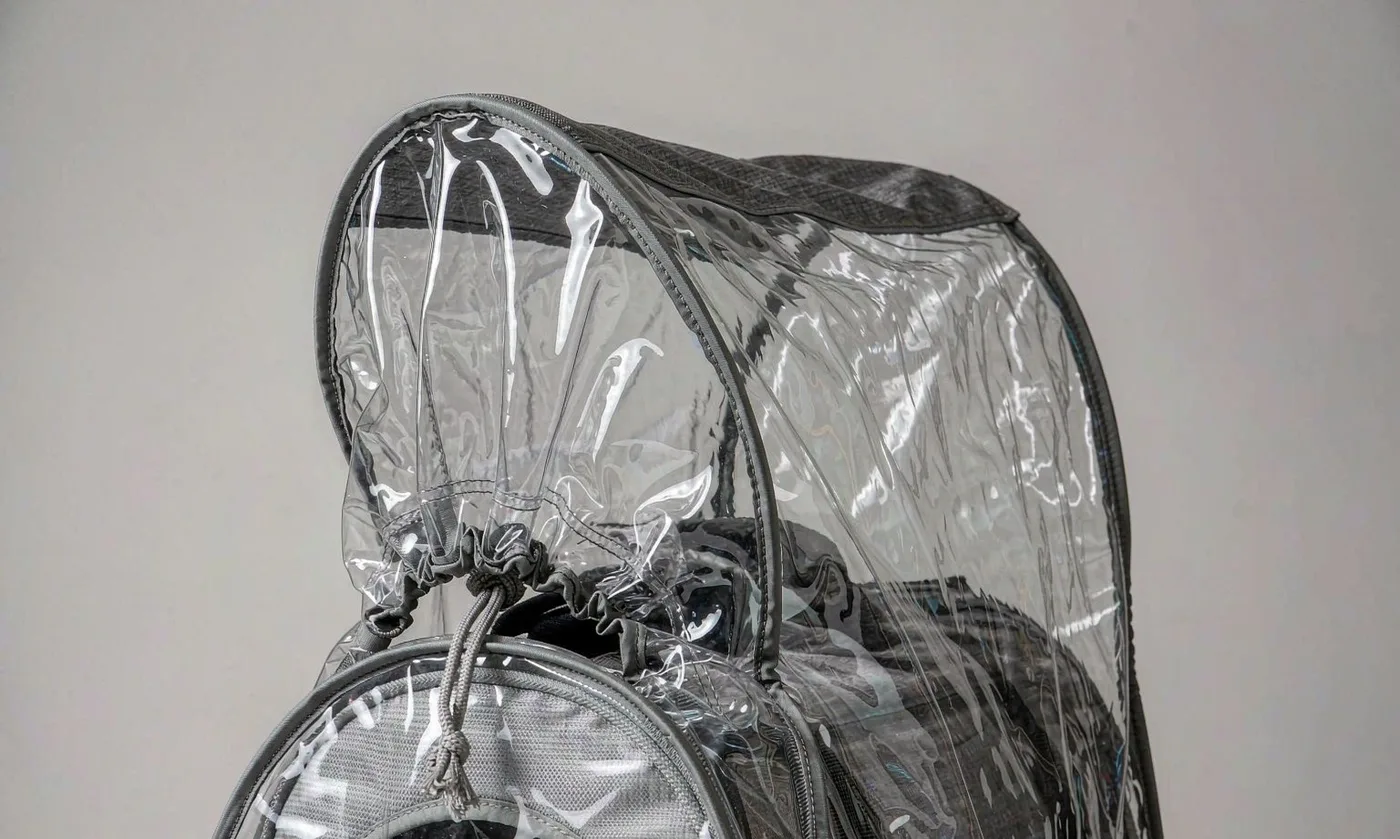
Transparent window. Two materials are used. Polyvinyl chloride film is cheap, clear and soft, and it has two problems: it plasticises and becomes tacky in heat, and it stiffens and cracks below about -5 °C. Thermoplastic polyurethane film costs roughly three times as much, stays flexible to -30 °C and resists abrasion far better. For a cover sold in a cold market, TPU is the only sensible specification, and the saving on PVC is not worth the returns.
Window attachment matters as much as material. A high-frequency welded window has no seam and is the best construction; a sewn window needs a sealed seam and is the second best; an adhesive-bonded window fails first, because the adhesive and the film have different thermal expansion and the bond lifts at the edges after a season.
Reflective trim. Specified by retroreflective coefficient, not by appearance. A glass-bead transfer film reaches 50-70 cd/(lx·m²) and is cheap; a microprismatic film reaches 300-500 cd/(lx·m²) and is worth it on a cover sold for roadside or dusk use. Trim should be placed on the moving edges — the hem and the sides — because a moving reflective element is detected far earlier than a static one.
Placement by panel. Reflective trim on the top panel is largely wasted, because a carried or wheeled carrier presents its sides to traffic. Two continuous bands at hem height and one vertical element at each corner give detection from any approach angle.
Colour. A dark cover absorbs heat and a light one reflects it, but a light cover shows dirt and looks worse after a season. The compromise used on most programmes is a mid-tone body with a light top panel, which puts the reflective surface where the sun is.
Ageing: Hydrolysis, Ultraviolet and Cold Crack
Three mechanisms end a cover service life, and only one of them is visible in normal use.
Hydrolysis is the dominant one for polyurethane-coated fabrics. The coating absorbs moisture and slowly breaks down, faster at higher temperature and humidity. The symptom is a coating that first goes tacky, then powdery, then flakes away from the fabric. A cover stored damp and folded is the worst case, because the fold holds moisture against the coating and the two faces stick together. The specification response is a polyether-based polyurethane rather than a polyester-based one, which hydrolyses far more slowly, and a care instruction to dry the cover before storing it.
Storage conditions do more damage than use. A container held at 40 °C and high humidity for a transit season can take a year off the life of a coated fabric before it is ever sold, which is why covers are packed dry, with a desiccant in the master carton for long sea transits.
Ultraviolet degrades the face fabric and, through it, the coating. Polyester resists better than polyamide, and the practical effect is loss of tensile strength in the fabric rather than loss of waterproofness — so a UV-aged cover does not leak, it tears. The specification is 70% strength retention after 300 hours of xenon-arc exposure, and the visible symptom is fading and a fabric that has gone slightly stiff.
Cold crack applies to windows and to stiff coatings. A PVC window below about -5 °C cracks at a crease, and a heavily coated fabric creases permanently when folded cold. The test is a fold test at temperature: the sample is conditioned at -10 °C for four hours, folded once along a 5 mm radius, and inspected for cracking. Folding a cover when it is cold is the single most damaging thing a customer does to it, and the care label should say so.
Service life. With a polyether PU coating, a polyester ripstop face and reasonable storage, a cover is a three-to-five-year item. With a PVC window it becomes a two-to-three-year item, because the window goes first.
Production, MOQ and Inspection
A rain cover is a cut-and-sewn item with a taping stage, and the process is short enough that setup dominates unit cost at low volumes.
Process. Fabric is cut on a die press or a knife table, panels are sewn, the hem tunnel is formed and the shock cord threaded, straps and buckles are attached, and seams are taped. Taping is the bottleneck and the stage most likely to be done badly, because it is a manual operation with a temperature and a speed that have to be held. Tape adhesion is checked by peel test at the start of every shift and after any machine adjustment.
MOQ. 500 pieces per colourway, met across the sizes in a cover range because the fabric is shared. A three-size range in one colour is one commitment. Covers are the accessory where a second colourway is most tempting and least justified, because the fabric buy is the whole cost.
Lead times. Prototypes in 6-10 working days, bulk production 35-50 days after sample approval. A cover with a welded rather than a taped seam runs longer, because the welding tooling is made for the specific panel set.
Inspection. AQL 2.5 applies, with cover-specific definitions: an unsealed seam or a lifted tape edge is critical, a missing shock cord or toggle is critical, a vent opening smaller than specified by more than 10% is major, and a print misregistration under 2 mm is minor. Hydrostatic head is verified on three panels per lot with a minimum of the specified figure, spray rating on three panels as new, and seam peel strength on three taped samples.
Packing. Covers ship dry, folded flat rather than rolled, in a printed stuff sack. A desiccant sachet goes in the master carton for sea transit. Our production team runs cover lots through the same SGS-verified production base as the carrier programme, on T/T 30/70 and FOB Xiamen terms, with chemical compliance handled under OEKO-TEX certification.
Why brands source here
- Pet carrier programs run since 2014; founding team in sewn goods since 2004
- SGS-verified production floor of 4,950 m² with 137 workers across 7 lines
- Monthly capacity of 200,000 units, audited to BSCI and ISO 9001
People Also Ask
How waterproof should a pet carrier rain cover be?
3,000 mm hydrostatic head with taped seams for sustained rain, 1,000 mm for shower resistance, 5,000 mm where the cover sits against a wet surface under load. Above 5,000 mm the seams and hem fail before the fabric does.
What fabric is used for a carrier rain cover?
210T polyester ripstop with a polyurethane coating is the standard at 72 g/m². 300T packs smaller for a pocket cover, and 210D Oxford is used on wheeled platforms where abrasion from the wheels is the failure.
Why does my rain cover leak at the seams?
Because needle holes pass straight through the coating and the seams were not taped or welded. Seam sealing is not optional on a product sold as waterproof, and tape must cover the stitch line with 4 mm of margin each side.
How do I stop a rain cover blowing off?
Positive anchors beyond the hem. Two webbing straps with buckles under the carrier, tensioned to 15 N each, resisting a 30 N uplift at the top panel without exposing the carrier.
Does a rain cover need ventilation?
Yes. The programme minimum is 4% of the cover surface as effective vent area across at least two non-adjacent faces, with storm flaps over the openings. A sealed cover in warm weather becomes a greenhouse.
What is the difference between hydrostatic head and spray rating?
Hydrostatic head is the water pressure resisted before leaking, in millimetres, and it is the coating test. Spray rating is how well the surface sheds water on a 0-100 scale, and it is the finish that deteriorates first.
How long does a rain cover last?
Three to five years with a polyether polyurethane coating and dry storage, or two to three years with a PVC window, because the window cracks and stiffens first. Hydrolysis from damp folded storage is what kills coatings.
Frequently Asked Questions
What is the minimum order for rain covers?
MOQ 500 pieces per colourway, met across the sizes in a range because the fabric is shared. A three-size range in one colour is a single commitment, and a second colourway is rarely justified because the fabric buy is the whole cost.
How long does cover sampling take?
6-10 working days, with bulk production 35-50 days after approval. A welded-seam cover takes longer because the welding tooling is made for a specific panel set.
What is hydrostatic head?
The height of a water column a fabric resists before three drops penetrate, measured by the ISO method for coated fabrics. It is the coating figure that belongs on a specification, unlike a spray rating, which measures the surface finish.
Should the coating be polyurethane or PVC?
Polyurethane, and specifically polyether-based, which hydrolyses far more slowly than polyester-based. Polyvinyl chloride is cheaper and stiffer but carries plasticiser content that is avoided on a pet product.
What shock cord is used in the hem?
A 3-4 mm braided polyester elastic with a natural rubber core, extending 1.8 times relaxed and retaining above 88% of recovery force after 2,000 cycles. A polypropylene core drops below 70% after 800 cycles.
Can a rain cover have a clear window?
Yes, but specify thermoplastic polyurethane film rather than PVC. PVC goes tacky in heat and cracks below about -5 °C, while TPU stays flexible to -30 °C and resists abrasion far better.
How is a window attached?
Preferably by high-frequency welding, which leaves no seam. A sewn window needs its seam sealed, and an adhesive-bonded one fails first because the film and the adhesive expand differently and the bond lifts at the edges.
Why did the coating go powdery?
Hydrolysis. The coating absorbed moisture and broke down, faster if it was stored warm and damp. It is irreversible, and the prevention is a polyether-based coating plus a care instruction to dry the cover before storing it.
How much vent area is enough?
Four percent of the cover surface as effective area, across at least two non-adjacent faces so air can cross. Below 2% the interior warms quickly; above 8% driven rain enters unless the vents are baffled.
What keeps water out of a vent?
A downward-overlapping storm flap, which is the cheapest and most effective. A coated mesh panel works where the vent must be large, and a folded labyrinth channel is best in driving wind.
How is a cover inspected?
To AQL 2.5, with an unsealed seam or lifted tape edge and a missing shock cord or toggle classified as critical. Hydrostatic head, spray rating and seam peel strength are each verified on three samples per lot.
Can a cover be folded when cold?
It should not be. A crease folded below about -5 °C cracks a PVC window and permanently creases a heavily coated fabric. The care label should instruct the customer to warm the cover before folding it.
Talk to QUANZHOU JUNYUAN BAGS about a pet carrier program: MOQ 500 pieces per colourway, samples in 6-10 working days, bulk production in 35-50 days under AQL 2.5 inspection.
Get a free quote Request a sample