Pet Carrier Playpen: Exercise Pen
An exercise pen is dimensioned by four interacting figures: wire diameter of 2.5-4.5 millimetres, panel height of 600-1,200 millimetres, a panel count of 8-16 giving an enclosed area of 1.1-7.3 square metres, and a folded carton of 0.055-0.140 cubic metres that decides the freight bracket.
An exercise pen looks like a barrier with more panels, and that resemblance is the reason the category is so often costed incorrectly. A pen is configured rather than erected, it is folded and unfolded far more often, it is moved rather than left in place, and the panel count is a marketing variable that changes the freight profile without changing a single tool. This page works through it in manufacturing order: what wire diameter and panel height actually contain and what they cost in steel, how the frame rails and corner geometry handle a stacking load in a warehouse, how connector rods and ground stakes make one panel set into five different shapes, and why the door panel is the component that decides whether the product is reviewed well. It then covers the coating choice between a welded steel build and an injection-moulded alternative, the fold-flat and nesting arithmetic that sets the carton, the test protocol, and the programme economics of panel count. Commercial terms are standard: MOQ 500 pieces per colourway, prototypes in 6-10 working days, bulk production 35-50 days after sample approval, final random inspection to AQL 2.5, T/T 30/70 and FOB Xiamen.
A pet carrier manufacturer is judged on three numbers in this category - MOQ per colourway, sample turnaround and the AQL level applied at final inspection. Ours are 500 pieces, 6-10 working days and AQL 2.5.
Wire Diameter, Panel Height and What They Contain
Two numbers decide whether a pen works, and they are the wire diameter and the panel height. Everything else in the specification is secondary to them, and both are frequently set by the retail price point rather than by the containment requirement.
Wire diameters in production run 2.5, 3.0, 3.2, 3.8 and 4.5 millimetres on low-carbon steel wire at 450-750 newtons per square millimetre tensile. The stiffness of a vertical wire in bending scales with the fourth power of its diameter, so moving from 2.5 to 3.2 millimetres makes the same panel 2.7 times stiffer for 64% more wire mass. That is the single most efficient change available on a pen that bows.
The consequence of a thin wire is not collapse; it is aperture growth. A 2.5 millimetre wire at a 50 by 100 millimetre aperture opens to 68-92 millimetres under a 250 newton concentrated push, which turns a compliant aperture into a non-compliant one under load. A 3.8 millimetre wire at the same aperture opens to 54-66 millimetres. This is why the wire diameter is written on the drawing as a containment parameter rather than as a cost parameter.
Panel height determines what gets out rather than what pushes through. A pen at 600 millimetres contains a small breed at rest and nothing else; 760 millimetres contains most small and medium breeds; 900-1,070 millimetres contains a medium breed that jumps; 1,200 millimetres is the figure used where the animal is known to climb. Jumping is the escape mode that height addresses, and it scales with shoulder height rather than with weight.
Height and wire interact through the panel mass. A 900 by 900 millimetre panel at 3.2 millimetre wire with a 22 millimetre frame weighs 2.6-3.8 kilograms; the same panel at 1,070 millimetres weighs 3.1-4.5. Eight of those is 25-36 kilograms of steel, which puts the product at the top of a parcel weight bracket and into a freight class that changes the landed cost by 8-19%.
The bottom rail is a containment feature that is often treated as a frame feature. A pen with no bottom rail leaves the wire ends in contact with the ground, and the wire ends are the corrosion site and the floor-scratch site. A bottom rail at 0-40 millimetres above the floor closes the gap and lifts the wire ends off the surface, at 0.30-0.85 USD per panel.
Specify 3.2-3.8 millimetres of wire and 900-1,070 millimetres of height for a general-purpose pen, because thin wire fails by aperture growth under a 250 newton push rather than by collapse, and 600 millimetres contains almost nothing that jumps.
Frame Rails, Corner Geometry and Warehouse Stacking
The frame of a pen panel carries a load that a barrier panel never sees: the pen is stacked flat in a warehouse and in a container, and the top panel of a stack carries the whole stack through the frame rails.
Frame tube is 19-25 millimetres outside diameter at 0.9-1.4 millimetres wall for a steel build, formed as a rectangle with the corners radiused at 25-60 millimetres or mitred and welded. A radiused corner is formed on a rotary-draw bender at 0.06-0.22 USD per bend and it is stronger than a mitre because the grain runs around the corner; a mitred and welded corner is cheaper to tool and is the weak point in a drop.
The vertical rails are the members that take the stacking load. A stack of 12 panels at 3.4 kilograms each puts 40 kilograms on the bottom panel, distributed through four frame corners, and a 22 millimetre tube at 1.1 millimetres wall deflects 1.5-4 millimetres under that load. Deflection is not the failure; permanent set is. A tube at 0.9 millimetres takes a set of 0.4-1.1 millimetres after 30-90 days in a stack and the panel never lies flat again.
Mesh-to-frame attachment is the second structural detail. The mesh is either welded into the frame as an insert during frame welding, or welded to the face of a completed frame. An inset mesh is stiffer and 8-15% heavier; a face-welded mesh is cheaper and leaves the wire ends exposed on one face, which is a snag and a corrosion site.
Weld count is the manufacturing cost driver. A 900 by 900 millimetre panel at 50 by 100 millimetre aperture has 9 vertical wires and 10 horizontal wires, giving 90 cross-point welds plus 19-38 perimeter welds to the frame, and a resistance welding machine produces the cross-points in 8-22 seconds. Frame welding is done on a jig at 40-110 seconds.
Corner projection is a packaging detail that is decided here. A radiused corner at 25-60 millimetres radius projects 12-30 millimetres beyond the mesh plane on both faces, and when panels are nested that projection sets the per-panel stack increment. A square corner with a welded cap projects 20-38 millimetres, which is why the radiused corner is also the better packing geometry.
A 22 millimetre frame at 1.1-1.4 millimetres wall with radiused corners survives a 12-panel stack without permanent set, and the radius is simultaneously the stronger corner and the tighter packing geometry.

Connector Rods, Ground Stakes and Configurability
The defining feature of a pen against a barrier is that the same panel set makes several shapes, and the component that enables that is the connector rod. It is a cheap part and it carries a disproportionate share of the product's perceived quality.
A connector rod is a 6-12 millimetre steel rod at 80-200 millimetres of effective length, dropped through aligned eyes on two adjacent panels. Two rods per joint are standard; one rod permits rotation and the panels walk apart. Rod diameter of 8-10 millimetres with eyes at 11-14 millimetres inside diameter gives 1-3 millimetres of play, which is enough to assemble easily and enough to let the pen rack by 2-6 degrees per joint.
Racking is what limits the configurations. With eight panels and 1-3 millimetres of play per joint, an octagon racks by up to 40 millimetres at the top rail and a straight run of four panels bows by 25-70 millimetres. Tighter eyes at 0.5-1.5 millimetres of play reduce that by 45-70% and make assembly 10-30% slower, which is the trade-off.
Configuration count is a marketing variable that costs nothing in tooling. A set of eight identical 900 millimetre panels makes a straight run, a square, an octagon, an L-shape and a divided rectangle, and all five are shown in the same instruction sheet. The only cost is artwork, at 300-1,400 USD for the instruction set.
Ground stakes are the outdoor accessory and they are sold both as an inclusion and as an add-on. A stake is 6-10 millimetres diameter at 200-400 millimetres, with a hook or a flat top engaging the frame, and it resists 120-380 newtons of pull-out in compacted soil and 40-140 in loose soil. Four stakes on an eight-panel pen cost 0.90-3.20 USD and they are the difference between a pen that stays and one that migrates across a lawn over a weekend.
Anchor geometry is the engineering behind the stake. A straight stake pulls out at 40-140 newtons in loose ground; the same stake with a 15-30 millimetre return at the bottom, or a helical form of one and a half turns, holds 180-520. The return costs nothing to form and it doubles the holding force.
Rod retention is the last detail and it is the one that generates the lost-part complaint. A rod dropped through two eyes with no retention works loose in 3-30 days of use and is then lost; the fix is a formed return of 8-15 millimetres at the top of the rod, or a spring clip at 0.04-0.18 USD, and both keep the rod captive without preventing disassembly.
Two rods per joint at 8-10 millimetres with eyes giving 0.5-1.5 millimetres of play, a formed return on the rod top, and stakes with a 15-30 millimetre bottom return holding 180-520 newtons, is the connector specification that makes five configurations from one panel set.
Door Panel, Latch and Access Geometry
The door panel is reviewed more than any other part of a pen because it is the part the owner operates, and it is also the part that most often compromises the containment the pen was bought for.
Access width is the first decision. A door aperture of 380-520 millimetres admits a person's arm and a small breed; 520-700 millimetres admits a person stooping. The aperture is cut into a standard panel, which means the door frame is a second welding operation on a panel that already has one, at 60-140 seconds and 1.40-4.20 USD.
Latch types on a pen door are a sliding bolt, a spring bolt or a hook-and-eye. A sliding bolt at 8-14 millimetres diameter with 15-30 millimetres of engagement holds 300-900 newtons and is operated with 8-25 newtons of force; a spring bolt is faster at 4-12 newtons and holds 180-520; a hook-and-eye is the cheapest at 0.10-0.45 USD and releases at 150-500 newtons under an upward pull.
Two-action behaviour is the safety question. A dog inside a pen pushing outward on a door with a plain sliding bolt will not open it, because the load is perpendicular to the bolt travel; the same dog pushing a hook-and-eye upward will. The engineering answer is to orient the latch so the animal's push is transverse to the release direction, which is free and which most low-cost designs get wrong.
Threshold height is the trip and containment detail. A door sill at 0-25 millimetres is a trip-free entry and it is also a gap; a sill at 45-90 millimetres closes the gap and is stepped over. The compromise in production is a sill at 25-40 millimetres, which is low enough to step over and too small to admit a small animal head-first.
Door swing direction is decided by the hinge side and it is a real constraint in a corner installation. A single-leaf door hinged on one side needs 400-700 millimetres of clear space in front of it; the same door in a corner of a square pen has 250-450. Where the pen is placed against a wall, the door has to be positioned in the panel adjacent to the wall rather than in the middle of a run.
Cycle life is the acceptance figure. A door latch is cycled 2,000-8,000 times at 10-25 cycles per minute and then tested for engagement depth within 0.5 millimetres of original and for release under a 250 newton push of zero. A bolt that wears 1.2 millimetres of engagement over 3,000 cycles will release under load in month six.
A 380-700 millimetre aperture with a sliding bolt oriented transverse to the animal's push, a sill at 25-40 millimetres and 2,000-8,000 cycles of qualification, is the door specification that survives both the review and the dog.
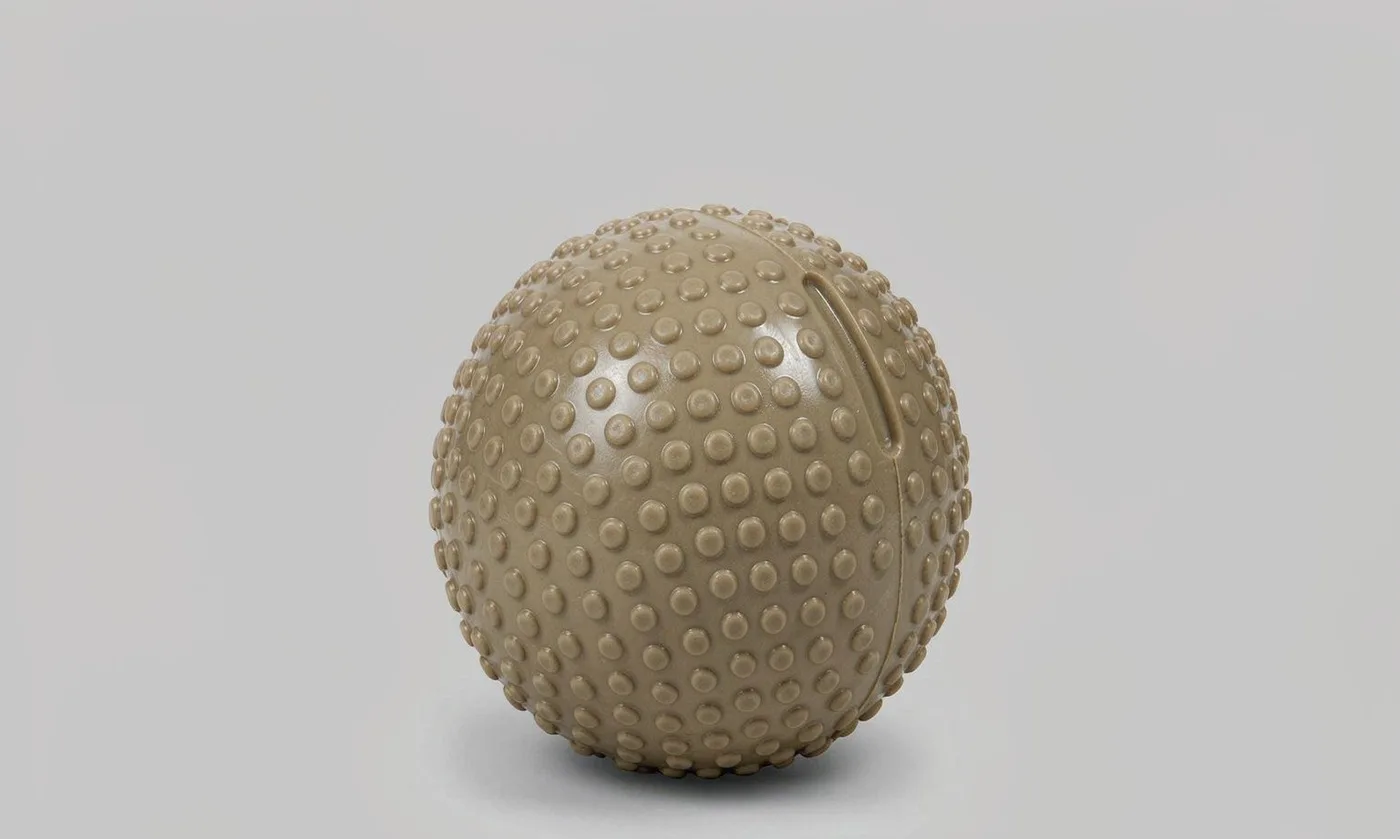
Coating, and the Injection-Moulded Alternative
A pen is offered in two material families and the choice changes the tooling, the freight, the corrosion story and the price point at the same time. It is a platform decision rather than a variant decision.
A welded steel build is powder-coated after a conversion pretreatment, at 60-120 microns dry film. The mesh is the difficulty: an electrostatic gun shadows the reverse of each wire, leaving 30-60% of the film thickness on one face, and the control is a fluidised-bed dip of the mesh panel before frame assembly or a two-pass electrostatic application with rotation. Dip gives 150-350 microns and a rounded wire profile; two-pass spray gives 60-120 and a thinner, sharper profile.
Salt spray performance follows the pretreatment. A cleaned-only steel panel fails at the scribe in 96-240 hours; a seven-stage zinc phosphate or zirconium conversion takes the same panel to 500-1,000 hours. The acceptance criterion is scribe creepage under 2 millimetres at 500 hours, and the relevant test reference sits in the ASTM B117 method.
An injection-moulded build in polypropylene or a polyethylene copolymer is the alternative. Panels are 2.5-4.5 millimetres wall, moulded in a tool of 45-320 tonnes clamp force with a cycle of 45-120 seconds, and a panel weighs 1.1-2.6 kilograms against 2.6-4.5 for steel. Tooling is 28,000-95,000 USD per panel size against 6,000-19,000 for a welded steel platform.
The moulded build wins on three counts and loses on two. It wins on corrosion, because there is none; on weight, at 40-58% less; and on noise, because a plastic panel does not ring. It loses on stiffness, deflecting 2.5-5 times more under the same push, and on ultraviolet stability, where an unpigmented polypropylene chalks in 12-30 months of outdoor exposure and needs a hindered amine light stabiliser package at 0.3-1.2% loading.
Ultraviolet stability is the specification that decides whether a moulded pen is an indoor or an outdoor product. A polypropylene with 0.3-0.6% hindered amine stabiliser and 1.5-3% carbon black survives 1,500-3,000 hours of accelerated weathering with a colour shift under Delta-E 3.0; the same polymer unstabilised reaches Delta-E 8 by 500 hours.
Fire and substance obligations apply to the moulded build and not to the steel one. A moulded panel has to meet the same substance declarations as any polymer article, and the evidence is a screening declaration supported by targeted testing against the restricted-substance list maintained by the European Chemicals Agency.
A welded steel platform costs 6,000-19,000 USD in tooling and 500-1,000 hours of salt spray; a moulded platform costs 28,000-95,000 USD, weighs 40-58% less, and needs a stabiliser package to survive outdoor exposure at all.
Fold-Flat, Nesting and Carton Cube
A pen ships as a bundle of flat panels and its freight cost is set almost entirely by how those panels nest. The arithmetic is simple but the consequences are large, because panel count multiplies the per-panel increment.
A single welded panel is 25-34 millimetres thick at the frame, including the mesh plane and any corner projection. Eight panels stacked without nesting are 200-272 millimetres thick; with the mesh of one panel sitting in the frame void of the next, the increment per panel falls to 16-24 millimetres and eight panels stack to 128-192 millimetres. Nesting saves 25-36% of the stack height and it requires the mesh to be welded to the same face on every panel.
The corner is what stops further nesting. A radiused corner at 25-60 millimetres radius projects 12-30 millimetres per face; a flat corner with a welded end cap projects 20-38. Where the packaging target is aggressive, the frame is formed with the mesh plane offset to one side, so the corner projections of adjacent panels interleave and the increment falls to 12-18 millimetres.
The carton is then the panel footprint plus the stack height. An 8-panel pen at 900 by 900 millimetre panels and a 165 millimetre stack packs in a carton of 940 by 940 by 205 millimetres, or 0.181 cubic metres, at 25-36 kilograms. A 16-panel pen at the same panel size is 0.302 cubic metres at 50-72 kilograms, which is at the top of a two-person handling limit and the reason a large pen is shipped as two cartons.
Two-carton shipping is the answer above 12 panels. It costs 2.80-7.40 USD in additional corrugate and handling, and it keeps both cartons under 32 kilograms, which is the figure that determines whether a parcel network will carry them at all.
The accessory bundle is the last cube item. Connector rods, stakes, a door latch and the instruction sheet add 0.6-2.4 kilograms and are packed in a void beside the panel stack rather than in a separate bag outside it, because a bag strapped to a carton is the item that goes missing in a distribution centre.
Container arithmetic closes the calculation. A 40-foot high-cube at 68 cubic metres takes 375 of the 0.181 cubic metre cartons before pallet losses and 315-345 after; the weight at 25-36 kilograms gives 26 tonnes at 720-1,040 units, so the volume ceiling binds first on an eight-panel steel pen.
Nesting the mesh into the frame void takes the per-panel increment from 25-34 millimetres to 12-24, cuts an eight-panel carton to 0.181 cubic metres, and splits above 12 panels into two cartons to stay under 32 kilograms.

Test Protocol: Push, Rack, Cycle and Weathering
A pen is qualified against six exposures, two of which are specific to the product being reconfigured rather than erected once.
Push-out is the primary test at 200-400 newtons applied horizontally at 900 millimetres height for 60 seconds, at the panel centre and at the joint. Acceptance is residual deflection under 15 millimetres at the centre and under 8 millimetres of joint separation. The joint figure is the one a pen fails, because a rod-and-eye connection has clearance that a fixed hinge does not.
Racking is the second and it is unique to a configurable product. An assembled octagon is pushed laterally at the top rail at 100-250 newtons and the horizontal displacement at the top relative to the base is measured; acceptance is under 45 millimetres on an eight-panel configuration. This is the test that catches loose eye tolerances, and it is run on three configurations rather than one.
Door latch release is the third at 250 newtons of sustained push from the inside and 10-25 joules of impact at the latch, with acceptance of zero release and engagement depth within 0.5 millimetres after 2,000-8,000 cycles.
Assembly and disassembly cycle is the fourth and it is specific to this category. A pen is assembled and struck 200-800 times at 2-6 cycles per hour, and the eyes are then measured for ovalisation of under 0.4 millimetres and the rods for straightness within 1.5 millimetres over their length. A rod that bends in assembly is the complaint that generates the most returns in the first month.
Stability against overturning is the fifth, at 100-250 newtons of horizontal push on a corner of an assembled configuration, and it is passed by every steel pen above 25 kilograms and failed by most moulded pens without ballast or stakes.
Weathering is the sixth and it applies to the coating or the polymer. A steel build is run to 240-1,000 hours of neutral salt spray with scribe creepage under 2 millimetres; a moulded build is run to 500-3,000 hours of accelerated weathering with a colour shift under Delta-E 3.0 and a retained impact strength above 70% of the unexposed figure.
Sample allocation is 16-28 units per model, and the configuration testing is what consumes them: three configurations at four units each for rack and stability, plus the balance for push, cycle and weathering.
A protocol of 16-28 units across push at 200-400 newtons, rack under 45 millimetres on three configurations, zero latch release at 250 newtons, 200-800 assembly cycles and the relevant weathering exposure, is what qualifies a configurable pen.
Panel Count Economics and Range Structure
Panel count is the marketing variable of this category and it is also the freight variable. Because every panel in a set is identical, the count changes the product without changing a tool, and the range decision is therefore a packaging decision as much as a design one.
The retail ladder runs from 4 panels at 32-68 USD to 16 panels at 110-240 USD, and the ladder is not linear in cost. Four extra panels cost 10.40-18.00 USD in steel and rod hardware against a retail step of 27-58 USD, which makes the upward extension of a range the highest-margin move available.
Weight is the constraint that stops the ladder. At 3.4 kilograms per panel, a 16-panel steel pen is 54 kilograms of steel plus carton, and it exceeds both the two-person handling limit and the parcel network limit, so the top of the range ships as two cartons at an additional 2.80-7.40 USD. The practical ceiling for a single-carton steel pen is 12 panels.
A moulded platform extends the ceiling because it weighs 40-58% less; a 16-panel moulded pen is 22-40 kilograms and ships in one carton at 0.24-0.31 cubic metres. It is the only way to reach the top of the ladder in a single parcel, and it is the argument for the 28,000-95,000 USD tooling.
The table below compares the common configurations on the parameters that decide the range structure.
| Configuration | Panels | Area (m²) | Steel mass (kg) | Stack height (mm) | Carton (m³) | Cartons | FOB (USD) | Retail (USD) |
|---|---|---|---|---|---|---|---|---|
| Starter square | 4 | 0.81 | 11-15 | 88-118 | 0.096 | 1 | 13.20-27.40 | 32-68 |
| Medium octagon | 8 | 2.34 | 22-30 | 128-192 | 0.181 | 1 | 23.60-49.20 | 58-124 |
| Large octagon | 12 | 4.86 | 33-45 | 192-288 | 0.272 | 1 | 34.10-71.60 | 84-178 |
| Yard pen, 900 mm | 16 | 7.29 | 44-60 | 256-384 | 0.362 | 2 | 45.30-95.10 | 110-240 |
| Tall pen, 1,070 mm | 8 | 2.34 | 26-36 | 128-192 | 0.208 | 1 | 27.90-58.30 | 72-152 |
| Moulded octagon | 8 | 2.34 | 9-21 | 148-232 | 0.196 | 1 | 31.40-64.80 | 68-146 |
| Moulded yard pen | 16 | 7.29 | 18-41 | 296-464 | 0.294 | 1 | 58.60-122.40 | 132-286 |
| Door panel option | +1 | n/a | +2.9-4.1 | +16-24 | +0.021 | 0 | +4.80-11.20 | +16-34 |
| Stake set of 4 | n/a | n/a | +0.5-1.3 | +0 | +0.003 | 0 | +0.90-3.20 | +8-19 |
Reading the FOB column against the retail column shows where the margin is. The door panel at 4.80-11.20 USD carrying 16-34 USD is the best line in the table, followed by the stake set at 0.90-3.20 against 8-19. Both are accessories that need no tooling and no testing.
The moulded rows show the platform trade-off honestly: 31.40-64.80 USD FOB against 23.60-49.20 for the steel equivalent at the same size, bought to reach the top of the ladder in one parcel and to remove corrosion from the range entirely.
Four extra panels cost 10.40-18.00 USD and carry a 27-58 USD retail step, making upward extension the highest-margin move in the range, with a single-carton ceiling at 12 panels for steel and 16 for a moulded platform.
Order and quality terms
- MOQ 500 pieces per colourway; samples in 6-10 working days
- Bulk production 35-50 days after approval; AQL 2.5 inspection standard
- T/T 30/70 terms, FOB Xiamen, full document set per shipment
People Also Ask
What wire diameter should an exercise pen use?
3.2-3.8 millimetres. A 2.5 millimetre wire at a 50 by 100 millimetre aperture opens to 68-92 millimetres under a 250 newton push, which turns a compliant aperture into a non-compliant one under load.
How tall should a playpen be?
900-1,070 millimetres for a general-purpose pen. A pen at 600 millimetres contains almost nothing that jumps, and jumping scales with shoulder height rather than with weight.
Why does a pen rack to one side?
Clearance of 1-3 millimetres per rod-and-eye joint accumulates across eight panels into up to 40 millimetres at the top rail. Eyes giving 0.5-1.5 millimetres cut that by 45-70%.
Can one panel set make different shapes?
Yes. Eight identical 900 millimetre panels make a straight run, a square, an octagon, an L and a divided rectangle. The only cost is the instruction artwork at 300-1,400 USD.
How much do ground stakes actually hold?
40-140 newtons for a straight stake in loose soil and 180-520 with a 15-30 millimetre return at the bottom or a helical form. The return costs nothing to form.
How many panels still ship in one carton?
Twelve for a steel pen, at 0.272 cubic metres and 33-45 kilograms. Sixteen panels reach 44-60 kilograms and have to ship as two cartons at an extra 2.80-7.40 USD.
Is an injection-moulded pen better than a welded steel one?
It weighs 40-58% less, does not corrode and does not ring, but it deflects 2.5-5 times more and needs a hindered amine stabiliser package to survive outdoor exposure at all.
Frequently Asked Questions
What causes a pen panel to bow permanently?
Stacking set. Twelve panels at 3.4 kilograms put 40 kilograms on the bottom panel, and a frame tube at 0.9 millimetres takes a permanent set of 0.4-1.1 millimetres after 30-90 days in a stack.
Should the mesh be welded into the frame or onto its face?
An inset mesh is stiffer and 8-15% heavier; a face-welded mesh is cheaper but leaves wire ends exposed on one face, which is both a snag and a corrosion site.
Why are two connector rods used per joint?
A single rod permits rotation and the panels walk apart. Two rods at 8-10 millimetres lock the angle and make the configuration hold its shape.
What door aperture is practical?
380-520 millimetres admits an arm and a small breed; 520-700 admits a person stooping. The aperture is cut into a standard panel as a second welding operation at 60-140 seconds.
Why does latch orientation matter?
An animal pushing outward loads a sliding bolt transversely and cannot open it, but loads a hook-and-eye in the release direction and can. Orienting the latch transversely costs nothing.
What threshold height should a pen door have?
25-40 millimetres. It is low enough to step over and too small to admit a small animal head-first, unlike a sill at 0-25 or one at 45-90.
How much does ultraviolet stabiliser matter on a moulded pen?
Polypropylene with 0.3-0.6% hindered amine stabiliser and 1.5-3% carbon black survives 1,500-3,000 hours of accelerated weathering under Delta-E 3.0; unstabilised it reaches Delta-E 8 by 500 hours.
Why is powder coverage uneven on welded mesh?
An electrostatic gun shadows the reverse of each wire, leaving 30-60% of film thickness on one face. A fluidised-bed dip before frame assembly gives 150-350 microns instead.
How much does nesting save on a panel stack?
The increment per panel falls from 25-34 millimetres to 12-24 when the mesh of one panel sits in the frame void of the next, cutting stack height by 25-36%.
What is the racking acceptance figure?
Under 45 millimetres of horizontal top-rail displacement on an eight-panel configuration under a 100-250 newton lateral push, tested on three configurations rather than one.
How many assembly cycles should a pen survive?
200-800, with eye ovalisation under 0.4 millimetres and rod straightness within 1.5 millimetres over the length. A rod that bends in assembly drives most first-month returns.
How much salt spray does a steel pen need?
240-1,000 hours with scribe creepage under 2 millimetres. The rating is set by the seven-stage conversion pretreatment rather than by the powder thickness.
How many units go into qualifying a pen?
16-28 per model. Three configurations at four units each for rack and stability, plus the balance for push, latch cycle and weathering.
Which accessory carries the best margin?
The door panel, at 4.80-11.20 USD FOB against a 16-34 USD retail step, followed by a stake set of four at 0.90-3.20 against 8-19. Neither needs tooling or testing.
Talk to QUANZHOU JUNYUAN BAGS about a pet carrier program: MOQ 500 pieces per colourway, samples in 6-10 working days, bulk production in 35-50 days under AQL 2.5 inspection.
Get a free quote Request a sample