Pet Carrier Tether: Interior Safety
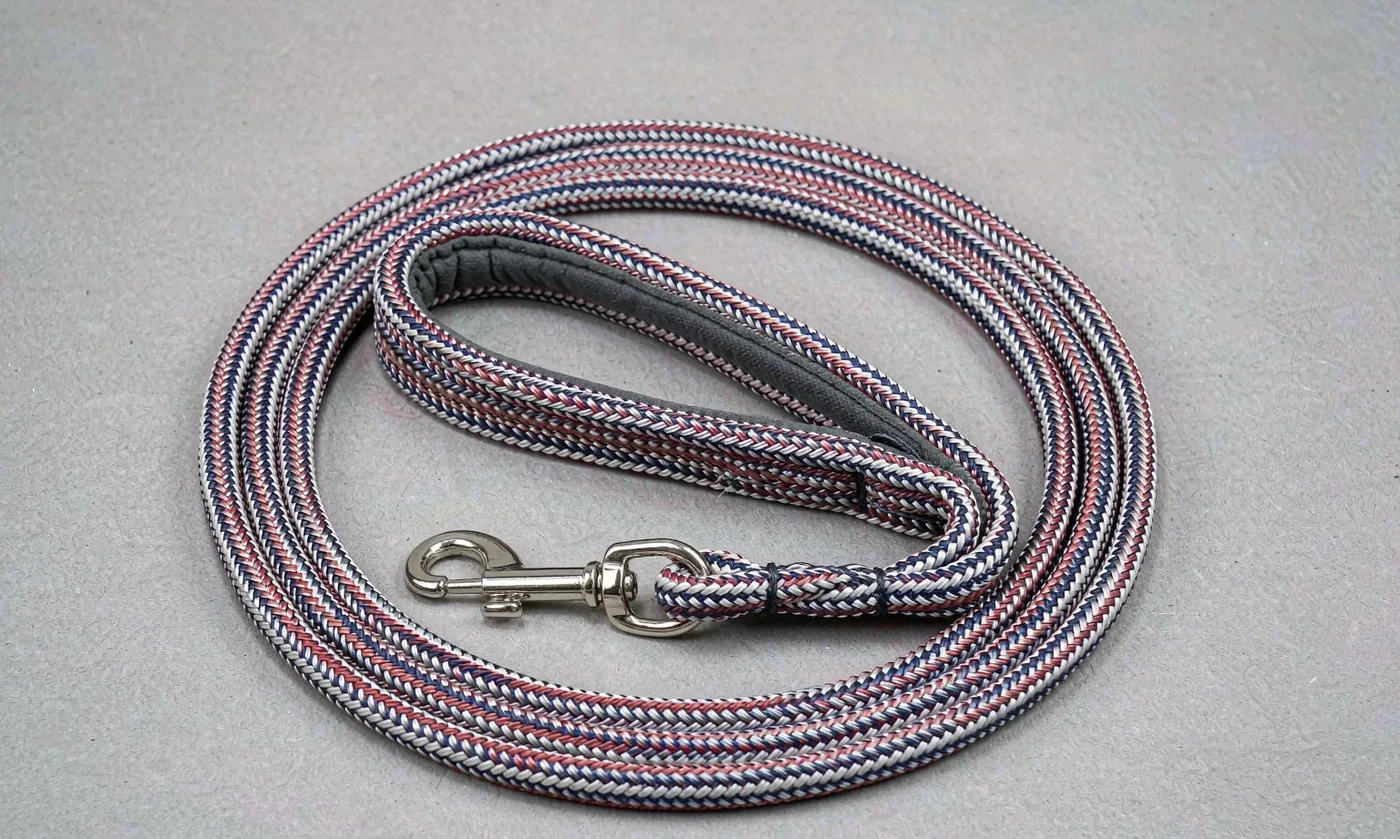
An interior pet tether is a short coupling, not a lead. Specification is 150-300 mm finished length, a minimum break strength of 3.5 kN, elongation capped at 12% under a 1.5 kN working load, and survival of 5,000 fatigue cycles at 0.5 kN. Environment range is -30 to 70 degrees Celsius, verified over 500 hours of UV exposure.
The interior tether is the least understood component in vehicle pet safety because it looks like a short lead and is frequently bought as one. It is not: it operates as a fixed-length coupling between a harness and a vehicle anchor, it is loaded at a rate an order of magnitude higher than any lead sees, and its whole purpose is to limit excursion rather than to allow it. This page treats it as the engineered part it is: how coupling length sets both excursion and peak load, which anchor interfaces are compatible and which are misused, how hardware is rated against partial engagement, and what fatigue and environment testing a production lot has to survive. It also covers length discipline for entanglement control, the labelling and instruction set that travels with a safety claim, and the cost structure of the programme. Terms are standard: MOQ 500 pieces per colourway, prototypes in 6-10 working days, bulk production 35-50 days after sample approval, final random inspection to AQL 2.5, T/T 30/70, FOB Xiamen.
Private label pet bags sit at the centre of most pet carrier accessory briefs we handle: the buyer owns the brand, the barcode and the artwork, while our production team holds the pattern.
Interior Load Case: Short Coupling, Very High Loading Rate
A tether and a lead differ in the parameter that governs the design: loading rate. A lead is loaded by an animal accelerating from rest over roughly 0.4-0.9 seconds. A tether is loaded by a vehicle deceleration event completing in 90-120 milliseconds. The same peak force arriving ten times faster produces a materially different response in webbing, hardware and stitch, because polymers are rate-sensitive and their apparent stiffness rises with strain rate.
The practical consequence is a dynamic amplification factor. A coupling that measures 2.2 kN in a quasi-static pull can transmit 2.9-4.0 kN in a 100 ms pulse, an amplification of 1.3-1.8 depending on elongation and construction. Every rating in this product has to be stated as a dynamic figure or converted with a stated factor, and a tether specified on quasi-static numbers alone is under-specified by roughly a third.
Length is the second governing parameter and it cuts both ways. A longer tether lowers the peak load by extending the arrest distance, but it increases excursion, which is the thing the product exists to control. A shorter tether controls excursion and raises peak load. The specification is a compromise resolved by measurement rather than by preference.
| Finished length | Static excursion | Dynamic excursion | Peak transmitted load | Amplification | Verdict |
|---|---|---|---|---|---|
| 100 mm | 80 mm | 130-170 mm | 3.9 kN | 1.77 | Too stiff |
| 150 mm | 120 mm | 190-240 mm | 3.4 kN | 1.55 | Acceptable, small blocks |
| 200 mm | 160 mm | 250-310 mm | 3.1 kN | 1.41 | Standard |
| 250 mm | 200 mm | 310-380 mm | 2.9 kN | 1.32 | Standard, large blocks |
| 300 mm | 240 mm | 370-450 mm | 2.7 kN | 1.23 | Upper limit |
| 400 mm | 320 mm | 490-600 mm | 2.5 kN | 1.14 | Fails excursion limit |
The excursion limit of 300 mm comes from the interior package: it is the largest forward travel that keeps the animal clear of the seat back, the front seat structure and the door trim in the vehicle classes this programme covers. Anything above it converts a restraint into a projectile path, which is why the table terminates at 300 mm regardless of how favourable the load figure looks.
Testing reflects the rate rather than the magnitude. Couplings are pulled on a servo-hydraulic frame at 1.5-3.0 metres per second rather than the 100 mm per minute used for quasi-static work, and the load cell is sampled at 2 kHz or higher because a 100 ms event captured at 50 Hz is a straight line, not a curve.
Rate the tether dynamically: a 2.2 kN quasi-static coupling transmits 2.9-4.0 kN in a 100 ms pulse, and 300 mm of excursion is the hard ceiling.
Anchor Interface: LATCH, ISOFIX and Seat Belt Buckle Geometry
A tether is only as good as what it attaches to, and the vehicle side of that interface is outside the supplier's control. The engineering answer is to design for the interfaces that exist, verify fit on a physical vehicle matrix, and state compatibility explicitly rather than implying universality.
Three interfaces cover the market. The lower anchor bars fitted for child restraints are the cleanest: rigid, located, and specified by the vehicle manufacturer. The seat belt buckle tongue is the most common and the most variable, with latch dimensions differing appreciably between manufacturers and between model years. The ISOFIX top-tether point is the least used for pets but is rigid and well located where present.
Compatibility is verified rather than assumed. A fit matrix of 18-30 vehicles covering the major platforms in the target market is checked physically at the development stage, and each combination is recorded as compatible, compatible with an adapter, or incompatible. A programme that skips this step discovers the problem through returns, which is the most expensive possible route to the same information.
| Interface | Rigidity | Variability | Typical rating | Adapter needed | Fit-check result | Share of fleet |
|---|---|---|---|---|---|---|
| LATCH lower anchor bars | Rigid | Low | Above 8 kN | No | Compatible on 96-100% | 62-78% |
| Seat belt buckle tongue | Semi-rigid | High | 5.6-7.4 kN | Sometimes | Compatible on 74-88% | 98-100% |
| ISOFIX top tether point | Rigid | Low | Above 6 kN | No | Compatible on 88-96% | 38-54% |
| Seat belt webbing loop | Flexible | Very high | Depends on belt | Yes | Not recommended | n/a |
| Headrest post | Semi-rigid | Very high | Unrated | Yes | Not recommended | n/a |
| Cargo tie-down point | Rigid | Medium | 2.2-6.0 kN | Sometimes | Compatible on 58-72% | 44-66% |
Two interfaces are deliberately excluded. A loop around the seat belt webbing loads the belt across its width in a way it was not designed for and can damage the webbing, and a headrest post is unrated plastic trim in most vehicles. Both are common in consumer practice and both are excluded from the instruction set.
The tongue itself is the wear item. A stamped steel tongue engaging a vehicle buckle is cycled 5,000 times against a representative buckle body with the release force measured at 1,000-cycle intervals, and the acceptance band is 40-90 N throughout. A tongue that releases below 40 N after cycling is a misuse hazard, and one above 90 N cannot be operated under load by an adult.
Design for lower anchors and the buckle tongue, exclude webbing loops and headrest posts, and record a physical fit matrix across 18-30 vehicles before release.

Coupling Hardware: Gate Strength, Swivels and Partial Engagement
The connector at each end of a tether is the component most likely to be misused, and the failure mode is specific: partial engagement. A snap hook whose gate closes against a webbing edge or a D-ring of the wrong section can appear latched while resting on the gate rather than behind it, and it then releases at a fraction of its rating. Design and testing both address this.
Gate strength is measured in the direction that matters, which is across the gate rather than along the body. A spring snap rated 2.4 kN along its axis will typically hold 0.6-0.9 kN across the gate, and it is the latter figure that governs a connector loaded at an angle. Hardware is therefore specified with both numbers written down, and the cross-gate figure is the one used in the assembly rating.
A swivel is not optional on this product. A tether rotates through 180-360 degrees as an animal moves, and a non-swivelling coupling transmits that rotation into the webbing, twisting it and eventually loading the stitch group in a direction it was not built for. A swivel rated at or above the coupling rating costs 0.18-0.44 USD and removes an entire class of field failure.
| Connector | Axial rating | Cross-gate rating | Swivel | Engagement cycles | Cost (USD) | Verdict |
|---|---|---|---|---|---|---|
| Spring snap, zinc | 2.4 kN | 0.6 kN | Optional | 8,000-12,000 | 0.16-0.34 | Light blocks only |
| Bolt snap, zinc | 2.9 kN | 0.9 kN | Optional | 10,000-16,000 | 0.22-0.46 | Acceptable |
| Bolt snap, steel | 4.6 kN | 1.6 kN | Optional | Above 20,000 | 0.42-0.86 | Preferred |
| Twist-lock carabiner | 5.2 kN | 2.2 kN | Fixed | Above 20,000 | 0.68-1.40 | Preferred, large blocks |
| Seat belt tongue, steel | 7.4 kN | 5.6 kN | Optional | Above 20,000 | 0.55-1.20 | Vehicle side |
| Trigger snap, zinc | 1.8 kN | 0.4 kN | No | 6,000-9,000 | 0.12-0.26 | Excluded |
Geometry controls the misuse. A gate throat of 12-16 mm accepts the harness D-ring with clearance but will not pass a second webbing, which reduces the chance of a user clipping the tether to something it was not designed for. A gate that is too generous invites exactly that, and the instruction set has to be written to match the hardware that ships.
Cycle testing is a fatigue test in disguise. Ten thousand engagements at 6,000-16,000 cycles of the spring is not the same as a fatigue test on the body, which is why the coupling also goes through the cyclic load programme described later. Springs lose 8-18% of their closing force over the cycle life, and a spring below 60% of its original force is a rejection at incoming inspection.
Specify connectors on their cross-gate rating, fit a swivel as standard, and size the gate throat at 12-16 mm so misuse is geometrically inconvenient.
Energy Management: Elongation, Absorbers and What Not to Use
Something has to absorb the kinetic energy of the arrest, and there are three places it can go: into elastic extension of the coupling, into controlled deformation of a designed absorber, or into the animal. The third is what the product exists to avoid, so the engineering question is how much of the first two to allow.
Elastic extension is the intuitive answer and the wrong one for this application. A bungee section stretching 30-60% does lower peak load, but it does so by extending the arrest distance, which increases excursion beyond the 300 mm envelope and then recoils, adding a second loading event. Two programmes that used elastic couplings measured 430-610 mm of excursion and a distinct secondary peak at 180-260 ms.
A controlled absorber is the correct answer. A tear-stitch section sewn with a programmed stitch pattern that releases progressively above a threshold force absorbs energy at a near-constant load, which is the ideal characteristic: it caps the transmitted force without the spring-back. Tear-stitch absorbers on this product are set to begin releasing at 1.8-2.4 kN and absorb 90-180 J over 60-120 mm of travel.
| Approach | Peak load | Excursion | Energy absorbed | Secondary peak | Recoil | Verdict |
|---|---|---|---|---|---|---|
| Rigid webbing, no absorption | 3.4 kN | 240 mm | 20-40 J | None | None | Acceptable |
| Elastic section, 40% stretch | 2.1 kN | 430-610 mm | 120-200 J | Yes, 180-260 ms | Severe | Rejected |
| Tear-stitch absorber | 2.3 kN | 260-330 mm | 90-180 J | None | None | Preferred |
| Folded webbing, progressive release | 2.5 kN | 280-360 mm | 80-150 J | None | Slight | Acceptable |
| Compressible spacer in line | 2.8 kN | 250-300 mm | 50-90 J | None | Slight | Acceptable, bulky |
| Elastic plus tear-stitch hybrid | 2.0 kN | 340-420 mm | 150-240 J | Slight | Moderate | Rejected |
An absorber introduces a service-life question that a rigid coupling does not have: it is a single-use device by design. The instruction set states this unambiguously, and the product carries a visible indicator — a contrast stitch that is destroyed when the absorber releases — so a user can tell at a glance whether the unit has been exercised. That indicator costs 0.04-0.11 USD and is the cheapest liability reduction available on the product.
The absorber also needs its own tolerance band. Tear-stitch release force varies with thread tension, needle condition and fabric lot, so the programme sets a band of 1.8-2.4 kN and verifies it on three units per 500 produced. A release outside that band is a process problem, not a sorting problem, and it is corrected at the machine rather than by inspection.
Use a tear-stitch absorber releasing at 1.8-2.4 kN with a visible release indicator, and reject elastic sections on excursion and recoil grounds.
Fatigue, Temperature and Service Life Verification
A tether spends its life doing almost nothing and then, once, doing a great deal. That duty cycle makes fatigue a poor predictor of field life and environment a good one: the material properties at the moment of the event are set by years of thermal cycling, UV exposure and humidity, not by the number of times the product has been loaded.
The cyclic programme is therefore a screen rather than a life prediction. Five thousand cycles at 0.5 kN, well below the working load, are applied to confirm that nothing loosens, creeps or frets: stitch groups, crimped ends and swivel bearings. Acceptance is no measurable elongation of the coupling beyond 3 mm, no stitch damage and no hardware deformation above 1%.
Environment is where the real loss occurs. Polyester webbing aged for 500 hours under UV at 60 degrees retains 86-92% of its break strength; the same webbing aged with humidity cycling retains 84-90%; combined UV, heat and humidity cycling retains 79-87%. Hardware plating aged the same way is judged on corrosion, with the same 48 hour salt spray criterion used elsewhere in this product family.
| Test | Condition | Duration | Measured item | Threshold | Cost (USD) |
|---|---|---|---|---|---|
| Cyclic load screen | 0.5 kN, 1 Hz | 5,000 cycles | Permanent elongation | 3 mm maximum | 180-420 |
| Dynamic pull to failure | 1.5-3.0 m/s | 3 units | Break strength | 3.5 kN minimum | 220-480 |
| Elongation under load | 1.5 kN hold, 60 s | 3 units | Strain | 12% maximum | 90-190 |
| UV ageing | 500 h, 60 C | 500 h | Retained strength | 80% minimum | 240-540 |
| Thermal cycling | -30 to 70 C | 50 cycles | Hardware function, cracking | No cracking, full function | 310-680 |
| Humidity ageing | 40 C, 93% RH | 240 h | Retained strength | 82% minimum | 190-420 |
| Salt spray on hardware | Neutral, 5% | 48-96 h | Base metal corrosion | None permitted | 120-260 |
| Abrasion on webbing | Hex bar, 12 kPa | 8,000 cycles | Retained strength | 78% minimum | 140-300 |
The full programme costs 1,490-3,290 USD per style and takes 22-38 working days, which is longer than the sampling cycle and has to be scheduled alongside it rather than after it. A programme that waits for sample approval before booking the laboratory loses the 6-10 working day sampling advantage entirely.
Re-verification is annual on a live style, at 890-1,850 USD, and it is justified by the same argument as everywhere else in this product family: materials and plating suppliers change even when the drawing does not, and an annual pull is how that is caught before it ships in volume.
Run 5,000 cycles at 0.5 kN as a screen and judge life by environment ageing: 500 hours of UV at 60 degrees with 80% retained strength as the threshold.
Length Discipline: Excursion Envelope and Entanglement Control
Length is the specification most often relaxed in production and the one with the widest safety consequence. A tether that ships 80 mm longer than specified increases excursion by roughly 30% at the same pulse and, more importantly, creates enough slack to form a loop that a limb can pass through. Both are addressed by specification rather than by instruction.
The finished length band is 150-300 mm with a manufacturing tolerance of plus or minus 5 mm, and it is graded by size block so that a large animal does not receive a coupling long enough to loop. Grading to animal mass rather than to a single universal length is the single most effective entanglement control available and it costs nothing in production.
Termination style matters at the margins. A tether that ends in a fixed loop large enough to pass a paw is a hazard; one that terminates directly into the connector body is not. Where a loop is required for attachment geometry, it is closed with a stitch group rather than left open, and the enclosed area is limited to below 900 mm².
| Block | Animal mass | Finished length | Tolerance | Excursion at 25 g | Max loop area | Termination |
|---|---|---|---|---|---|---|
| XS | 2-4 kg | 150 mm | Plus or minus 5 mm | 190-240 mm | 600 mm² | Direct to connector |
| S | 4-8 kg | 180 mm | Plus or minus 5 mm | 220-280 mm | 700 mm² | Direct to connector |
| M | 8-16 kg | 210 mm | Plus or minus 5 mm | 250-310 mm | 800 mm² | Stitched loop |
| L | 16-28 kg | 250 mm | Plus or minus 5 mm | 310-380 mm | 900 mm² | Stitched loop |
| XL | 28-45 kg | 280 mm | Plus or minus 5 mm | 340-410 mm | 900 mm² | Stitched loop |
| XXL | 45-60 kg | 300 mm | Plus or minus 5 mm | 370-450 mm | 900 mm² | Stitched loop |
Chewing is the field failure that no laboratory test predicts well. A tether left in a vehicle is accessible, and a determined animal damages webbing far faster than any abrasion test reproduces. The mitigation is material rather than instructional: a tight-weave webbing at 42-52 g/m resists penetration better than a loose one, and an outer sleeve of 400D polyester over the load-bearing core adds 0.30-0.70 USD while roughly doubling the time to penetration in the chewing rig used for development.
Storage state is the last item. An unclipped tether hanging in a vehicle is a dangling loop, so the product ships with a keeper that holds the free end flat against the anchor end when not in use. The keeper costs 0.06-0.14 USD and it addresses the failure mode that occurs in the 99.9% of time when nothing is happening.
Grade length to animal mass within a 150-300 mm band at plus or minus 5 mm, cap enclosed loop area at 900 mm², and ship a keeper for the unclipped state.
Labelling, Instruction Set and Restraint Claims
A restraint claim is a legal statement, and the engineering is only half of it. The other half is the label and the instruction set, which have to state the rating, the compatible interfaces and the limits clearly enough that a reasonably careful user cannot misapply the product. Under-specifying the documentation is the most common way a technically sound product becomes a liability.
The label carries four items permanently: the maximum animal mass for the block, the compatible anchor interfaces, a single-event statement where an absorber is fitted, and the manufacturer reference. Permanence is tested rather than assumed — a printed label on webbing is rub-tested to the same criterion as the fabric, and a woven label is preferred because it does not depend on an adhesive.
The instruction set is where compatibility is stated. It names the interfaces from the fit matrix, shows the excluded ones with a clear prohibition, and gives the geometric check for full engagement: a visible gap of 2 mm or less at the gate and an audible latch. Instructions are printed at a minimum body text size that remains legible after folding, and they are supplied in the language of every market in the distribution.
| Document | Content | Format | Permanence test | Languages | Cost (USD) |
|---|---|---|---|---|---|
| Product label | Mass rating, interfaces, single-event note | Woven or printed | Rub fastness grade 4 | Symbolic | 0.08-0.22 per unit |
| Instruction leaflet | Fit procedure, exclusions, inspection | Printed, folded | n/a | 2-8 | 0.10-0.34 per unit |
| Fit matrix insert | Vehicle compatibility list | Printed or QR | n/a | 2-8 | 0.04-0.18 per unit |
| Test summary | Dynamic pull, fatigue, environment | n/a | 1 | Included | |
| Material declaration | CPSIA, REACH, OEKO-TEX | n/a | 1 | 420-980 annually | |
| Retained sample record | Lot, date, test results | Internal | n/a | 1 | Included |
Claims are checked against the evidence before they are printed. A statement of a mass rating must be supported by dynamic test data at that mass; a statement of compatibility must be supported by the physical fit matrix; a statement of a standard met must name the standard and the laboratory. Guidance on restraint claims and product safety is tracked against the framework published by the U.S. Consumer Product Safety Commission, and chemical declarations are issued against ECHA guidance.
The retained sample closes the loop. One production unit per lot is held for 24 months with its test record, so a question raised two years after shipment can be answered with the actual unit rather than with a reconstruction. Storage cost is negligible against the value of a defensible answer.
Print the mass rating, the compatible interfaces and the single-event note permanently on the product, and hold one retained unit per lot for 24 months.
Cost Structure, MOQ and Production Planning
A tether is a low-unit-cost, high-engineering-cost product, and quoting it as though the engineering were free is the usual error. At 500 units the hardware and webbing content is 3.10-5.40 USD and the amortised engineering, validation and compliance content is 4.20-9.80 USD, so the engineering is the majority of the first-season unit cost. It is also the part that does not repeat.
The repeat-season picture is very different and it is worth showing to a buyer planning a second drop. With tooling, patterns, validation protocols and compliance panels all existing, the second season carries only re-validation at 890-1,850 USD and annual declaration renewal at 420-980 USD, and the unit cost falls to 3.40-5.90 USD at the same volume.
Volume behaves as expected inside the content cost. At 2,000 units the content falls to 2.60-4.30 USD and at 5,000 to 2.20-3.60 USD, driven mostly by the hardware price ladder and by cutting utilisation on a product that nests efficiently on the cutting table.
| Element | 500 units | 2,000 units | 5,000 units | Repeat season, 2,000 | Note |
|---|---|---|---|---|---|
| Webbing and sleeve | 0.90-1.60 | 0.72-1.28 | 0.62-1.10 | 0.72-1.28 | Tight weave, 42-52 g/m |
| Hardware, two ends | 1.30-2.60 | 1.05-2.10 | 0.90-1.80 | 1.05-2.10 | Steel bolt snap plus swivel |
| Absorber and stitch | 0.50-0.80 | 0.42-0.66 | 0.36-0.58 | 0.42-0.66 | Tear-stitch group |
| Label and documentation | 0.22-0.74 | 0.18-0.60 | 0.16-0.52 | 0.18-0.60 | Per market language |
| Content subtotal | 3.10-5.40 | 2.60-4.30 | 2.20-3.60 | 2.60-4.30 | |
| Amortised engineering | 4.20-9.80 | 1.10-2.45 | 0.44-0.98 | 0.55-1.10 | Tooling, validation, compliance |
| Landed unit cost | 7.30-15.20 | 3.70-6.75 | 2.64-4.58 | 3.15-5.40 | Before duty and freight |
Scheduling runs on the standard structure with one addition: the laboratory calendar. Sampling takes 6-10 working days and bulk production 35-50 days after sample approval, but the service life programme takes 22-38 working days and can run in parallel with sampling rather than after it. Booking the laboratory at enquiry stage rather than at approval saves 15-28 days on a first season.
Inspection is to AQL 2.5 with coupling length in the critical class, because a length deviation is the defect with the largest safety consequence and the easiest one to miss visually. Length is gauged on a fixed jig at ten units per carton rather than measured with a tape, which turns a judgement into a pass or fail.
Quote the non-recurring engineering openly at 4.20-9.80 USD per unit on a first 500-unit season, and book the service life laboratory at enquiry stage.
Why brands source here
- Pet carrier programs run since 2014; founding team in sewn goods since 2004
- SGS-verified production floor of 4,950 m² with 137 workers across 7 lines
- Monthly capacity of 200,000 units, audited to BSCI and ISO 9001
People Also Ask
How long should an interior pet tether be?
150-300 mm finished length, graded by animal mass, at a tolerance of plus or minus 5 mm. Above 300 mm the excursion exceeds the 300 mm interior envelope that keeps the animal clear of the seat back and trim.
Why is dynamic testing used instead of a static pull?
Because polymers are rate sensitive. A coupling measuring 2.2 kN quasi-statically transmits 2.9-4.0 kN in a 100 ms pulse, an amplification of 1.3-1.8.
Are elastic or bungee tethers safe?
No. A 40% stretch section cuts peak load to 2.1 kN but pushes excursion to 430-610 mm and adds a recoil peak at 180-260 ms. A tear-stitch absorber caps load at 2.3 kN without recoil.
What break strength should a tether carry?
3.5 kN minimum measured in a dynamic pull at 1.5-3.0 m/s, with elongation capped at 12% under a 1.5 kN hold for 60 seconds.
How many fatigue cycles does a tether need?
5,000 cycles at 0.5 kN as a screen, with acceptance at 3 mm or less permanent elongation, no stitch damage and hardware deformation under 1%.
Which vehicle anchor points are compatible?
LATCH lower anchor bars and the seat belt buckle tongue. Webbing loops around the belt and headrest posts are excluded from the instruction set.
How is entanglement risk controlled?
By grading length to animal mass, capping enclosed loop area at 900 mm², terminating directly into the connector body where possible, and shipping a keeper for the unclipped state.
What does the full service life test programme cost?
1,490-3,290 USD per style over 22-38 working days, with annual re-verification at 890-1,850 USD.
Frequently Asked Questions
Why does a tether need a swivel?
The coupling rotates through 180-360 degrees as an animal moves. Without a swivel that rotation twists the webbing and eventually loads the stitch group in a direction it was not built for. A swivel costs 0.18-0.44 USD.
What is cross-gate rating and why does it matter?
It is the strength across the gate rather than along the body. A spring snap rated 2.4 kN axially holds only 0.6 kN across the gate, and off-axis loading is what an event produces.
How is partial engagement prevented?
A gate throat of 12-16 mm accepts the harness D-ring with clearance but will not pass a second webbing, so misuse becomes geometrically inconvenient rather than merely discouraged.
How much closing force can a snap spring lose before rejection?
Springs lose 8-18% of closing force over a 6,000-16,000 cycle life. A spring measured below 60% of its original force is a rejection at incoming inspection.
How does a tear-stitch absorber show it has been used?
A contrast stitch is destroyed when the absorber releases, so a user can see at a glance that the unit has been exercised. The indicator costs 0.04-0.11 USD.
What tolerance does tear-stitch release force carry?
A band of 1.8-2.4 kN, verified on three units per 500 produced. A release outside the band is corrected at the machine rather than sorted at inspection.
Why is environment ageing more important than fatigue on this product?
The duty cycle is thousands of hours of nothing and one event, so properties at that moment are set by thermal cycling, UV and humidity, not by cycle count.
What retained strength is required after UV ageing?
80% minimum after 500 hours at 60 degrees. Combined UV, heat and humidity ageing typically leaves 79-87%.
What thermal range must the hardware survive?
-30 to 70 degrees Celsius over 50 cycles, with no cracking and full function retained. Interior temperatures in a parked vehicle routinely exceed 70 degrees in summer markets.
How is chewing resistance addressed?
With a tight-weave webbing at 42-52 g/m and an optional 400D polyester sleeve at 0.30-0.70 USD that roughly doubles time to penetration in the development rig.
What must appear permanently on the product label?
Maximum animal mass for the block, compatible anchor interfaces, a single-event note where an absorber is fitted, and the manufacturer reference, rub-tested to grade 4.
How is full engagement described in the instructions?
A visible gate gap of 2 mm or less plus an audible latch, with the excluded interfaces shown as a clear prohibition rather than an omission.
Why is coupling length in the critical defect class?
Because a length deviation has the largest safety consequence and is the easiest defect to miss visually. It is gauged on a fixed jig at ten units per carton.
How much does a second season save against the first?
Amortised engineering drops from 4.20-9.80 USD per unit to 0.55-1.10 USD, taking a 2,000-unit landed cost from 3.70-6.75 to 3.15-5.40 USD.
Talk to QUANZHOU JUNYUAN BAGS about a pet carrier program: MOQ 500 pieces per colourway, samples in 6-10 working days, bulk production in 35-50 days under AQL 2.5 inspection.
Get a free quote Request a sample