How to Choose the Right Dog Carrier Backpack for Your Brand
Choose by load case, not by look. Fix the target dog weight band first (3-8 kg, 8-15 kg or 15-25 kg), then lock a 600D-900D polyester shell, a 25-38 mm webbing load path, and a baseboard rated to 4x the rated pet mass. Qualify on paper before you qualify on price. Working terms for a private program: MOQ 500 pieces per colourway, samples in 6-10 working days, bulk production in 35-50 days under AQL 2.5 inspection.
Executive Summary. Selecting a dog carrier backpack for a branded line is an engineering purchase, not a catalogue pick. This guide walks the specification in the order our production team actually builds it: load case, shell fabric, load path hardware, ventilation geometry, base structure, compliance, cost, and schedule. Every decision downstream changes unit cost, and the expensive mistakes are almost always made at step one, when a brand chooses a silhouette before it has defined the mass it must carry.
Programme terms are stable across the QUANZHOU JUNYUAN BAGS production network: MOQ 500 pieces per colourway, samples in 6-10 working days from tech pack sign-off, bulk production 35-50 days after sample approval, and final random inspection to AQL 2.5 with a defined critical/major/minor defect list. Capacity sits at 200,000 units per month across 7 partner production lines, 149 machines and a 137-person team working inside an SGS-verified production base of 4,950 m2. Quality systems are audited to BSCI and ISO 9001. Payment is T/T 30/70, shipment FOB Xiamen. Treat those numbers as the fixed frame of the decision, then spend your effort on the variables that actually differentiate the product.
Working as a pet carrier manufacturer on dog carrier backpack ranges means the technical file is shared before any quotation: pattern, bill of materials, test report and packing specification.
Start With the Load Case, Not the Silhouette
Every structural failure we see in returned carrier backpacks traces back to a load case that was never written down. A carrier is a suspended platform: the pet's mass hangs from the shoulder interface through a webbing path, and it presses down on a base panel that is only supported at its perimeter. If the brand team starts from a mood board, the base panel gets value-engineered into 3 mm EVA over a single layer of 210D lining, and the first 12 kg dog flexes it into a hammock within three weeks.
Write the load case as four numbers before any sketch: rated pet mass, dynamic amplification factor, duty cycle, and abuse case. Rated pet mass should be stated as a band, not a single figure, because customers shop by their dog's actual weight and will always buy the unit that barely fits. Dynamic amplification covers the vertical shock when the wearer walks; a 1.6-1.8x multiplier on static mass is a reasonable design input for a walking pet carrier, and 2.2x if you intend to market it for hiking or trail use. Duty cycle is the number of load/unload cycles per week. Abuse case is the worst realistic event: a 20 kg dog launching sideways against the side wall.
- Rated pet mass 3-8 kg: 25 mm webbing, 600D shell, 5 mm baseboard, single-bar buckles acceptable
- Rated pet mass 8-15 kg: 32 mm webbing, 600D or 900D shell, 8 mm baseboard, box-stitched strap roots
- Rated pet mass 15-25 kg: 38 mm webbing, 900D shell, 10 mm honeycomb board, alloy or steel hardware at the load path
Once those four numbers exist, the rest of the specification becomes arithmetic rather than taste. This is also the point at which you should decide whether the unit is a soft carrier, a semi-rigid carrier, or a framed carrier, because that decision fixes the bill of materials for everything downstream.
One more input belongs in the load case: the wearer. A carrier sold to a 55 kg urban commuter and one sold to a 95 kg hiker impose different requirements on strap geometry, sternum strap position and back-panel padding, even when the dog is the same mass. Record the intended wearer torso range and the maximum acceptable shoulder pressure, then size the strap width and foam density to that number. Our production team asks for this figure at tech pack stage precisely because it is the one most often missing, and its absence is why otherwise well-built carriers are returned as uncomfortable.
Finally, decide the failure mode you are willing to accept. Every carrier design trades one failure against another: a rigid base resists sag but transmits shock to the pet, while a soft suspended base absorbs shock but lets the unit deform. Writing the preferred failure mode into the brief stops the argument before the first sample is cut, and it gives the pattern maker a defensible instruction when a compromise is unavoidable.
Shell Fabric: Denier, Coating and GSM Read Together
Shell fabric is quoted in denier, but denier alone tells you almost nothing. A 600D polyester can be woven from 600D yarn in a plain weave with a 0.35 mm PU backing and weigh 230 gsm, or it can be a cheaper 600D air-textured yarn with a thinner coating at 180 gsm. Two fabrics with identical denier labels can differ by 40% in tear strength and by a factor of four in abrasion cycles. Specify all three numbers: yarn denier, weave type, and finished GSM with tolerance.
For dog carrier backpacks the working range is 300D to 900D. Below 300D the shell snags on claws and the print registration distorts over a curved panel. Above 900D the material becomes stiff enough to fight the pattern maker at the corner radii and it adds 80-120 g to a product where weight is a marketing claim. Coating matters as much as the base cloth: PU coating at 0.25-0.40 mm gives you the hydrostatic head you need for light rain, while PVC coating gives better abrasion but adds weight and raises REACH scrutiny on plasticisers.
| Parameter | Entry tier | Core tier | Premium tier |
|---|---|---|---|
| Shell yarn | 300D polyester | 600D polyester | 900D polyester or 500D nylon |
| Finished weight | 150-170 gsm | 210-240 gsm | 280-330 gsm |
| Coating | PU 0.20 mm | PU 0.30 mm | PU 0.40 mm + DWR finish |
| Hydrostatic head | 300-500 mm | 800-1,200 mm | 1,500-3,000 mm |
| Martindale abrasion | 10,000 cycles | 20,000 cycles | 35,000+ cycles |
| Tear strength (warp) | >25 N | >40 N | >60 N |
| Colour fastness to rubbing | Grade 3 | Grade 4 | Grade 4-5 |
Ask for the mill's test report with the lot number, not a generic mill sheet. Fabric is the single largest variable cost line in a carrier bill of materials, typically 22-30% of FOB, and it is also the line most often silently substituted between sample and bulk. Lock the mill, the lot reference and the GSM tolerance in the tech pack, and require a retained bulk swatch signed by both parties.
The Load Path: Webbing, Stitch and Hardware Gauge
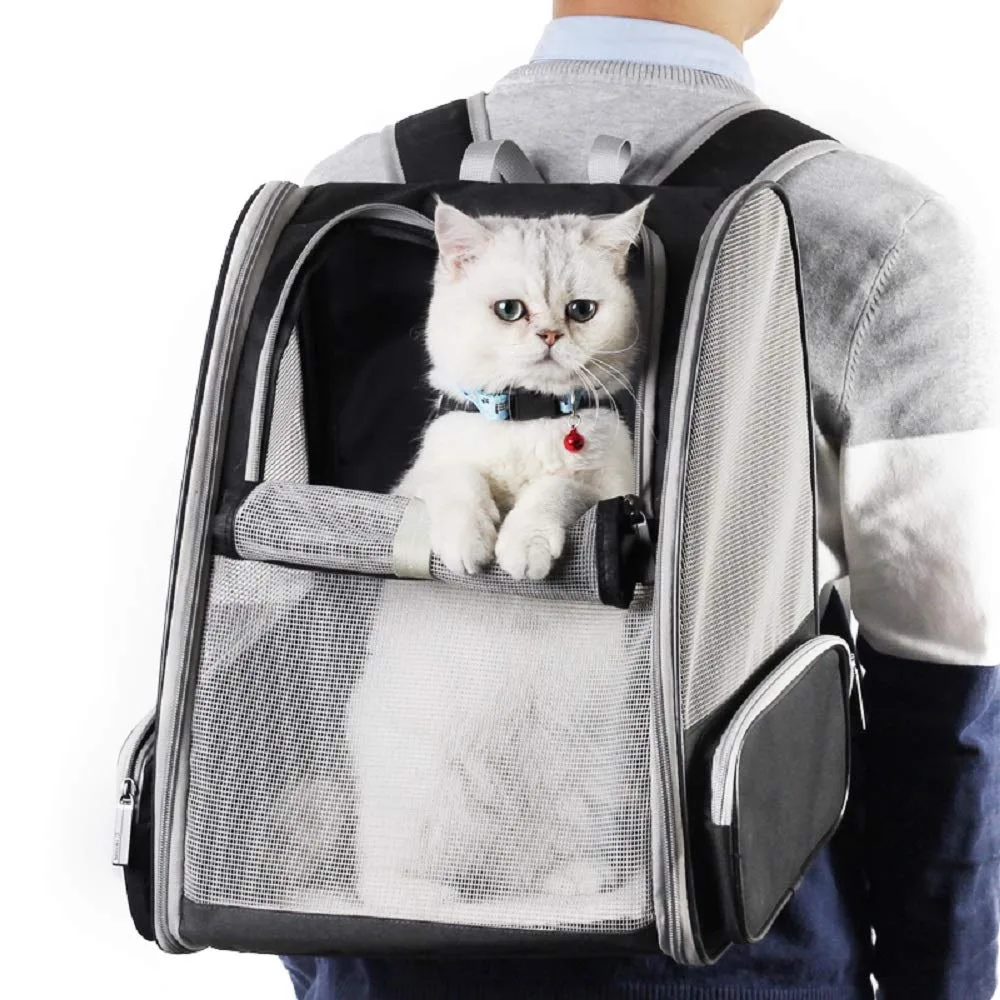
A carrier backpack carries its load along a continuous path: shoulder strap webbing, through a ladderlock or cam buckle, into a strap root that is box-stitched into the back panel, down the panel into the base board, and back up the other side. The path fails at its weakest link, and in every field failure we have analysed the weakest link was the stitch, not the webbing.
Webbing specification is width, material and tensile rating. Polyester webbing resists UV and moisture better than nylon and holds its width under load; nylon has a softer hand and better abrasion but stretches 8-12% at working load, which changes the fit of a carrier over a long walk. For the 8-15 kg band, 32 mm polyester webbing with a minimum breaking strength of 900 daN is the practical floor. Below that you are relying on the fabric shell to carry part of the load, and the shell will creep.
Stitch specification is where Chinese OEM quotes quietly diverge. A strap root should be box-stitched with a bartack at the load corner using bonded nylon 69 or polyester thread at Tex 70 minimum, with 8-10 stitches per inch. Stitch density below 7 spi leaves enough perforation to weaken the shell; above 11 spi you start cutting the yarns. Our production team specifies the stitch type, thread ticket number and SPI in the tech pack rather than leaving it to the line, because "reinforced" is not a testable instruction.
- Buckles: acetal (POM) for 25-32 mm, zinc alloy or aluminium for 38 mm load-path positions
- Zippers: #5 or #8 coil for the main opening, #8 reverse coil with a water-resistant tape for the entry panel
- D-rings and triglides: zinc alloy die-cast, minimum 3 mm wire section, salt-spray tested 24-48 h
- Thread: bonded polyester Tex 70 for structure, Tex 40 for binding and light assembly
Hardware is roughly 8-14% of FOB and it is the second most common silent substitution. Specify brand or equivalent-plus-test-report, and put a salt-spray and a pull-test acceptance line in the inspection protocol.
Ventilation Geometry and Thermal Load
Ventilation is sold as a percentage of mesh area, but the number that actually governs thermal comfort is the convective path. A carrier with 40% mesh split into six small panels can run hotter than one with 25% mesh arranged as two large panels on opposite walls, because cross-flow needs an inlet and an outlet at different pressures. For a pet carrier, aim for inlet low on the front or side wall and outlet high on the opposite wall, with a clear internal air path at least 60 mm wide that is not blocked by the base board or a removable mat.
Mesh selection is a durability problem more than a comfort one. Standard polyester tricot mesh at 60-80 gsm claws out within weeks. Air mesh at 180-260 gsm resists claws and holds shape but restricts flow by roughly 30% at equal open area. The practical compromise is a 210 gsm air mesh in the lower claw zone with a lighter mesh above the claw line, or a single 3D spacer mesh at 250 gsm with a 3 mm loft, which gives both airflow and a cushioning layer.
Thermal load should be estimated, not guessed. A 10 kg dog at rest dissipates roughly 35-45 W; confined in a carrier with limited convection, the internal air temperature can rise 6-11 °C above ambient within 20 minutes in direct sun. That is the reason dark shells and full-sun marketing photography are a liability, and the reason a light-coloured top panel with a reflective coating is an engineering control rather than a styling option. Reference the veterinary guidance on heat risk in confined carriers published by the American Veterinary Medical Association when you write the warning label.
Base Structure: Board, Reinforcement and Insert
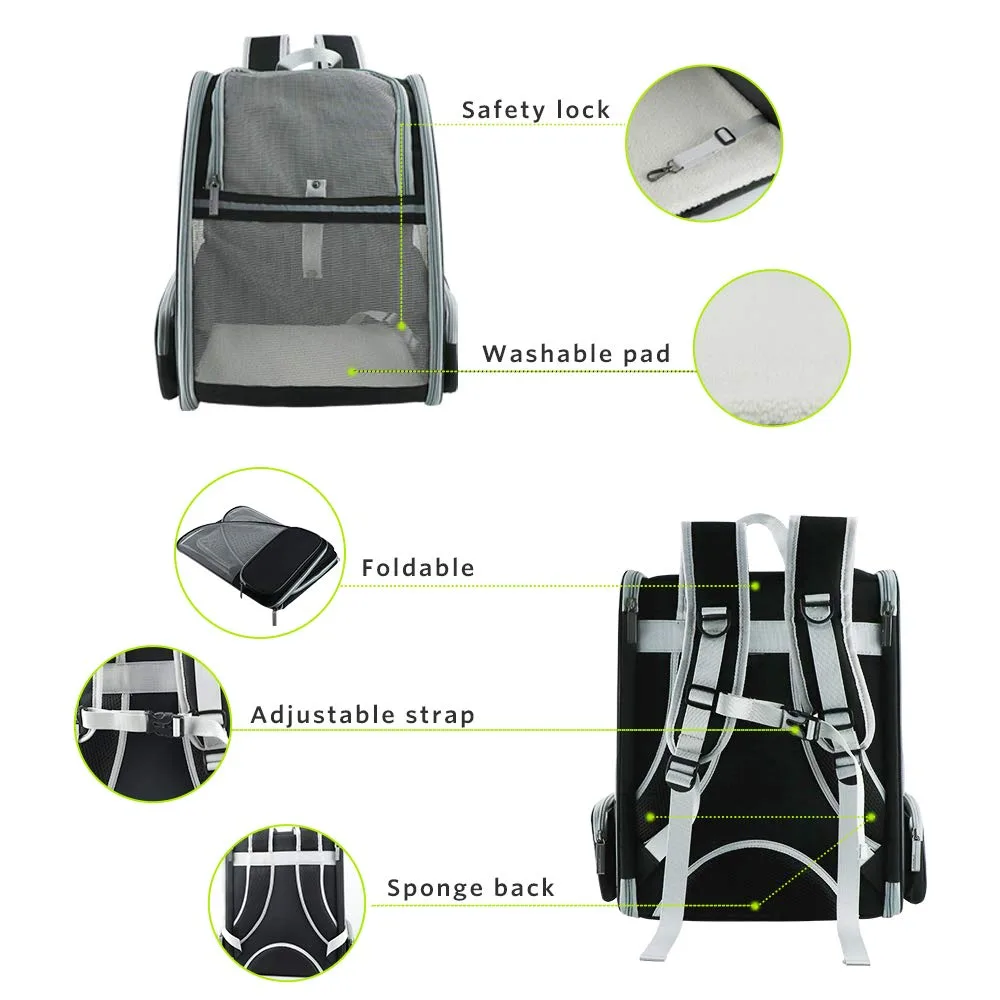
The base is the part of a dog carrier backpack that customers never see and always judge. It carries the pet's full static mass plus dynamic amplification, it is the surface that gets set down on wet ground, and it is the panel that determines whether the carrier keeps its shape on a shelf. Three elements control performance: the board, the reinforcement frame, and the removable insert.
Board material choice runs from 3 mm EVA through 5 mm and 8 mm PE board to 10 mm honeycomb polypropylene. Honeycomb PP at 10 mm with a 600-900 gsm skin gives the best stiffness-to-weight ratio and holds flat under 20 kg point loads, but it costs roughly 2.4x an 8 mm PE board and it needs a sewn channel with a bound edge rather than a simple slip pocket. For the 8-15 kg band, 8 mm PE board with a 25 mm perimeter wire or a folded 600D perimeter frame is the cost-effective answer.
The insert is a washability and hygiene component. Specify a 200-260 gsm quilted pad with a TPU or PU backing so it actually resists liquid, plus a 4 mm foam core that recovers after compression. Inserts that are specified only as "removable cushion" arrive as 150 gsm non-quilted padding that loses 40% of its loft after one wash cycle. Add a compression-recovery requirement to the inspection sheet: 70% thickness recovery after 72 h under 2 kPa.
Perimeter reinforcement is the cheaper half of the base system and the one more often skipped. A folded shell flap with an internal 25 mm webbing band sewn into the base seam converts the perimeter from a hinge into a beam, costs under $0.20 in material, and roughly doubles the load at which the base starts to dish. When the board is upgraded and the perimeter is not, the panel still folds along the seam line, and the brand pays for stiffness it never receives.
Water resistance at the base deserves its own line in the spec. The panel that touches wet ground should be a coated 600D or a TPU-laminated fabric with taped or bound seams rather than a plain lining, and the base board should sit in a sealed channel so a soaked insert does not wick into the board. Where the carrier is marketed for wet climates, our production team specifies high-frequency welded side seams at the lower 120 mm of the shell, which removes the needle perforations that are the usual leak path.
Compliance: Map the Test Protocol to the Destination Market
Compliance is not a certificate you buy at the end; it is a set of design constraints you apply at the start. For the US market, children's product rules do not normally apply to a pet carrier, but the CPSIA lead and phthalate limits are nevertheless requested by most major retailers because the product sits in the same sourcing system, and the practical effect is a restriction on PVC coatings and on low-grade printed inks. Confirm your requirements against the U.S. Consumer Product Safety Commission guidance before you freeze the coating spec.
For the EU, REACH SVHC declarations and, where a Prop 65-style claim matters in California, the OEHHA list drive the same material restrictions from a different direction. Textile contact materials are commonly asked to meet OEKO-TEX Standard 100 class II, which is a testable line item rather than a marketing badge. If the carrier is marketed for car travel, the crash-test protocol published by the Center for Pet Safety is the reference buyers cite, and it has direct design consequences: the tether must anchor to the load path, not to a decorative ring.
Put every requirement in the tech pack as a test method plus an acceptance number. "Lead free" is not a test; "total lead in coatings <90 ppm by CPSC-CH-E1003-09.1" is. The same discipline applies to mechanical tests: specify the standard, the sample size, the conditioning, and the pass number, and agree who pays for re-testing when a lot fails.
Cost Structure: Where the Money Actually Goes
Brands routinely try to cut the two cheapest lines and then wonder why the product feels cheap. Fabric and hardware together are 30-44% of FOB; labour is 18-26%; trim, packaging and labelling is 8-14%; testing, certification and inspection is 3-6%; and the factory margin plus overhead makes up the balance. The lines with the highest perceived-quality impact per dollar are the base board, the shoulder strap foam, the zipper, and the edge binding. Cutting the base board from 10 mm honeycomb to 5 mm PE saves roughly $0.55 and is immediately visible in how the carrier sits on a shelf.
| Cost line | Share of FOB | Cut risk | Visible to customer |
|---|---|---|---|
| Shell fabric + lining | 22-30% | High substitution risk | Medium |
| Hardware (buckles, zips, rings) | 8-14% | High substitution risk | High |
| Base board + reinforcement | 6-10% | Structural risk | High on shelf |
| Strap foam + mesh backing | 5-8% | Comfort risk | High in use |
| Cutting, sewing, assembly labour | 18-26% | Yield and SPI risk | Low |
| Packaging, hangtag, labelling | 6-9% | Low | High at unboxing |
| Testing, audit, inspection | 3-6% | Compliance risk | None until it fails |
Tooling is the other conversation worth having early. A custom moulded buckle set costs $3,500-$9,000 and adds 20-30 days to the critical path, but it is the only hardware that cannot be copied from a catalogue. Custom zipper pulls, custom woven labels and a branded liner print cost a fraction of that and deliver most of the perceived differentiation. Choose the low-cost customisation first; go to moulded hardware only when volume justifies the amortisation.
Schedule: From Tech Pack to Container
The timeline is stable and it is longer than most brand calendars assume. Day 0 is tech pack sign-off. Sampling takes 6-10 working days for a first prototype including pattern making, cutting and assembly; a second revision adds 5-7 working days, and a third adds another 5. Most programmes land on sample approval between calendar day 25 and day 40, which is entirely a function of how many revisions the brand requests, not of how fast the line runs.
Once the sample is approved, bulk production takes 35-50 days. The range is driven by material lead time, not by sewing capacity. Stock 600D in a common colourway is available in 5-8 days; a custom dyed lot or a printed shell needs 18-25 days for lab dips, bulk dyeing and inspection. Custom hardware is 20-30 days. The single most effective thing a brand can do to shorten the schedule is to approve lab dips and artwork in the first week rather than the fourth.
- Days 0-3: tech pack sign-off, BOM freeze, lab dip request
- Days 4-14: first prototype built, internal fit and load test
- Days 15-35: revisions, revised sample, wearer trial, gold seal
- Days 36-50: material booking, custom hardware, printed trim
- Days 51-95: bulk cutting, sewing, welding, assembly, inline QC
- Days 96-103: AQL 2.5 final random inspection, packing, container loading
Book freight against the inspection date, not against a promise. A carrier backpack ships at roughly 4-6 kg per master carton of 8-12 units, so volumetric weight governs cost far more than actual weight, and compressing the pack flat in the carton is worth 12-18% of the freight bill.
Supplier Qualification Checklist
Qualification is a document exercise before it is a visit. Ask for the audit certificate with its registration number and validity date, the ISO 9001 certificate scope wording, and a recent third-party test report on a comparable product. Then ask the questions that actually separate a capable partner production line from a trading desk: what is your line capacity per month for this product class, what is your retained-sample process, and how do you handle a failed AQL lot.
Our production team works inside an SGS-verified production base of 4,950 m2 with 7 partner production lines, 149 machines and 137 people, audited to BSCI and ISO 9001, shipping 200,000 units per month. Those numbers matter less as a marketing claim and more as a constraint you can plan against: it means a 5,000-unit programme is roughly 5% of a month's capacity and will not be crowded out by a larger order.
Close the loop with a written quality agreement. It should name the AQL level (2.5 for major, 4.0 for minor, zero tolerance for critical), the defect classification list, the re-inspection cost allocation, and the retained counter-sample that both parties sign. A supplier who will not sign a defect list will not honour one later.
Production capability
- SGS-verified production space of 4,950 m², 149 machines, 7 assembly lines
- Pet carrier and pet bag output since 2014 from a 137-person team
- 200,000 units shipped monthly under BSCI and ISO 9001 systems
People Also Ask
What is a good MOQ for a custom dog carrier backpack?
500 pieces per colourway is the standard floor for a custom build, because it is the point where fabric dye-lot minimums, custom woven labels and hardware orders all become economical. Below 500 the per-unit cost typically rises 18-35% without any change in quality.
How long does it take to make a dog carrier backpack sample?
Six to ten working days from tech pack sign-off for a first prototype, covering pattern making, cutting, assembly and an internal load check. A second revision adds five to seven working days.
Which fabric is best for a dog carrier backpack?
600D polyester with a 0.30 mm PU coating at 210-240 gsm is the best balance of tear strength, abrasion and weight for most programmes. Move to 900D when the rated pet mass exceeds 15 kg.
How much weight should a dog carrier backpack hold?
Specify a rated band rather than a single figure, and design the structure to four times the top of that band. A carrier rated 8-15 kg should have a base board and load path tested to 60 kg static.
Do dog carrier backpacks need certification?
No certificate is legally mandatory for a pet carrier in most markets, but REACH SVHC declarations, CPSIA lead and phthalate testing, and OEKO-TEX Standard 100 class II for contact textiles are routinely required by retailers.
What is AQL 2.5 in bag inspection?
AQL 2.5 is the acceptable quality limit for major defects in a final random inspection: on a 5,000-unit lot it permits 21 major defects before the lot is rejected, with zero tolerance for critical defects such as broken load-path stitching.
Frequently Asked Questions
How do I choose between a soft carrier and a framed carrier?
Soft carriers fold, pack flat and cost less, but they rely entirely on the base board and perimeter reinforcement for shape, so they are limited to roughly the 3-12 kg band. A framed or semi-rigid carrier adds a perimeter wire or moulded frame, holds shape on a shelf, and supports 15-25 kg, at roughly 30-45% higher FOB and about 20% more freight volume because it does not compress.
Should the shoulder straps be padded or unpadded?
Padded, with an 8-10 mm EVA or PU foam core at 45-60 kg/m3 density and a breathable air-mesh backing. Unpadded 38 mm webbing is acceptable only for the 3-8 kg band where the total load stays under about 14 kg including the bag.
What zipper size should a dog carrier backpack use?
Use a #8 coil zipper for the main pet entry and a #5 for accessory pockets. The entry zipper is the part customers operate one-handed while holding a dog, so specify a branded slider with a moulded pull and test it to 5,000 open-close cycles.
How do I stop the base from sagging?
Specify 8 mm PE board or 10 mm honeycomb polypropylene, a perimeter reinforcement frame, and a base panel cut on the straight grain rather than the bias. Require a flatness check in the inspection: no more than 6 mm deflection under a 20 kg centrally placed load for 24 hours.
Can I use recycled polyester in the shell?
Yes. rPET at 600D made from post-consumer bottle flake is widely available at 210-250 gsm, with tear and abrasion within 5-10% of virgin polyester. Confirm the GRS transaction certificate is in the supplier's name so your brand can make the claim on-pack.
What is the typical defect rate I should plan for?
Under a disciplined AQL 2.5 regime with inline QC at cutting and at assembly, expect first-pass yield of 96-98.5%, with the residual concentrated in stitch defects at curved seams and print registration on panels.
How much does packaging add to the unit cost?
Retail packaging runs $0.60-$2.40 per unit depending on whether you use a printed polybag, a header card, or a full-colour box. A printed box adds roughly 12% to carton volume and is the highest-impact change you can make to shelf perception.
Do I need a crash test for a pet carrier?
Only if you market it for vehicle restraint. If you do, the anchor point must be load-path webbing with a minimum 900 daN rating, and the tether must be tested as an assembly rather than as a component.
How do I control colour consistency across production runs?
Approve a lab dip against a physical standard under D65 lighting, keep a signed bulk swatch, and require a Delta E of 1.5 or less against the approved standard for every subsequent lot. Store the standard in the dark; dyed standards fade.
What should a tech pack for a carrier backpack contain?
A full dimensioned drawing with tolerances, a bill of materials with mill and lot references, a stitch specification including thread ticket and SPI, a hardware list with test reports, artwork files with Pantone references, a packing specification, and the test protocol with acceptance numbers.
Is FOB Xiamen the only shipping option?
FOB Xiamen is the standard term, but DDP and DAP can be arranged through a nominated forwarder. Under DDP the supplier carries duty and clearance risk, which typically adds 8-15% to the landed figure in exchange for a fixed door cost.
How do I protect my tooling and design?
Register the design where you sell it, put an NNN agreement in place before sharing a tech pack, and keep mould ownership explicitly in your name in the manufacturing agreement. Custom moulds should be physically marked with your reference number.
Talk to QUANZHOU JUNYUAN BAGS about a pet carrier program: MOQ 500 pieces per colourway, samples in 6-10 working days, bulk production in 35-50 days under AQL 2.5 inspection.
Get a free quote Request a sample