Cat Carrier Dog Walker: Dual Pet Use
2 independently secured compartments are the minimum for a dog walker transporting a cat and a small dog in one professional carrier. Specify a rigid breathable partition, a 12 kg combined working load, separate doors, low-sway hands-free carry, snag-controlled exteriors, and species-specific cleaning records. Never attach a live dog's leash to the carrier or treat a fabric curtain as separation.
A dog-walking business that adds feline visits faces a distinctive control problem: one hand may manage a lead while the other operates doors, checks gates, and stabilizes a carrier. Product engineering must begin with that simultaneous workload, not with a generic “two pets” claim. The recommended system uses two independent cells around a structural centre partition, offset shoulder anchors, a quick-stow stabilizer, protected mesh, non-snag outer faces, and vehicle-belt tunnels connected to the base cradle. A single-cell insert remains available for ordinary cat transport, but the dual configuration receives lower per-cell limits and separate validation. Procurement begins at MOQ 500 pieces per colourway. Working samples are prepared in 6-10 working days for pavement, stair, doorway, and vehicle trials. Following approval of the complete configuration and instruction labels, schedule bulk production 35-50 days. Final workmanship inspection is performed to AQL 2.5, while divider collapse, unsafe closure, open load seams, and sharp interior parts are handled as critical project defects. The deliverable is a professional transport tool with explicit boundaries, not a consumer accessory that implies any two animals can share space.
A custom pet carrier brief for cat carrier is quoted against three variables before the sample is cut: fabric weight, hardware grade and print method.
Define the simultaneous dog-walking operating envelope
The first design input is not pet count; it is the handler's sequence. Document whether the walker collects a crated cat while another client's small dog is already leashed, whether stairs or communal gates are involved, how long the combined segment lasts, and which vehicles are used. Count every point where a lead changes hands or a door must be held. If the carrier forces the handler to place a dog lead around a wrist while adjusting a slipping strap, it has failed before material selection begins.
Separate normal and exceptional missions. Normal cat transfers may use one full compartment with supplies stored outside. Approved combined transfers should be short, preplanned, and limited to animals whose behaviour and health status the business has assessed. Unknown dogs, distressed cats, incompatible animals, or any case requiring close monitoring needs separate handlers or separate journeys. Product labels cannot replace this operating policy, but they can make its limits visible at the moment of use.
Set the duty cycle from bookings: perhaps 400 combined route segments, 2,000 loaded lifts, 1,000 pavement set-downs, and 150 cleaning cycles over the commercial service target. Add an exterior snag exposure because leads, gates, branches, and coat hooks contact the bag. Observe the carrier in the actual walking position and measure clearance from the handler's dog-side leg, lead hand, and gate hardware. The bag should not occupy the same space where a dog moves during a turn.
Prototype trials should script collection, independent loading, gate exit, a ten-minute walk, stair ascent, vehicle securement, unloading in reverse order, and cleaning. Use inert moving loads before any controlled animal trial. Record hand availability, carrier angle, strap adjustment, leash contact, door exposure, and time spent stationary. A dual-use carrier is justified only when it reduces simultaneous handling conflicts without asking one person to manage incompatible animals or unsafe route complexity.
Make the centre partition a structural component
A hanging textile divider is unsuitable between species because it deforms, transfers movement, and can permit contact under the lower edge. Use a removable semi-rigid partition with a 3 mm fluted polypropylene core, padded perimeter, independent mesh windows above nose height, and six positive anchor points. The lower edge keys into the floor cassette so neither occupant can push beneath it. Covered attachment flaps protect the interior when the carrier is converted to single-cell mode.
A proposed outer envelope of 52 x 33 x 35 cm should be validated against the business's actual small-animal population. In dual mode, set a 12 kg combined working load and a maximum of 7 kg in either cell; these numbers are examples requiring full-product verification. Volume, posture, ventilation, temperament, and route duration may impose stricter limits than mass. Each bay needs its own end door, closure clip, and visual check panel. Opening one cell must not loosen or expose the other.
Build the floor as a retained cassette with two 4.5 mm boards separated by a stiff central spine. Continuous webbing runs beneath both boards and rises to the handle and shoulder anchors. Under a one-sided 7 kg load, specify a maximum base roll angle on a level fixture and a centre deflection limit after thirty minutes. The partition should remain within 15 mm of its neutral plane under a defined lateral test load. These geometric criteria make “rigid” measurable.
Single-cell conversion requires more than removing the panel. Cover the centre groove, protect every anchor, and ensure the floor does not hinge undesirably at the former separation line. Mark all divider parts with orientation and revision codes. Safe dual-pet separation depends on a keyed floor, restrained partition, independent access, and asymmetrical-load stability tested as one structural system.
Ventilation must be evaluated by cell rather than as a percentage of the total outer wall. Calculate unobstructed mesh area for each bay after the divider, pocket contents, belt route, and handler's body are in place. A high mesh total can still leave the inner sides of both cells poorly served. Use smoke visualization or low-velocity airflow mapping on an empty instrumented prototype to identify stagnant regions, then confirm surface temperatures with safe simulated heat sources. These engineering observations support layout decisions but do not replace the handler's direct monitoring of each animal during transport.
Engineer hands-free control without creating leash hazards
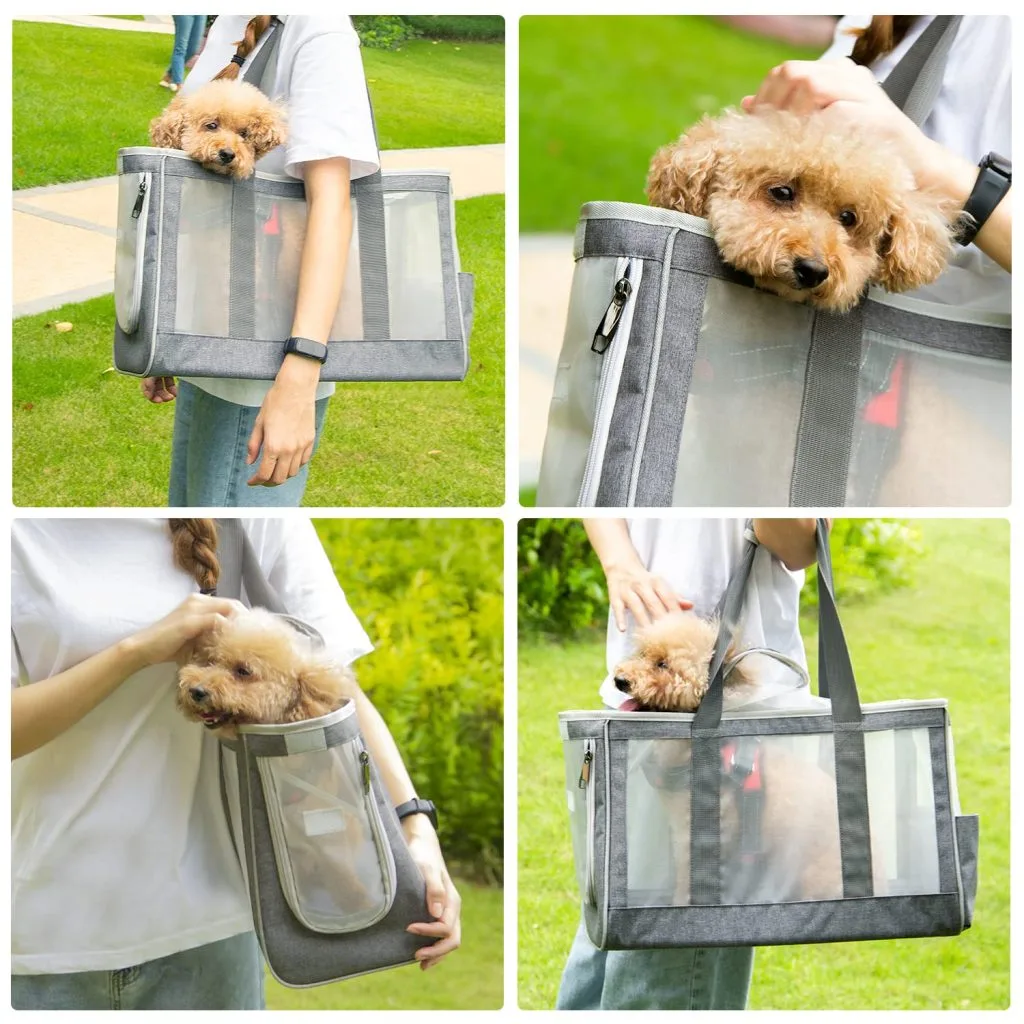
The carrier should sit on the side opposite the handler's principal lead hand and resist pendulum movement. Use diagonal upper anchors feeding into an under-base cradle, a contoured 60 mm shoulder pad, and a short waist stabilizer that stores in a closed pocket. The stabilizer is not a dog tether. Print “NO LEASH ATTACHMENT” beside any ring that could be misinterpreted, and avoid exposed D-rings altogether unless they serve an essential carrier function. A dog pulling against a bag can destabilize both contained animals and the handler.
Control loose tails. Webbing adjusters should have elastic keepers; zipper pulls should be short, soft, and parked in covered garages; mesh should be recessed behind 25 mm fabric rails. Exterior pockets need reverse-coil or shielded zippers rather than loops that can catch a lead clip. The bag's lower corners should be rounded but not so soft that they collapse into the handler's leg. Add two replaceable low-profile feet to keep the coated base off damp pavement without creating trip or snag points.
Human-factor trials need left- and right-handed participants within the declared adjustment range. Each person completes a figure-eight walk, gate passage, curb step, stair sequence, and controlled stop while holding a neutral test lead in the designated hand. Instrument the carrier to record peak roll angle and strap migration. Observe whether participants touch the animal doors while seeking balance. If users repeatedly grab mesh or a zipper pull, add a dedicated exterior stabilization handle on the solid upper rail.
Emergency release should be possible without dropping the carrier. Test the shoulder strap's quick adjustment and stabilizer release while the loaded unit is supported. Hardware must not release accidentally under rubbing or lead contact. Hands-free design is successful when the carrier remains close and level while every loose component stays outside the dog's lead path.
A small exterior lead-management pocket may hold a spare lead only when it is completely closed and structurally separate from animal doors. Define the maximum coil diameter and clip position so a metal hook cannot swing against the carrier or be mistaken for a restraint attachment. During the gate exercise, require the user to retrieve and restow the spare while the carrier stays supported and all animal exits remain closed. If the task consistently takes both hands, move spare-lead handling to the walker's normal belt system rather than adding more carrier hardware.
Control cross-species soil and odour between routes
Dog-walking equipment encounters mud, pavement water, saliva, treats, and outdoor debris; cat transport adds urine, litter, fur, and stress-related contamination. Specify a 900D polyester lower shell with a qualified TPU laminate, a 600D low-lustre upper shell, and a smooth 300D coated lining. The centre partition should be fully removable so its perimeter groove can be wiped. Use closed-cell padding in floor sleeves and shoulder components to reduce retained moisture.
Cleaning instructions need separate steps for routine outdoor soil and animal contamination. Dry brush external grit before wiping, because abrasive particles can damage coatings when rubbed. Remove floor and partition modules, clean each face with the approved chemistry and contact time, wipe high-touch handles and zipper garages, then dry parts separately. A green/amber status tab can indicate READY or PROCESSING, but staff must not flip it until all components are dry and reassembled.
Validate the full material stack with 150 primary disinfectant cycles, 50 detergent soil-removal cycles, and a synthetic mud challenge on the base. Measure colour change, coating adhesion, seam wicking, odour after drying, print legibility, and reassembly time. Challenge each compartment independently with a measured dyed solution to check migration around the central spine. The product should not claim isolation of pathogens; the engineering objective is accessible surfaces and a reproducible cleaning workflow.
Animal welfare guidance should inform operating procedures as well as product limits. Buyers can review resources from the American Veterinary Medical Association and align their transport protocol with veterinary advice. A cross-species carrier remains serviceable only when dirt entry, compartment cleaning, drying, and ready-state control are designed into the daily route.
Drying validation should use defined conditions rather than a casual overnight assumption. Weigh the disassembled modules before cleaning, after wiping, and at timed intervals in the business's expected drying room. Inspect the divider perimeter and central floor groove, because concealed moisture there can survive after broad panels feel dry. Establish a release threshold and maximum target time, then provide a rack orientation that exposes all surfaces without distorting the stays. If the workflow cannot achieve the target between bookings, the correct response is more rotating inventory or a material revision, not shortening the disinfectant contact period.
Add vehicle securement without overstating crash performance
Combined routes often transition from pavement to a vehicle. Provide two horizontal belt tunnels stitched through reinforcement connected to the base cradle, plus a defined lower orientation surface that sits flat on a seat. Do not route a belt over an animal door or through carry handles. The tunnels should be visually obvious from either side, wide enough for common three-point belt hardware, and free from stored straps. The partition must remain vertical when the seat cushion slopes.
Test fit in a small hatchback, sedan, and commercial van or the business's actual fleet. With inert shifting loads in both cells, tighten the belt, apply a controlled deceleration input on a suitable rig, and record carrier translation, roll, buckle interference, and mesh obstruction. Repeat with only one cell loaded because asymmetry is the more difficult condition. A securement feature may reduce routine movement, but it is not a crash rating. Independent pet travel research from the Center for Pet Safety can help purchasers understand that distinction.
| Field mode | Primary hazard | Design control | Acceptance evidence |
|---|---|---|---|
| Walking, one cell loaded | Carrier roll | Diagonal anchors and stabilizer | Measured figure-eight angle |
| Walking with dog lead | Snag or tether confusion | Covered pulls, no exposed rings | Lead sweep inspection |
| Rear seat, both cells loaded | Translation under braking | Reinforced belt tunnels | Controlled deceleration trial |
| Van staging | Wrong orientation | End labels and flat base | Timed setup observation |
| Single-cell conversion | Hidden anchor exposure | Covered divider fittings | Interior hand and light check |
Vehicle instructions should show routing with diagrams on a durable external label, while the business trains staff on climate and supervision. Vehicle readiness means repeatable placement and reinforced routine securement, never an implied collision claim unsupported by a defined dynamic test.
When several carriers enter a van, do not stack occupied units or rely on adjacent bags to prevent movement. Define one floor or seat position per carrier, minimum clearance around mesh, and a route for the approved vehicle restraint that does not cross another unit. An empty-unit nesting test can be useful for return logistics, but it is separate from live transport. Mark orientation on both ends so a driver can verify doors and compartment labels before departure. A staged four-unit loading drill should measure setup time, belt access, ventilation clearance, and whether any door becomes inaccessible during an emergency unload.
Use visibility and branding that fit street operations
A dog-walking brand needs to be recognized at a client's building yet remain calm around animals and passers-by. Choose a matte charcoal, deep olive, or muted blue body with two high-visibility piping segments at the end corners. Continuous reflective borders can flare in flash photography and become visually dominant. Test retroreflective trim only where it improves the carrier's boundary recognition in low light, and keep it away from mesh edges where repeated flex may cause delamination.
Place a 100 x 55 mm removable logo patch on the solid face above the centre of mass. In dual mode, use clear CAT and SMALL DOG bay icons on their respective end doors, but make them replaceable if the business uses both bays for approved same-species transport. Safety and load information belongs on permanent labels. The brand patch can use woven construction or a low-gloss transfer; evaluate edge peel after cleaning and after 500 panel flexes.
Surface gloss affects both field appearance and incident documentation. A very shiny coated shell creates hotspots under phone flash, hiding seam condition. Set a visual matte standard with approved swatches and photograph prototypes under daylight, fluorescent lobby light, and direct phone flash. Confirm that compartment identifiers, asset code, and damage areas remain readable. Keep dark-on-dark decorative stitching away from critical seams so supervisors can still inspect structure.
Brand placement must remain visible when the shoulder strap, stabilizer, vehicle belt, and handler's forearm are in their normal positions. Use four-view photography with the carrier loaded and unloaded to approve placement. Street-ready branding combines restrained identity, selective visibility, and inspection-friendly surfaces without introducing reflective glare or leash-catching decoration.
Artwork control should include an actual decorated strike-off, not only a screen proof. Measure logo position from stable seam references, check colour under daylight and common street lighting, and flex the panel before cleaning tests. If the patch is removable, its hook or attachment field must have rounded covered corners and remain smooth when the patch is absent. Approve an unbranded service patch as well, enabling staff to cover a retired campaign without exposing rough fastener material. These details protect both presentation and functional safety across changing franchise or sponsorship arrangements.
Manufacture the dual system with controlled interfaces
The central spine, divider anchors, two door frames, under-base cradle, and shoulder geometry create more critical interfaces than a single-cell carrier. Assign measurable tolerances to board pocket width, spine position, anchor coordinates, end-opening diagonal, belt-tunnel spacing, and webbing overlap. Cutting markers should preserve grain and mesh direction. Number divider components by size and revision to prevent assembly with a similar-looking part from another model.
Inspect the continuous webbing cradle before the floor cassette and lining conceal it. Use a fixture to locate diagonal shoulder anchors and a second gauge to verify centre-spine perpendicularity. The divider attachment must be sewn through reinforcement without piercing the board sleeve or obstructing removal. On the doors, manage zipper tape around corners so the twin sliders meet without gaps or excess force. Each garage receives a pull-retention check and visual confirmation that no raw edge faces inward.
Line controls should include first-off approval after an operator, material roll, needle, or machine-setting change. Record stitch density on the TPU laminate; excessive perforation can reduce seam resistance, while low density permits extension. Conduct inline seam pulls on representative coupons from each major roll. Use needle-fragment control and illuminated interior inspection because the dual cells create more enclosed edges than a conventional bag.
The SGS-verified production base should retain the golden sample, material codes, approved divider board, colour standards, artwork, and process test records. Final erected inspection checks symmetry under one-sided ballast, not only flat appearance. A carton-level assembly audit should also confirm that each divider, centre cover, floor cassette, and strap revision belongs to the same shell revision before the set is folded. Manufacturing repeatability in a dual carrier depends on controlling the centreline and hidden cradle before cosmetic panels make structural errors difficult to see.
Verify asymmetric loads, snags, cleaning, and field life
Qualification starts with a 18 kg one-hour static proof load, 1.5 times the proposed 12 kg combined working load, distributed through both cells. Follow with 2,000 handle lifts at combined load and 800 shoulder-route cycles that include a 10-degree side oscillation. Repeat a 1,000-cycle sequence with 7 kg in one bay and the opposite bay empty. Measure anchor movement, floor roll, central-spine shift, hardware function, and closure alignment after every interval.
Apply a 180 N lateral load to the divider at three heights for the agreed duration, then inspect core set, anchor extension, and lower-edge escape. Cycle divider installation 300 times and single-cell covers 500 times. Each door completes 3,000 open-close cycles, including 500 after chemical exposure. Run a flexible lead with representative clips over every exterior surface for 1,000 sweep cycles; any trapped clip, opened pull garage, or torn trim requires redesign.
Test the base with synthetic mud abrasion, wet pavement set-downs, and 1,000 low-energy drops from 100 mm. Conduct 150 complete cleaning cycles, measuring coating peel, seam migration, drying, odour, and status-label legibility. Belt tunnels receive a static pull through the sewn structure and a repeated vehicle-placement cycle. Relevant standardized test methods can be sourced through ASTM International, with the chosen fixture and deviations documented in the project plan.
At final inspection, AQL 2.5 covers agreed major workmanship characteristics. Treat divider detachment, open cradle seams, insecure doors, sharp parts, wrong load labels, and a belt tunnel not connected to reinforcement as critical dispositions. Verify pack sets because a missing centre cover makes single-cell conversion unsafe. A dual-pet product is production-ready only after one-sided and combined loads, divider force, leash sweeps, contamination, and securement are tested on the same final construction.
Order and quality terms
- MOQ 500 pieces per colourway; samples in 6-10 working days
- Bulk production 35-50 days after approval; AQL 2.5 inspection standard
- T/T 30/70 terms, FOB Xiamen, full document set per shipment
People Also Ask
What is a dual-pet carrier for dog walkers?
It is a professional transport carrier with independent cells, controlled combined and individual loads, leash-safe exterior geometry, and hands-free stability.
How should cats and dogs be separated in one carrier?
Use a semi-rigid keyed partition with covered positive anchors, separate floor support, independent doors, and ventilation for each bay; a loose curtain is inadequate.
How is a dual carrier cleaned between species?
Remove the divider and floor modules, clean every face and groove with approved chemistry, dry separately, reassemble, inspect, and only then mark the unit READY.
What makes a carrier leash safe?
It should avoid exposed rings, retain webbing tails, recess mesh, cover zipper pulls, and pass a representative lead-and-clip sweep test.
Can a dual carrier be secured in a car?
Reinforced belt tunnels can control routine movement when properly routed and fit tested, but they do not establish crash protection.
What production tests are important for the divider?
Measure lateral resistance at several heights, anchor extension, lower-edge retention, installation cycles, and performance after cleaning and one-sided load tests.
Where should a dog-walking logo appear?
Use a compact removable patch on an upper solid panel that stays visible around straps but does not block ventilation or create reflective glare.
Frequently Asked Questions
Can a dog walker carry any cat and dog together?
No. Combined transport requires compatible, pre-assessed animals, a short controlled route, and independent cells. Unknown, distressed, ill, or incompatible animals need separate handling.
May a dog leash clip to the carrier?
No. Carrier fittings and straps are not dog tether points. Avoid exposed rings and label any potentially confusing hardware clearly.
What is the working load in dual mode?
This example proposes 12 kg combined with no more than 7 kg in one cell, subject to full-product testing and animal-space requirements.
Can the divider be folded away inside?
It should be removed rather than left loose inside. Covered anchor flaps and a centre-groove cover create the qualified single-cell configuration.
How are the two doors distinguished?
Use replaceable bay icons and different pull details while keeping permanent closure and load instructions visible at both ends.
Does reflective trim affect photography?
Large reflective areas can flare under flash. Limit trim to selected boundary segments and approve the appearance under representative phone-camera lighting.
Can supplies share an empty compartment?
Only if the operating protocol permits it and supplies remain secured away from an animal. External zones are preferred because they preserve a clean conversion path.
How is one-sided stability measured?
Load one bay to its individual limit on a level fixture and during route cycles, then measure base roll, partition position, anchor movement, and strap migration.
Is the carrier crash tested?
Not unless the complete configuration has passed a declared dynamic protocol. Reinforced belt tunnels alone support routine securement, not a collision claim.
What components need replacement codes?
Divider, centre cover, dual-board floor cassette, shoulder strap, stabilizer, status tabs, and bay labels should all use controlled size and revision codes.
What payment terms are typical?
Programs are normally quoted on T/T 30/70 and FOB Xiamen terms unless a written offer states different commercial conditions.
How should returned units be stored?
Clean, dry, fully inspect, and reassemble each unit before setting it to READY. Store it without crushing the centre spine or blocking its status label.
Talk to QUANZHOU JUNYUAN BAGS about a pet carrier program: MOQ 500 pieces per colourway, samples in 6-10 working days, bulk production in 35-50 days under AQL 2.5 inspection.
Get a free quote Request a sample