Cat Carrier Pet Trainer: Training Sessions
10 graded opening positions turn a cat carrier into controlled professional training equipment. Add quiet zipper pulls, independently retained visual covers, an 8 kg working load, a removable treat-resistant floor, and camera-readable cue points. Group classes still require one identified carrier per cat; controlled exposure must never weaken closure security, ventilation, or the animal's ability to remain safely contained.
Trainers use a carrier as both transport equipment and a structured environment for stationing, voluntary entry, door movement, handling preparation, and recovery. That requires different engineering from a bag opened only at journey endpoints. The specification should translate training steps into multiple secure door positions, low-noise hardware, tactile cue patches, removable visual panels, accessible reward storage outside the chamber, and surfaces that release food oils and disinfectant. Class operation adds strict identity, spacing, and visual-barrier controls; simultaneous cats remain in independent carriers or, for a pre-assessed household pair during transport only, in a fully divided model with separate exits. Programs begin at MOQ 500 pieces per colourway. Samples can be made in 6-10 working days for session observation, acoustic checks, cleaning trials, and recording tests. After cue layout, safety labels, construction, and test criteria are approved, allow bulk production 35-50 days. Final random inspection uses AQL 2.5 for major workmanship characteristics, with unsafe exits, sharp parts, failed load seams, or an incorrect working-load instruction under stricter disposition. The resulting carrier supports repeatable training plans without making behavioural claims that belong to qualified professionals.
Working as a pet carrier manufacturer on cat carrier ranges means the technical file is shared before any quotation: pattern, bill of materials, test report and packing specification.
Break the training session into product interactions
A trainer may begin with the carrier stationary and fully open, reward orientation toward it, reinforce entry, move a door a few centimetres, close for one second, lift briefly, and later add vehicle context. List every interaction in sequence: where the trainer's hands go, which opening moves, where rewards are delivered, what the camera must see, and how the carrier returns to a secure transport state. This task analysis exposes the need for stable door parking and clear state cues.
Define two modes that cannot be confused. TRAINING mode permits only the opening positions authorized by the session plan while the carrier remains stationary under direct supervision. TRANSPORT mode requires every door fully closed, sliders parked, clips engaged, floor installed, and loose covers secured. A two-sided mode tab can support the procedure, but it must not replace the trainer's physical check. The tab should remain outside the animal area and differ in both word and shape.
Set a service-life profile such as 1,500 sessions, 10,000 partial door movements, 3,000 complete closure cycles, 1,000 brief lifts, and 250 sanitation cycles. Partial movements matter because trainers may work repeatedly within a small zipper arc that wears tape and sliders unevenly. Add 5,000 flap operations and repeated reward-oil cleaning. These cycles should be distributed across multiple samples to reveal variation rather than concentrated on one ideal prototype.
Video at least three pilot sessions from the trainer's normal camera position and code every interruption caused by the product: door falls, pull clicks, base shifts, reward pouch blocks, flap detaches, or cue mark disappears. A training carrier is correctly specified when every physical feature maps to an intentional session step and returns unmistakably to secure transport mode.
The carrier should not automate progression or imply a guaranteed behavioural outcome. The trainer controls duration, distance, criteria, and when to stop based on the individual animal and professional protocol. Product markings can standardize hardware positions, but they cannot standardize emotional state. Include this boundary in staff training so purchasing metrics such as faster sessions do not pressure trainers to skip observation or advance opening steps prematurely.
Create stable, quiet, and measurable door positions
A full end door can include ten small exterior index marks along the zipper path, allowing trainers to record repeatable opening positions without adding ten mechanical stops. Use a parking strap to hold the rolled door fully open and a separate soft limiter for selected stationary-training positions. The limiter must be removed or stowed before transport so it cannot interfere with full slider closure. No training attachment should create a loop inside the chamber.
Select a matched reverse-coil zipper and sliders with smooth low-force operation, then cover pull bodies with short textile sleeves to reduce contact noise. Sound is tested at a fixed microphone distance and operating speed in a controlled room, comparing new and aged samples. Do not promise silence; set a project limit relative to the approved golden sample and identify any sharp impulse caused by pulls striking clips or frames.
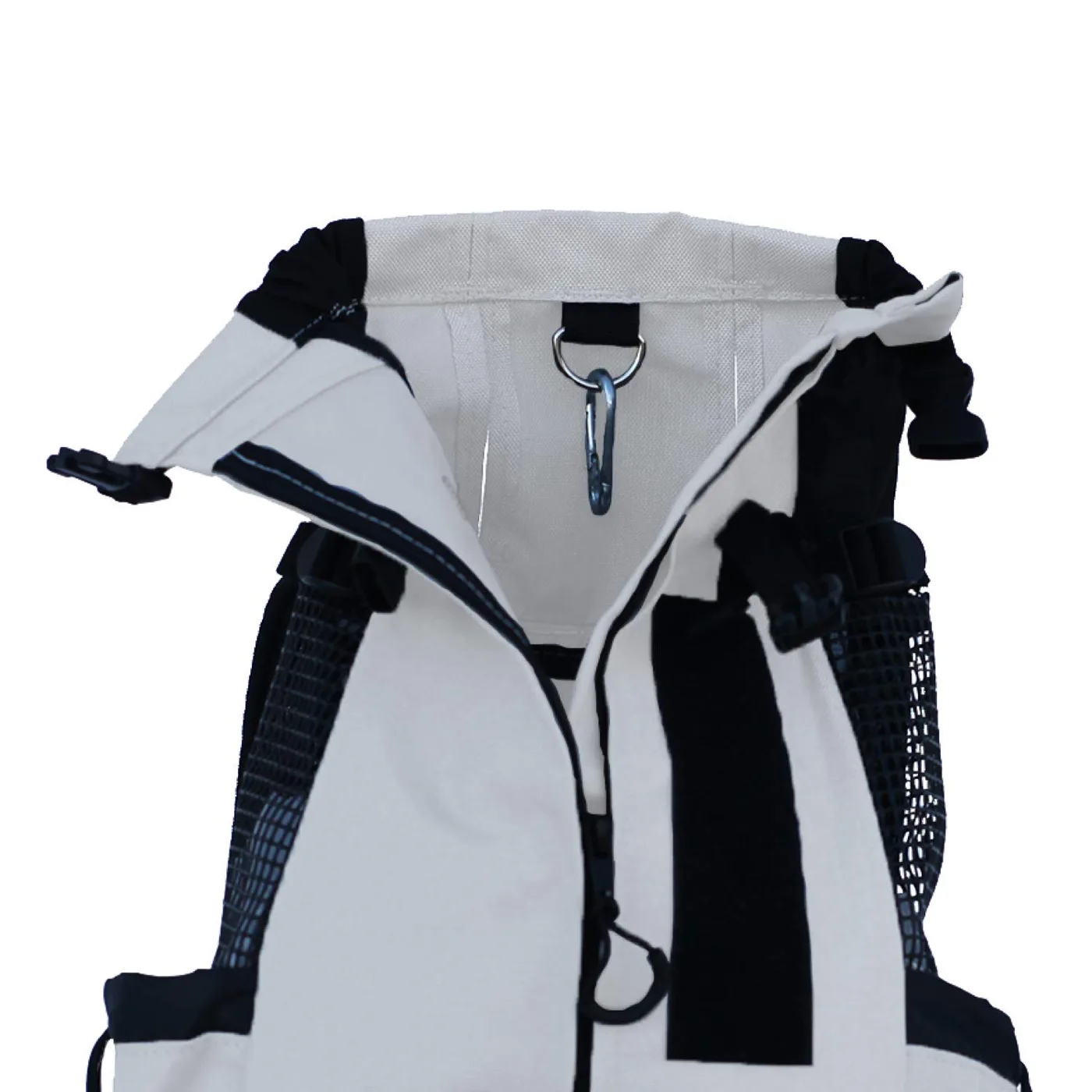
The top service hatch can support brief handling preparation, but it needs its own index marks and secure garage. Its frame should not collapse when partly open. A trainer must be able to move the hatch with one hand while the other remains outside or follows the professional handling plan. Door edges receive smooth binding, and no stiffener end may become exposed after repeated flexing.
Run 10,000 partial movements across the most-used 150 mm arc, plus 3,000 complete cycles. Introduce synthetic fur and reward crumbs at scheduled intervals, clean as instructed, and measure operating force. Apply outward pressure at each authorized stationary position and at the fully closed garage. Graded access is safe only when positions are repeatable for supervised training and the final transport closure remains mechanically independent and unmistakable.
Human-factor trials should include gloved and ungloved trainers, left- and right-hand operation, and low-light room conditions. Record missed index positions, accidental contact with clips, and time to convert from a partial opening to transport closure. If users must look away from the cat for too long, improve tactile distinction and route visibility. The design goal is predictable handling, not maximum adjustment complexity.
Build a stable station with removable cue surfaces
A training station should not rock, sag, or slide when the cat approaches. Use a 4.5 mm polypropylene board in a retained sleeve, a thin closed-cell layer, and a low-lint washable cover. Four low-profile thermoplastic feet or anti-slip base strips can improve floor stability if they remain smooth and replaceable. The 45 x 30 x 32 cm starting envelope and 8 kg working load must be validated against the trainer's client population and transport requirements.
Add two removable cue patches on solid exterior panels: one near the end entry and one near the settled position. These are visual and tactile targets for the trainer, not labels for the cat. Use matte, nonreflective colours with measurable contrast from the shell. Patches must attach without exposed hook surface or loose parts inside, and a blank cover should close the field when cues are not used.
The floor cover may include one replaceable target mat with bounded dimensions and no high pile. It should lie flat, resist bunching under turns, and remain visually distinct in video. Avoid printed gradients or decorative patterns that make paw placement difficult to review. Test the mat with dry and oil-based rewards, then launder it under the stated procedure and measure shrinkage and colour transfer.
Stability testing uses centred and off-centre ballast, approach steps, door movement, and repeated entry simulation with an articulated load. Measure base translation on the facility's common flooring and record floor deflection. A useful training station provides a flat, predictable platform and replaceable cue surfaces without altering the carrier's tested load structure.
Floor acoustics also matter. A rigid board can click against feet or sleeve hardware when weight shifts. Place compliant isolators only where they do not absorb liquid or change board retention, then compare impulse noise before and after cleaning aging. The solution should remain inspectable; concealed foam layers that trap crumbs and moisture are not acceptable merely because they damp sound.
Manage group classes with space, identity, and visual barriers
Group training does not justify shared containment. Every unrelated cat needs an independent carrier, client identity, and floor position. Mark class stations on the room plan with minimum carrier spacing and an orientation that prevents direct face-to-face mesh alignment. Occupied units should never be stacked. A transfer cart can have numbered positions, but carriers move to individual floor stations before doors are used for exercises.
Provide a three-panel visual-cover system: roof, left side, and right side can each be exposed or covered under the trainer's plan. Covers roll outward and secure in captured pockets; they must not hang over ventilation or lie loose on the floor. Use a permeable, low-lustre fabric and test airflow in every authorized configuration. A clear position indicator lets another trainer see which panels are deployed without approaching closely.
For transport of an assessed same-household pair only, a rigidly divided model may be qualified at 7 kg combined and 4 kg per bay. It has a keyed centre wall, dual floor support, separate end exits, and independent identity. The divider is removed during individual training sessions; it is not a method for conducting two exercises inside one shell. Unrelated class cats always remain in distinct carriers.
| Training condition | Carrier state | Primary control | Verification |
|---|---|---|---|
| Individual station | One cat, selected supervised opening | Indexed door and stable floor | Session interaction audit |
| Group class | Independent spaced carriers | Three-panel visual covers | Room layout and airflow check |
| Same-family transport | Two rigidly separated bays | Separate doors and identities | Divider and unequal-load test |
| Cleaning queue | Empty, fully opened shell | Removed mats and covers | Crumb and oil inspection |
| Vehicle transfer | All openings in TRANSPORT mode | Reinforced belt path | Closure and routing check |
A class carrier system manages multiple cats by controlling independent spaces, sightlines, and equipment state rather than combining animals for convenience.
Station labels should identify position and equipment without displaying unnecessary client information to the room. Use a large class code on the outward face and keep detailed records in the trainer's controlled system. Before exercises begin, a two-person or scan-based check can match cat, carrier asset, and station. During rotation, move the complete identified carrier rather than swapping cards between similar units. This procedure reduces wrong-equipment handling and preserves each carrier's cleaning and observation history through the session.
Remove reward residue without degrading cues
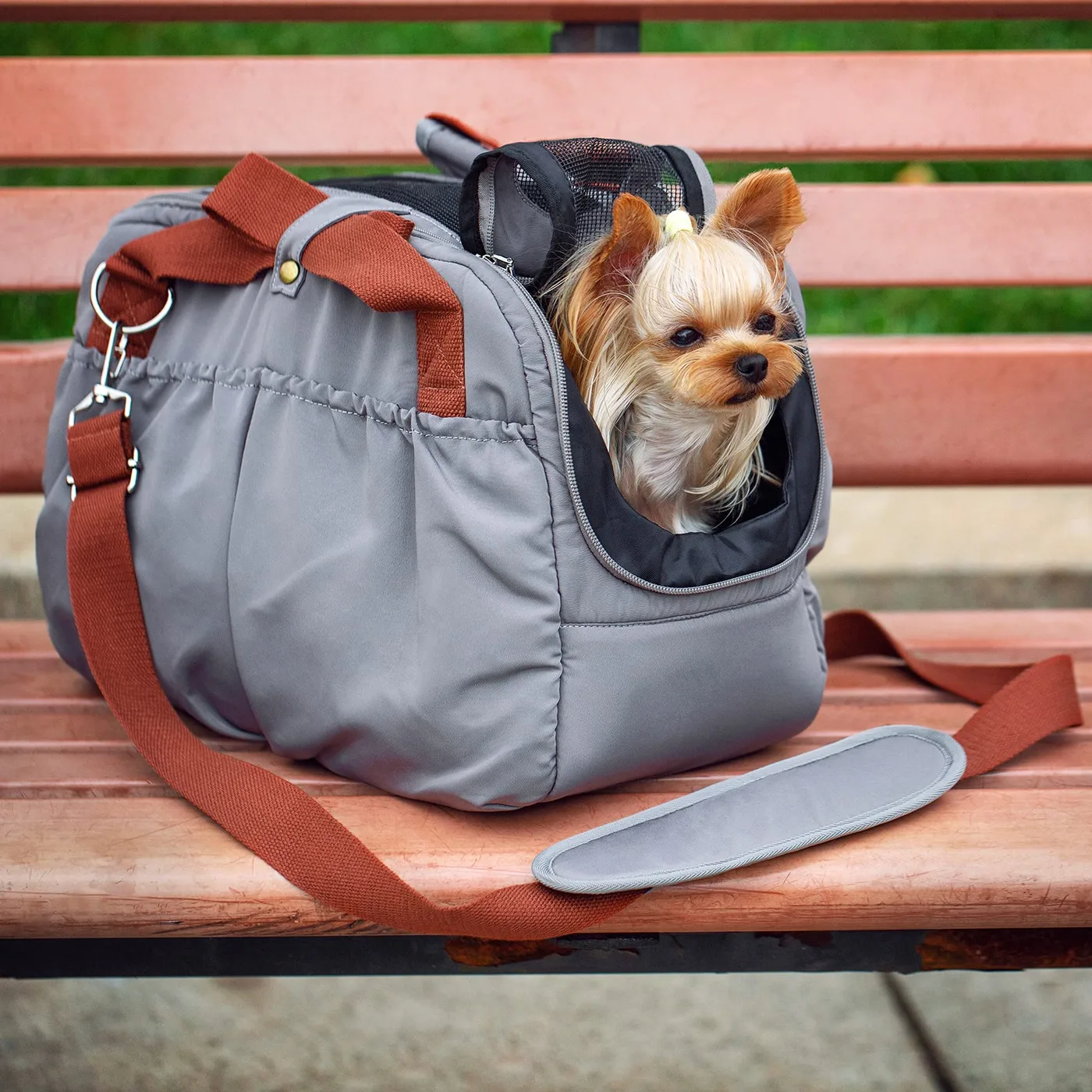
Training rewards introduce oils, crumbs, and odour in concentrated locations. Use a smooth 300D coated lining, 600D matte polyester exterior, removable low-lint target mat, and a coated reward-delivery ledge outside the main entry. Do not build a deep treat pocket into the chamber wall. An external washable reward pouch can attach to the trainer's belt or a solid outer field, but it must be removed before transport and cannot obstruct mesh.
Qualify the common reward types used by the training business. Apply standardized amounts of dry crumb, fish-based oil, and moist paste to material coupons, wait the realistic interval, then clean with the approved detergent and disinfectant sequence. Grade staining, retained odour, tack, colour change, and surface damage. Repeat challenges on finished seams and the target mat because liquids migrate differently around binding and stitching.
Run 250 complete sanitation cycles, with reward challenges every tenth cycle. Inspect cue-patch contrast, cover dimensions, zipper force, coating flexibility, anti-slip base, label readability, and drying time. Repeat the base stability and partial-door tests after aging. If a target mat remains oily or shrinks out of tolerance, replace that controlled part rather than applying stronger unvalidated chemistry to the complete shell.
Buyers can use European Chemicals Agency resources when defining relevant chemical restrictions for destination markets. Material declarations should identify coatings, prints, plastics, and metal finishes actually supplied. Training-carrier hygiene requires measured removal of the business's real reward residues while preserving cue visibility and closure function.
Drying racks should hold covers open and target mats flat, with no fold that transfers residual oil back to the lining. Record mass or moisture at timed intervals and release only when every removable part is dry. A trainer who needs rapid reuse should keep rotating clean mats and covers by code; heat or concentrated cleaner should not be improvised to accelerate turnaround. Store dry reward-contact parts in sealed, labelled bins separate from used pouches, and audit part counts before each class at every branch or session venue so a missing mat does not prompt an unapproved substitute.
Use low-glare surfaces for coaching and recorded review
Professional trainers frequently record sessions for client education and their own review. Glossy coated panels create hotspots that obscure door position and paw location, while busy prints make cue patches difficult to distinguish. Choose a matte neutral shell with a stable texture and reserve saturated colour for small replaceable cues. Evaluate reflectance under daylight, overhead LEDs, and the phone or camera lights used in the business.
Place the principal brand mark on a removable 90 x 50 mm patch above the solid side centre, outside the camera's usual view of the entry. A trainer identifier can occupy a narrow replaceable strip. Safety labels, door indices, mode tab, and asset identity must use a separate visual hierarchy. The logo should never look like a training target unless that is an intentional, documented cue system.
Record the decorated sample against common studio and client-home backgrounds. Check edge contrast, moiré in woven panels, reflective trim flare, and whether auto-exposure hides black mesh. Approve colour on physical production fabric. Run badge adhesion, wet rub, flex, and cleaning tests; if embroidery is used, keep it on the patch so dense needle penetration does not affect coated structural panels.
Branding may need to change when trainers join a franchise or deliver a co-branded class. A neutral blank patch should cover the attachment field without exposed hook material. Camera-ready training gear uses controlled matte texture and a deliberate cue hierarchy so branding never competes with the behaviour being observed.
Create a shot checklist at sample approval: front entry at each index, side profile, top hatch, closed transport state, floor cue, visual-cover positions, and vehicle routing. These reference images support staff training and later quality inspection. Because camera processing can shift colour, retain the physical golden sample and lighting notes rather than using online images as the sole appearance standard.
Manufacture repeatable cues, closures, and quiet interfaces
Door-index accuracy, parking-strap position, cue-field location, floor flatness, visual-cover size, and load-webbing overlap are critical-to-quality features. Use print or sewing fixtures referenced to stable seams. An index placed correctly on an unstretched panel can drift when the zipper is installed, so final position must be checked on the erected carrier. Tolerances should reflect what trainers can distinguish on video and by touch.
The 25 mm polyester cradle passes beneath the floor board and connects to handle and vehicle-restraint interfaces. Inspect it before the lining closes. Zipper chain, sliders, stops, garages, and textile pull covers are approved as a system. Conduct first-piece sound and force checks after a zipper lot, operator, machine, or needle change. Pull covers must remain captured after repeated movement and cleaning.
Cue patches, target mats, covers, boards, and mode tabs need revision codes and cross-fit checks. Sample parts from early and late production and install them on carriers from multiple cartons. A replacement cue that differs significantly in colour or a cover that blocks more mesh can alter training use. Service kits should be packed separately, counted, and labelled with the compatible model.
Needle control and illuminated interior inspection are mandatory around the floor sleeve, door binding, and patch fields. The production team retains a golden sample, material cards, acoustic comparison record, cue-colour standards, seam coupons, and inline test results. Training consistency is manufactured by holding cue location, door feel, acoustic behaviour, and hidden load paths within controlled limits.
Process change review should examine function rather than appearance alone. A substituted pull cord, hook material, board, coating, or zipper may match colour yet change sound, tactile feedback, cleaning, or opening force. Flag substitutions before cutting, build comparative samples, and repeat the affected tests. Update the bill of materials and reference images only after written approval.
Packing must protect calibrated interfaces. Secure cue patches, mats, covers, boards, and mode tabs as one counted set without pressing them into mesh or bending door frames. Condition packed samples under the proposed carton compression, then erect them without heat and repeat door-position, acoustic, floor-flatness, and cover-fit checks. Carton labels should state model, revision, colour, quantity, and service-kit compatibility. A bag that passes before packing but loses its indexed geometry in shipment is not production-ready.
Verify session endurance and preserve professional boundaries
For an 8 kg working load, apply a 12 kg static proof for one hour, followed by 1,000 loaded handle lifts and 500 vehicle-placement cycles. Measure webbing migration, base deflection, floor translation, and door alignment. Run 10,000 partial zipper movements, 3,000 full cycles, and 5,000 visual-cover operations. Include reward debris and cleaning exposure at defined intervals.
Measure zipper operating force and peak sound using a documented microphone distance, room background level, motion speed, and apparatus. Compare new, mid-cycle, and final samples. Apply outward force at authorized partial positions only to characterize supervised use, while the secure closed position receives the full retention acceptance. Test mode-tab readability, tactile distinction, and resistance to 5,000 changes.
The floor undergoes 2,000 entry-load simulations and 1,500 low-height set-downs. Cue contrast is measured or visually graded after abrasion and sanitation. The optional divider receives 200 installations, a 150 N lateral force, unequal loading, and independent-door checks. Vehicle belt loops, if included, are tested as routine securement interfaces without making an unsupported crash claim. Relevant test methods can be reviewed through ASTM International.
Run recorded sessions with new and endurance-aged prototypes, using inert forms first and controlled professional protocols thereafter. Score hardware interruptions, missed door indices, cue visibility, floor movement, and time to reach secure transport state. Guidance from the American Veterinary Medical Association may inform welfare planning alongside qualified behavioural expertise.
Final inspection applies AQL 2.5 to major workmanship, dimensions, operation, decoration, accessories, and packing. Unsafe exits, exposed sharp parts, failed load seams, missing mode labels, or blocked ventilation require critical handling. A professional training carrier is validated when aged equipment still supports deliberate session steps and returns securely to transport mode without implying a guaranteed behavioural result.
Field monitoring should capture equipment facts rather than subjective outcome claims. Log asset code, session count, opening range used, cleaning cycle, hardware interruption, cue damage, and quarantine reason. Review trends every defined interval and compare them with laboratory wear. If one zipper arc, cover strap, or floor component fails earlier than expected, revise that test and maintenance threshold before reorder. These records improve the product system while respecting that training progress belongs to the individual animal and qualified professional.
Production capability
- SGS-verified production space of 4,950 m², 149 machines, 7 assembly lines
- Pet carrier and pet bag output since 2014 from a 137-person team
- 200,000 units shipped monthly under BSCI and ISO 9001 systems
People Also Ask
What features make a cat carrier useful for trainers?
Useful features include graded supervised openings, secure transport closure, stable flooring, removable cues, quiet hardware, visual covers, and cleanable reward-contact zones.
How many zipper cycles should a training carrier pass?
This specification uses 10,000 partial movements across the most-used arc plus 3,000 complete closure cycles with debris and cleaning exposure.
Can a carrier be used as a training station?
Yes, when it has a flat non-slip floor, securely parked doors, controlled cue surfaces, adequate ventilation, and direct professional supervision.
How are visual barriers added to a training carrier?
Use independently retained side and roof covers with defined open and closed positions, measured airflow, and no loose fabric inside or on the floor.
What material handles treat residue?
A smooth qualified coated lining and removable low-lint target mat should be tested against the trainer's actual dry, oily, and moist rewards plus cleaning chemistry.
How should training sessions with multiple cats be arranged?
Use one identified carrier and floor station per unrelated cat, controlled spacing and sightlines, and a numbered cart only for separate transport.
Why use matte carrier surfaces for training?
Low-glare surfaces preserve door-index and cue visibility in recorded review, reduce hotspots, and keep branding from obscuring the interaction.
Frequently Asked Questions
Does a training carrier guarantee easier cat handling?
No. The carrier provides controlled physical interfaces, while outcomes depend on the individual animal, qualified instruction, pace, environment, and welfare decisions.
What are graded opening positions?
They are visible index points that help a trainer record repeatable supervised door movement. They are not transport locks; transport requires full closure and clips.
Can two class cats share one carrier?
No. Unrelated cats need independent carriers and controlled station spacing. A divided model is only for approved same-household transport, not shared training.
How is zipper noise tested?
Operate the zipper at a fixed speed and microphone distance in a controlled background, then compare peak and overall sound on new and aged samples.
Can treats be stored inside the animal chamber?
No deep food pocket should occupy the chamber. Use a removable external reward pouch and a cleanable delivery ledge under the trainer's procedure.
Are cue patches permanent?
They should be replaceable and have blank covers, allowing trainers to change or remove visual targets without exposing rough attachment material.
What happens before vehicle transport?
Remove or stow training attachments, install the full floor, close every door, park sliders, engage clips, secure covers, and set the TRANSPORT state.
Can the whole carrier be machine washed?
Only components explicitly qualified for laundering should be machine washed. The shell, board, hardware, and stays usually use a validated wipe process.
How are group carriers spaced?
The trainer sets a room plan based on animals and environment, with independent floor positions, no occupied stacking, controlled sightlines, and accessible doors.
Where should the trainer logo be placed?
Use a removable matte patch outside the primary camera view of the entry, keeping it distinct from cue, mode, safety, and identity markings.
What triggers immediate quarantine?
An insecure exit, open load seam, sharp part, unstable floor, damaged divider, blocked mesh, or missing transport-mode instruction requires quarantine.
How are replacement cues kept consistent?
Control colour, texture, dimensions, attachment, model revision, and cross-fit, then compare replacements with retained physical standards.
Talk to QUANZHOU JUNYUAN BAGS about a pet carrier program: MOQ 500 pieces per colourway, samples in 6-10 working days, bulk production in 35-50 days under AQL 2.5 inspection.
Get a free quote Request a sample