Dog Carrier Backpack for French Bulldogs: Breathable
A French Bulldog carrier is specified by airway and thermal performance rather than by load: the class runs 8-13 kg with brachycephalic obstructive airway syndrome, requiring 30-38% open area in cross-flow, a rigid anti-compression frame holding 250 mm of unobstructed internal height, a head-up neck-extended resting posture, a hemivertebrae-safe flat floor and active cooling rated to 24 °C.
This page sets out the engineering behind a carrier built for a brachycephalic breed of moderate mass. The load is unremarkable for the range, but three constraints dominate and all three are physiological. The breed's upper airway is structurally restricted, which means it cannot increase ventilation by panting and therefore cannot shed heat; it must be carried in a posture that keeps the neck extended and the chest uncompressed; and many airlines restrict or refuse brachycephalic breeds outright, which removes the air-travel use case that most carrier programmes are designed around. Those three facts set ventilation geometry, frame rigidity and the regulatory position respectively, and they change the product more than the 8-13 kg load does. Commercial terms follow the standard program: MOQ 500 pieces per colourway, prototypes in 6-10 working days, bulk production 35-50 days after sample approval, final random inspection to AQL 2.5, T/T 30/70 payment and FOB Xiamen loading.
A pet carrier manufacturer is judged on three numbers in this category - MOQ per colourway, sample turnaround and the AQL level applied at final inspection. Ours are 500 pieces, 6-10 working days and AQL 2.5.
Mass Class, Chest Geometry and the Anti-Compression Requirement
French Bulldog dimensions are compact and dense. Adult mass runs 8-13 kg, with males typically 9-13 kg and females 8-11 kg, over a body length of 450-600 mm and a height at the withers of 280-350 mm. The distinguishing feature is not the mass but the distribution: the breed is broad through the chest and shoulders and comparatively narrow through the pelvis, with a chest girth of 550-750 mm against a waist substantially smaller than that.
That proportion sets the internal plan. Shoulder width of 250-320 mm is the governing cross-section and it is wider than a dog of the same mass in a leaner breed, so a compartment derived from a length-and-weight chart under-sizes the width and produces a product the animal cannot sit in squarely. The working interior is 300-380 mm wide, 480-620 mm long and 300-400 mm high.
The anti-compression requirement follows from the same anatomy and it is the first hard constraint. A brachycephalic dog with a broad, barrel chest tolerates lateral or vertical compression of the thorax poorly, because the additional work of breathing against an external restraint is added to an airway that is already restricted. A soft-sided carrier that collapses inward when lifted by a single handle, or when loaded against the wearer's back, or when stowed under a seat, is a respiratory hazard for this breed rather than an inconvenience.
The specification is a rigid frame that holds the internal cross-section under load. Two constructions meet it: an internal hoop or wire frame captured in the shell seams, or a moulded or semi-rigid panel set into the walls and roof. The acceptance test is dimensional rather than force-based — the internal width and height must not reduce by more than 10 mm under a 150 N lateral load and a 100 N vertical load applied simultaneously — because what matters is the retained cross-section, not the strength of the frame.
Handle and lift geometry is part of the same control. A single central lift handle puts the shell into compression across the animal's back and is the most common cause of the failure in service. Two handles positioned at the ends of the compartment, or a rigid yoke, keeps the load in tension along the length instead. Specify the retained cross-section under combined load, not the force the frame withstands.
BOAS and the Airway Posture Rule: Head Up, Neck Extended
Brachycephalic obstructive airway syndrome is the defining condition for this breed and it has a direct mechanical translation into carrier geometry. The components are stenotic nares, an elongated soft palate and, in a substantial proportion of the population, a hypoplastic trachea. All three restrict airflow, and all three worsen when the neck is flexed, because flexion narrows the pharyngeal space and lets the soft palate obstruct further.
The posture rule follows directly: the animal must be able to rest with the head up and the neck extended in line with the spine. This is not a comfort preference, it is the difference between an airway that is marginal and one that is obstructed. In carrier terms it sets three requirements that a dog-derived design does not naturally meet.
The first is internal height at the head end. The compartment needs 300-400 mm of internal height at the front, unobstructed by padding, pockets or a sloping roof, so that a sitting animal with its head raised clears the roof by 40-80 mm. A tapered or wedge-shaped compartment that is tall at the rear and low at the front is the specific geometry to avoid, and it is common because it looks efficient.
The second is the absence of any forward-facing obstruction. A raised bolster, a chin rest or a padded edge at the front of the compartment encourages the animal to rest its head forward and down, which is the flexed posture. The specification is a flat, unobstructed front face with ventilation placed laterally rather than in front of the muzzle, and no interior fitting within 150 mm of the head position.
The third is the resting angle. A floor that slopes toward the front drops the head; a floor that slopes toward the rear raises it. A rear-down slope of 3-6 degrees is worth specifying because it uses gravity to hold the extended posture rather than relying on the animal to maintain it, and it also drains liquid toward a rear sump, which is a secondary benefit.
Exercise and stress restraint is the last item and it belongs in the documentation. A brachycephalic dog in a carrier is already working harder to breathe than a normal dog at rest, so excitement and physical struggle have an outsized effect. Any product element that provokes struggling — a tight aperture, a slippery floor, a closure that requires the animal to be pushed in — is a respiratory load, not just a handling annoyance.
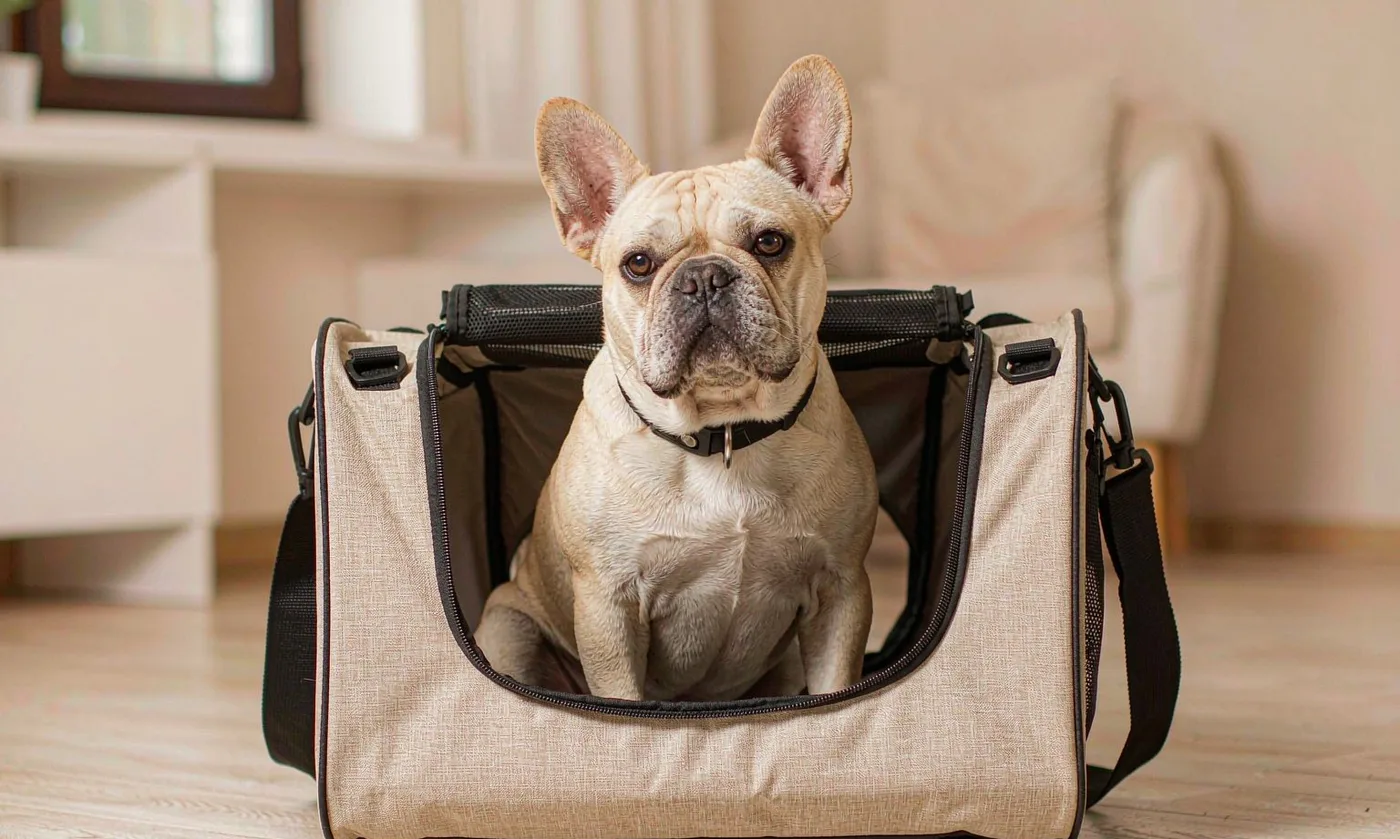
Ventilation Engineering: Open Area, Cross-Flow and Face Clearance
This is the section the product is named for and it is the one with the most engineering content. A French Bulldog in an enclosed compartment produces heat and carbon dioxide at a normal canine rate but cannot increase its respiratory volume to compensate, so the compartment has to do the work the animal cannot. Ventilation here is a life-support function rather than a comfort feature.
Open area of 30-38% is the specification, which is the highest figure in the dog range and roughly double the figure used for a mid-size breed. It has to be delivered on at least three faces, because open area concentrated on one face gives no cross-flow and cross-flow is what actually removes heat. The distribution target is intake on the two lower side faces and a low front face, exhaust across the full upper rear face, with the exhaust area at least 80% of the total intake area.
Cross-flow geometry is specified rather than assumed. A straight-line path from intake to exhaust that passes through the animal's resting position gives the best result, and it is achieved by placing the intake low and forward and the exhaust high and rearward, so the path runs diagonally through the compartment. A design with intake and exhaust on the same face, which happens when ventilation is concentrated on a front panel for retail visibility, produces a short-circuit path that bypasses the animal entirely.
| Configuration | Open area | Face velocity at head | Interior rise at 24 °C | Verdict |
|---|---|---|---|---|
| Single front mesh panel | 14-18% | 0.05 m/s | 6.5-8.0 °C | Reject |
| Two side panels, no exhaust | 20-24% | 0.12 m/s | 4.5-6.0 °C | Reject |
| Side intake plus rear exhaust | 30-38% | 0.30-0.45 m/s | 2.0-3.0 °C | Accept |
| Above plus elevated floor plenum | 30-38% | 0.40-0.60 m/s | 1.2-2.0 °C | Preferred |
| Above plus forced fan module | 30-38% | 0.80-1.20 m/s | 0.5-1.2 °C | Hot-climate option |
An elevated floor plenum is the single most effective passive addition. A perforated floor raised 15-25 mm above a solid base, with intake air admitted into the plenum, delivers air underneath the animal where convective loss is greatest and where a broad-chested dog dumps heat by conduction. It costs 0.60-1.50 USD and it is the cheapest performance gain in the product.
Face clearance is the last ventilation requirement. Airflow that blows directly into a flat face at close range dries the cornea and, in a breed with prominent shallow-orbit eyes, increases the risk of corneal injury. The specification is no ventilation aperture within 150 mm of the head position at less than 300 mm standoff, which is another reason to place intake laterally and low rather than frontally.
Thermal Management for a Breed That Cannot Pant
Panting is the primary heat-loss mechanism in dogs and it is precisely the mechanism this breed cannot use effectively. The airway restriction that defines brachycephaly reduces the maximum voluntary ventilation, and panting itself increases airway turbulence and swelling, which further narrows an already narrow passage. The result is a positive feedback loop: the hotter the animal gets, the harder it breathes, the more the airway swells, and the hotter it gets. Heat stroke is a leading cause of death in the breed and it occurs at ambient temperatures a normal dog tolerates without difficulty.
The thermal specification therefore starts from an unusually low ceiling. A stated maximum ambient of 24 °C for continuous occupancy is the working figure for the class, with any use above 27 °C requiring active cooling. That is roughly 6-8 °C below the figure a mid-size dog carrier is designed to, and it is the reason the product is sold as a breathable design rather than as an insulated one.
Insulation is consequently counterproductive for most of the product. The correct thermal arrangement is the reverse of the Chihuahua one: no insulation in the walls or floor, a reflective outer finish to reject solar gain, and maximum airflow. The exception is the roof, where a reflective and ventilated double-skin — an outer reflective layer with a 10-15 mm air gap over a perforated inner layer — reduces solar gain without restricting airflow, and is worth the 0.80-1.80 USD.
Active cooling is often required rather than optional. Three options exist. A phase-change pack of 500-900 g with a transition at 18-22 °C, sited in the floor plenum, holds the interior for two to four hours. An evaporative element — a wicking panel over the exhaust with a water reservoir of 200-400 ml — gives 3-5 °C of depression in dry climates and near zero in humid ones, so it is market-specific. A battery fan module of 0.5-1.5 W gives the largest and most consistent gain, at 3.50-8.00 USD and with a regulatory and charging-compliance burden that has to be budgeted separately.
Monitoring is the final element and it is cheap to include. A reversible temperature indicator on the interior roof, or a simple probe port for a customer's thermometer, converts an invisible hazard into a visible one. Welfare and heat-stress framing for the breed is commonly cross-checked against guidance published by the American Veterinary Medical Association, and thermal conditioning methods follow standards published by ASTM International.
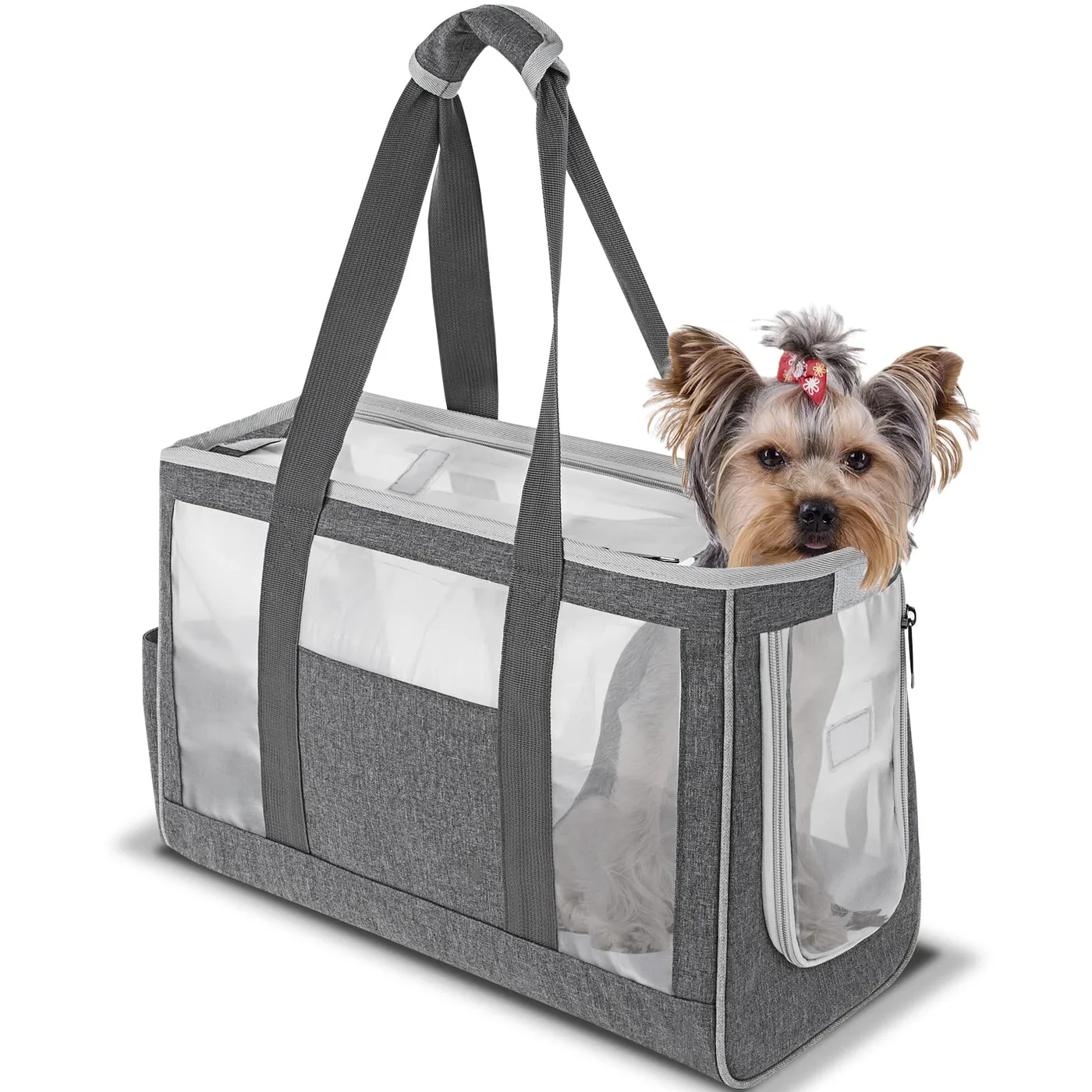
Floor, Spine and Hemivertebrae Considerations
French Bulldogs carry a high incidence of congenital vertebral malformation, typically hemivertebrae in the thoracic spine, and a corresponding predisposition to spinal cord compression. The mechanical consequence for a carrier is the same as it is for a chondrodystrophic breed: the spine must be supported in a neutral, extended line and must not be twisted or allowed to sag, and the animal should not be required to hold itself in a curled or a sitting-up posture for extended periods.
Floor deflection is the first specification. Under a 13 kg load measured at mid-span with the floor supported at its edges, deflection must stay under 4 mm, which at a span of 480-620 mm requires a board of 4.0-6.0 mm or a moulded tray with ribs of 12-18 mm depth on a 40-55 mm pitch. That is a heavier board than a dog of this mass would otherwise receive and the difference is entirely due to the spinal tolerance rather than to load.
Flatness matters as much as deflection. A contoured or dished floor that cups the animal encourages lateral curvature, and a floor with a raised centre ridge forces the spine over an apex. The specification is a flat, unbroken support surface with no contour above 3 mm across the width, plus a mat that is flat rather than sculpted, which is a departure from the comfort-shaped mats used elsewhere in the range.
Traction is a spinal consideration here as well as a comfort one. A heavy, front-loaded dog that slips on a smooth floor either scrambles or is thrown, and both load the spine asymmetrically. A coefficient of friction above 0.6 with a textured mat of 5-8 mm closed-cell foam is the specification, and the mat must be captive because a shifting mat under a 13 kg animal produces exactly the asymmetric loading the specification exists to prevent.
Support continuity closes the section and it is the same requirement as elsewhere in the range: full-perimeter support rather than corner support, a board sleeve captured in the base seam on all four sides, bar-tacks of at least 15 mm at each corner and a corner radius of 30 mm or greater. At this mass the base-to-side seam is also a genuine structural element, and it is specified at a 15-18 mm allowance with a bound or welded reinforcement.
Load Paths, Suspension and Carry Geometry at 8-13 kg
At 8-13 kg the animal is a substantial carried load and the product has to be engineered as a load-carrying device rather than as a bag. The working figure is 4x the rated animal mass plus the product mass, so a compartment rated to 13 kg is tested at 52 kg plus roughly 1.5 kg of product, which puts the requirement at the level of a technical daypack rather than a pet accessory.
Load paths run from the floor board through the base seam into the harness. The board is the load-spreading element and it has to be captured on all four sides so that load enters the shell as distributed tension rather than as a point load at the corners. The base seam is the highest-stressed joint in the product and it is specified with a 15-18 mm allowance, a bound reinforcement and a stitch density of 7-9 per inch, which is higher than the 6-8 per inch used on a lighter product.
Suspension is specified around the breed's front-loaded proportion. Because the chest is broad and the pelvis narrow, the animal's centre of mass sits forward of the compartment midpoint — typically at 42-48% of interior length rather than at 50% — and a suspension designed symmetrically produces a compartment that tips forward. The correction is a load-lifter attachment biased forward of centre and a back panel contact area that extends below the compartment floor so the load is transferred to the hips rather than hanging off the shoulders.
Shoulder strap geometry follows the carried mass: 25-38 mm webbing with a foam core of 45-60 kg/m³, a sternum strap positioned so it does not cross the wearer's throat, and a hip belt for any product rated above 10 kg. A hip belt at this mass is not a feature, it is the difference between a product that can be carried for an hour and one that cannot.
Carry stability is the last item. A 13 kg animal that shifts produces a lateral moment the wearer has to correct, and the control is a compartment that is as short as the animal allows rather than as roomy as possible, plus a back panel with enough vertical stiffness that the compartment does not roll independently of the frame. Vertical stiffness is achieved with a moulded or framed back panel rather than with a soft one.
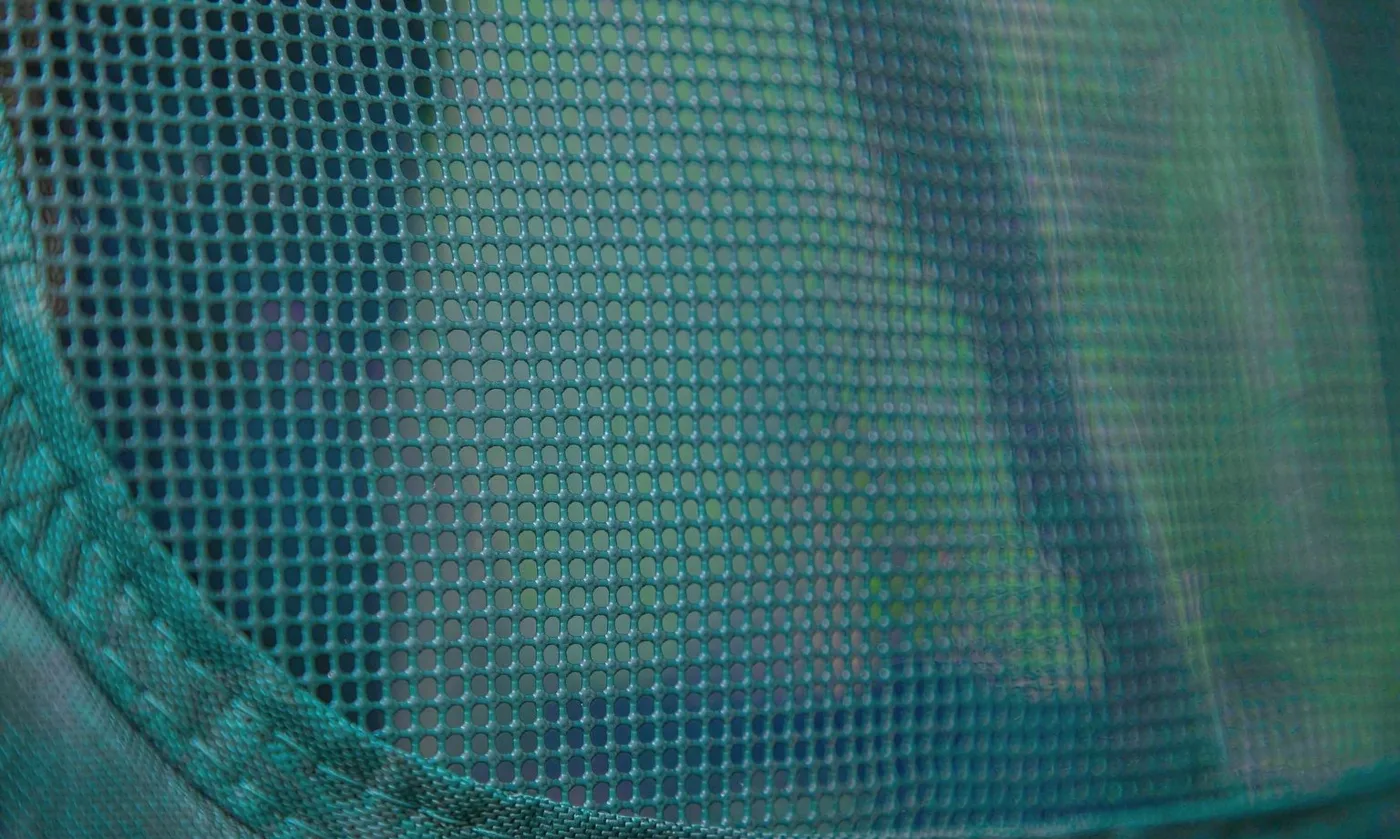
Airline and Regulatory Constraints on Brachycephalic Breeds
The regulatory position is the commercial reality that shapes this product and it has to be understood before a programme is quoted. A significant number of airlines restrict or refuse brachycephalic breeds in the hold, and several refuse them in the cabin as well, on the basis of the respiratory risk described above. A carrier marketed as airline approved cannot honestly be marketed for this breed, and a programme that assumes air travel as the primary use case is building to the wrong requirement.
The practical consequence is that this product is a ground-transport and general-carry design, and the specification should say so. That removes the under-seat dimensional constraint that dominates airline-approved design — typically a maximum height of 200-280 mm — and frees the interior height to the 300-400 mm the airway posture rule requires. Those two requirements are in direct conflict, and the airway one wins.
Where a programme does need air travel, the correct position is to document it rather than to imply it. The cabin-acceptance rules that do exist are published by individual carriers and by IATA in the live-animal regulations; the US position on pets in the cabin is summarised by the FAA. Neither is a product certification, and neither overrides a carrier's breed policy, so the documentation should state that acceptance is at the carrier's discretion.
General product compliance is unaffected. Textile and coating components are screened against OEKO-TEX criteria, metal hardware is screened for heavy metals, and any electrical cooling module carries its own conformity documentation. Labelling should carry the breed-specific thermal and occupancy limits because for this class they are the safety-relevant information on the product, not a marketing restriction.
Test Protocol, Cost and Programme Notes
Release testing for the class adds four tests to the standard dog protocol: a retained-cross-section test under combined load, an airflow measurement, a thermal rise test and a floor deflection test at 13 kg. The structural protocol is run at 4x rated mass as usual, which at 52 kg is the dominant test in the product.
The retained-cross-section test applies 150 N lateral and 100 N vertical simultaneously to the loaded compartment and measures internal width and height, accepting a reduction of no more than 10 mm on either. Airflow is measured as face velocity at the animal's resting position in still air and in a 1.5 m/s cross-draught, with acceptance of 0.30-0.60 m/s in the passive configuration and no short-circuit path, verified by smoke visualisation as well as by anemometer.
The thermal test logs interior temperature at the resting position for 60 minutes in a 24 °C chamber with the compartment loaded by a 13 kg thermal mass, accepting a rise of no more than 3 °C in the passive configuration and no more than 2 °C with the plenum floor. Carbon dioxide is logged in the same test against a 5,000 ppm ceiling at head height.
Cost is dominated by ventilation and frame rather than by fabric. The perforated plenum floor runs 0.60-1.50 USD, the anti-compression frame 1.80-4.20 USD, expanded ventilation panels and binding 1.20-2.80 USD, the reflective ventilated roof 0.80-1.80 USD, and reinforced load-path hardware and webbing 1.40-3.20 USD. Total increment over a mid-size dog carrier is 5.80-13.50 USD, landing the unit at 19-34 USD FOB before any active cooling module.
Programme notes close the page. MOQ is 500 pieces per colourway, prototypes run 6-10 working days and bulk production 35-50 days after approval, with final random inspection to AQL 2.5 and the cross-section, airflow and floor deflection checks written into the defect list. Because the breed-specific performance is invisible, packaging should state the open area, the retained cross-section and the thermal ceiling numerically. Occupant-restraint and crash-performance framing is commonly cross-checked against published work from the Center for Pet Safety. A brachycephalic product is a ventilation and thermal product that happens to carry 12 kg.
Order and quality terms
- MOQ 500 pieces per colourway; samples in 6-10 working days
- Bulk production 35-50 days after approval; AQL 2.5 inspection standard
- T/T 30/70 terms, FOB Xiamen, full document set per shipment
People Also Ask
Why do French Bulldogs need a rigid carrier frame?
Lateral or vertical compression of the broad chest adds breathing work to an airway that is already restricted. The specification is a frame holding internal width and height within 10 mm under a combined 150 N lateral and 100 N vertical load.
How much ventilation does a brachycephalic dog need?
30-38% open area on at least three faces, with low side and front intake and a full upper rear exhaust at 80% of intake area. Without cross-flow a single large panel short-circuits and bypasses the animal.
At what temperature is a French Bulldog at risk in a carrier?
A stated maximum of 24 °C for continuous occupancy, with active cooling required above 27 °C. Panting is the heat-loss mechanism the breed cannot use, so the compartment has to do the work.
What resting posture does the airway require?
Head up with the neck extended in line with the spine. Neck flexion narrows the pharyngeal space and lets the soft palate obstruct further, so the compartment needs 300-400 mm of unobstructed front height and a 3-6 degree rear-down floor slope.
Why is the floor specified flat rather than contoured?
The breed carries a high incidence of hemivertebrae and spinal cord compression. Any contour above 3 mm across the width encourages curvature, and deflection must stay under 4 mm at 13 kg.
Can a French Bulldog carrier be airline approved?
Not honestly. Many carriers restrict or refuse brachycephalic breeds, and the under-seat height limit conflicts directly with the 300-400 mm the airway posture needs. Position the product as ground transport and general carry.
What is an elevated floor plenum?
A perforated floor raised 15-25 mm above a solid base with intake air admitted underneath, delivering air where a broad-chested dog dumps heat by conduction. It costs 0.60-1.50 USD and gives the largest passive gain.
Frequently Asked Questions
What interior dimensions suit the French Bulldog class?
300-380 mm wide, 480-620 mm long and 300-400 mm high. Shoulder width of 250-320 mm is the governing cross-section and is wider than a leaner dog of the same mass, so a length-and-weight chart under-sizes it.
Why are two end handles specified instead of one central handle?
A single central lift handle puts the shell into compression across the animal's back, which is the most common in-service failure. End handles or a rigid yoke keep the load in tension along the length.
Why should ventilation not be placed in front of the muzzle?
Two reasons: a frontal aperture encourages the head-forward flexed posture, and close-range airflow dries the cornea in a breed with prominent shallow-orbit eyes. No aperture within 150 mm of the head at under 300 mm standoff.
What floor slope is specified and why?
3-6 degrees rear-down. It uses gravity to hold the neck-extended posture rather than relying on the animal, and it drains liquid toward a rear sump as a secondary benefit.
Is insulation ever used in this product?
Only in the roof, as a reflective ventilated double skin with a 10-15 mm air gap over a perforated inner layer. Walls and floor are deliberately uninsulated because airflow is the cooling mechanism.
Which active cooling option suits which market?
A 500-900 g phase-change pack at 18-22 °C in the plenum suits most markets; an evaporative wicking panel gives 3-5 °C in dry climates and near zero in humid ones; a 0.5-1.5 W fan module gives the largest gain at 3.50-8.00 USD plus compliance burden.
What board thickness does the floor need?
4.0-6.0 mm, or a moulded tray with 12-18 mm ribs on a 40-55 mm pitch, holding deflection under 4 mm at 13 kg over a 480-620 mm span. The figure is set by spinal tolerance, not by load.
Why must the floor mat be captive?
A shifting mat under a 13 kg front-loaded animal produces the asymmetric spinal loading the specification exists to prevent. It is retained mechanically with a 5-8 mm closed-cell texture above 0.6 coefficient of friction.
Where does the centre of mass sit?
At 42-48% of interior length rather than 50%, because the chest is broad and the pelvis narrow. The suspension is biased forward of centre and the back panel contact extends below the floor line.
Is a hip belt necessary at this mass?
Yes above 10 kg. It is what allows the product to be carried for an hour rather than a few minutes, and it transfers load to the hips instead of hanging it off the shoulders.
How is the structural test load calculated?
4x rated animal mass plus product mass, so a 13 kg compartment is tested at roughly 53.5 kg. At that level the base seam is the highest-stressed joint, specified at a 15-18 mm allowance with bound reinforcement and 7-9 stitches per inch.
How is airflow verified?
Face velocity at the resting position by anemometer in still air and in a 1.5 m/s cross-draught, accepting 0.30-0.60 m/s, plus smoke visualisation to confirm there is no short-circuit path between intake and exhaust.
What are the thermal and air-quality acceptance figures?
A rise under 3 °C in the passive configuration and under 2 °C with the plenum floor after 60 minutes at 24 °C, plus carbon dioxide under 5,000 ppm at head height.
What does a French Bulldog build cost?
19-34 USD FOB before active cooling, an increment of 5.80-13.50 USD over a mid-size carrier: plenum 0.60-1.50 USD, frame 1.80-4.20 USD, ventilation 1.20-2.80 USD, roof 0.80-1.80 USD and load-path hardware 1.40-3.20 USD.
Talk to QUANZHOU JUNYUAN BAGS about a pet carrier program: MOQ 500 pieces per colourway, samples in 6-10 working days, bulk production in 35-50 days under AQL 2.5 inspection.
Get a free quote Request a sampleKeep reading
- Dog Carrier Backpack for Pugs: Flat-Faced Breed
- Dog Carrier Backpack Mesh: Airflow and Durability
- Dog Carrier Backpack Bottom: Reinforcement Options
- Airline Approved Dog Carrier Backpack: Compliance Requirements
- Dog Carrier Backpack Straps: Webbing Width and Strength
- Dog Carrier Backpack Size Guide: Sizing Chart and Specifications