Dog Carrier Backpack for Pugs: Flat-Faced Breed
A Pug-specific carrier is engineered around ocular protection and airway clearance: the class runs 6-10 kg with a compact cubic body, requiring a 25 mm unobstructed clearance envelope around the head, a harness-only restraint with no neck load, 28-36% open area in cross-flow, a fold-moisture management surface and a floor rated to 12 kg rather than to 8 kg.
This page covers the specification decisions behind a carrier for a small brachycephalic breed. Two hazards dominate and they are not the ones a dog-derived tech pack addresses. The breed has the most prominent and shallowest-orbit eyes in the dog range, and ocular proptosis is a recognised consequence of trauma or of pressure applied around the neck and head, so the head environment is a controlled geometric envelope rather than a padded space. The airway is restricted in the same way as other brachycephalic breeds, but at half the body mass, which changes the ventilation and thermal arithmetic rather than the principle. A third factor is commercial: the breed is strongly predisposed to obesity, so the rated load has to carry a margin over the standard weight rather than sit on it. Commercial terms follow the standard program: MOQ 500 pieces per colourway, prototypes in 6-10 working days, bulk production 35-50 days after sample approval, final random inspection to AQL 2.5, T/T 30/70 payment and FOB Xiamen loading.
Any dog carrier factory quoting dog carrier backpack work should be able to show a current BSCI audit and an ISO 9001 certificate before a deposit is released.
Mass Class and Compact Proportion: Specifying a Cubic Load
Pug dimensions are compact and nearly cubic. The standard adult mass is 6.3-8.1 kg, height at the withers 250-330 mm, and body length 400-520 mm, which gives a length-to-height ratio close to 1.5 against roughly 1.8 for a French Bulldog and 2.2 for a dachshund. Shorter-coupled animals produce a load that is tall relative to its plan area, and that proportion drives the compartment shape and the suspension differently from a longer dog of identical mass.
The interior is therefore closer to a cube than a tunnel. Working dimensions are 300-380 mm wide, 420-540 mm long and 320-420 mm high, with the height figure larger than a length-and-weight chart would suggest because the animal's dorsal height in a sitting posture is a large fraction of its body length. A compartment derived from a generic small-dog pattern is typically too low, and the animal sits with its head against the roof.
Chest geometry is the second proportion issue. The breed is deep and broad through the chest relative to its height, with a chest girth of 500-650 mm on a 7 kg animal. That girth-to-mass ratio is the highest in the range and it means the cross-section, not the length, is again the governing dimension — as it is for the French Bulldog, but at a smaller absolute size, which makes the panel-to-animal clearance tighter and the compression risk correspondingly higher.
Centre of mass sits low and central, at roughly 30-35% of interior height and close to 50% of interior length. That is the most favourable load position in the brachycephalic group: no forward bias to correct in the suspension, and a low roll moment during walking. The engineering consequence is that the product does not need the forward-biased load-lifter geometry the French Bulldog design requires, and it can be built on a symmetric harness.
Volume is modest and it is worth stating because it affects how the product is sold: 45-70 litres of internal volume for the class, against 60-90 litres for a French Bulldog carrier. The product is smaller, denser and heavier per litre than buyers expect from a 7 kg dog, and a tech pack that quotes volume without quoting mass misleads everyone downstream.
| Parameter | Standard adult | Design value | Margin source |
|---|---|---|---|
| Body mass | 6.3-8.1 kg | 12 kg rated | Obesity predisposition |
| Chest girth | 500-650 mm | 660 mm cross-section | Depth relative to height |
| Body length | 400-520 mm | 540 mm interior | Extended rest posture |
| Dorsal height, sitting | 300-380 mm | 420 mm interior | Head clearance envelope |
| Centre of mass height | 30-35% of height | Symmetric suspension | Low roll moment |
| Ocular clearance | Not previously specified | 25 mm envelope | Proptosis risk |
Rating the product above the standard mass is the decision that has to be made at quotation rather than later, because it changes the board, the seam allowance and the webbing gauge. Design to 12 kg for a 7 kg breed; the margin is what keeps an overweight animal safe.
Ocular Protection: Proptosis Risk and the Head Clearance Envelope
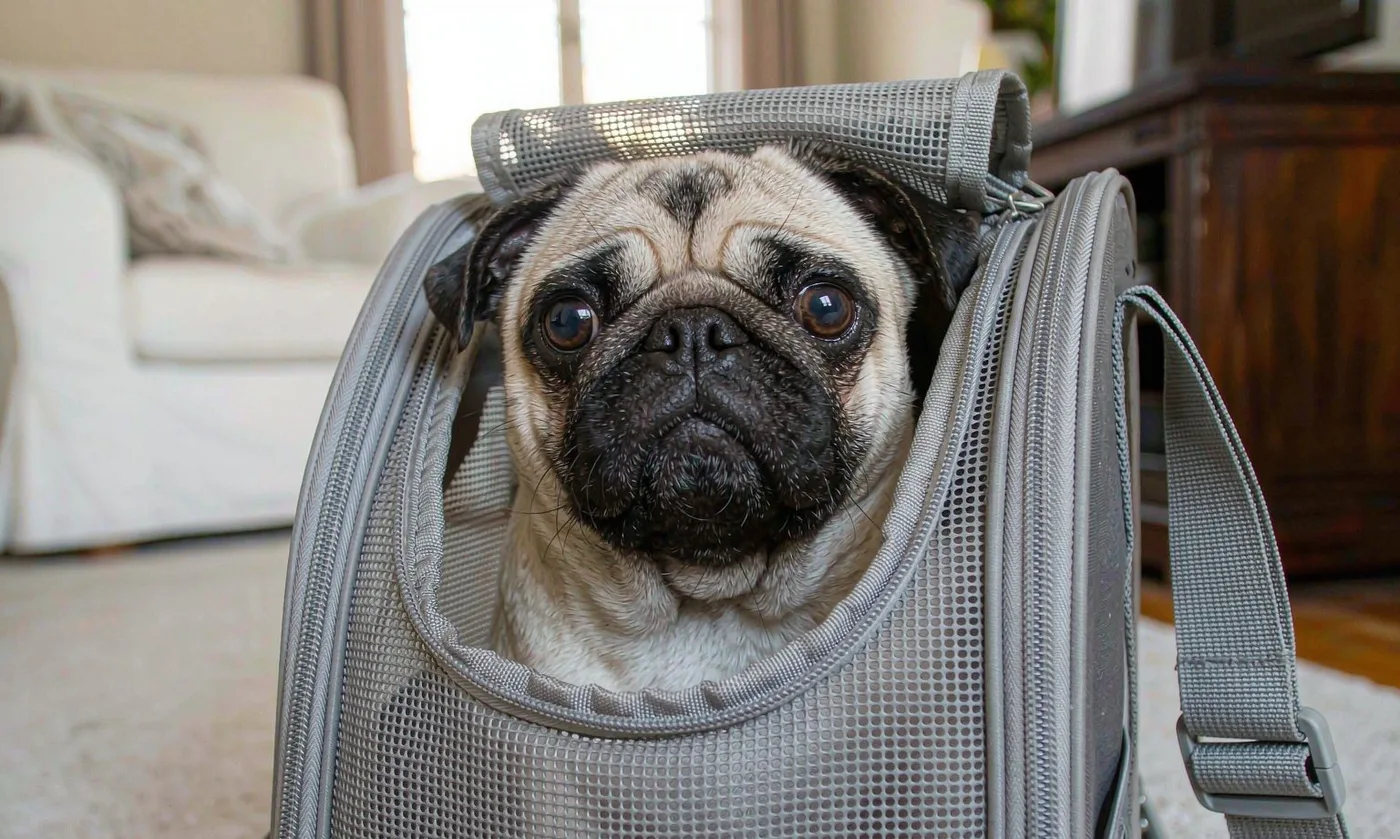
This is the section that distinguishes the Pug specification from every other breed in the range. The breed has large, prominent globes in shallow orbits with a relatively tight palpebral fissure, and it is the most over-represented breed for traumatic ocular proptosis. The mechanism is blunt pressure applied to the head or neck that displaces the globe forward past the orbital rim, and once displacement occurs the outcome depends on how quickly it is reduced. There is no material or padding specification that makes this safe; the control is geometric.
The control is a clearance envelope: a defined volume around the animal's head and neck within which no product element may intrude, whatever position the animal adopts. The working figure is 25 mm of unobstructed clearance around the head in every direction, measured from the widest point of the skull, with 40 mm above the crown. That envelope has to hold when the compartment is compressed by handling, which is why it is coupled to the anti-compression frame described below.
Padding placement is where most designs fail. The instinct is to pad the head end generously, and that is wrong: thick padding reduces the free volume and converts a clearance envelope into contact. The specification is thin, high-density padding on the structural surfaces — 8-12 mm at 45-60 kg/m³ — rather than thick soft padding, because it protects against a transmitted impact without occupying the envelope.
Neck pressure is the second control and it is the reason the harness rule is absolute rather than advisory. Venous pressure in the head rises when the neck is compressed, the orbital venous plexus engorges, and the globe is pushed forward. Any element that can load the neck — a collar attachment point, an elastic aperture that closes around the neck, a tether that pulls from behind — is a proptosis mechanism, not merely an airway problem.
Contact surfaces near the head are the last item. Everything within 200 mm of the head position is specified with a smooth, low-friction finish and no seam, binding edge or protruding element above 2 mm, because in a proptosis-prone breed a corneal abrasion from interior trim is a routine veterinary presentation. Interior trim near the head is eliminated rather than softened.
Airway: BOAS, Neck Load and the Harness-Only Rule
The airway constraint is mechanically the same as for the French Bulldog and physically smaller. Stenotic nares, an elongated soft palate and a frequently hypoplastic trachea reduce the maximum voluntary ventilation, and the breed cannot increase respiratory volume to shed heat or to recover from exertion. At 7 kg rather than 12 kg the absolute airflow requirement is lower, which is the only sense in which the problem is easier.
Open area of 28-36% suits the class, marginally below the French Bulldog figure because the metabolic mass is lower, and it must be delivered in cross-flow for the same reason: intake low and lateral on two faces, exhaust across the upper rear face at 80% or more of intake area. The elevated plenum floor is equally valuable here and costs proportionally less because the span is shorter.
The posture rule is unchanged and it sets the internal height. The animal must be able to rest with the neck extended in line with the spine, with 40-80 mm of clearance above the crown, and with no forward obstruction within 150 mm of the muzzle. Because the breed is compact and sits upright more readily than a longer dog, the risk of a flexed posture is higher in a low compartment and the height figure of 320-420 mm is a hard minimum rather than a target.
The harness rule is stated in absolute terms for this breed, and for a different reason than for the Chihuahua. There the concern is tracheal collapse; here it is both tracheal collapse and ocular pressure. The internal restraint is a chest-loading harness attached to a roof-centreline anchor rated at 150 N, with no neck-adjacent loop, no elastic aperture that can close on the neck, and a label statement prohibiting collar restraint.
Stress and exertion control completes the section. Anything that makes the animal struggle — a tight entry, a slippery floor, a closure that requires pushing — raises both airway resistance and venous pressure in the head, which loads the same two failure modes. In this breed, the handling experience is part of the clinical control.
Thermal Performance at Lower Mass
A 7 kg brachycephalic dog has an advantage over a 12 kg one and two disadvantages. The advantage is that heat production scales with mass while the compartment's ventilation scales with surface area, so the same open area gives a smaller temperature rise. The first disadvantage is that a smaller compartment has a shorter airflow path and a greater tendency to short-circuit, so the nominal open area delivers less real airflow per unit volume. The second is that the same product is bought by owners in hot climates for the same reason.
The net requirement is a stated maximum ambient of 24 °C for continuous occupancy, identical to the French Bulldog figure, with active cooling required above 27 °C. The interior temperature rise target in a 24 °C chamber is no more than 2.5 °C over 60 minutes in the passive configuration, which is slightly tighter than the larger breed's 3 °C and is achievable because of the mass difference.
Insulation is again counterproductive on walls and floor, with one exception worth noting for this breed: a reflective outer finish is more valuable here than on a larger product, because the surface-to-volume ratio is higher and solar gain therefore enters faster per unit of animal mass. A shell with a solar reflectance above 0.55 on the upper surfaces is the cheapest control and it should be specified in the colourway decision rather than left to styling.
Active cooling scales down cleanly. A phase-change pack of 400-700 g with a transition at 18-22 °C, sited in the plenum or under the floor mat, holds the interior for two to four hours. A fan module of 0.5-1.0 W is sufficient at this volume and is easier to package than the larger unit, at 3.00-6.50 USD, with the same conformity burden.
Monitoring is worth including and is easier to justify at this size. A reversible temperature indicator on the interior roof costs 0.15-0.40 USD and converts an invisible hazard into a visible one for an owner who may not recognise early heat stress in a breed that snorts and breathes noisily at baseline. Thermal conditioning methods follow standards published by ASTM International, and welfare framing is cross-checked against guidance from the American Veterinary Medical Association.
Facial Fold Moisture, Coat and Cleanability
The breed carries deep facial folds and a dense short double coat that sheds heavily year-round. Neither is a welfare hazard on the scale of the airway or the eyes, but both generate returns and both have an engineering answer that belongs in the specification rather than in the care instructions.
Fold moisture accumulates during a journey because the folds hold exhaled humidity and the animal cannot groom them away. The accumulation produces dermatitis over repeated use, and the product's contribution is to keep the head area as dry as possible. Two measures work: directed airflow across the head position, which is a further argument for lateral rather than frontal ventilation, and a moisture-moving rather than moisture-holding surface under the head. The specification is a wicking knit face fabric of 180-260 g/m² over an open spacer layer, which moves moisture laterally away from contact and dries in use.
Cleanability of that surface is the second half. A wicking knit holds sebum and requires washing, so the head-contact panel is a removable, washable element retained by hook-and-loop or by a zipper, rated to fifty machine cycles at 40 °C with no dimensional change above 3%. It is the only panel in the product specified this way, and it is worth isolating because it is the one that needs washing most often.
Coat shedding drives two mechanical requirements. The first is hair ingress into the closure: a dense short coat sheds into the zipper coil, accumulates at the slider and eventually jams it. The specification is a reverse-coil zipper with a covered garage and a brush-finished slider, plus a closure geometry that allows the slider channel to be flushed rather than one that traps debris in a bound channel.
The second is interior cleanliness. Hair accumulates in corners and in any loop-pile surface, so the interior lining is a tight weave or a closed surface with no loop, corners are radiused at R25 or greater rather than square, and the floor mat is removable and shake-cleanable. A square-cornered interior is measurably harder to clean and the difference is visible in a returned product.
Floor, Chest Support and the Load Margin
The floor specification is set by the rated 12 kg rather than by the standard 8 kg, and that decision has to be defended at quotation because it makes the product heavier and more expensive than a straight mass-based calculation would. The justification is the breed's obesity predisposition combined with its compact build: an overweight animal of 10-12 kg in a compartment rated to 8 kg is a realistic in-service case, not an abuse case.
Deflection under 4 mm at 12 kg measured at mid-span is the specification, over a span of 420-540 mm. That requires a board of 4.0-5.5 mm or a moulded tray with ribs of 12-16 mm depth on a 40-50 mm pitch. A board sized to 8 kg would be 3.0-3.5 mm and would be the cheapest component to downgrade in a cost-down exercise, which is why it is called out explicitly in the tech pack.
Chest support is the second floor item and it relates to the breed's deep chest. A deep-chested animal resting in a compartment with a low internal height carries its weight on the sternum rather than distributing it, and sustained sternal pressure in a brachycephalic dog compromises the breathing pattern the product is otherwise designed to protect. The internal height figure of 320-420 mm and the flat, unobstructed floor both serve this requirement, and the rear-down slope of 3-5 degrees used for the airway also shifts load off the sternum.
Traction and mat specification follow the standard, with one adjustment for mass: a 5-8 mm closed-cell mat with a coefficient of friction above 0.6, captive rather than loose, because a shifting mat under a 12 kg compact animal produces a lateral load the animal cannot correct.
Load paths are rated to the same margin. The structural protocol runs at 4x the rated 12 kg, so 48 kg plus product mass, which puts the base seam, the webbing and the hardware at the same specification a mid-size product uses. Webbing is 25 mm with a foam core of 45-60 kg/m³, the base seam is 15-18 mm with bound reinforcement at 7-9 stitches per inch, and hardware is a declared powder coat or stainless screened for heavy metals.
Closure, Frame and Head-Envelope Retention
The anti-compression frame serves a second purpose in this product beyond the respiratory one: it is what preserves the ocular clearance envelope when the compartment is handled, stacked or pressed against the wearer's back. A soft-sided compartment that deforms by 30 mm under lateral load reduces a 25 mm envelope to contact, which is the failure this section exists to prevent.
The frame specification is therefore dimensional rather than force-based, as it is for the French Bulldog, but with a tighter figure. Internal width and height must not reduce by more than 8 mm under a combined 120 N lateral and 80 N vertical load, against 10 mm for the larger breed. That is achievable with an internal hoop frame captured in the shell seams, or with semi-rigid moulded panels set into the walls and roof, and it is verified on the finished assembly rather than on the frame alone.
Closure geometry is driven by the same envelope. An entry that passes the animal through a narrow aperture puts transient pressure on the head and neck at exactly the wrong place, so the opening has to be generous relative to body size: a full-perimeter or three-sided top opening with a minimum dimension of 280 mm, rather than an end tunnel. A three-sided top opening is the better answer because it allows the animal to be lowered in vertically without the head passing any restriction.
Closure security is specified against an internal push rather than an external pull, as it is across the small-dog range. A rigid-framed top closure with two-point engagement resists a push; a centred zipper lifts under one. Where a zipper is used, it is a reverse-coil type with a covered garage, a locking slider and a 70 N pull test on the closed state.
Interior trim is controlled against the clearance envelope rather than against a general protrusion limit. Nothing within 200 mm of the head position may protrude more than 2 mm, no seam or binding edge within that zone may stand above 2 mm, and every fastener in the zone is recessed under a welded washer or a cover. The head envelope is a controlled volume, and the frame is what holds it open under load.
Test Protocol, Cost and Programme Notes
Release testing for the class adds four checks to the standard dog protocol: a head-envelope retention test, an ocular clearance survey, an airflow measurement and a thermal rise test. The structural protocol runs at 4x the 12 kg rated mass, so 48 kg plus product mass.
The head-envelope retention test applies 120 N lateral and 80 N vertical simultaneously to the loaded compartment and measures internal width and height, accepting a reduction of no more than 8 mm. The ocular clearance survey is a physical check with a gauge block sized to the head plus the 25 mm envelope, passed through the compartment and seated at the resting position on three production samples, verifying no contact anywhere in the zone.
Airflow is measured as face velocity at the resting position, accepting 0.30-0.55 m/s in still air, with smoke visualisation to confirm no short-circuit path. The thermal test logs interior temperature for 60 minutes in a 24 °C chamber against a rise of no more than 2.5 °C, plus carbon dioxide under 5,000 ppm at head height.
Cost is driven by the frame, the ventilation and the load margin rather than by fabric. The anti-compression frame runs 1.60-3.60 USD, the perforated plenum floor 0.55-1.30 USD, expanded ventilation panels 1.10-2.40 USD, the removable wicking head panel 0.60-1.40 USD, and margin-rated board, seam and webbing 1.10-2.60 USD. Total increment over a generic small-dog carrier is 4.95-11.30 USD, landing the unit at 16-29 USD FOB before any active cooling.
Programme notes close the page. MOQ is 500 pieces per colourway, prototypes run 6-10 working days and bulk production 35-50 days after approval, with final random inspection to AQL 2.5 and the envelope retention and clearance checks written into the defect list at critical severity. Packaging should state the clearance envelope and the thermal ceiling numerically, because neither is visible and both are the reasons the product exists. Occupant-restraint framing is cross-checked against published work from the Center for Pet Safety, and textile components are screened against OEKO-TEX criteria.
Why brands source here
- Pet carrier programs run since 2014; founding team in sewn goods since 2004
- SGS-verified production floor of 4,950 m² with 137 workers across 7 lines
- Monthly capacity of 200,000 units, audited to BSCI and ISO 9001
People Also Ask
Why do Pugs need head clearance rather than head padding?
The breed is the most over-represented for traumatic ocular proptosis: pressure displaces a prominent globe in a shallow orbit past the orbital rim. Padding reduces free volume and turns clearance into contact, so the control is a 25 mm geometric envelope held by a frame.
Can a collar be used to restrain a Pug in a carrier?
No. Neck compression raises venous pressure in the head, engorges the orbital venous plexus and pushes the globe forward, in addition to the tracheal risk. The restraint is a chest-loading harness on a roof-centreline anchor rated at 150 N.
How much ventilation does a Pug need?
28-36% open area in cross-flow, with low lateral intake on two faces and a full upper rear exhaust at 80% or more of intake area. Cross-flow matters more at this size because a shorter airflow path short-circuits more easily.
At what temperature is a Pug at risk in a carrier?
A stated maximum of 24 °C for continuous occupancy, with active cooling above 27 °C. The passive temperature rise target is no more than 2.5 °C over 60 minutes in a 24 °C chamber.
Why is the product rated to 12 kg for a 7 kg breed?
The breed is strongly predisposed to obesity, so an overweight animal is a realistic in-service case rather than an abuse case. The margin changes the board to 4.0-5.5 mm, the seam to 15-18 mm and the webbing to 25 mm.
How is the head clearance envelope verified?
A gauge block sized to the head plus 25 mm is passed through the compartment and seated at the resting position on three production samples, with no contact anywhere in the zone, plus an 8 mm maximum deformation check under combined 120 N lateral and 80 N vertical load.
Why is the entry opening a top opening rather than an end tunnel?
An entry that passes the animal through a narrow aperture puts transient pressure on the head and neck at exactly the wrong location. A three-sided top opening with a 280 mm minimum lets the animal be lowered in vertically.
Frequently Asked Questions
What interior dimensions suit the Pug class?
300-380 mm wide, 420-540 mm long and 320-420 mm high, giving 45-70 litres. The body is nearly cubic with a length-to-height ratio near 1.5, so a generic small-dog pattern is typically too low.
Why is the height figure a hard minimum?
The breed sits upright more readily than a longer dog, so a low compartment produces the flexed neck posture that narrows the pharyngeal space. The animal also needs 40-80 mm of clearance above the crown.
What padding is specified near the head?
Thin and dense: 8-12 mm at 45-60 kg/m³ on the structural surfaces. It protects against transmitted impact without occupying the clearance envelope, which thick soft padding does.
How is the centre of mass different from the French Bulldog?
It sits low and central at 30-35% of interior height and close to 50% of length, so there is no forward bias to correct. The product can be built on a symmetric harness without forward-biased load lifters.
Why is a reflective outer finish more valuable here?
The surface-to-volume ratio is higher on a smaller product, so solar gain enters faster per unit of animal mass. A shell above 0.55 solar reflectance is the cheapest thermal control available.
How is fold moisture managed?
Directed lateral airflow across the head position, plus a wicking knit face fabric of 180-260 g/m² over an open spacer layer that moves moisture laterally away from contact and dries in use.
Why is the head-contact panel removable?
A wicking knit holds sebum and needs washing more often than any other surface. It is retained by hook-and-loop or zipper and rated to fifty machine cycles at 40 °C with dimensional change under 3%.
How is hair ingress into the closure controlled?
A reverse-coil zipper with a covered garage and a brush-finished slider, plus a slider channel geometry that can be flushed rather than one that traps debris in a bound channel.
Why are interior corners radiused?
A dense short coat sheds year-round and hair accumulates in square corners and in any loop-pile surface. Corners are radiused at R25 or greater and the lining is a tight weave or closed surface with no loop.
What floor deflection is specified?
Under 4 mm at 12 kg measured at mid-span over 420-540 mm, requiring a 4.0-5.5 mm board or a moulded tray with 12-16 mm ribs on a 40-50 mm pitch.
Why does chest depth affect internal height?
A deep-chested animal in a low compartment carries its weight on the sternum instead of distributing it, and sustained sternal pressure compromises the breathing pattern the product protects. The 3-5 degree rear-down slope shifts load off the sternum as well.
What is the structural test load?
4x the rated 12 kg plus product mass, roughly 49.5 kg, which puts the base seam, webbing and hardware at mid-size product specification: 25 mm webbing, a 15-18 mm seam at 7-9 stitches per inch.
What does a Pug-specific build cost?
16-29 USD FOB before active cooling, an increment of 4.95-11.30 USD: frame 1.60-3.60 USD, plenum 0.55-1.30 USD, ventilation 1.10-2.40 USD, head panel 0.60-1.40 USD and margin-rated structure 1.10-2.60 USD.
What active cooling scales to this size?
A 400-700 g phase-change pack at 18-22 °C in the plenum or under the mat, holding the interior two to four hours, or a 0.5-1.0 W fan module at 3.00-6.50 USD with its own conformity documentation.
Talk to QUANZHOU JUNYUAN BAGS about a pet carrier program: MOQ 500 pieces per colourway, samples in 6-10 working days, bulk production in 35-50 days under AQL 2.5 inspection.
Get a free quote Request a sampleKeep reading
- Dog Carrier Backpack for French Bulldogs: Breathable
- Dog Carrier Backpack for Shih Tzus: Small Breed
- Dog Carrier Backpack Mesh: Airflow and Durability
- Dog Carrier Backpack for Small Dogs: Compact Design
- Dog Carrier Backpack Bottom: Reinforcement Options
- Best Dog Carrier Backpack Materials: A Complete Comparison