Dog Carrier Backpack Mesh: Airflow and Durability
Dog carrier backpack mesh must deliver airflow and containment through 6 measured inputs: open area, aperture, yarn construction, burst strength, snag resistance, and seam retention. A practical design uses at least 2 separated ventilation zones so intake and exhaust paths remain available when the dog or wearer's back blocks one surface. Approve the mesh only after testing it in the loaded, fully assembled carrier.
Executive Summary
Mesh selection is a system decision involving opening size, effective open area, layer thickness, yarn diameter, knit or weave, stretch, recovery, visibility, abrasion, cleaning, and edge construction. Large apertures can lower pressure resistance but may snag, admit claws, or lose containment; fine mesh can protect better yet deliver less airflow when coated, doubled, or blocked. Panel position is as important as material. Place lower intake and higher exhaust zones on more than one face, then measure exposed area with the rated dog volume, padding, pockets, rain covers, and wearer interface in place. Commercial planning uses MOQ 500 pieces per color, samples in 6-10 working days, bulk production in 35-50 days, and final workmanship inspection to AQL 2.5. Verify mesh through identity, weight, thickness, aperture, open area, airflow or pressure drop, burst or puncture, snag, abrasion, dimensional stability, colorfastness, and seam pull-out tests. Control cutting direction, capture depth, binding tension, corner radius, and hidden inspection. A durable breathable carrier is one whose finished ventilation path and containment strength remain within specification after load, flexing, cleaning, climate exposure, and packaging. Release records should identify mesh lot, orientation, exposed panel dimensions, binding construction, and post-conditioning airflow and containment results.
Choose a pet bag supplier that keeps the dog carrier backpack pattern card on file for at least twelve months, so a repeat order matches the approved sample instead of drifting.
Describe Mesh by Construction, Not by Appearance
“Breathable mesh” is not a material specification. A mesh can be warp knitted, weft knitted, woven, extruded, spacer constructed, laminated, or coated. Each route creates different stretch, edge stability, snag behavior, thickness, and air resistance. The BOM should identify fiber, construction, finished weight, thickness, aperture dimensions or reference, open-area method, color, finish, usable width, direction, and approved source. Attach a labeled swatch, but use measurable values to control bulk lots.
Aperture and open area are related but not identical. Aperture describes the size and geometry of an opening; effective open area accounts for yarns and can change under stretch. A diamond mesh may elongate and narrow in one direction. A multilayer or spacer mesh has internal filaments that add resistance even when the face looks open. Coatings, print, embroidery, binding, and seam allowances further reduce the usable opening.
Yarn properties matter. Monofilament can provide crisp openings and abrasion behavior different from multifilament yarn. Textured yarn may feel softer but collect debris. Fiber type affects moisture uptake, heat, dyeing, UV behavior, and chemical requirements. Yarn diameter and knit density influence burst and snag resistance. A heavy mesh is not automatically stronger if its loop construction propagates damage.
Stretch should be recorded by direction and at a specified load. Too much extension can let the panel bulge, reduce internal clearance, or open apertures around claws. Too little can concentrate stress at bound corners. Recovery after cyclic extension determines whether the panel returns to shape. Pattern orientation must follow the tested directions.
A production-ready mesh specification identifies its physical structure and performance limits closely enough that receiving inspection can distinguish a true replacement from a visually similar substitute. This prevents transparent, black, or gray samples from being approved solely because they look alike on a screen.
Specify visual and dimensional inspection conditions as well. Condition the swatch, lay it without artificial stretch over a contrasting grid, and identify which face and direction are being examined. Measure aperture at several locations because knit relaxation and finishing can vary across width. Record finished weight and thickness using agreed specimen size and pressure. Photograph the structure at controlled magnification so loop shape, filament arrangement, and coating coverage can be compared. A mesh that matches average aperture but has unstable edges or intermittent coating blockage is not the same construction. Combining this identity profile with performance limits gives purchasing and quality a practical barrier against silent material drift.
Engineer a Complete Intake and Exhaust Airflow Path
Air moves through a system, not a percentage on a flat drawing. The carrier needs inlet and outlet zones separated enough to support exchange. Lower side or front areas can provide intake while upper and opposite panels provide exhaust, but the exact pattern depends on dog position and carrying orientation. A single large window may be substantially blocked by fur, body contact, a pocket, the wearer's back, or packed accessories.
Calculate gross panel area first, then subtract seam capture, binding, overlays, frames, logos, and structural tapes. Apply the mesh's measured open-area ratio to the exposed region for an estimate, but verify airflow because yarn shape and layer depth affect pressure drop. Document whether the mesh is relaxed or stretched during measurement. If a rain flap or privacy cover is included, assess every specified position and define a minimum open setting.
Internal padding and lining can obstruct the path even when exterior mesh is visible. Cross sections should show clearance between the dog's expected body envelope and ventilation surfaces. For deep-chested dogs, side-panel bow and posture can cover lower zones. The design may need higher panels or protected stand-off structure. Ensure that loose bedding does not rise and block the inlet.
Use controlled airflow measurements where claims require them. Set pressure difference or flow rate, specimen area, conditioning, and fixture seal. For whole-carrier evaluation, document loading fixture, orientation, closed openings, cover positions, and which faces remain exposed. Smoke visualization or low-speed tracing can reveal dead zones qualitatively but should not replace quantitative acceptance when a number is claimed.
Effective ventilation is the exposed, low-resistance route that remains after the carrier is loaded and worn, not the uncorrected area of mesh shown on a technical drawing. Approve the path in every intended carry mode, especially if backpack straps or trolley panels cover different surfaces.
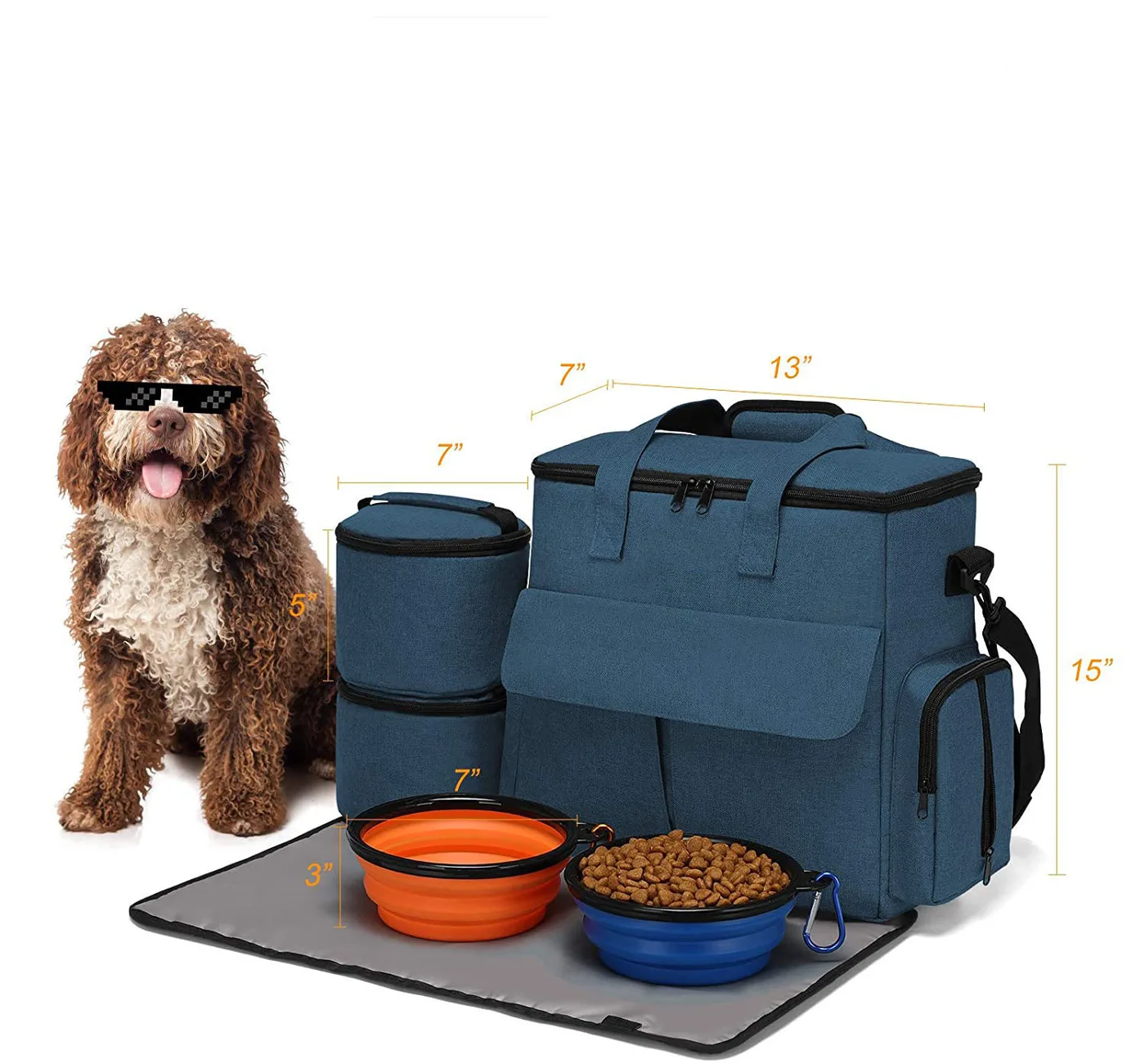
Balance Aperture With Claw, Snag, and Containment Risks
Larger openings can reduce airflow resistance, yet they provide more access for claws, teeth, tags, and external objects. Very fine openings can resist claw entry but may use thin yarns or dense structures that clog and reduce flow. The engineer should define the hazard and test representative aperture-yarn combinations rather than assuming one visual size is safest.
Snag testing should include hooks or probes shaped to the intended risk and a controlled force or motion. Record whether yarns pull, loops extend, holes propagate, or the panel permanently distorts. A small local snag can become a containment failure after repeated movement. Trimmed yarn ends must not create hard points inside the compartment. Inspect both face and reverse sides.
Burst or puncture performance assesses a different mechanism. Use a defined probe, diaphragm, or fixture, specimen size, rate, and endpoint. Test both material and finished panels because seam curvature and pre-tension change response. For soft backpacks, loaded dog movement creates repeated distributed and localized pressure against mesh, especially at lower corners and opening panels.
Abrasion comes from claws, fur, collars, shell edges, the wearer's clothing, and folded packaging. Test likely contact surfaces and inspect yarn wear, fuzzing, hole growth, transparency change, and residual strength. If two mesh layers are used, check rubbing between them. A protective interior grid can improve containment but may reduce open area or create pressure points.
Design prevents some damage more efficiently than stronger mesh. Position seams away from direct paw bracing, add controlled stand-off, round panel corners, avoid loose loops, and keep tether length from allowing the dog to climb against the opening. The correct aperture is the largest geometry that meets airflow goals without permitting defined snag, claw-entry, or containment failures after cyclic loading.
Failure progression should be part of the evaluation. After creating a controlled snag or small puncture at a representative location, continue cyclic panel loading and measure hole growth, yarn run, and seam interaction. Some structures localize damage while others unzip along a course or distort a broad region. Test near a free field, bound edge, curved corner, and reinforcement transition because the surrounding constraint changes propagation. Photograph the same marked area at fixed intervals and state the maximum acceptable growth. Residual burst or containment checks after this pre-damage sequence show whether a minor field defect remains minor or can rapidly become an escape opening.
Position and Shape Mesh Panels Without Weakening the Frame
Cutting a large window removes structural shell area. The remaining frame around it must carry zipper, strap, handle, and panel loads without collapsing. Map forces before deciding panel shape. Keep adequate solid material around anchor zones and high-stress corners. If a mesh opening approaches the main zipper, piping or stays may be needed to preserve geometry, but these elements must not block the airflow being created.
Corner shape is critical. Acute corners concentrate stress and complicate binding. Rounded corners provide smoother load distribution and more consistent folder operation. Define minimum radius based on the mesh, binding, and production equipment. Pattern notches must support alignment without cutting deeply into the net structure. Grain or stretch direction should be marked on every mesh pattern piece.
Panel pre-tension needs control. Mesh sewn too loose wrinkles and can contact the dog; too tight, it distorts the shell and increases seam pull. Pattern dimensions should account for directional extension and binding take-up. Compare flat piece dimensions with finished exposed opening and loaded deflection. Use templates or reference marks to maintain tension across left and right panels.
Visibility and airflow can conflict with structural coverage. Reinforcement tapes, pockets, frame channels, and logo patches may cross the mesh. Document their actual blocked area. Avoid placing storage pockets over primary ventilation zones unless the remaining path passes the requirement. Removable covers need secure open positions so they do not fall across mesh during movement.
A mesh panel is structurally successful when it preserves the carrier envelope and ventilation path without diverting concentrated loads into weak net edges. Validate panel shape on the assembled, loaded carrier and inspect internal clearance after straps are tensioned.
Use a loaded deflection map to compare panel designs. Mark a grid on or beside the mesh, apply the rated distributed load and strap tension, and photograph from fixed positions. Measure maximum inward bow, frame movement, exposed area, and distance to the animal envelope. Repeat after zipper cycling and pack-out recovery. If deflection is excessive, evaluate frame width, panel aspect ratio, stay position, pre-tension, and nearby anchor loads before selecting a heavier mesh. Structural correction in the surrounding shell can preserve more airflow than reducing aperture or adding a second layer across the entire opening.
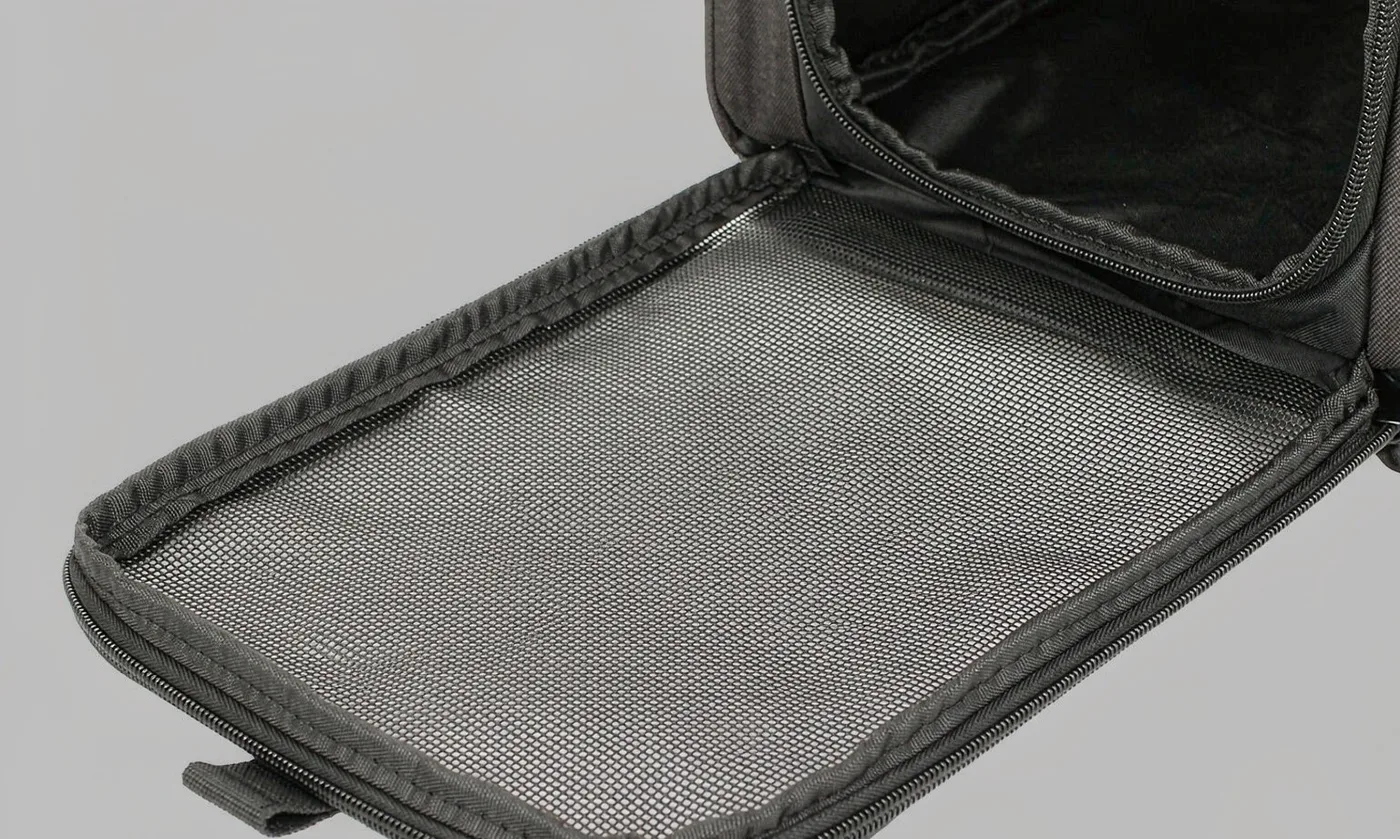
Control Cutting, Binding, Seams, and Opening Construction
Mesh can distort during spreading and cutting. Reduce lay height when needed, support slippery layers, align stretch direction, and avoid pulling material while placing patterns. Cutting method should produce clean edges without fused beads, melted filaments, or unraveling. Bundle pieces with orientation and shade or lot identity. Do not use marker pens or adhesives that create chemical or odor issues.
Binding protects cut edges and transfers panel load. Specify binding fiber, width, fold, finished coverage, stitch position, seam allowance, capture depth, and corner treatment. The folder must suit the combined shell and mesh thickness. Excessive binding tension gathers the mesh; low tension permits edge movement. A second seam line can help only if spacing and perforation do not weaken the net.
At openings, zipper tape, shell, mesh, lining, and binding may meet in one stack. Cross sections should define sequence and seam margins. Keep zipper teeth and slider paths clear of mesh loops. Secure zipper ends and opening corners before they become hidden. If the mesh is removable or zipped, test all interfaces and ensure no gap exceeds the containment criterion.
Needle and thread selection influence seam retention. A large needle can cut yarns, while very dense stitching can create a tear line. Use production-intent coupons and pull the mesh away from the seam in the expected direction. Inspect gradual slippage, yarn breakage, stitch rupture, and binding peel. Record the failure mode rather than only the peak force.
Mesh seam strength comes from controlled edge capture, compatible binding, appropriate stitch formation, and low-stress geometry—not from extra stitch rows added without testing. Use an in-line hold point to inspect hidden edges, corner reinforcement, and zipper-end capture before lining closure.
Test Airflow, Burst, Seam Retention, and Aging
Qualification combines material and product-level methods. Measure material identity and airflow on conditioned specimens, then test complete panels after sewing. Whole-carrier checks capture blockage, panel tension, and frame distortion. The test plan states sample count, orientation, conditioning, fixture, load or flow, duration, cycles, endpoint, and acceptance.
| Test area | Controlled setup | Acceptance focus |
|---|---|---|
| Open area | Defined image or geometric method and tension | Minimum effective exposed ratio |
| Airflow | Pressure differential, area, seal, orientation | Flow or pressure drop within limit |
| Burst or puncture | Probe or diaphragm, rate, specimen support | No failure below specified level |
| Seam pull-out | Production binding stack and force direction | No yarn escape or seam failure |
| Snag and abrasion | Defined hook or surface, force and cycles | No unacceptable hole growth or weakness |
| Environmental aging | Heat, humidity, UV or cleaning as specified | Retained strength, color and dimensions |
Research sources for voluntary test methods include ASTM International. Quality-system record principles are summarized by the ISO 9001 overview. Select exact methods and limits for the material and claim rather than citing an organization generically.
Sequence tests when damage interaction matters: condition, abrade or snag, flex the loaded panel, then repeat airflow and containment checks. A mesh system passes only when its ventilation and containment performance remain acceptable after realistic structural and environmental preconditioning. Retain failed samples and controls by lot and revision.
Airflow fixtures need leakage control and calibration. Seal only the intended specimen boundary, verify the instrument range, and run a blank or reference material before comparing candidates. Record ambient temperature and humidity, mesh direction, applied tension, pressure points, and stabilized reading. For a complete carrier, map which panels are open and measure or calculate the same configuration after adding the load fixture, bedding, pockets, covers, and worn back interface. Repeat the measurement after durability conditioning. Reporting only a free-swatch flow value can exaggerate performance if production binding, overlays, or body blockage dominate the final pressure drop.
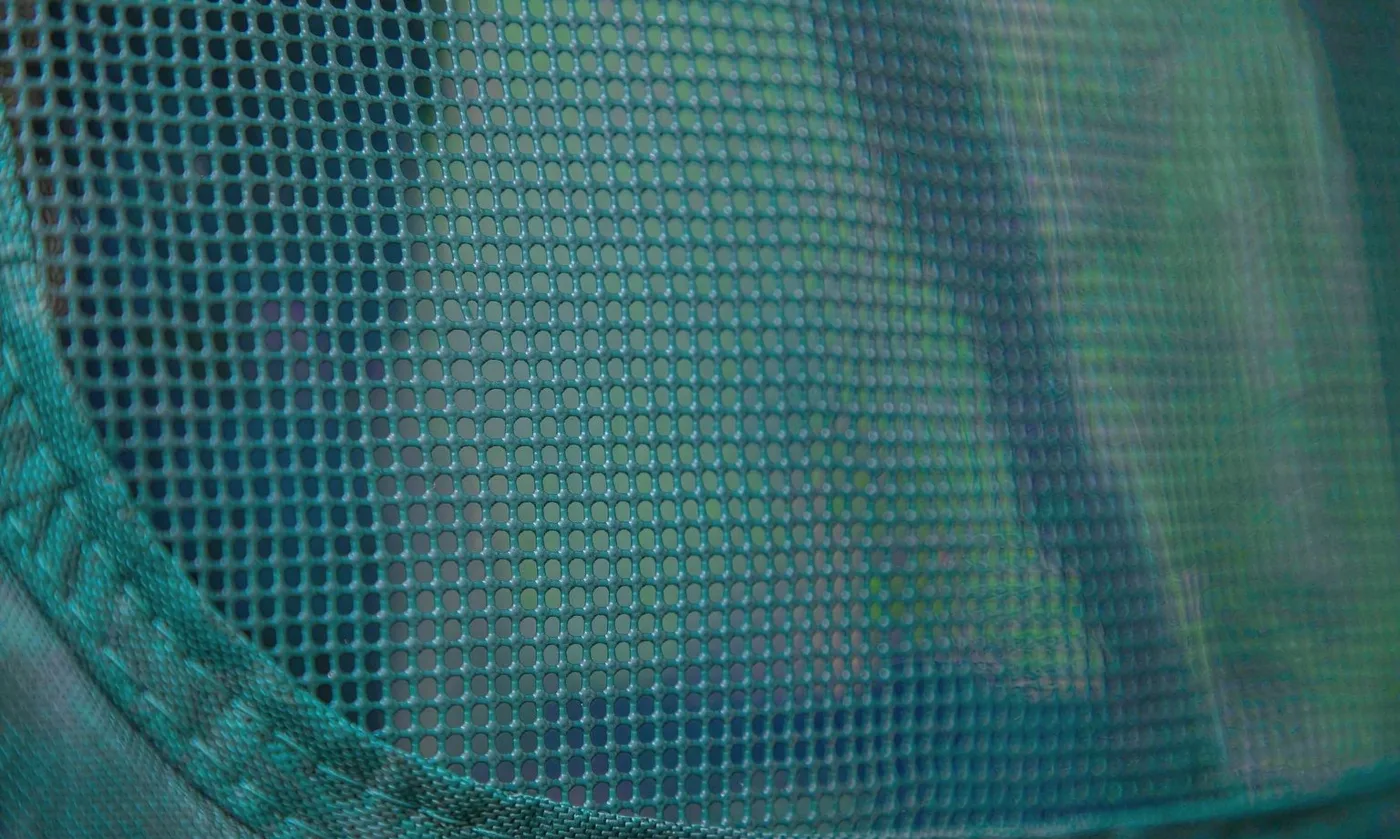
Review Hygiene, Color, Chemicals, and Animal-Contact Details
Mesh can retain fur, dust, saliva, and cleaning residues. Aperture geometry and yarn texture influence how easily the panel can be wiped or vacuumed. Cleaning instructions should be validated on the complete carrier, not copied from the fiber name. Repeated cleaning can alter finish, stretch, color, coating, and binding. Inspect trapped debris and drying time after the defined method.
Odor and color transfer need controlled evaluation. Dark mesh can crock onto light lining or shell under humid compression. Print or coating applied to mesh can block openings and crack during extension. Approve shade, gloss, transparency, pattern registration, and maximum blocked area. After pack-out conditioning, inspect contact surfaces for migration and the mesh for permanent creasing.
Animal-contact surfaces should have no hard fused edges, loose filament ends, sharp binding corners, exposed adhesive, or detachable decoration. Apertures should be assessed against claw and tag access. Mesh near the tether should not create an entanglement path. Evaluate any interior protector for pressure points when the dog leans against the panel.
Chemical evidence should cover fiber, dye, finish, coating, print, adhesive, and binding as applicable. European-market research can begin with ECHA, and voluntary textile certification information is available from OEKO-TEX. Reports must identify the exact mesh code and color.
A contact-safe mesh is one whose edges, apertures, finishes, and cleaning behavior remain controlled after the same extension and wear experienced in the carrier. Reassess any supplier, yarn, dye, coating, print, or construction change.
Hygiene validation should use a repeatable soil and cleaning sequence where the product claim requires it. Apply a documented representative soil to finished panels, allow the stated dwell, clean using labeled tools and chemistry, and record removal, residue, odor, color change, drying time, shrinkage, and hand. After repeated cycles, inspect binding interiors and multilayer areas where moisture can remain. Recheck airflow and seam retention because clogged apertures or degraded coatings may not be obvious from appearance. Do not claim antimicrobial performance without specific treated-material identity, efficacy evidence, durability conditions, and market review. Easy cleaning is best supported by construction that can be accessed and dried, not by an unsupported additive statement.
Approve Mesh Lots and Protect Ventilation Through Bulk Production
The BOM should connect mesh code to fiber, knit or weave, weight, thickness, aperture, open area, stretch directions, strength, color, finish, and source. Drawings specify panel orientation, exposed dimensions, blocked zones, seam allowance, capture depth, binding, corner radius, and inspection points. Use a sealed swatch and finished-panel reference under one revision.
Incoming inspection samples packages and roll positions for identity, width, mass, thickness, aperture, stretch, shade, defects, odor, contamination, and selected performance screens. Inspect holes, dropped yarns, streaks, coating blockage, curled edges, and distorted rolls. Trace lots into cut bundles because similar meshes can be hard to distinguish after sewing. Quarantine unapproved substitutions.
Within the 6-10 working day sample period, build seam coupons, bound-corner trials, a loaded ventilation mock-up, a functional carrier, and the bulk-intent pre-production sample. At MOQ 500 pieces per color, confirm custom-dye minimums and spare allowance. Mesh arrival, conditioning, cutting, testing, and subassembly must fit the 35-50 day schedule.
In-line checks cover orientation, panel tension, exposed area, binding coverage, stitch formation, zipper clearance, reinforcement, and hidden seam capture. Measure representative openings and loaded deflection. If a seam pull or snag defect appears, contain output since the last accepted check and review cutting, folder settings, needle, tension, and lot identity.
Final AQL 2.5 inspection samples workmanship, dimensions, function, visible damage, openings, labels, and packing. Qualification records support airflow and durability claims. Bulk ventilation remains controlled only when the approved mesh, exposed panel area, seam construction, and post-pack shape are traceable throughout the lot.
Define a reaction plan for any critical hole, seam release, wrong mesh, reversed stretch direction, or blocked ventilation panel. Stop and segregate output since the last accepted checkpoint, identify mesh lot and operator or machine range, and assess finished and work-in-process units. Correct the material or process cause, then approve new first-off panels before restart. Track actual mesh consumption, defects, recuts, and remnants by lot; unlabeled remnants should not return to common stock. Retain beginning, middle, and end production samples when performance is critical. Shipment records linking roll lots, bundle numbers, dates, and carton ranges allow precise containment if a later airflow or containment result is disputed.
Production capability
- SGS-verified production space of 4,950 m², 149 machines, 7 assembly lines
- Pet carrier and pet bag output since 2014 from a 137-person team
- 200,000 units shipped monthly under BSCI and ISO 9001 systems
People Also Ask
What mesh is best for a dog carrier backpack?
The best mesh meets defined airflow, aperture, burst, snag, seam, stretch, cleaning, and chemical requirements in the assembled carrier.
How much mesh should a dog carrier have?
There is no universal percentage. Design at least separated intake and exhaust zones, then verify exposed open area and airflow when loaded.
Does larger mesh aperture mean better airflow?
Often it lowers resistance, but yarn diameter, open area, depth, stretch, layers, and blockage also control airflow and containment.
How is pet carrier mesh strength tested?
Use defined burst or puncture, snag, abrasion, and seam pull-out methods plus complete-panel loading and post-conditioning checks.
Can mesh panels be printed?
Yes, but print can block openings, alter stretch, crack, transfer, add chemicals, and therefore needs open-area and durability validation.
How long does a mesh carrier sample take?
A standard sample takes 6-10 working days after mesh, pattern, binding, dimensions, and test criteria are available.
Frequently Asked Questions
What is mesh open area?
It is the proportion of unobstructed opening within a defined area, measured under a stated tension or condition.
Is spacer mesh a ventilation window?
Spacer mesh can pass air, but its internal filaments and compression create different resistance from a thin open window mesh.
Why test mesh stretch by direction?
Knit or weave geometry can extend differently in warp and weft, changing aperture, panel bulge, seam load, and pattern fit.
How is mesh capture depth specified?
Drawings define how far the mesh enters the bound seam, finished binding coverage, stitch location, and tolerance.
Can stronger mesh reduce airflow?
It can if greater yarn diameter, density, coating, or layering reduces effective open area or raises pressure drop.
What causes mesh seam pull-out?
Insufficient capture, unstable edges, poor binding tension, needle damage, narrow margin, corner stress, or weak yarn can contribute.
Should mesh be tested after cleaning?
Yes, when cleaning is claimed; repeat dimensional, color, edge, strength, and airflow checks after the validated method.
How are mesh defects classified?
Critical containment holes or seam release are separated from major functional distortion and minor appearance variation in the inspection plan.
Does black mesh need colorfastness testing?
Yes. Dark dyes can crock or migrate onto adjacent light materials, especially during warm humid compression.
Can a pocket cover a mesh panel?
Only if the remaining exposed route meets the ventilation requirement in every specified pocket and carry condition.
Does AQL 2.5 verify airflow?
No. AQL samples finished-lot conformity; airflow claims need separate controlled material and assembled-product tests.
When must mesh be requalified?
Review changes to fiber, yarn, knit, aperture, weight, finish, color, supplier, panel area, binding, or seam construction.
Talk to QUANZHOU JUNYUAN BAGS about a pet carrier program: MOQ 500 pieces per colourway, samples in 6-10 working days, bulk production in 35-50 days under AQL 2.5 inspection.
Get a free quote Request a sample