Dog Carrier Backpack with Wheels: Manufacturing Process
A wheeled dog carrier backpack is built on a load-bearing base module, not on a sewn shell with wheels bolted on. The process runs through eleven stations: board forming, axle carrier riveting, wheel assembly, handle tube insertion, shell seaming, module marriage, bonding, trim, testing, cleaning and packing. Wheel life targets 25 km of loaded travel and the handle survives 5,000 extension cycles.
Executive summary. This process note documents how a wheeled dog carrier backpack is assembled on the SGS-verified production base, from board forming to final packing, with the control points and the acceptance limits at each station. Wheeled builds carry material and labour content roughly 40 percent above a non-wheeled equivalent, and most of that sits in the base module, the telescoping handle and the assembly labour rather than in the fabric. Programme terms are the standard ones: MOQ 500 pieces per colourway, samples in 6-10 working days, bulk production in 35-50 days after approval, and release under AQL 2.5 inspection. Wheeled units add four critical defect classes to that inspection: axle retention, handle locking, wheel runout and loaded drop performance, each at zero acceptance. Buyers should plan one extra sampling round compared with a soft carrier, because the base module and the sewn shell are developed in parallel and their interface has to be validated together before bulk tooling is released. Buyers should also confirm early whether the wheel and handle suppliers are already on the approved parts list, because a new source adds its own validation cycle before the first unit can be built.
Private label pet bags and dog carrier backpack lines share one packaging standard here, so a mixed order does not add handling cost or a second carton size.
Product Architecture: A Base Module, Not a Backpack With Wheels
The most common engineering error in this category is to treat wheels as an accessory fitted to an existing carrier. The loads say otherwise. A wheeled unit converts a vertical lifting load into a rolling load with impact, and the impact component arrives at the axle carrier as a short-duration spike. Instrumented testing over a standard kerb-drop cycle recorded peak axle loads of 320 N on a 12 kg unit, which is more than twice the static share any single wheel sees when stationary. The structure that receives that load has to be engineered as a module with its own load path.
The module concept splits the product into three assemblies that are built separately and joined at station six. The base module carries the structural board, the axle carriers, the wheels and the handle tubes. The shell module carries the fabric envelope, the ventilation panels, the door and the interior. The trim module carries the shoulder straps, which on a wheeled unit are stowable rather than load-bearing. Keeping the split clean means a defect in one module does not scrap the other two, which matters a great deal at a 40 percent higher material cost.
The interface between base and shell is where wheeled programmes fail. The shell must be bonded to the base under controlled pressure so no gap opens at the perimeter under rolling vibration, and the bond line has to be continuous rather than spot-applied. A discontinuous bond line produces a drumming noise within the first kilometre of use and then delaminates, which is a warranty failure that cannot be repaired in the field.
Stowable straps complete the architecture. On a wheeled unit the straps are used only for stairs and for lifting into vehicles, so they are specified at 40 mm rather than 65 mm and they stow into a zippered back panel. That decision removes 130 g and, more importantly, removes the strap webbing from the rolling envelope where it would otherwise catch on the wheels.
Noise is another architecture-level decision that cannot be fixed downstream. A wheeled carrier generates noise at three sources: tyre to floor contact, bearing rotation and panel resonance in the base board. The first two are controlled by material and bearing choice, but the third is controlled by the board laminate and by the bond line, and a board that resonates at the frequency produced by a 65 mm wheel at walking pace will amplify rather than damp the contact noise. Adding a 1 mm bitumen damping pad over 40 percent of the board area costs 0.35 USD and typically reduces measured rolling noise by 4 to 6 dB(A).
Base Structure, Axle Carrier and Mounting Interface
The base board on a wheeled build is 5 mm honeycomb polypropylene with a 0.8 mm polypropylene skin laminated to both faces, which gives a bending stiffness roughly three times that of a 4 mm board at a mass penalty of 90 g. Perimeter stiffening is a 30 mm aluminium or PP extrusion on the two long sides, because the axle load enters at the corners and an unstiffened board ovalises at the carrier holes within a few kilometres.
The axle carrier is the critical part. It is a 3 mm cold-rolled steel bracket or, on lighter builds, a 4 mm glass-filled nylon moulding, and it distributes the axle load over a 90 mm by 60 mm footprint on the board. Six rivets at 4 mm diameter attach it, and rivet spacing is held at 30 mm because closer spacing splits the board laminate while wider spacing allows the bracket to rock. Pull-out strength of the assembly is tested to 900 N and the production minimum is 750 N.
- Board: 5 mm honeycomb PP, 0.8 mm skins, deflection under 8 mm at 15 kg.
- Axle carrier: 3 mm steel or 4 mm glass-filled nylon, 90 by 60 mm footprint.
- Fasteners: six 4 mm rivets at 30 mm spacing, 750 N minimum pull-out.
- Corner reinforcement: 2 mm PP gusset at each of the four wheel positions.
- Sealing: every fastener penetration is sealed with a 12 mm butyl patch on the interior face.
Wheel position is a design decision with a manufacturing consequence. Wheels set inside the board footprint protect the wheels but reduce the interior floor area by 4 to 6 percent. Wheels set outside the footprint preserve floor area but need a longer axle and a stronger carrier because the moment arm grows by 25 mm. Programmes targeting airline cabin use choose the inside position, since the wheel envelope then stays inside the declared dimensional envelope and the unit still fits the sizer at the gate.
Wheel, Tyre and Bearing Specification
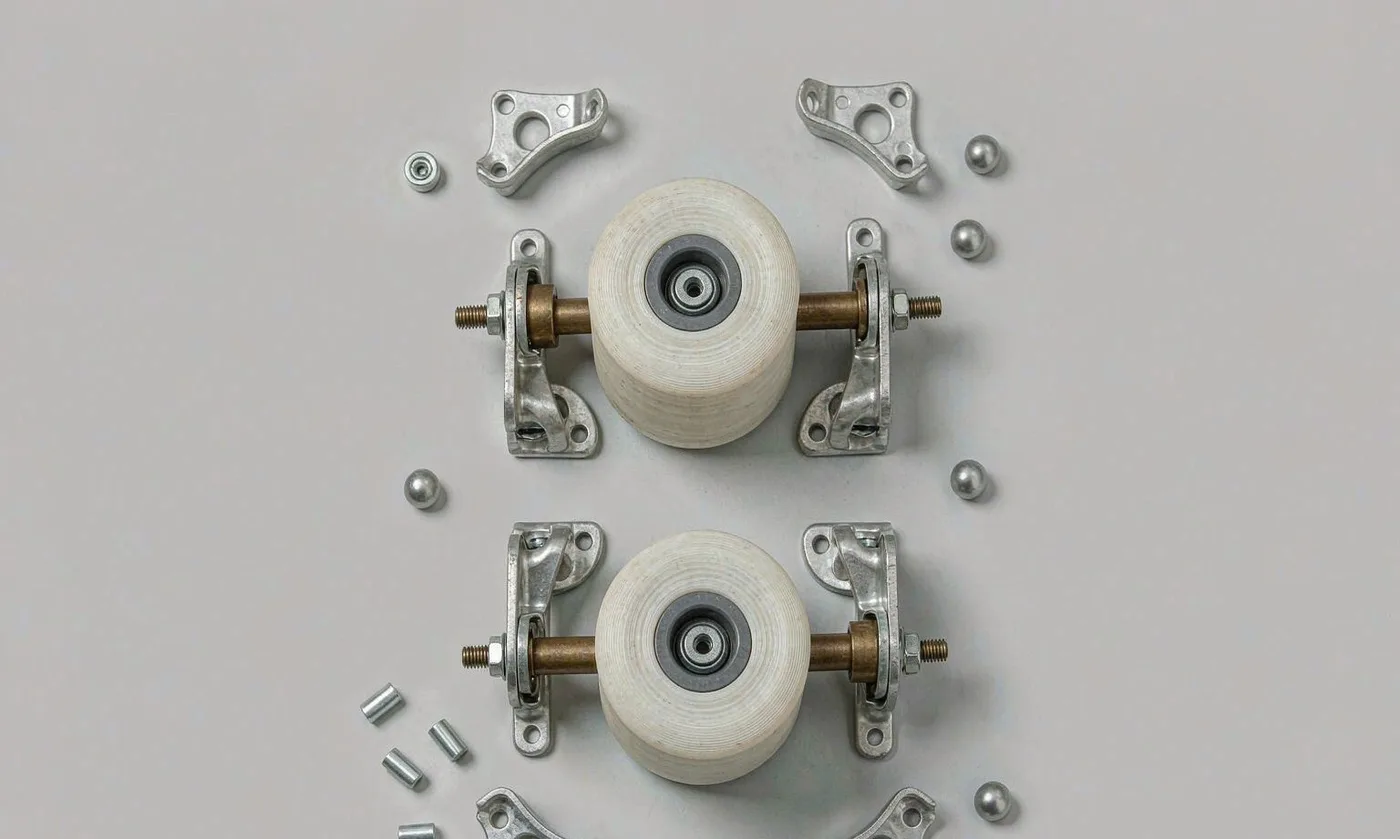
Wheel specification is governed by three numbers: durometer, bearing type and runout. Tyre durometer of 78 to 85 Shore A gives the best compromise between rolling resistance and impact absorption on the mixed surfaces a pet carrier actually sees. Below 70 Shore A the tyre deforms under load and rolling resistance rises by about 30 percent; above 90 Shore A the impact load transmits straight into the axle carrier and rivet fatigue life halves.
Tyre material is thermoplastic elastomer for cabin-grade builds and cast polyurethane for heavy-duty builds. TPE at 65 mm diameter weighs 58 g per wheel and returns a wear loss of 0.8 mm after 25 km on the drum tester. Cast PU at the same diameter weighs 74 g and returns 0.3 mm, which is why heavy-duty programmes accept the mass penalty. Both are injection or cast directly onto a polypropylene core, and bond failure between tyre and core is checked by a 200 N axial push-off test on every production lot.
Bearings are the quiet failure point. A plain bore on a steel axle is adequate for occasional use and costs 0.18 USD per wheel. A sealed 608 cartridge bearing costs 0.55 USD and extends service life from roughly 8 km to beyond 30 km before noise becomes noticeable. Programmes selling into a retail channel with a two-year warranty should specify the cartridge; programmes selling at a budget price point can use the plain bore provided the axle is stainless, because a plated axle rusts at the bore within one season in a coastal market.
Telescoping Handle: Tube, Locking Mechanism and Cycle Testing
The telescoping handle is the second highest warranty item after the wheels, and almost every failure is at the locking mechanism rather than in the tube. The standard construction is a two-stage anodised aluminium tube at 20 mm and 16 mm outer diameter with 1.2 mm wall thickness, and the lock is a spring-loaded steel button engaging a drilled hole with a 0.15 mm clearance. Clearance above 0.3 mm produces rattle within a few hundred cycles; clearance below 0.08 mm makes the button stick when grit enters the tube.
Handle length is set by ergonomics and by the packed envelope. A two-stage handle giving 480 mm of extension suits users between 1.55 m and 1.85 m, and the collapsed length must not add more than 60 mm to the overall product height or the unit stops fitting a cabin sizer. Where the programme is airline-led, the handle is specified as a three-stage unit with 420 mm extension and a 40 mm collapsed addition, which trades 30 mm of extension for a smaller packed envelope.
- Tube: anodised aluminium, 20 mm and 16 mm, 1.2 mm wall, 5,000 extension cycles.
- Lock: steel button, 0.15 mm hole clearance, release force 12 to 22 N.
- Bushings: two acetal bushings per stage, replaced at 3,000 cycles in service.
- Grip: TPE over-mould, 110 mm wide, durometer 60 Shore A.
- Rattle test: no audible knock at 2 Hz over a 50 mm stroke after 1,000 cycles.
The handle tube is inserted into a moulded channel in the base module rather than into the fabric shell, and the channel carries a drain hole at its lower end. Without the drain hole, water entering at the grip runs into the channel and pools at the bottom, and the resulting corrosion on a plated tube is visible through the anodising within one season.
Handle grip geometry is worth specifying explicitly because it sets the handling force. A 110 mm wide TPE over-mould at 60 Shore A lets a user control a 15 kg loaded unit with one hand at a grip force of about 45 N. Narrow the grip to 80 mm and the same unit needs 70 N, which is above the comfortable single-hand threshold for most users and is the reason carriers with narrow handles get returned as unstable even when nothing is structurally wrong with them.
Assembly Sequence and Line Layout
A wheeled build runs eleven stations against seven for a standard carrier, and the line is laid out so the base module and the shell module travel in parallel and meet at station six. Labour content is 14.5 minutes per unit against 9.2 minutes for a non-wheeled carrier, and the extra time is almost entirely in stations two, three and six. Line balancing is done to a 15 minute takt with two operators per station on the module build and three at the marriage station.
| Station | Operation | Control point | Time (min) |
|---|---|---|---|
| 1 | Board forming and skin lamination | Thickness 5.0 plus or minus 0.2 mm | 1.4 |
| 2 | Axle carrier riveting, four positions | Torque and spacing, 30 mm gauge | 2.1 |
| 3 | Wheel and bearing assembly | Runout under 0.4 mm | 1.8 |
| 4 | Handle tube insertion and lock fit | Extension force and rattle check | 1.6 |
| 5 | Shell seaming, panels and door | Seam strength 200 N | 3.2 |
| 6 | Module marriage and perimeter bonding | Bond line continuous, 8 mm width | 2.4 |
| 7 | Trim, straps and binding | Bar-tack stitch count 42 | 1.5 |
| 8 | Functional test: roll, drop, handle | Pass or fail, logged by unit | 1.2 |
| 9 | Cleaning and label application | Label position plus or minus 3 mm | 0.9 |
| 10 | Packing and carton weighing | Gross weight tolerance | 0.8 |
Two control points deserve emphasis. Station three checks wheel runout on a mandrel before the wheel goes to the module, because a wheel with 0.8 mm runout is felt by the user as a vibration within the first 100 metres and cannot be corrected later. Station eight is a functional gate rather than a visual one: every unit is rolled 20 metres on a test track, dropped once from 150 mm loaded, and handle-cycled twice before it is packed. Units are logged by serial so a field complaint can be traced back to the station record.
Welding, Riveting and Bonding Processes
Three joining processes carry the structural load on a wheeled unit, and each has its own process window. High-frequency welding is used for the interior tray and for any TPU component; the window is 27.12 MHz, 2.5 to 3.2 seconds of dwell at 0.4 MPa, and the weld is verified by a 25 mm peel strip tested to 60 N. Dwell below 2.2 seconds produces a cold weld that passes visual inspection and fails the leak test two weeks later.
Riveting carries the axle load. The process is a controlled-stroke pneumatic riveter set to a fixed closing height rather than to a fixed pressure, because board thickness varies by 0.2 mm and a pressure-set riveter either crushes the laminate or leaves the rivet loose. Closing height is verified with a go and no-go gauge every 50 units, and the pull-out test is run on two units per hour of production.
Perimeter bonding joins the shell to the base. A moisture-curing polyurethane adhesive is applied in a continuous 8 mm bead at 180 g per square metre, the assembly is closed under 0.15 MPa for 90 seconds, and it is then held for 24 hours before it goes to functional test. Cure time is the constraint that sets the line buffer: a wheeled line needs 24 hours of work-in-progress storage between station six and station eight, which is about 1,200 units of floor space at a 500 unit per day rate.
Process documentation for the three joining operations follows the same structure used across the SGS-verified production base: a written work instruction at each station, a first-piece approval at the start of every shift, and a recorded parameter check every 50 units. Weld dwell, rivet closing height and adhesive bead weight are the three recorded parameters, and they are the three that appear in any root-cause analysis because they are the only ones with a window narrow enough to drift without being visible.
Wheeled Unit Test Protocol
The test protocol for wheeled builds adds five tests to the standard carrier set and modifies two. The added tests are loaded rolling wear, kerb impact, handle cycling, wheel push-off and axle retention. The modified tests are the drop test, which moves from 300 mm unloaded to 150 mm loaded, and the static load test, which is run with the unit resting on its wheels rather than on its base.
| Test | Method | Limit | Frequency |
|---|---|---|---|
| Loaded rolling wear | 25 km drum, 12 kg load, 4 km/h | Tyre wear under 1.0 mm | Per tyre lot |
| Kerb impact | 1,000 drops from 100 mm onto a 20 mm edge | No carrier deformation | Per programme |
| Handle cycling | 5,000 extension and retraction cycles | Lock engagement intact | Per handle lot |
| Wheel push-off | 200 N axial | No tyre to core separation | Per wheel lot |
| Axle retention | Pull-out test | 750 N minimum | 2 per hour |
| Loaded drop | 150 mm, 12 kg ballast, four orientations | No structural failure | Per lot, 3 units |
| Wheel runout | Mandrel and dial gauge | Under 0.4 mm | Every wheel |
| Rolling noise | 60 dB(A) at 1 m, 4 km/h | Under 62 dB(A) | Per programme |
Classification follows the usual critical, major and minor structure under AQL 2.5, with four zero-acceptance conditions specific to this build: axle retention below 750 N, handle lock failure at any cycle count, wheel runout above 0.6 mm, and any structural failure in the loaded drop. Reference methods for the mechanical tests follow ASTM practice where an equivalent exists, and internal methods with documented calibration where it does not. The quality system that governs the records, the calibration intervals and the corrective action loop is maintained to ISO 9001, which is what allows a test result from one season to be accepted as evidence in the next.
Reliability data is collected across programmes rather than per order, and it drives the specification review. The current field ranking puts wheel wear first at 38 percent of claims, handle lock second at 24 percent, axle loosening third at 17 percent, and everything else below 10 percent. Those proportions are why the two highest-cost components in the bill of materials are also the two with the tightest incoming inspection, and why a cost-reduction request on the bearing or the lock button is normally declined at specification review.
Tooling, Cost and Programme Planning for Wheeled Builds
Wheeled programmes carry tooling that soft carrier programmes do not. The axle carrier needs a moulding tool if the nylon option is chosen, at roughly 4,500 USD amortised over the programme; the steel bracket option needs only a bending and drilling jig at 900 USD but adds 40 g per unit. The handle channel needs a forming tool at 2,200 USD, and the base board needs a cutting die at 600 USD. Total one-time tooling for a first wheeled programme is typically 5,000 to 8,000 USD, and it is amortised into unit price across the first order.
Unit cost sits 40 percent above a non-wheeled equivalent. The base module adds 4.20 to 5.60 USD, the handle adds 2.80 to 4.10 USD, the wheels and bearings add 1.90 to 3.40 USD depending on bearing choice, and assembly labour adds 1.10 to 1.60 USD. Fabric and shell content is unchanged, which means the increment is almost entirely mechanical and is therefore sensitive to order quantity rather than to colourway count.
Development runs one round longer than a soft carrier because the module and the shell are validated separately before they are married. Round one is a base module prototype with stock wheels, delivered in 6-10 working days, and it sets axle geometry and board stiffness. Round two is a shell prototype. Round three is the married unit, which is the first time the interface can be tested, and it carries the full protocol. Bulk production follows in 35-50 days, with the handle tube and wheel orders on the critical path because both are bought components with their own mill lead times.
Minimum quantity is MOQ 500 pieces per colourway, and on wheeled builds that number is set by the wheel supplier rather than by the sewing line. A custom tyre colour carries a 3,000 piece mill minimum, so a colourway-specific tyre is only economic above that quantity; below it, the programme uses a stock tyre colour and matches the shell to the tyre rather than the other way round.
Spare parts are the last planning item and the one most often forgotten. A wheeled programme should ship with a spare wheel and axle kit ratio of 2 percent of unit quantity, because wheels are the only wear item a distributor can replace without returning the product. Kits are packed in the final container and the ratio is agreed at order placement, since adding them after production means a separate freight consolidation and a second customs entry.
Order and quality terms
- MOQ 500 pieces per colourway; samples in 6-10 working days
- Bulk production 35-50 days after approval; AQL 2.5 inspection standard
- T/T 30/70 terms, FOB Xiamen, full document set per shipment
People Also Ask
How long do pet carrier wheels last?
Cast polyurethane tyres lose about 0.3 mm and TPE tyres about 0.8 mm over 25 km of loaded drum testing at 12 kg. In field terms a cartridge-bearing wheel runs beyond 30 km before noise becomes noticeable, while a plain bore wheel is audible after roughly 8 km.
What makes a wheeled pet carrier durable?
A load-bearing base module with a riveted axle carrier distributing load over a 90 by 60 mm footprint, six 4 mm rivets at 30 mm spacing, and a continuous perimeter bond between shell and base rather than spot bonding.
Should wheels be inside or outside the base footprint?
Inside for airline cabin programmes, because the wheel envelope then stays within the declared dimensions and the unit still fits a sizer. Outside preserves 4 to 6 percent more floor area but needs a longer axle and a stronger carrier.
What handle extension length is needed?
480 mm of extension on a two-stage tube covers users from 1.55 m to 1.85 m. Airline-led programmes use a three-stage unit with 420 mm extension so the collapsed handle adds only 40 mm to the packed height.
How much does tooling cost for a wheeled carrier?
5,000 to 8,000 USD for a first programme, covering the axle carrier tool or jig, the handle channel forming tool and the base board cutting die. That amount is amortised into unit price across the first order.
Why does wheel runout matter?
A wheel with 0.8 mm runout is felt as vibration within the first 100 metres of use and cannot be corrected after assembly, which is why runout is checked on every wheel at station three before it enters the module.
How much assembly time does a wheeled unit take?
14.5 minutes against 9.2 minutes for a non-wheeled carrier, across eleven stations rather than seven. The additional time sits in axle riveting, wheel assembly and the module marriage step.
Frequently Asked Questions
What board thickness is used in a wheeled carrier base?
5 mm honeycomb polypropylene with 0.8 mm skins on both faces, giving roughly three times the bending stiffness of a 4 mm board at a 90 g mass penalty and holding deflection under 8 mm at 15 kg.
How is the axle carrier attached?
Six 4 mm rivets at 30 mm spacing, set with a controlled-stroke riveter to a fixed closing height rather than a fixed pressure, because board thickness varies by 0.2 mm and a pressure-set tool either crushes the laminate or leaves the rivet loose.
What tyre durometer is recommended?
78 to 85 Shore A. Below 70 the tyre deforms under load and rolling resistance rises about 30 percent; above 90 the impact load transmits into the axle carrier and rivet fatigue life halves.
Are sealed bearings worth the cost?
For any programme with a two-year retail warranty, yes. A sealed 608 cartridge costs 0.55 USD against 0.18 USD for a plain bore and extends service life from about 8 km to beyond 30 km before noise appears.
How is the shell joined to the base?
A continuous 8 mm bead of moisture-curing polyurethane adhesive at 180 g per square metre, closed under 0.15 MPa for 90 seconds, then held 24 hours before functional test.
What causes drumming noise in a wheeled carrier?
A discontinuous perimeter bond line. Spot-applied adhesive leaves voids that open under rolling vibration, producing noise within the first kilometre and delamination shortly after.
How many extension cycles should the handle survive?
5,000 extension and retraction cycles with lock engagement intact. The failure point is the button to hole clearance, specified at 0.15 mm: above 0.3 mm the handle rattles, below 0.08 mm it sticks when grit enters.
Why does the handle channel need a drain hole?
Water entering at the grip runs down the tube and pools at the bottom of the channel. Without a drain hole the resulting corrosion shows through the anodising within one season.
What is the loaded drop test for a wheeled unit?
150 mm with 12 kg ballast in four orientations, with no structural failure permitted. It replaces the 300 mm unloaded drop used for soft carriers because a wheeled unit is dropped in service while loaded.
How much extra does a wheeled build cost?
About 40 percent above a non-wheeled equivalent: base module 4.20 to 5.60 USD, handle 2.80 to 4.10 USD, wheels and bearings 1.90 to 3.40 USD, and assembly labour 1.10 to 1.60 USD.
Why do wheeled programmes need an extra sampling round?
The base module and the sewn shell are developed in parallel and their interface can only be tested once they are married. That marriage round is where the perimeter bond, the wheel envelope and the handle geometry are validated together.
Can the tyre colour be customised to the colourway?
Only above roughly 3,000 pieces, because a custom tyre colour carries a mill minimum at that level. Below it, the programme uses a stock tyre colour and matches the shell to the tyre.
Which defects stop a wheeled shipment?
Four zero-acceptance conditions: axle retention below 750 N, handle lock failure at any cycle count, wheel runout above 0.6 mm, and any structural failure in the loaded drop test.
Talk to QUANZHOU JUNYUAN BAGS about a pet carrier program: MOQ 500 pieces per colourway, samples in 6-10 working days, bulk production in 35-50 days under AQL 2.5 inspection.
Get a free quote Request a sample